 Skip to content
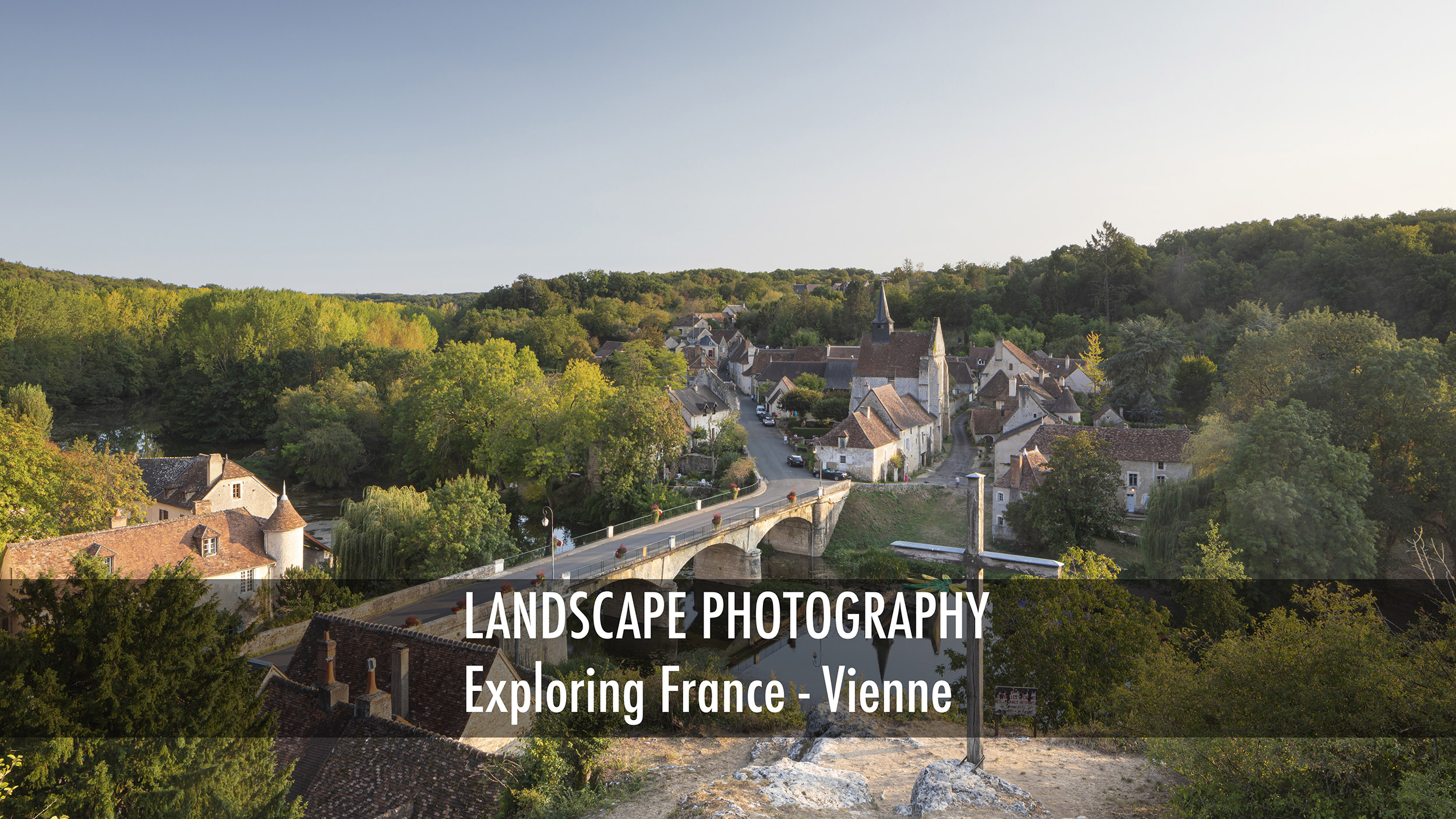

For this episode of my YouTube vlog, Landscape Photography Exploring France, I travelled to the department of Vienne on 13 September 2020. A rural area of the country that like my previous video in Indre, has some gems that any photographer would appreciate.
Starting in Montmorillon, the day started well, but afterwards I struggled a little as some of the places I wanted to go were off-limits. At the end of the day, I was back in Angles-sur-l’Anglin, as in the previous vlo,g the weather had closed in.
And if you’re interested, I offer photography tours and workshops in a variety of destinations around the world. If you’re interested in learning more from me to help you get the best out of your photography, then get in touch.
I began the day in Montmorillon, a town I had picked out whilst researching the department of Vienne. It is often called the City of Writing, and it has the sort of old riverside setting that quickly catches my eye when I’m planning a route. I arrived before sunrise after getting up at half past four and driving for two hours, so I was already feeling the lack of sleep before I had even put the tripod down.
The first goal was simple enough. I wanted to wait for the sun to rise behind me and catch the church with some early light. From where I was standing, I could already see the old bridge nearby, and I knew there were at least a couple of possible compositions worth trying before I moved on.
My rough plan looked like this:
That second idea turned out to be the better one. Once I had made an image from the bridge, I looked down and noticed a gap between the buildings. A path I had passed a moment earlier led me to the riverbank, and that small discovery changed the whole composition.
From down there, I could line up the bridge and the church far more cleanly. The problem was the light. The church had some illumination, but the bridge still sat in shadow. That meant the scene had shape, but not the balance I wanted. For me, it was clearly more of an afternoon shot from that angle. Still, the location had enough strength to make it worth working.
The main reason this view worked was my tilt-shift lens. With a regular lens, I would have struggled to include both the church and the bridge without compromising the framing. From the riverbank, I could set the lens to zero, then shift upward to pull the church into the frame while keeping the structure of the shot tidy.
I also used the movement to remove small distractions. There was a slight reflection in the water that I didn’t want, and careful framing helped clean that up. On the back of the camera, the scene had one strong diagonal running along the bridge, and that gave the image a solid base. The church then sat nicely higher in the frame, which gave the composition a clear point of focus.
I considered trying the same scene as a vertical image as well, because the height of the church and the arch of the bridge both suited that format. Even when a shot isn’t perfect, I like to test those small variations. Sometimes the version I expect least ends up being the one I keep.
In a place like Montmorillon, the composition can be there before the light is. The trick is recognising when the scene still has enough to give.
If I return, I will go back to that riverbank view in the afternoon. The structure is right, and with the bridge lit as well as the church, it could be a much stronger photograph.
After Montmorillon, the day became a bit uneven. Some places I wanted to photograph didn’t work out, and the morning never quite settled into a rhythm. By the time I reached Civaux in the south-west of Vienne, I had already accepted that much of the best work would probably come later in the day, or indoors.
Civaux changed my mood straight away. The church there is beautiful from the outside, but the real surprise is inside. The painted interior is stunning, and it reminded me of Notre-Dame-la-Grande in Poitiers, though this church felt slightly smaller. The decorative work has that same sense of richness, where every surface seems to pull your eye somewhere new.
Because it was Sunday, Mass was taking place when I arrived, so I had to wait for about an hour before photographing the interior. That pause turned out to be useful. Midday light outdoors was harsh and unforgiving, but inside the church I had a scene full of colour, depth and detail. It was a much better use of the conditions than trying to force something in flat, hard sunshine outside.
When I finally set up, I chose an angle looking into the nave at roughly 30 degrees rather than going straight down the centre. That gave the scene more movement and helped me build the frame around a diagonal line in the architecture.
I approached the image in a clear sequence:
The final image had the feel I wanted. One diagonal carried the eye into the church, and the painted surfaces did the rest. There was one small irritation near the transept, a bright modern object that I would rather not have had in the frame, but there was little I could do about it.
This is where a tilt-shift lens earns its place. In a church interior, I want the space to feel upright and calm. If I point a standard wide lens up too much, the lines start to lean, and the image can feel unstable. Shifting upward lets me keep the camera position more controlled whilst still including the height of the building.
That matters even more in a painted church like Civaux. The decoration is part of the structure of the image, not a background detail. If the lines pull awkwardly, the eye notices it straight away.
When the midday sun is too harsh outside, a church interior can save the day. The light is softer, the pace slows down, and composition becomes more deliberate.
If you’re in this part of Vienne, Civaux is well worth the stop. For photographers, it is one of those places that gives something back even on a difficult day.
My final stop was Angles-sur-l’Anglin. I had already visited it in the previous vlog, but a bank of cloud had ruined the light late in the day, so I wanted another chance. That return was one of the reasons I had set off so early in the first place.
By the time I got there, the road was busy, and the light still wasn’t especially kind. Even so, I wanted to finish the day there rather than leave the earlier disappointment hanging. Sometimes going back is less about getting a perfect image and more about closing the loop on a place that didn’t give you the chance you hoped for the first time around.
I didn’t film much there because the conditions never softened enough to make the place look its best. I did make a few quick shots and gathered some extra footage, but it wasn’t one of those evenings where everything suddenly falls into place. Angles-sur-l’Anglin remains photogenic, though, and I was glad to stand there again with the camera, even if the result was quieter than I had imagined.
I try to be honest about days like this because not every part of France opens up easily to the camera. Vienne has some lovely towns and some strong pockets of character, but as a broader landscape on this occasion, I found it difficult.
A lot of what I drove through felt open and flat. Under softer weather, or earlier in the season, that might have been fine. On this trip, though, the land looked parched after so much summer sunshine. The fields had that dry, tired appearance that can drain colour and atmosphere from a scene. It wasn’t ugly, but it didn’t give me much to work with.
Timing played a part, too. Had I been there at the beginning of August, the sunflowers would have changed the story completely. That bright seasonal colour can transform a road trip through rural France. In September, with hard light and dry ground, many of the wider views felt sparse.
Access was another issue. Some of the places I had hoped to photograph were off limits, and that always narrows the day. You set off with a map in your head, and then a gate, a sign or a barrier quietly rewrites the whole plan. That happened more than once.
Still, I don’t see a day like this as wasted. I came away with images from Montmorillon and Civaux that I genuinely liked, and I learned more about what Vienne gives well. It gave me architecture, old stone, river views and interiors. It did not give me much in the way of broad scenic drama on this particular trip.
Even though this day was mixed, it pushed me towards what came next. I was already planning work in the Val de la Loire, the UNESCO World Heritage area that offers a very different set of subjects and a broader sweep of French history and landscape. I had also been given an outline of the protected sites there, which would help shape future vlogs and photography plans.
At the same time, a larger project was beginning to take shape in the background. I couldn’t say much about it then because nothing had been signed, but it felt like one of those moments when travel, photography and long-term planning start to meet in the same place.
For anyone who enjoys following that journey, I also share updates on Instagram and Facebook.
Vienne gave me a tired start, awkward light and a few closed doors, but it still gave me photographs worth making. That is often how travel photography works. The day rarely follows the neat version you picture beforehand.
What stayed with me most was the contrast between places. Montmorillon offered shape and possibility, Civaux offered depth and beauty, and Angles-sur-l’Anglin offered a second chance, even if the light still held back. In the end, Vienne worked best for me when I focused on its built character rather than its wider countryside.
That is sometimes enough. A bridge in shadow, a painted nave at noon and a return to a village before dusk can still tell the truth of a day on the road in France.
We noticed you're visiting from United Kingdom (UK). We've updated our prices to Pound sterling for your shopping convenience. Use Euro instead. Dismiss