 Skip to content
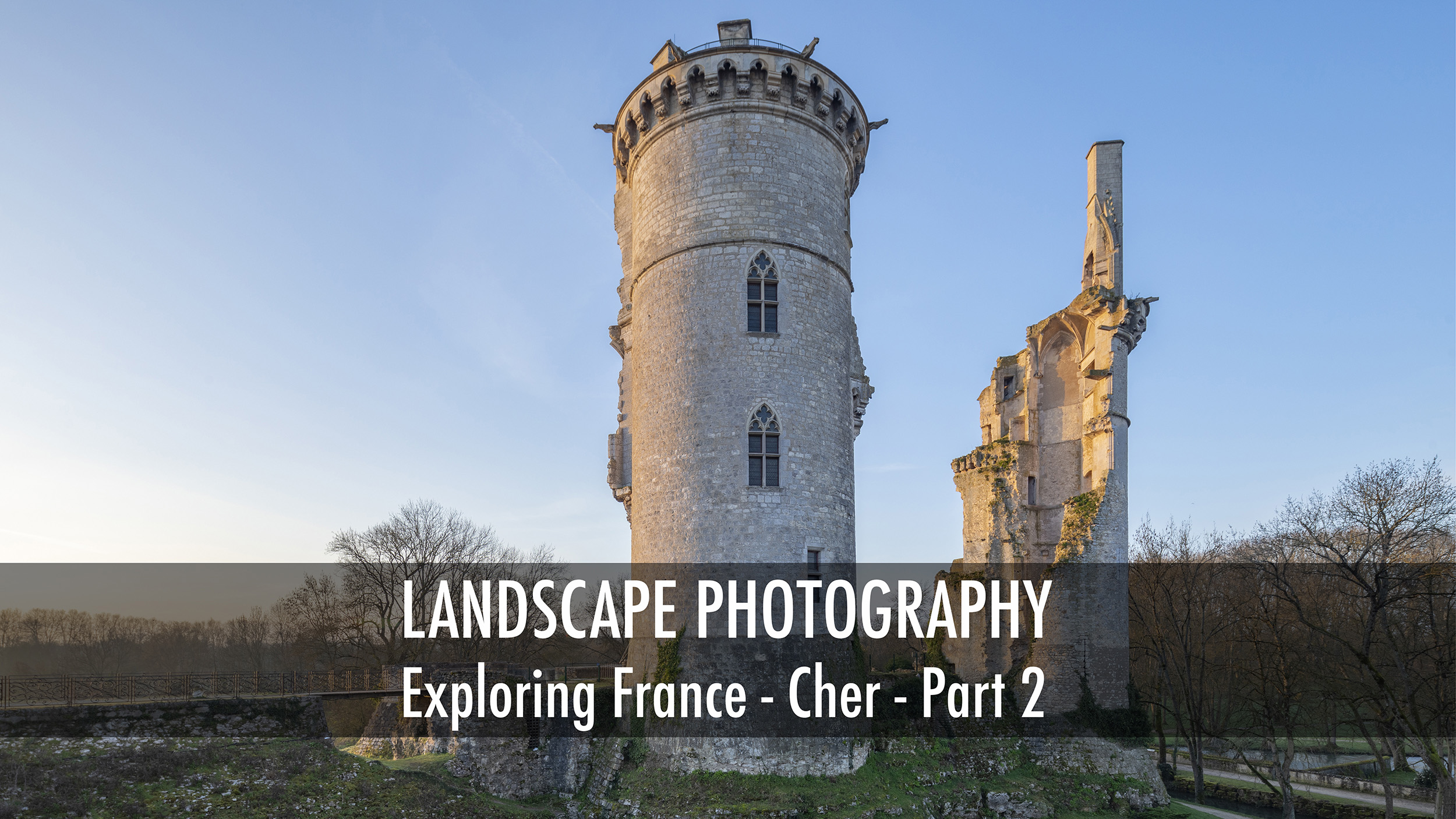

In this week’s YouTube vlog, Landscape Photography Exploring France, I visit the department of Cher for a second time. This central department has a whole raft of places to go, but in this episode, the architecture is what I mainly focus on.
It goes without saying that if you say France to people, then images of the Eiffel Tower in Paris, lavender in Provence and the Alps are probably high in people’s minds. But there is more to the country, and it’s worth researching to discover just how much more there is.
Throughout the year, I offer photography tours and workshops in a variety of destinations around the world. If you’re interested in learning more from me to help you get the best out of your photography, then get in touch.
The day started hard and early. I woke at half past five, realised I should have been up 45 minutes earlier, skipped breakfast, and hurried out the door with that slightly foggy feeling that only a rushed sunrise start can give you.
My destination was Mehun-sur-Yèvre, in the department of Cher in central France, part of the Centre-Val de Loire region. I had arrived just in time for the sun to start lifting past a bank of cloud. The subject was Charles VII’s ruined castle, a place I had seen many times from the road when heading south from Paris towards Clermont-Ferrand.
I had photographed it before, but never at that hour. Dawn changes a place like this. The stone feels softer, the ruin gains shape, and even a familiar subject starts to look fresh again. I set up with a 24mm tilt-shift lens, shifted upward and framed in portrait orientation, so I could hold the lines properly and keep the structure looking clean.
My plans for the rest of the day were simple enough:
That last part matters. In Cher and in much of rural France, the day often changes once you get on the road. A place looks promising on the map, then gives you mud, parked vans, poor angles, or flat light. Another place, barely marked at all, turns out to be the one that saves the day.
The sunrise start was the cleanest part of the morning. After that, the plan wobbled.
I had wanted to visit a chapel in the middle of a forest. On paper, it sounded ideal, remote, atmospheric, and different enough to make the effort worthwhile. The trouble came with the track. In France, I can often drive forest tracks without much concern, but this one was too muddy, with too much risk of getting stuck. It needed a 4×4, and I didn’t have one.
Before settling on the next stop, I tried another location as well. That one failed for a simpler reason: the research had made it look more interesting than it was. That happens. A photograph online can hide clutter, awkward access or a lack of any real subject once I see it with my own eyes.
Those dead ends pushed me towards an old collégiale church instead, and that shift improved the day.
Good research saves time, but fieldwork still matters. A map can only tell me so much.
I spent around three to four hours researching this part of Cher the day before. That sounds like a lot, but it is the job. I don’t want to turn up and photograph anything for the sake of it. I want places that are visually strong, historically interesting, and worth showing.
Cher rewards that effort because the obvious sites are only part of the story. Bourges gets the attention, and rightly so, but the smaller places are often where the day becomes interesting.
The collégiale church was a far better fallback than I expected. Parts of it date from the 11th century, with later additions from the 13th, 15th and 16th centuries. That long building history shows in the stonework. The whole place feels like a conversation between different periods rather than a single neat style.
Outside, the light was not ideal for the west front. When I photograph churches, I often want the sun there first because that is usually where the main decorative work sits. In this case, though, there was no great tympanum demanding attention, and the side light worked well enough on the exterior to make a solid image.
Inside, the building came alive. I fitted the 17mm tilt-shift and worked a couple of angles rather than repeating the same obvious frame. I took the classic view down the nave, of course, but I also looked for details that made the church feel distinct.
A stained glass window stood out straight away. It showed a knight attacking a dragon, vivid and striking against the dimmer stone around it. I couldn’t say how old the glass was, so I didn’t try to force an answer, but its colour carried the space beautifully.
The carved capitals caught my eye as well. Some details looked Romanesque, while other arches and windows leaned more towards Gothic. That mix is one of the reasons I keep photographing churches in central France. They are not all textbook examples of one period. Many have grown over centuries, and the joins between those eras are where the character sits.
I photograph so many churches here because the architecture keeps giving me reasons to stop. Even when the weather goes flat, these buildings hold their own. In a region where clouds can erase a landscape in minutes, churches are dependable in the best sense. They still ask me to look closely.
The next major stop was a village church that had jumped out at me during research, Église Saint-Blaise de La Celle. I had already seen photographs of the interior, and I knew it was special. What pulled me there first, though, was the exterior.
The side of the church has flying buttresses, and they transform the shape of the building. They do not look original to the earliest phase of the church, and I suspect they were added later to support the structure, but they give the exterior a striking profile. The whole place feels layered, practical and beautiful all at once.
Photographing it was less relaxed than it may sound. I was half-standing in the road during the school run, waiting for cars to clear and making sure no children appeared in the frame. Privacy matters, and I wasn’t going to include pupils in a photograph of the church while the school day was starting nearby.
The composition itself needed care as well. I wanted what I think of as a little breathing space around the building, enough room at the bottom and above the roofline so the church didn’t feel cramped. The sky kept changing, too. Ten minutes earlier, I had more blue, then the grey closed in. I was glad I caught a patch of side light on the stone when I did.
There were other distractions:
That is often what architectural photography comes down to. I am not only arranging what goes into the frame. I am working hard to remove what does not belong there.
Inside, Saint-Blaise was every bit as good as I had hoped. I did not need to reinvent the wheel photographically because I had already worked on the interior, but the ambulatory and choir are superb. The Romanesque sculpture there is rich, expressive and full of life. Even the roofline outside carries a row of carved details that reward a slower look.
Days like this remind me why churches make so much sense in central France. When the light is unstable, the subject still has weight.
The most uncertain stop of the day was also the one I was happiest to find. I had researched a ruined château, but the information was thin, the mapping was limited, and there were no road signs announcing it. I could not even say with confidence what the correct name was from the material I had seen beforehand.
I parked up, found no sign telling me to keep out, and walked over to take a look. There were no obvious warnings, but there was no invitation either. That left me doing what I often do in France, proceeding carefully, reading the place as I went, and stopping short of anywhere that felt clearly private.
I had my drone with me, although I had forgotten my gimbal for the video kit, which made the footage less stable than I wanted. The castle itself was worth the effort. It sits out in the open with very little around it, and the main façade faces east. That matters, because sunrise would suit it far better than the flatter midday light I had on the day.
From the field I could see enough to know it has serious photographic promise. Part of the turret roof has been restored and looks fairly new. Some stones in the walls also look newer than the rest, so somebody has put money into it at some point. Yet much of the place still feels abandoned. Inside the surviving tower, there is no proper staircase, and the wider structure has that familiar air of a project that started with ambition and stalled with reality.
One chimney was visible behind the walls, which suggested either a fire had been lit there at some stage or another building once sat tucked behind the section I could see. The style looked medieval to me, though I wasn’t in a position to date it properly.
What struck me most was the gap between what the place is and what it could be in the right conditions. With dawn light on the east face, or perhaps a winter sunset catching the side, it could be superb. If the crop in the field rises well later in the season, that would only help. I also suspect it may have astro potential, depending on the darkness of the sky there.
With care, time and the right light, this château could become one of those locations I return to more than once.
This day in Cher was a good example of how photography often works in practice, not in theory. I began with high hopes and a clear list. The weather then shifted, one access road became useless, another stop did not deliver, and the strongest images came from adapting rather than forcing the original plan.
That matters more than any single location. I can research for hours, and I should, but the field recce still decides the day. Mud on my boots, waiting for cars to move, changing lenses because the interior works better than the exterior, all of that is part of the process.
One lesson came through again with the church at La Celle:
In architectural photography, what I leave out matters as much as what I include.
That means mirrors, signs, vans, stray traffic, awkward edges and even my own reflection in the wrong place. It also means patience. A good building can be spoiled by a few inches of poor framing.
Cher is full of these small decisions because the department rarely shouts. Bourges is the famous name, with its UNESCO-listed cathedral and historic centre, but the quieter locations often ask more of me and give more back. About 20 miles from where I was, Noirlac Abbey is another fine example, beautiful if it is open and well worth the stop. Yet the unsigned places matter too, the churches with mixed styles, the half-forgotten castle in a field, the side road that turns out better than the headline attraction.
This whole part of France keeps me coming back, and the same appeal runs through my Loire Valley photography tours, where chateaux, old towns and layered history sit naturally alongside the photography.
What I like about Cher is that it corrects lazy ideas about France. If someone only pictures Paris, Provence or the Alps, this department can look easy to overlook. Once I start researching properly, that idea falls apart.
The range is what makes it satisfying. I can begin with a royal ruin at sunrise, move on to an 11th-century church with Romanesque and Gothic details, then end at a château that barely appears to want visitors at all. The thread running through all of it is old stone, patience, and the need to keep looking beyond the first result on the map.
The weather did not give me everything I wanted on this trip. The clouds never settled into something truly dramatic, and the light faded when I could have done with one more break. Even so, the day worked because the architecture in Cher is strong enough to carry interest without perfect conditions.
That is why I keep returning to central France. The region asks for effort, but it rarely wastes it.
Cher does not need to shout to be memorable. On a day like this, its appeal came from detail, timing and the willingness to follow a hunch when the first plan failed.
What stays with me is not only the sunrise at Mehun-sur-Yèvre or the quality of the Romanesque carving. It is the feeling that there is always another road, another church, another overlooked château waiting for a better patch of light.
That is enough reason for me to keep going back.
We noticed you're visiting from United Kingdom (UK). We've updated our prices to Pound sterling for your shopping convenience. Use Euro instead. Dismiss