 Skip to content
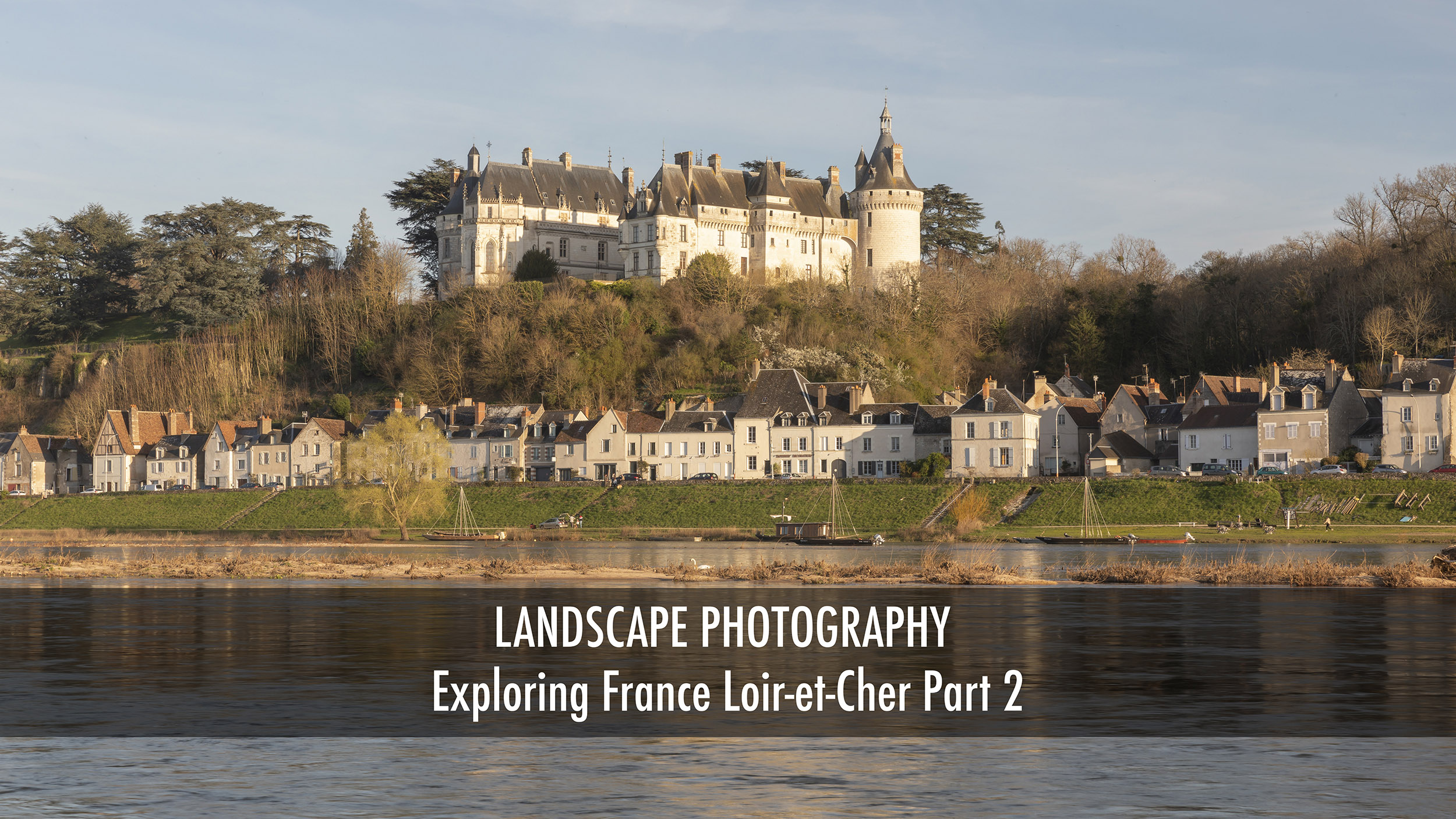

For this week’s YouTube vlog of Exploring France, I’m back in Loir-et-Cher for more landscape photography and, of course, architecture photography.
Although the department is called Loir-et-Cher, it also has the mighty river Loire going through it, but in any case, outside of the UNESCO World Heritage Site, there is a ton to do.
One of the things I was lucky enough to do was go up the bell tower of the church in Selles-sur-Cher. But, as you’ll see at the end, I forgot about the bell strike at the half hour 🙂
And if you’re interested in discovering the Loire Valley with a camera, then do check out my annual Loire Valley photo tour in May.
I started the day in the south of the department, on the Cher side of Loir-et-Cher, looking across towards Saint-Aignan. It is a lovely place to begin a photography day because the village climbs the hillside and the church crowns the view. From down by the river, the shape of it all makes sense at once. You get layers, height, stone, and a proper sense of place.
A few weeks earlier, on another trip to Loir-et-Cher, I had been lucky enough to go inside the collegiale. On that visit, I was given access high up near the organ, with a view down into the nave, and it was absolutely stunning. Even without going indoors again, the exterior alone was enough to pull me back.
That morning was clear, which was both beautiful and a little frustrating. Clear skies can feel flat if you want drama, but they can also give you those first clean strikes of colour when the sun lifts above the horizon. The trees in front of me were blocking the earliest light, so I waited. Bit by bit, the sun edged up through the branches, and I knew the village would soon start to glow.
There was more in the frame than the church. Nearby sat the old Château de Saint-Aignan, and beyond that, older remains still hinted at the area’s long history. I took the shot I already knew I wanted, this time with sunlight on the scene, and then worked on a panoramic image across the valley. That first stop set the tone for the whole day. The light was simple, the location was strong, and there was plenty more ahead.
From Saint-Aignan, I drove across Loir-et-Cher and on to Château de Cheverny, which is one of those buildings that looks straightforward until you set up a tripod. At first glance, you might think it is an easy architectural photograph. The reality was different.
The building has a look that sits between feudal and Renaissance, and that mix is part of its appeal. It feels old, solid, and refined at the same time. Yet the position of the sun mattered a lot. With the light behind me, I had the classic problem of my own shadow creeping into the foreground. That is one of those awkward details that can ruin a clean composition if you miss it.
I found that the best angle was from the south-eastern corner of the château. From there, the building had shape. It felt three-dimensional. When I tried a more obvious front-on angle, the image flattened out and lost its depth.
A few things made the shot work:
That lens choice mattered. A 24mm tilt-shift would have worked in portrait orientation, but not for the frame I wanted. This is exactly why I carry more than one tilt-shift lens. Sometimes the difference between a record shot and a finished photograph is only a few millimetres of focal length.
Cheverny was also a good reminder that the first viewpoint is not always the right one. A building can look better from the less obvious corner, especially when you want volume and shape rather than a flat facade.
By the time I reached my next stop in Loir-et-Cher at Selles-sur-Cher, the sun was well and truly up, and I hoped the church would be open. I had planned to photograph the interior if I could. What happened next was far better than I expected.
I was given special access to the bell tower.
Moments like that are one of the true privileges of working as a photographer in France. Because I speak the language, I can have the sort of conversations that sometimes lead to doors opening. That morning, the town hall was kind enough to let me go up, and I was grateful for it. From the tower, the view over the town was good, but the real thrill was being able to photograph the bells and work from a place most visitors never see.
I had already enjoyed photographing church interiors from elevated positions before, including views down the nave, but this was different. Up there, surrounded by the bells, the whole building felt alive in another way. Stone churches from ground level can seem still and composed. In the tower, you feel the mechanism, the weight, and the sound waiting to happen.
Then the half-hour struck.
Standing beside a bell when it suddenly goes off is the sort of thing that makes you jump out of your skin.
That happened at half past nine, and I nearly hit the roof. I had been concentrating on the photographs and had not given the time enough thought. The shock of the sound, that close up, was unforgettable.
The visit was short because people were waiting for me below, but I came away with images of the bells, the tower, and the church from a rare viewpoint. More than that, I came away reminded that access is often part trust, part courtesy, and part timing. On a day of churches and chateaux, this was the moment I will remember first.
Continuing my journey through Loir-et-Cher, I stopped at a lakeside château that felt more like a grand country house than a fortress. There was no clear information board, no obvious visitor set-up, and no signposting from the villages I had passed through. It appeared to be private property, but the building sat beautifully by the water and was impossible to ignore.
The light was hard by then. It must have been around half past eleven, so this was not the kind of soft, low-angle light that makes life easy. Even so, I was glad I stopped. Midday scouting has real value, especially in a place like this where the orientation tells you a lot. By checking where the sun sat over my left shoulder and how the building faced, I could see that the location would work at many times of year. That is useful knowledge to bank for another visit.
The composition I chose avoided a perfect mirror reflection. It would have been easy to go for symmetry, but I wanted something with a bit more shape. By getting lower, I could pull more of the reflection into the frame, then trim the edge with trees so the photograph felt less formal and more grounded.
What I loved most, though, was the quiet which is typical of the Loir-et-Cher. There were no tourists, no queue of cars, no distraction. I could hear running water and birds, and that was about it. Places like this often come from patient map work and a willingness to stop when something catches your eye. That is one reason I keep returning to rural France with the camera. The well-known places are good, but the unsung ones often give me more room to think.
If this side of France appeals to you, my Loire Valley photography tours are built around that same mix of strong locations, good light, and time to work properly.
One of the more unusual photographs from my day in Loir-et-Cher came from a building I had not planned to shoot at all. I was driving along the road when I looked across the fields and noticed an abandoned structure sitting under a bright sky and thin cirrus clouds. The grass was lush, the light was strong, and I could immediately see it as an infrared image.
Because the field was not under cultivation, I could cross it without causing damage, and I found a place to pull the car over nearby. That made the stop practical, which is often half the battle with roadside discoveries.
For the shot itself, I used the 24mm tilt-shift lens and added a polariser. The sun was roughly 90 degrees from the building, which helped the contrast. I switched my thinking straight into black and white because infrared tends to simplify a scene into tone, shape, and texture. In normal colour, the building might have looked ordinary. In infrared, the grass, sky, and masonry had a different kind of bite.
My exposure notes were simple enough: ISO 400, f/8, and around two minutes. I spent a little time checking sharpness and adjusting exposure because infrared filters can be awkward if you do not know their exact strength. I knew mine was stronger than ten stops, but I had not pinned it down precisely. That sort of trial and error is part of the process with specialist work.
I like stops like this in the Loir-et-Cher because they break the rhythm of the day. Castles and churches can shape a route, but a quick infrared detour keeps the eye fresh. It also proves a point. Good travel photography is not only about the headline location. It is also about noticing what appears off to the side and giving it a chance.
I finished my day in the department of Loir-et-Cher by the river Loire with the Château de Chaumont-sur-Loire rising above the river. This was not the final thing I hoped to do, because I still had a drone shot in mind for later, but it was the last stop I knew I needed to photograph properly before the light went.
Chaumont-sur-Loire is well known for its garden festival, which begins in May and changes each year. Even without the festival, the setting is enough. The château sits above the river with real presence, and the trick is finding the right profile. I had already done a recce a couple of days earlier, which helped, but the Loire does not make life easy. Water levels shift, riverbeds change, and a spot you stood on before may not be reachable next time.
That evening, I was on a stretch of riverbed that gave me the best view I had found so far. There is another place by the road, but it does not show the château nearly as well. From down by the river, the building had room around it, and the line of the bank led the eye up towards the walls.
The light still needed care. White stone in late sun can burn out quickly, especially when the rest of the scene is darker. I knew that if I stayed another half hour or so the stone would begin to glow more evenly, but even when I arrived, it was already strong enough to make the effort worthwhile. I used the 24-70mm lens at 70mm to crop in slightly and tighten the frame.
This was one of those photographs that felt like a keeper the moment I saw it on the back of the camera. It was not a grand secret location, but it did take research, a recce, and a bit of timing. That combination comes up again and again in Loir-et-Cher. The best views are often there, but they do not always give themselves up at first glance.
This day reminded me that Loir-et-Cher is far richer than the standard Loire Valley checklist suggests. Saint-Aignan at dawn, Cheverny in hard morning light, the bell tower at Selles-sur-Cher, a private lakeside château, an infrared roadside stop, and Chaumont-sur-Loire at sunset all asked for different ways of seeing.
What ties them together is simple. Research matters, recce work matters, and being willing to wait for the right angle matters most of all. When that comes together, even a clear sky day can turn into one of those outings that stays with you for a long time.
We noticed you're visiting from United Kingdom (UK). We've updated our prices to Pound sterling for your shopping convenience. Use Euro instead. Dismiss