 Skip to content
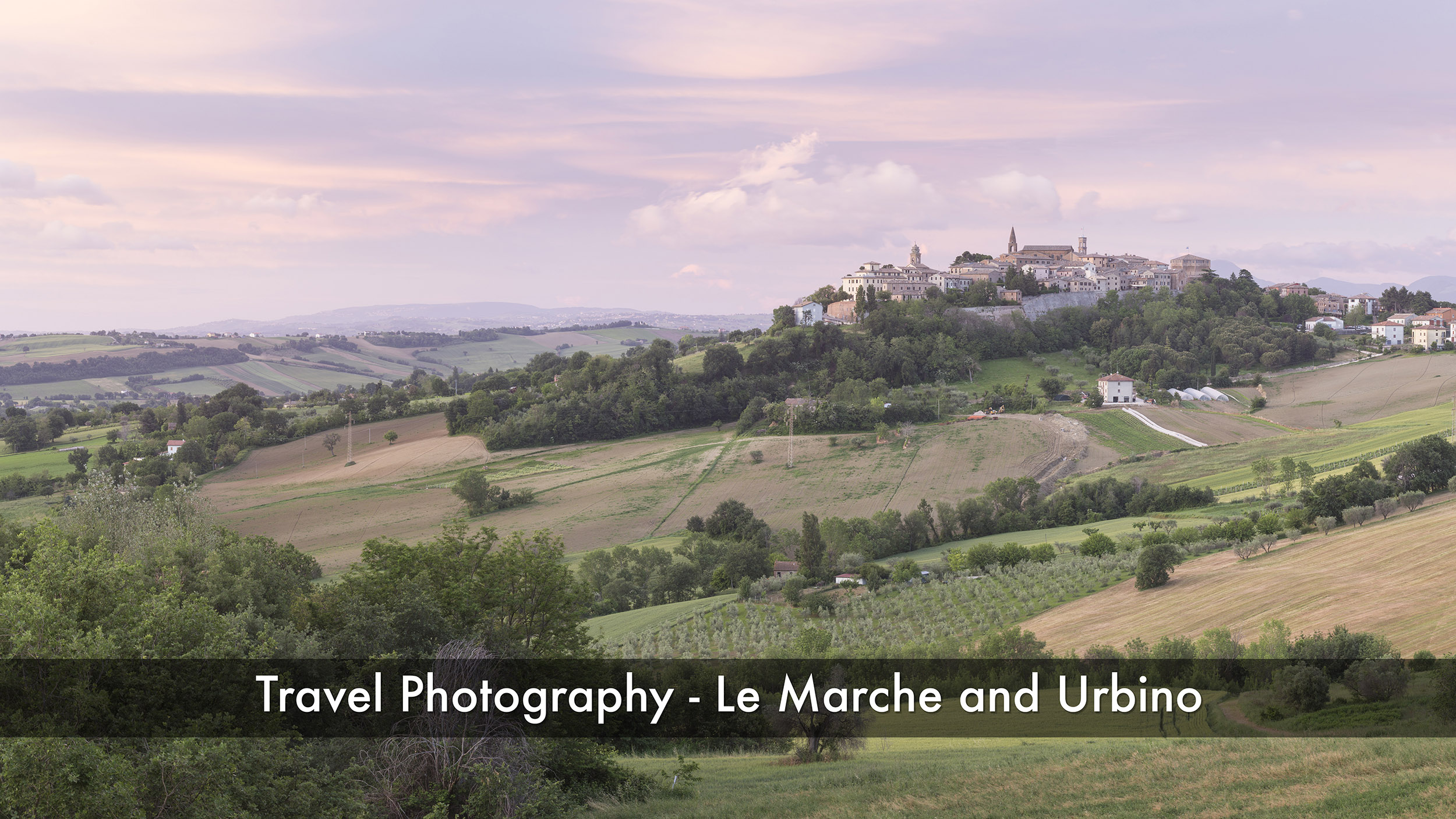

Landscape and Travel Photography – Le Marche, Italy, is my latest YouTube vlog detailing some of my exploits as I travel to various parts of the world.
The region of Le Marche in eastern Italy is somewhere that is not on a lot of people’s bucket list. It’s little discovered by a lot of people, but if you take the time to investigate what this beautiful region has to offer, then you’ll be hooked.
Le March had been on my bucket list for a long time. Ever since I came across images of the city of Urbino, I’ve been wanting to get there.
Getting there is either by taking a low-cost airline flight to Ancona or by doing as I did, by flying in through Florence and then driving a couple of hours. But either way brings you to this gorgeous area of Italy, and what a treat you’re in for.
I’ve heard it said that Le Marche, translated as The Marshes in English, is going to be the next Tuscany. Honestly, I think that this comment is not far off the mark. It has rolling hills and beautiful hilltop towns as well as a coastline just like its more famous counterpart. What I found, though, is that when my minuscule Italian didn’t work then English seemed to be little spoken, which is unusual from my many travels to the country.
In any case, if you want to get away from the hordes of Florence or Siena and experience a slower pace of life, then give Le Marche a go. You won’t be disappointed!
I arrived in Le Marche expecting a pleasant few days. I left feeling as though I’d only brushed the surface of a part of Italy that should be spoken about far more often.
The region of Le Marche sits next to Tuscany, yet it feels very different once you start driving around it. There is the same pleasure in hill country, old towns, long views, and shifting weather, but there is also a sense of space. I kept finding scenes that felt fresh because I wasn’t standing in a line of tripods.
My base for my short stay in Le Marche was Urbino, and that proved to be the right anchor point. From the outside, the city already looked superb. I could see enough from a distance to know I wanted to come back later and give it proper time. Since I only had three nights, I wanted to balance the city itself with the roads and ridges around it.
A few things stood out from the start:
What struck me most was how little I seemed to hear about Le Marche compared with other parts of Italy. That made every drive feel open-ended. I wasn’t ticking off famous viewpoints. I was looking, stopping, and reacting to whatever appeared around the next bend.
In Le Marche, taking the wrong road often gave me the best view of the day.
One morning, after breakfast, I headed off towards the next place on my list and went the wrong way. I wasn’t paying enough attention to the sat-nav, but that mistake paid off almost at once.
As I drove away, I noticed a lovely view of Urbino sitting on the hill behind me. It wasn’t the grand, obvious view that everyone hunts for. It felt smaller and more personal, which often makes for a stronger photograph.
I pulled over as soon as I could and set up a time-lapse. The wind was moving well at that altitude, so I chose a two-second interval. If I’d stretched that to five seconds, the clouds would have moved too much between frames and the final sequence would have felt jumpy, almost as if the sky were boiling. At two seconds, I could keep the cloud movement gentle and natural over the city.
That choice mattered because the whole mood of the scene came from the sky. Urbino had presence, of course, but the weather was doing half the work. When clouds move too fast in a time-lapse, the atmosphere disappears. I wanted a flow, not a rush.
Later on, I saw another hilltop village from the main road and had the same feeling; I needed to stop and make something of it. I didn’t even know where I was at first. I had to check the GPS simply to geo-tag the place so I could find it again later.
That sums up Le Marche rather well. I wasn’t working through famous landmarks all day. I was finding scenes by chance and making quick decisions. There was a freedom in that, because I wasn’t trying to recreate photographs I’d already seen elsewhere. I was responding to the shape of the land, the way the roads curved, and the way these villages seemed to grow out of the ridges.
For photographers, that is a gift. A region like Le Marche asks you to keep your eyes open at all times. The main destination matters, of course, but the in-between moments can be better.
Because the weather shifted throughout the day, I kept adjusting my time-lapse settings to match the speed of the clouds.
This quick comparison shows how I approached it:
| Location | Conditions | Interval | Why I chose it |
|---|---|---|---|
| Viewpoint outside Urbino | Windy, clouds moving quickly | 2 seconds | To keep the motion smooth and stop the clouds from looking too erratic |
| Old fort above Urbino | Slower-moving cloud, softer evening light | 1 second | To bring life into a gentler scene without overdoing the movement |
The main point was simple. I let the sky decide the settings, not habit.
A lot of my time in Le Marche was spent driving, and I mean proper driving, long stretches, wrong turns, and plenty of stopping to look. On one of those drives, I headed towards an abbey I had marked on Google Maps in a personal map before the trip.
The area around it felt remote. There were very few tourists about, and it seemed well away from the main flow of traffic. From where I stood, I felt close to the Umbria border, with a ridge line ahead and the sense that the regional edge wasn’t far off. That north-west corner of Le Marche has a calm, tucked-away feel to it.
The abbey itself appeared to be Fonte Avellana from what I could make out on the map, although I wanted to confirm that later. What mattered in the moment was the light. The sun was high above the ridge and falling down onto the building well, so I took a more standard landscape frame first to secure the shot.
After that, I wanted something wider and cleaner. Rather than keep too much sky in the frame, I planned a panorama focused on the building itself, more like a 17:6 composition. That approach suited the subject because the architecture was the story. The sky was pleasant enough, with some blue showing, but it wasn’t strong enough to carry half the image.
My approach at the abbey came down to two options:
That small shift in thinking made a difference. The first photograph recorded the place. The second had a better chance of saying something about it.
By about 6.15 in the evening, I was back in Urbino. Above the city, there is an old fort with a brilliant view across the rooftops and the surrounding countryside. The only real frustration was timing. It was open during the day and shut around 7 pm, so a proper dawn or sunset from that position wasn’t possible on this visit.
Still, the light was lovely when I got there. The sun kept slipping behind clouds and then returning, which gave the scene a soft rhythm. I set another time-lapse, this time at a one-second interval, because the cloud movement had slowed down compared with the earlier viewpoint.
That slower interval made sense in softer wind. If I’d left too much time between frames, the movement would have felt too sparse. One second helped hold the pace of the scene and kept the sequence alive.
The sun was directly in my face for part of it, and I could barely look up without squinting, but that direct light also helped the photograph. Urbino took it well. The city has weight from above, and the evening light gave the stone an extra lift.
From that fort, the value of Urbino became even clearer to me. It wasn’t only an attractive base for a few nights. It was a subject in its own right, and one that changed character depending on where I stood. That matters for travel photography. A place that works from only one viewpoint can feel limited. Urbino kept offering more.
Once the sequence was done, I went off in search of food and one last scouted location before the end of the day. Whether that final spot would work or not almost didn’t matter. The view from the fort had already made the evening.
My last morning in Le Marche started with the kind of sky every photographer wants. The clouds were full of shape and movement, and after the flatter conditions earlier, it felt like a gift.
That came after a rough patch the day before. Google Maps had taken me down what was supposed to be a road, but it turned into a five-kilometre track that was awkward enough to cost me about an hour. I couldn’t move forward with confidence, and turning back wasn’t simple either. Those moments are part of travelling with a camera, especially when you keep pushing into lesser-known areas, but they test your patience.
Even with that frustration, my feelings about Le Marche didn’t change. If anything, it became stronger. This is a region with a huge amount to offer photographers, and I only saw a fraction of it.
A few things stayed with me after the trip:
I came away knowing I needed more time here. Three nights gave me a taste, not a full picture.
For this trip, I used the same dependable kit I often carry for travel and landscape work. The combination gave me flexibility, from wide scenes to tighter studies and time-lapse sequences.
Here’s the gear I had with me:
| Item | How it helped on the trip |
|---|---|
| Canon 6D | General stills and travel work |
| Canon 5D Mark II | Second body and backup option |
| Canon 17-40mm | Wide views, city scenes, and environmental compositions |
| Canon 28-70mm f/2.8 L | Flexible mid-range coverage |
| Canon 24mm TS-E Mark II | Controlled perspective and careful composition |
| Canon 70-200mm f/4 L | Pulling out distant details and compressed views |
| Canon 100-400 Mark II | Reaching further into the landscape when needed |
| Lee Filters | Managing contrast and exposure in changeable light |
| Manfrotto carbon fibre tripod | Stability for stills and time-lapse work |
| Manfrotto 410 geared head | Precise framing, especially for architecture and panoramas |
I also share updates and photographs on Instagram and Facebook. If you follow my trips, you’ll know this short stay in Le Marche only made me want to return for longer.
Some places win me over because they are famous. Le Marche did the opposite. It stayed with me because it felt open, unseen, and full of photographs I hadn’t expected to make.
What I found around Urbino was enough to make me plan a return. The city, the hilltop villages, the abbey, and even the wrong turns all added up to a region with far more depth than a quick glance at the map suggests.
If Tuscany has long been your Italian pull, Le Marche deserves room in your plans as well. I went for three days and left knowing I had only started.
We noticed you're visiting from United Kingdom (UK). We've updated our prices to Pound sterling for your shopping convenience. Use Euro instead. Dismiss