 Skip to content
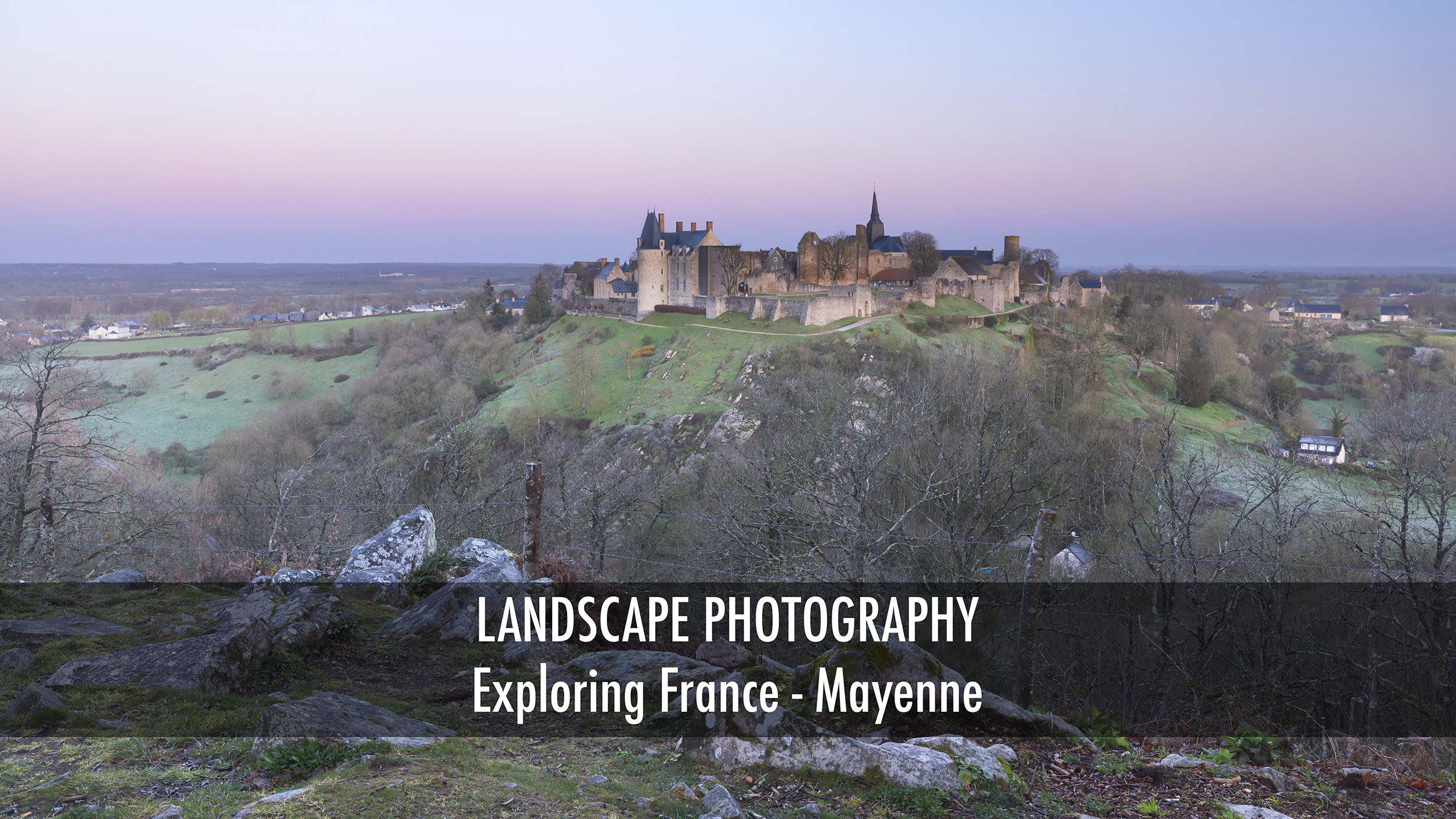

In this week’s YouTube vlog entitled Landscape Photography Exploring France – Mayenne, I head to the department of Mayenne.
This rural department in central France has an absolute ton of things to photograph. From hilltop medieval villages to ruined castles and, of course, the obligatory churches too.
So sit back and take a look at what I’ve got up. It’s only scratching the surface, but it should give you ideas.
And if you’re interested, I offer photography tours and workshops in a variety of destinations around the world. If you’re interested in learning more from me to help you get the best out of your photography, then get in touch.
I began at one of the classic viewpoints over Saint-Suzanne, one of those villages that seems built for a photographer’s eye. Perched on its height, with stone walls and the castle catching the early sun, it has the kind of shape that reads clearly from a distance. Even before the light turned, the place had presence.
What I wanted was mist. That soft layer would have added separation around the village and made the hilltop stand out even more. It never arrived. Instead, I waited for the sun to strike the buildings from the side, because that was always going to be the better option once the haze failed to show.
A lot of photography in places like this comes down to patience. The scene may already be strong, but it still needs the right angle of light to give form to stone, roofs, trees and walls. Backlit scenes can work, of course, though here I knew side light would be stronger and far more useful for showing the village properly.
That early stop also gave the day an unexpected moment. I almost never meet other photographers when I am out working in rural France, yet that morning I found myself chatting with a photographer from Laval. It was a small thing, but it changed the feel of the day. Photography can be solitary, so a good conversation beside a viewpoint is always welcome.
By that point, I already had a rough list in my head for Mayenne, ruined castles, churches, a cathedral or two, and whatever else I could find by following the roads. Saint-Suzanne was the opening scene, but it was never going to be the whole story.
When the weather does not give me the photograph I had planned, I look for the light it is giving me instead.
From Sainte-Suzanne, I drove for about half an hour to a ruined castle, a place I understood to be Chateau de Corsiere. The ruins stood out immediately, broken stone, age in every wall, and the sort of structure that still holds shape even after centuries of collapse. I did not know much about its history, but I did have the good fortune to arrive while the owner was there.
That mattered because the site was on private property. Before doing anything else, I asked if I could photograph it. He was perfectly happy for me to take photographs, which was a good reminder that a polite question often opens doors that would otherwise stay closed. I never assume access, especially in France, where private land and historic buildings often sit side by side.
He also mentioned something useful for anyone planning a trip. During the heritage weekend in September, private places like this can open to the public free of charge as part of France’s heritage days, the Journées du Patrimoine. If you enjoy photographing old properties, that is worth remembering.
This stop also became a good place to start using a tool I had been meaning to put into proper use, the Spyder Cube. It had been sent to me to try, without sponsorship, and the point of it was simple enough. I wanted better white balance and more consistent colour when I processed the files later.
The cube gives me reference points for white, mid-grey and black. Since I try to keep my images looking natural, that kind of reference can make a difference, especially in mixed light or awkward shade. I placed it into a frame and took a reference shot so I could compare it later against the camera’s auto white balance.
That sort of test is not glamorous, but it is practical. If the colour is off, every later decision becomes harder. Starting from a sound reference saves time and makes the final image feel honest.
Not every location behaved the way I wanted that morning. There was one castle I had planned to photograph with a reflection in a small lake. In theory, it was a lovely idea. In practice, the entire edge of the lake seemed to be filled with fishermen. Every promising angle had someone settled into it.
Another ruined castle also failed on the first attempt, though for a different reason. The light was wrong. Rather than force it, I made the unusual choice to leave it and return later in the day. Normally, I prefer to build a sensible circuit, one route that works with morning, midday and afternoon without too much doubling back. On this occasion, Mayenne had other ideas, so I went north, then south, then planned to swing back again.
That change in route brought me into the town of Mayenne itself and to a church that was well worth the detour. The exterior had a strong Gothic feel, and what struck me straight away was how much it reminded me of some churches in Brittany. Mayenne is not Brittany, of course, but the style felt related, especially in the massing and the stonework outside.
The inside had a different character. It felt compact in one sense, almost squat from certain positions, yet it also rose well above me. That contrast made it interesting to photograph. The painted area at the far end caught my eye, too. It looked comparatively fresh, or at least fresher than much of the surrounding stone, and it gave the interior a different visual weight.
I reached for a tilt-shift lens here because interiors like this reward careful control of lines. Churches can look awkward very quickly if the verticals are slipping too far. With the tilt-shift, I could keep the architecture feeling solid and let the height speak for itself.
I also tried the Spyder Cube indoors. That was less straightforward than outside. I needed a long exposure, around six seconds, and I included the cube in a frame to see whether I could later pull a better white balance from it than the camera’s auto setting had given me. It was a rough test rather than a polished one, and I could already see I needed a better way to mount or hang the cube in place.
Still, that is how new bits of kit become useful. I do not learn them by reading the box. I learn them by carrying them, forgetting them for weeks, then finally putting them into real scenes and seeing what holds up.
By midday, the sun was high and hard, so I turned my attention to a place that was less about the photograph in front of me and more about the photograph it might become. I had come to a standing stone in the countryside, and the first thing I thought was not about the daylight at all. I was thinking about the Milky Way.
The stone stood tall and simple, rising straight from the ground in a way that lends itself to a clean composition. I checked the direction and found myself facing roughly south-east. If summer conditions are right, with a clear night and the right season, the Milky Way should arc somewhere above that line. In my head, I could already see the frame, the stone rising from the foreground, and the sky pouring down towards it.
I checked the light pollution map on my phone, and the reading looked to be around Bortle 3 or 4. That is not perfect dark-sky country, but it is promising, especially given the direction I would be shooting. Laval lay off one way, yet the view ahead was open countryside. I could see a farm and what looked like an old château on a hill, but beyond that, the place felt rural and open.
This is where my photography is starting to broaden. Astrophotography has not been my main area up to now, but I have begun building a list of places across rural central France that could work well once the season lines up. This standing stone went straight onto that list.
I also have a star tracker that I still need to spend time with. Rather than fumble through that learning process on camera, I want to practise quietly, understand the setup, and get used to the techniques. I know that stacking exposures can help reduce noise, so that is another area I want to work on. The location deserves more than guesswork.
For now, I made a note to return in June. Some places do not ask for immediate results. They ask to be remembered.
Later in the day, I went back to one of the castles that had not worked in the morning. The other castle, the one with the lake, still had people dotted around the water and remained more trouble than it was worth. This one, however, finally began to open up.
It was a beautiful old medieval building, though I could not remember the name while I was there. That happens sometimes. I know where these places are on the map, I know why I want to photograph them, and then the name slips out of my head the moment I need it. The important part was the light.
Cloud had started to build, so the window was narrow. I waited for around twenty minutes and then got the one frame I felt I needed before the light disappeared almost at once. One moment, the building had shape and tone, and the next it flattened out under the cloud. That single keeper was enough to make the stop worthwhile.
The more useful part, though, was what I learned about the location itself. The castle faces roughly north, which made me think straight away about summer sunrise. With the sun rising further round at that time of year, the building should catch much better light from the right direction. That sort of mental note matters. A return visit in better conditions can turn an acceptable stop into a proper result.
There was also a farmhouse nearby, though it did not intrude into the composition I wanted. Better still, there was public access via a footpath, so I could move around and stand close to the structure without feeling I was pushing my luck. France often surprises me like that. Some of these old sites sit on or beside private land, yet they remain open enough to explore respectfully.
A location is not only about the frame I take home that day. It is also about what I learn for the next visit.
As the afternoon shifted towards evening, I made my way back to the overlook at Saint-Suzanne. By then, the sky had changed completely from the clear optimism of morning. Clouds had spread across much of it, but they had not closed everything down. Instead, there was a gap near the horizon, and that gave me hope.
From the viewpoint, I could see the setup forming. If the sun dropped beneath the cloud at the right moment, it would throw side light straight onto the village. That is exactly the kind of late light I had wanted earlier, only richer now, lower, warmer, and far more dramatic.
It is hard not to feel a rise in energy when that kind of scene starts to build in front of you. I knew I had perhaps half an hour. The cloud looked as if it might also catch colour once the sun sank further, so there was a chance of both strong light on the village and a good sky behind it. Those are the evenings that make the waiting worthwhile.
Sainte-Suzanne looked superb from that perch. The stone took on warmth, the village gained shape and depth, and the whole place felt settled into the evening in a way that morning had only hinted at. I had spent the day zig-zagging around Mayenne, changing plans, abandoning one shot, returning to another, and stopping at places I had not expected to matter so much. Yet the day closing where it began felt right.
That is also a fair picture of my work as a full-time landscape and travel photographer. The photographs are one part of it. The rest is weather, driving, waiting, talking to people, checking maps, revisiting locations, and trying to judge not only what works now but what might work better in another month, another season, or another kind of light.
Mayenne gave me more than a list of locations. It gave me a day full of decisions, which is often where the real work sits. I started with a hilltop village that needed patience rather than mist. Then I found a ruined château where a simple conversation with the owner made the stop possible. After that came a church in Mayenne town, a standing stone that made me think ahead to summer nights, and a castle that rewarded persistence with one brief burst of usable light.
If I took one lesson from the day, it is that Mayenne rewards flexibility. You can plan the route, note the subjects and watch the forecast, but the department still asks you to respond in the moment. One blocked reflection, one patch of cloud or one shift in sun angle is enough to send you elsewhere.
That is why I enjoyed it so much. Mayenne is full of subjects for photographers, but it is the changing light between them that holds the day together.
We noticed you're visiting from United Kingdom (UK). We've updated our prices to Pound sterling for your shopping convenience. Use Euro instead. Dismiss