Travel Photography in Rome, Italy
From the 29th May to 1st June 2017, I visited Rome for the fourth time. Excessive? Absolutely not! I like to get the best out of a city that I can, and if that means multiple visits, then so be it.
Even now, after this short stay, I still feel that I am only scratching the surface of the Eternal City.
My latest YouTube vlog shows some of what I do during my time as a working travel stock photographer. Creating time-lapse sequences and trying to work on a particular view that interests me. Something I will say about this particular vlog is that when listening back to it, I seem to have lost the diction that I’d built up over the last few months, so apologies for that.
The gear that I used includes Canon 6D, Canon 5D Mark II, Canon 24mm TS-E Mark II, Canon 28- 70mm L, Canon 17-40mm L, Canon 70-200mm F4 L, Canon 1.4x Mark III Extender, Manfrotto carbon fibre tripod, Manfrotto 410 geared head.
Starting on a rooftop above the Eternal City
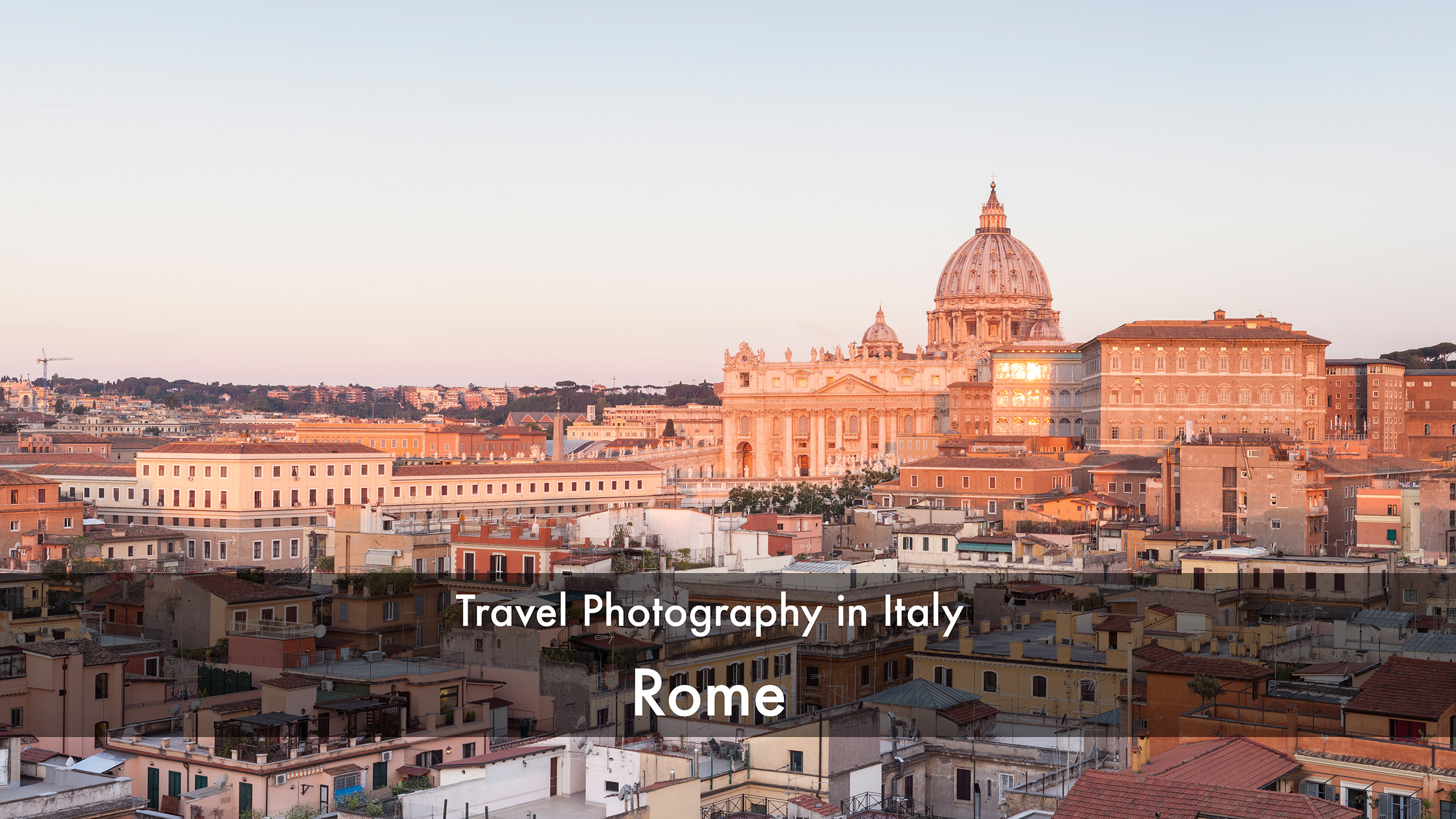
I began high above the city, looking out towards St Peter’s and Vatican City. That kind of viewpoint suits me far more than walking busy streets while trying to film and shoot at the same time. In cities, I carry too much gear to relax when I’m moving through crowds, and because of that, I much prefer a rooftop or overlook where I can keep an eye on everything and still concentrate on the photograph.
The view behind me was exactly why I started there. St Peter’s sat in the distance, the rooftops of Rome spread out below, and the light was still changing. I had a night-to-day time-lapse running and hoped the first light of sunrise would pick out the city and give the sequence a proper finish.
My setup was simple and practical:
- A Canon 6D
- A Canon 70-200mm f/4L
- A remote release
- An intervalometer to fire the camera at set intervals
That sort of shot isn’t complicated in theory. I find a clear line towards a subject I love, lock the camera down, and then wait for the light to do something useful. Of course, that wait is part of the job. Sometimes the sky stays flat. Sometimes the glow arrives for a minute and disappears. This morning, the conditions looked promising enough to stick with it.
Once the time lapse was done, I had a loose plan for the rest of my time in Rome. I wanted to head down towards the Tiber and try for a quieter view of Ponte Sant’Angelo, because the previous evening had been packed with people. I also had the Spanish Steps in mind, especially because on my last visit, they had been hidden by scaffolding. After that, I was thinking ahead to Piazza del Popolo and a dawn shoot at the Colosseum.
In a city like Rome, a good viewpoint buys me two things at once, safety for my gear and space to think.
Working the Tiber at first light
By about 7 in the morning, I was down on the banks of the Tiber, trying to solve a problem that will be familiar to anyone who photographs cities. The obvious viewpoint is not always the best one.
Up on the bridge, there is a classic line towards St Peter’s and Ponte Sant’Angelo. I had been there the night before, and it was busy enough that working properly felt almost impossible. Back in the morning, with fewer people around, the bigger issue became clear. A line or wire cut across the scene in a way that made the composition frustratingly awkward.
Why the obvious viewpoint didn’t work
From the bridge, too much clutter crept into the frame. The wire was one problem, but it wasn’t the only one. There was also a pale fence off to one side, workmen under the bridge, and cleaning activity along the riverbank. Every wider composition picked up something I didn’t want.
That is often the real puzzle in travel photography. A place can be beautiful, the subject can be strong, and yet the photograph still refuses to come together because the edges are untidy. Rome is full of these small battles. The monuments are grand, but the modern world keeps sneaking into the frame.
Why I switched to a longer lens
Instead of forcing the obvious angle, I moved lower and worked with a longer telephoto setup on the Canon 6D. That choice helped me strip out some of the distractions and concentrate on the relationship between the bridge and St Peter’s, rather than everything around them.
Three practical issues shaped that decision:
- The wider view included the wire and fence.
- Workmen and morning cleaning activity kept creeping into shot.
- A more ambitious telephoto panorama didn’t quite come together, so I had to accept a simpler image.
I still knew I’d need to clean a few bits up later, which I never enjoy doing, but there is a point where “needs must” applies. The better choice is to solve as much as possible in camera, then deal with the last small distractions afterwards. This morning, the final frame came from adapting to the scene rather than insisting on the first idea.
That was one of the most useful parts of the trip. Rome gave me a reminder that a strong travel photograph often depends less on finding the famous viewpoint and more on finding the clean one.
Dawn at the Colosseum
The next major shoot was the Colosseum, one of those places that can feel impossible to photograph well because it has been seen so many times. Even so, I still wanted my own version of it, and sunrise gave me the best chance.
It took me about 40 minutes to walk there from my hotel. On the way, I picked up a couple of other frames, but the Colosseum was the main reason for the early start. The conditions were a little frustrating because the sky was cloudless. The previous evening had given me better colour over the city, and I had managed a nice day-to-night timelapse from that. By comparison, the morning was cleaner and simpler, which can be good, but it leaves less room for drama.
Even small interruptions mattered. At one point, a police car looked as though it would sit right where I didn’t want it. Thankfully, it moved, and I could settle into the composition I had in mind.
Choosing the right lens for the foreground
For this shot, I used the Canon 6D with the 17-40L. I don’t often reach for that lens first when architecture is involved, but on this occasion, my 24mm tilt-shift wasn’t wide enough for the composition I wanted. The foreground mattered as much as the building, because I wanted the cobblestones to lead the eye towards the Colosseum and give the frame some weight.
I stopped the lens down to f/22 to keep the stones in the foreground sharp and hold detail through to the structure itself. That choice came with the usual trade-offs, but the depth of field was more important to me than anything else in that moment.
There was another detail that mattered, and it had nothing to do with camera settings. Before I started shooting, I picked up some rubbish that was sitting in front of the lens, including a bright bottle that would have glared in the photograph. I always find it strange when people say they’ll “sort it in Photoshop later” if they could simply tidy the scene first. If something small is ruining the foreground, moving it takes seconds and saves time later.
A clean frame often starts before I press the shutter.
Waiting for the first light on the stone
By then, I was simply waiting for the sun to strike the side of the Colosseum. That kind of wait can feel long, even when it is only a few minutes, because all the work is already done. The tripod is set, the composition is fixed, and there is nothing left but patience.
When it works, sunrise suits the Colosseum beautifully. The city is quieter, the foreground isn’t full of people, and the first warm light gives the stone a bit of life. I wasn’t working with dramatic clouds, but I did have calm conditions, a tidy frame and the shape of the monument standing clear against the morning sky. Sometimes that is enough.
My last morning above Rome from Gianicolo Hill
My final shoot in Rome came on the morning I was due to fly back home to France. Whenever time allows, I try to squeeze in one last dawn before a journey home. It is a good way to end a trip because it forces me to focus. There is no time to wander, second-guess or hang about.
This spot was on Gianicolo, one of the best overlooks in the city. From there, Rome opens out in layers of rooftops, domes and distant haze. If you want a broad sense of the city rather than a single monument, it is hard to beat.
The setup surprised some people because it wasn’t a wide view. A line of trees blocked too much of the lower foreground, so the scene worked better with a longer focal length. I was somewhere around 150mm, compressing the rooftops and pulling the city closer together.
I had hoped to catch sunlight coming over the mountains behind Rome, but time was tight. By about 5.25 in the morning, I only had 25 minutes left before I needed to pack up and start the half-hour walk back to the hotel. That is not much margin when you’re trying to photograph changing light and still make a flight.
Even so, I left happy with what I had. The view was strong, the city was quiet, and the morning still gave me a pleasing set of frames. That is often how it goes on travel jobs. You don’t always get the full version of the scene you imagined, but if you arrive early, stay organised and work the view properly, you can still come away with something worthwhile.
For anyone heading to Rome with a camera, Gianicolo is worth keeping in mind. It is one of those places that makes the city feel vast and intimate at the same time.
The gear and habits that helped me most in Rome
This trip wasn’t about carrying every lens I own and trying to use all of them. It was about choosing the right tool for each scene and keeping the process practical. Across the few days, the pieces that mattered most were my Canon 6D, the 17-40L, the 70-200mm f/4L, a remote release, an intervalometer, and my Manfrotto tripod and geared head.
A few habits mattered more than the gear itself.
Early mornings gave me quieter streets and cleaner compositions. That helped at Ponte Sant’Angelo, the Colosseum and Gianicolo. Longer focal lengths also proved their worth because they let me cut out wires, fences and clutter that would have weakened a wider frame.
The other habit was simple: tidy the scene before shooting. Whether it was a bottle near the Colosseum or some awkward distraction at the edge of a city frame, doing what I could on location made the final image better.
I also came away reminded that stubbornness can ruin a shoot. If a telephoto panorama doesn’t work, or if the famous viewpoint is compromised, I need to change position and try a different approach. Rome rewards that kind of flexibility.
I share future trips, updates and new photography workshop dates through my newsletter. I also post new work and travel photographs on Instagram and Facebook.
Three nights in Rome still felt too short
I was in Rome from 29 May to 1 June 2017, and by the end of the trip, I had most of the material I had hoped for. Three nights gave me rooftop views, riverside problem-solving, a dawn at the Colosseum and one last cityscape before the flight home.
Even after a fourth visit, I still felt I was only scratching the surface. That is part of Rome’s pull for me. The city gives enough on a short stay, yet it always leaves a reason to come back.