 Skip to content
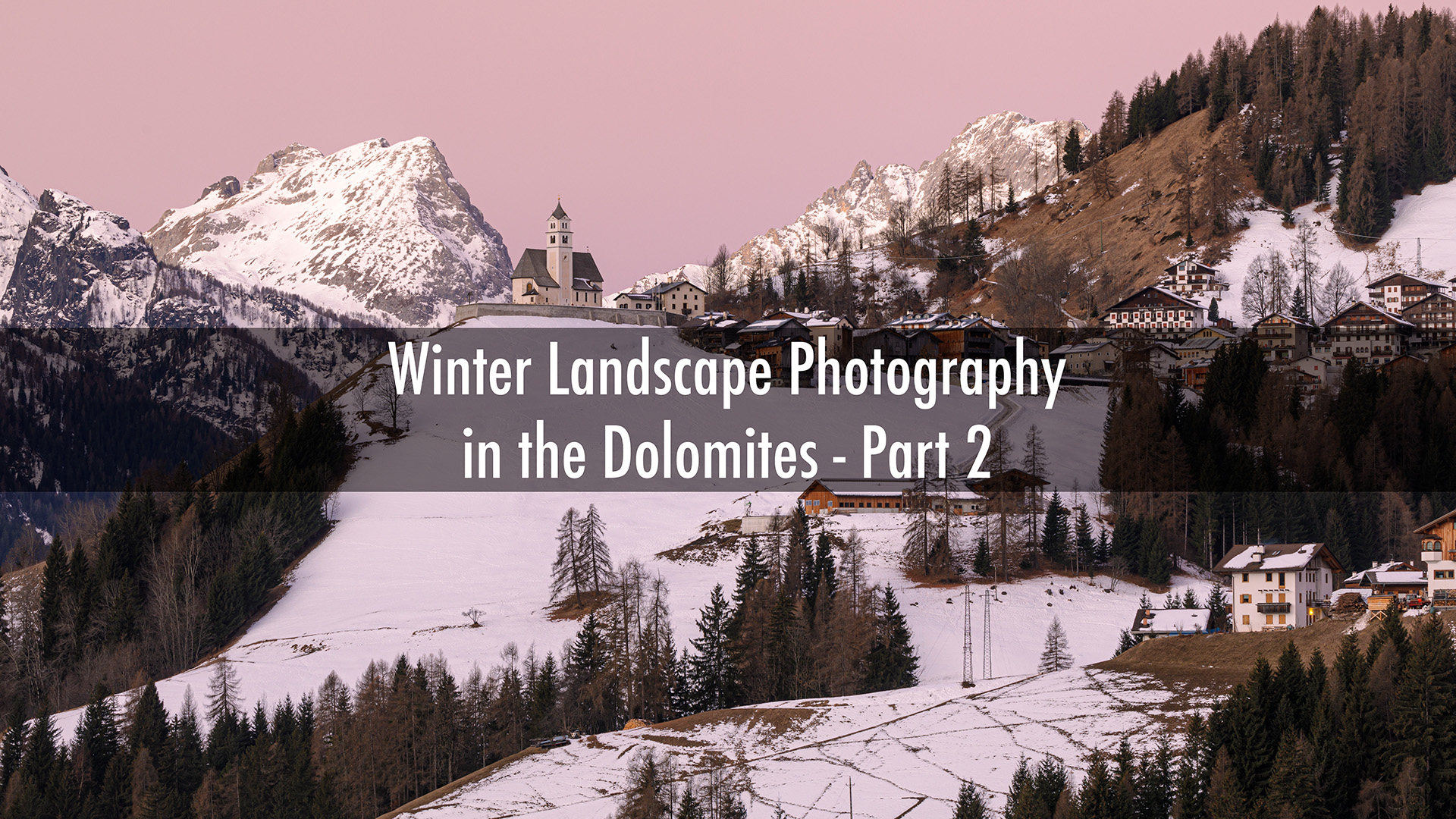

Winter Landscape Photography in the Dolomites Part 2 shows you some of what I got up to in the north of Italy during the second week of January 2022.
Known as one of Europe’s premier ski destinations in winter, it’s also a stunning place to visit for winter landscape photography.
With snow-covered mountains and beautiful sunrises and sunsets, what’s not to like about this beautiful corner of Italy?
Whenever you venture out into snow and ice for your winter landscape photography, expect some significant challenges.
My YouTube channel is dedicated to all things landscape and travel photography, so if that’s your thing, then I’d love to have you come along for the ride.
Throughout the year, I offer photography tours and workshops in a variety of destinations around the world. If you’re interested in learning more from me to help you get the best out of your photography, then get in touch.
I started the morning back at Passo Giau, the place where the previous part of the trip had ended. I was tired, short on sleep, and climbing into serious cold, but the mountain pass looked beautiful before the sun had fully arrived. The air temperature up there was around -9°C, although my car had shown -16°C on the drive in.
What struck me straight away was that the strongest colour wasn’t where the sun was coming up. Sunrise sat off in one direction, yet the richer tones were elsewhere. That’s one of the joys of winter in the Dolomites. You can stand there expecting one thing and end up turning your tripod the other way because the better light is happening behind you.
How can you not love mountain scenery like this?
The wider views were obvious enough to photograph. Snow-covered peaks, layered ridges, pale dawn light, and that stillness you only seem to get before other people arrive. Yet I also found myself drawn to something far smaller within the scene. From a slightly higher position on the pass, I noticed the way the snow draped down the slope in repeating layers. It was a simple subject, but it had rhythm and shape.
That was a good reminder that mountain photography doesn’t always need an ultra-wide lens. For that tighter composition, I used my 100-400mm, because it let me isolate the lines and folds in the snow. I keep coming back to the same three lenses when I travel for this kind of work: the 24-70mm, the 100-400mm, and a 24mm tilt-shift. Between them, I can cover almost everything I want to do.
A few frames from that cold dawn stayed with me:
The cold also did what cold often does to small cameras. My GoPro battery died quickly, even though it didn’t feel as brutal as some winter mornings. That sort of thing happens all the time in the mountains. The camera claims the battery is dead, then comes back to life the moment it warms up in the car. Annoying, yes, but the light more than made up for it. The alpenglow was superb.
In the Dolomites, the best dawn colour isn’t always where the sun rises. Sometimes the strongest image is the one behind you.
There are places in the Dolomites that stay in your head for years, and on this trip, I finally reached one of them in the right conditions. I’d been coming to the area for about five and a half years, and there was a viewpoint I had wanted the whole time. This morning, I got it.
The scene was immense. Jagged mountains opened out in front of me, and the snow picked up every bit of contrast in the light. Because of that contrast, I made two exposures and blended them later. Snow can fool the meter and block up shadows at the same time, so a careful exposure blend made sense. I had the 24-70mm on the camera, set to around 30mm, which felt right for keeping the scene simple without making it look too distant.
I also found myself doing what anyone would do in a place like that, making panoramas. Some views in the Dolomites don’t fit into a single frame without losing their scale. Stitching them together gives the mountains room to breathe, and it suits these ridges and passes especially well.
The view in the opposite direction was no weaker. Looking the other way, I had another wide sweep of mountains and a look out towards Alpe di Siusi, one of the most beautiful areas in the region. I worked several long-lens panoramas there with the 100-400mm, and because the wind had picked up, I used a cable release to keep things steady.
There was one practical issue hanging over all of it. I needed to keep an eye on the time because the last cable car was at 4.45 pm. That adds a quiet pressure to mountain work. It doesn’t matter how good the light is if missing your ride down turns a relaxed session into a problem. I should have worn my watch that day. My phone kept dying in the cold, so time became another thing I had to guess at between shots.
The next morning started with a bit more stress. I made it up to another mountain pass later than I wanted because I had a longer drive than usual. When I stay closer, dawn is simple enough. This time, I had a 5 am start, icy roads, and the usual winter delays behind lorries and buses. That is mountain travel in January. Even when everything is planned, the road can still steal the best half hour of the morning.
Still, the light was worth the effort. One side of the sky had gorgeous colour, and what I believed were the Sella Towers caught that famous warm glow the Dolomites are known for. This is the colour that brings so many photographers back. The rock turns red and orange for a short spell, and when snow sits below it the contrast is perfect.
I worked that scene with the 24-70mm and a polariser on the front. On one of the frames, I was at f/11 for 4 seconds, which held the exposure nicely without blowing the highlights. The image was simple, but simple often works best in the mountains when the light is doing enough on its own.
I also made a panorama of the surrounding peaks because one frame couldn’t hold the whole sweep of what was happening. The pass was glowing in more than one direction, and that is one reason I keep returning to the Dolomites in winter. A clear morning isn’t always a dull morning. If the air is clean and the timing is right, the colour can still be excellent.
Later in the trip, I went to one of the most photographed locations in the Dolomites, Santa Maddalena. The little church sat behind me as I spoke, and I arrived about an hour before sunset. There was plenty of high cloud building, mostly cirrus, and that gave me some hope for colour later on.
By that point, I had already taken what I needed from the scene in technical terms. I made a normal frame and a panorama, and I had good light on the church itself. After that, it became a waiting game. That sounds dull to anyone who hasn’t spent time photographing places like this, but waiting is part of the work. You don’t rush a location like Santa Maddalena. You watch it. You learn how it behaves.
I had been visiting the area for about six and a half years, so I already had a decent feel for how the light moved through it. Winter still changes the equation, though. The sun disappears earlier behind the ridges, the cold affects batteries and timing, and the useful light can collapse faster than expected.
That kind of note-taking matters to me because it feeds directly into how I plan future trips and Dolomites photography tours. If I’m bringing people to a location, I need to know when the sun drops away, how long the colour tends to hold, and when a place stops being worth standing in.
The waiting at Santa Maddalena reinforced three things for me:
That sort of recce work is easy to overlook. Yet it matters as much as camera settings. Knowing the place is often the difference between arriving early enough and arriving after the moment has gone.
The third morning brought another clear sky, but again the colour was strong. Sunrise was off to one side, whilst the better tones sat elsewhere. I had the 100-400mm on the camera with a polariser, and that raised another small but important point. With this sort of light, you have to be careful not to rotate the polariser too far. If you do, you can reduce the very colour you’re trying to keep. I always judge that by eye on the back of the camera rather than forcing the filter to its strongest position.
That morning also confirmed, once more, how useful my core lens setup is. The 100-400mm lens let me reach a distant peak and compress the scene. The 24-70mm stayed close at hand for broader frames. My 24mm tilt-shift completes the trio when I want cleaner control over wide compositions. For travel and winter mountain work, that combination keeps proving itself.
The day after that should have ended with a bigger finish than it did. I went off to explore another mountain pass I had never been to before, then found two beautiful passes that made me want to return in autumn. I don’t recall seeing many images from that area, and it had clear potential. The trouble came when I borrowed a pair of snowshoes from where I was staying and tried to push across the snow to reach a viewpoint.
They were awful.
No matter how tightly I secured them, my toes kept slipping out. That meant every step felt unstable, and after a while, it became obvious that one bad placement could easily twist an ankle. Snowshoes are meant to make access easier, but these didn’t suit the ground I was covering. I lost two hours to that mess, did more driving than I wanted, and never reached the grand final location I had hoped to photograph. I didn’t film that part because I was too busy dealing with the problem.
By my final morning in the Dolomites, I was back out in the cold with a church on a hill in front of me. It was around -8°C, which felt almost mild by comparison. I had the 100-400mm set to roughly 325mm, a polariser on the front, and I worked several variations of the same subject. Some frames used a touch of red glow to set off the church. Others tightened the composition more. I also made another panorama, because that wider spread of hills and mountains deserved it.
The pink in the sky had already faded by then, although some alpenglow remained on the mountains. After that session, I planned to head up a pass for one more photograph for a separate vlog, then begin the drive back to Venice airport. Ten days later, I was due to head for Cape Horn and, I hoped, Torres del Paine, with Nepal waiting in April. Travel moves on quickly, but the Dolomites have a way of staying in my mind longer than almost anywhere else.
The strongest lesson from this part of the journey was simple. Winter landscape photography in the Dolomites rewards patience more than speed. The best light often appears where you aren’t first looking, the best composition may come from a telephoto lens rather than a wide one, and the practical details, cold batteries, cable cars, icy roads, awkward snowshoes, matter more than people like to admit.
I came away with images I had wanted for years, a better feel for several winter locations, and a reminder that mountain photography always asks for flexibility. Even when the plan breaks, the place can still give you something memorable.