 Skip to content
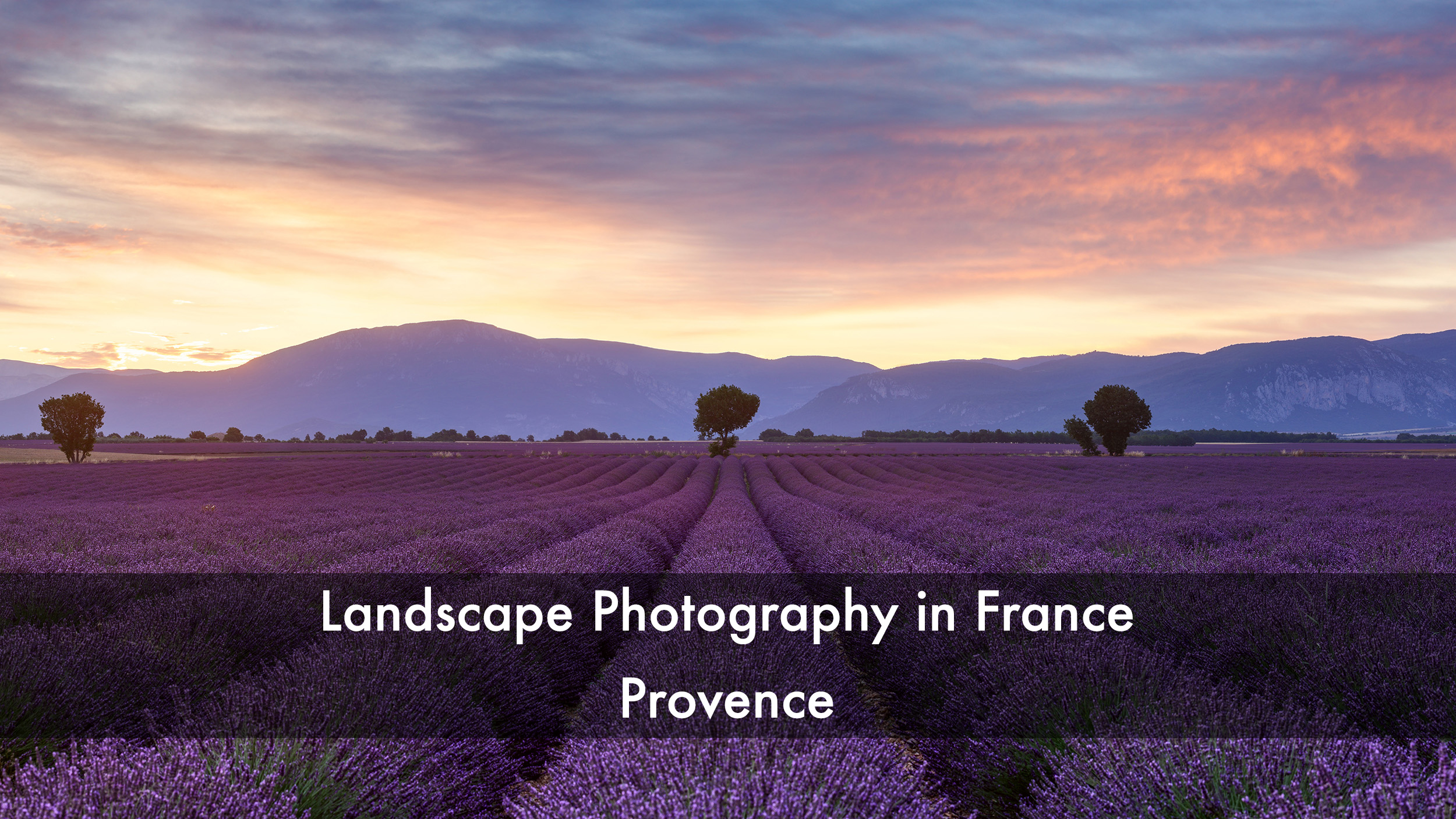

Provence Lavender Fields is my latest YouTube vlog detailing some of my exploits as I travel to various parts of the world.
From the 28th June to the 5th July, I spent some time around the Plateau de Valensole in Provence in southern France.
The area is widely known as one of the most beautiful places to see lavender, and it certainly does not disappoint.
My time there was divided between personal time and time needed to recce the area as I was to be meeting up with fellow photographer David Clapp, who was running a photography tour. David needs no introduction to UK landscape photographers as he is extremely well known through his work with Canon, the various photography magazines he writes for and of course his tours and workshops.
I did have time to do a little vlogging to highlight some of the work that I was up to, and this is the result of it.
In 2018, I will be teaming up with David to run a Provence photo tour so that we can combine our knowledge of the area to bring you the best of the area. More details on that in the coming months.
When I reached the Plateau de Valensole, the first thing that struck me was not only the colour, but the smell. As I drove between the fields, the scent of the lavender drifting through the air was beautiful. It gave the whole area a sense of summer that photographs can only hint at.
This was not my first visit to Provence, although it was the first time I had enough days to explore without rushing. That changed everything. Instead of moving from one known location to the next, I could spend time scouting, checking the shape of the rows, watching the cloud cover, and learning which spots had promise at dawn or sunset.
The plateau is one of the best places I know for studying leading lines. The rows of lavender seem to pull the eye through the frame, and when you find a lone tree, a distant ridge, or a mountain in the background, the composition can fall into place with surprising ease. Of course, ease is only part of the story. Even in a place this photogenic, the difference between a decent image and a strong one often comes down to patience.
That was the theme of my time in Provence. I was not there simply to collect postcards. I wanted to understand the place well enough to work with it, rather than against it.
One of the first scenes I worked on was a classic Valensole composition, a lane of lavender rows leading towards a lone tree. I pointed the camera straight down the lines and placed the horizon slightly below the centre of the frame. I had tried the horizon on a third, but it gave too much space to the sky and took away from the strength of the rows. In this case, the lower horizon balanced the image better.
The tree gave the frame a clear subject. Behind it, a mountain added another layer of interest and stopped the picture from feeling flat. The important thing was not to overcomplicate it. The lines were already doing a lot of heavy lifting, so the rest of the frame needed to stay clean.
For a short spell, the light was exactly what I wanted. I probably had ten minutes of sunlight touching the scene before a bank of cloud drifted in and killed it. That is often how it goes in the field. The window opens, then shuts, and you either have the image or you do not. On this occasion, I was pleased that I had already settled on the composition before the light arrived.
There is another side to photographing lavender in Provence, and it matters. Much of the land is private property, even if there are communal paths crossing some areas. While I was out photographing, I stayed aware of where I was standing and how I moved through the scene.
The lavender may look like a dream for photographers, but it is also somebody’s livelihood.
That is easy to forget when the plateau is full of visitors in June and July. The fields are not there as props. They are part of a working landscape, and the people who grow the lavender depend on it.
I kept three simple things in mind:
That respect should be part of photographing Provence. A strong image never feels worth damaging the place itself.
Later, I moved to the village of Moustiers-Sainte-Marie, one of the most striking villages on the edge of the plateau. It sits beneath huge limestone cliffs, and the setting is hard to ignore. The lavender fields were some distance away, roughly 8 kilometres or so from where I stood, but I wanted a different subject for the evening, and the village offered that.
Earlier in the day, I had explored the area and looked at a higher path above the village, where there is a view across the rooftops and out towards the countryside. From there, I could also see a lake in the distance, although I did not know its name at the time. Later, staff at the tourist office suggested another route, a path that leaves the village, curves around, and ends in an olive grove with a view back towards Moustiers-Sainte-Marie.
That was the viewpoint I chose. It gave me more than the usual postcard angle. I could see the village tucked below the cliffs, with the bell tower rising from the centre and the rock face catching the evening light. It felt more complete than a tighter shot from inside the village.
For this composition, I used my Canon 6D with a Canon 17-40L and a Heliopan polariser. I had tested the 24mm TS-E to see if it would cover everything I wanted, but I needed the extra width of the 17-40L to hold the village, the bell tower, and the cliff in one frame.
The sun was off to my right, and there was too much glare to show the back of the camera properly, but the principle was simple enough. I wanted to cut away anything messy and keep the frame tidy. A longer lens would have pulled me closer to the houses, yet I would have lost the scale and drama of the cliff above, and that cliff was a big part of the picture.
The polariser helped a little by adding a touch more blue to the sky. More importantly, the evening sun brought out texture in the rock and gave shape to the scene. Provence often gives you these moments, where the subject is less about colour and more about warm stone, shadow, and structure.
By the time I finished there, I still had another plan in mind. The walk back to the car took around 25 minutes, and I wanted to make one last try for sunset on the plateau itself.
After leaving Moustiers-Sainte-Marie, I drove back towards Valensole looking for a field that could work at the end of the day. Sunset options had been harder to find than I expected. Many places were busy, and others did not quite line up with the direction of the light.
Eventually, I found a large field just outside Valensole that made me stop. One thing I noticed during the trip was how different the fields could be. Some were beautifully kept, with clean rows and strong colour. Others had weeds, rough edges, and broken structure. This one was in good condition, and that matters when the rows are doing so much in the frame.
The field stretched away towards the Prealps and pointed roughly north-west. That gave it promise not only for the evening, but also for dawn, because the mountains sat in a useful position for first light as well. Even when a photograph does not come together on the spot, I always like finding places worth returning to.
For this scene, I had the Canon 6D, a 1.4x extender, and the Canon 24mm TS-E Mark II on the tripod. I used front tilt and a touch of shift to get the perspective where I wanted it. With a subject like this, those small adjustments can help the rows sit more comfortably in the frame and keep the structure looking clean.
In the end, the light did not quite do what I hoped. Shadows had shifted, and the patch of shade I was watching disappeared. I still made an end-of-day image, but it was not the sunset frame I had imagined.
That did not make the stop a waste of time. Far from it.
Good light matters, but so does the hard work of scouting when the light is poor.
That is one of the truths of photographing Provence, or anywhere else for that matter. The finished picture may come from dawn or sunset, yet the groundwork often happens in the middle of the day, when I am driving, walking, testing lenses, and learning which scenes deserve another try.
On my last free day in Provence, I spent the morning doing recce work on another plateau where lavender was also being grown. Instead of returning to the main hotspots on the Plateau de Valensole, I wanted to see if I could find a quieter view with more of a sense of discovery.
I found a viewpoint with lavender in the foreground and a small village in the distance. There were more fields dropping down the slope, and the Prealps sat behind everything. I chose not to name the village because part of the appeal was how quiet it felt. There were no crowds there, none of the steady flow of people you often get at the more famous locations.
By the time I was working on the scene, it was close to 09:00, and the best light had already gone. That did not bother me. I was not trying to make a finished portfolio image. I was building a reference, studying the direction of the sunrise, checking where sunset side-light might strike the slopes, and deciding whether the location had enough strength to revisit later.
The image worked well enough as a recce frame. More importantly, it showed promise. Dawn would arrive from the direction of the Prealps, while late light should rake across the plateau from the other side. That sort of knowledge is often what turns a vague idea into a location I can trust.
The trip covered a mix of classic views, village scenes, and recce work, so I carried a fairly flexible kit. Across the week, the gear I used included:
I did not use every piece of it for every scene, of course. Still, that combination gave me enough width for the big lavender compositions, enough reach for tighter studies, and enough control when a tilt-shift lens made sense.
The strongest lesson from this trip was simple. Provence gives you remarkable colour and shape, but the best photographs still come from time, restraint, and careful scouting.
I left with images of lavender, lone trees, cliffs, and villages, yet the part I remember most is the slower work behind them. That is what made the trip feel worthwhile, and it is what keeps drawing me back.
We noticed you're visiting from United Kingdom (UK). We've updated our prices to Pound sterling for your shopping convenience. Use Euro instead. Dismiss