 Skip to content

Paris to Tours cycle race 2017 is my latest YouTube vlog detailing some of my exploits as I travel to various parts of the world.
As well as being a stock travel and landscape photographer, I also do editorial photography when and where I can. One of the things I love doing is the Paris to Tours cycle race, as living near Tours, I can easily get access to it.
On Sunday, 8th October 2017, it was time again for the last race of the season. The Paris to Tours race is organised by ASO.
Starting in Brou and ending in Tours, I had a long and eventful day photographing the race. I don’t follow the route but rather make my way down, picking up the cyclists at various points on the way to Tours.
Photography of cycle races isn’t the easiest, as you get a moment to get your shot. Once they’re gone, that’s it. Over and done with. If you weren’t ready, then tough, you lost out!
Hopefully, you’ll enjoy a different edge to my photography that isn’t widely seen.
Most of the time, my photography slows me down. I look for weather, light, shape, and timing in a calmer way. Much of that sits closer to the work I do through my Photography Tours & Workshops, where patience often pays off more than speed. Paris-Tours is the opposite. It demands quick reactions and a clear plan before the riders have even rolled out.
This race on 8 October 2017 was the 111th edition of Paris-Tours, organised by ASO. Although the name says Paris, the race did not begin there. In 2017, it started in Brou and finished in Tours, which suited me well because I live near Tours and know the area.
For this job, I was working in editorial mode rather than personal work mode. That changes everything. The pictures are not only for me, but they also need to go out to picture desks and news clients while the event still matters. I was filing to the Alamy news feed and to Rex Features, which I had recently joined, so I needed the day to work on two levels. First, I had to get the pictures. Then I had to get them edited, captioned, and sent out without delay.
That pressure is part of what makes race coverage enjoyable. It strips photography back to timing, access, and judgment.
When I cover an event like Paris-Tours, accreditation is everything. It is the difference between standing with the crowd and working from the places where the pictures happen.
The pass itself might look simple, but it opens doors. On the back, it lists the zones that exist across the event. On the front, it shows the areas I am allowed into. I do not get every level of access, and that is normal. Seniority matters in major races, much as it does at the Tour de France, so some photographers can go places others cannot.
Even so, the access I had was more than enough to do the job properly. It let me work in places the public could not reach, and on a day like this, that matters because the race moves through controlled areas all along the route. In the past, police and officials have helped me get through or around certain restrictions, and that can save valuable minutes when I am trying to leap ahead of the peloton by car.
At the start, accreditation also gives me room to move amongst the riders. Paris-Tours never feels overcrowded with photographers at that point. There might be 20 photographers there, often fewer, which means I can work around the line-up, find clean angles, and get those early portraits and preparation shots before the race begins.
Race coverage rewards simple choices. I do not want to carry gear that slows me down, and I do not want to think too much once the riders are moving.
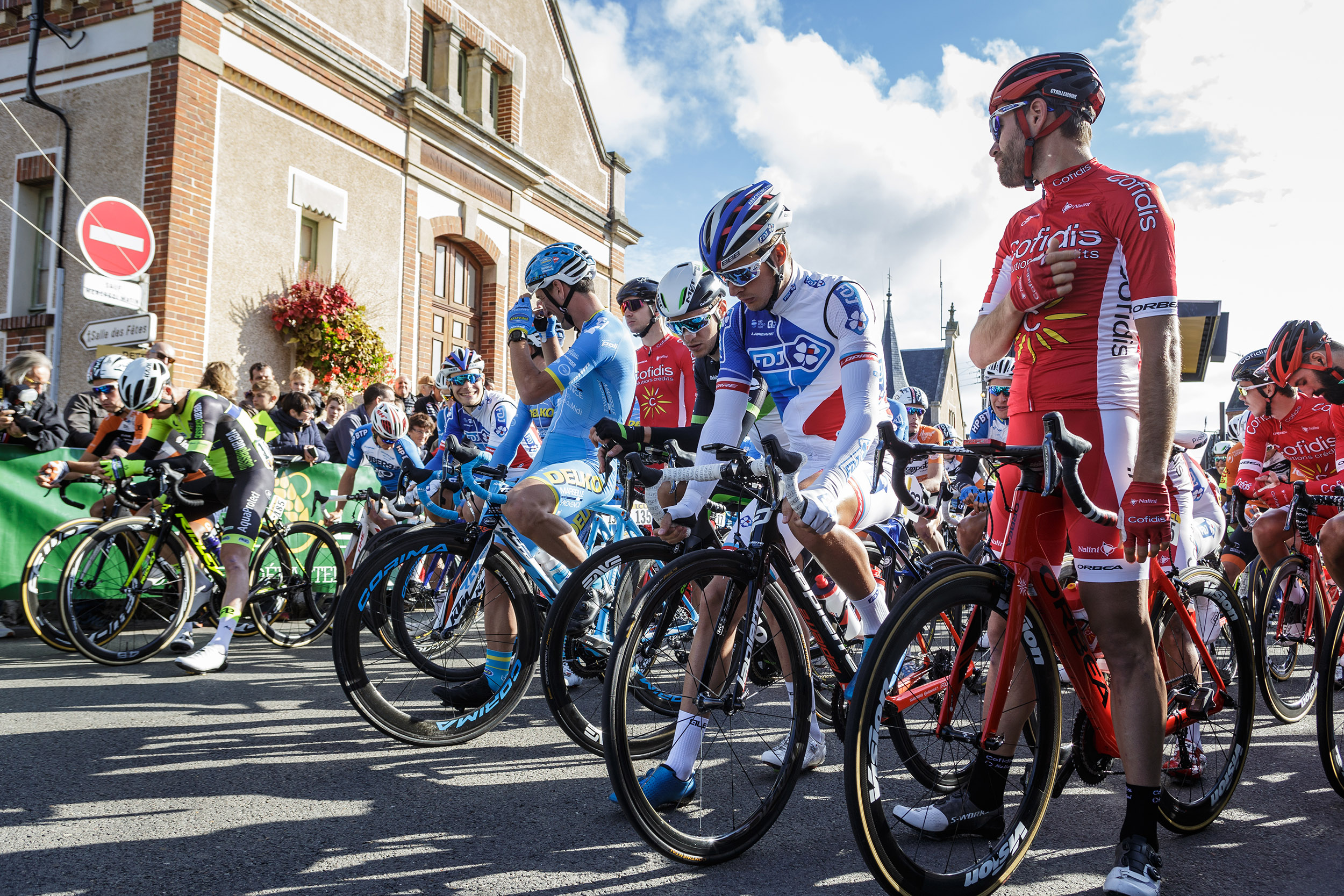
At the beginning of the day, my main aim was to get portraits and pre-race images of the riders as they lined up, warmed up, and mingled before the start. For that, I packed my Canon 28-70L, which was ideal because the riders were static and close enough for flexible framing.
I also had my Canon 6D with me as a backup, and my Canon 5D Mark II was in the bag as part of the working setup for those opening images. At the start line, I did not need anything huge or heavy. The riders were where I expected them to be, and I could move around them easily enough.
For editorial work, I like a setup that lets me react without fuss. The less I change lenses or second-guess a body choice, the better. The opening part of the day is about getting solid, usable frames that tell the story of the race before the speed kicks in.
The finish in Tours is a different problem. The riders come in at high speed on a straight road through the centre, and photographers are pushed well back from the line, roughly 100 metres or so. That means reach matters far more than comfort.
For that reason, my key lens at the finish was the Canon 100-400 Mark II L. It let me work from the restricted press area and still reach right up to the line. I considered taking my 70-200 as well, but the 100-400 covered the finish and the prize presentation well enough.
Once the riders had crossed the line and the top finishers went off to collect their prizes, I switched back towards the 28-70 and used my Canon 430EX II flash for the award shots.
A tripod had no place in this kit. In race photography, the moment arrives and disappears almost at once. If a cyclist is coming towards me at 50 mph, I do not have time to fiddle with a tripod. I need to be ready, and I need to know my camera without thinking.
In editorial sport, hesitation costs pictures.
The part many people never see is the preparation that happens before I leave home. For editorial work, post-production starts long before the race does.
I need my metadata ready. That means setting up the title, starting the caption, thinking about keywords, and leaving space to add the names of first, second, and third once the race is over. If I do that groundwork first, I can move quickly later and get the final files onto the news feeds in minutes rather than spending extra time building captions from scratch.
Speed matters because the value of a news image drops fast. A strong picture of the winner only helps editors if it reaches them while the race is still fresh.
Route planning is the other half of the job. Paris-Tours did not start in Paris, so I began in Brou and studied the route from there. I wanted places where the riders would come through cleanly, with as few visual distractions as possible. I also wanted options. One of the places I know well is Amboise, and I hoped to find a higher viewpoint over a straight section of road as the race crossed the Loire area.
The final puzzle was Tours itself. The last time I covered Paris-Tours, I lived in Tours, which made the run back to the finish much easier. In 2017, I lived outside the city, so I had to think about parking, access, and how quickly I could get from the car to the finish line.
I left early and reached Brou in the morning, with enough time to collect my accreditation and get into position before the riders rolled out. That opening period is always worth taking seriously because the atmosphere changes quickly once the race gets moving.
I spent that time photographing the riders warming up, lining up, and getting themselves ready. Those pictures matter because they add context to the race coverage. They are not the headline finish images, but they give editors and readers the build-up, the faces, and the small details that make the day feel complete.
The weather had looked poor on the drive up. It had been a grey and messy start, but by the time I got close to Brou, the sky was beginning to clear. Seeing patches of blue and the sun lifting made a big difference to the mood of the morning and to the pictures.
I had packed lunch in the back of the car as well, which sounds mundane but helps on a day like this. Once the race starts, it becomes a chase. I need enough food and water to keep going because there is no fixed base and no guarantee of a quiet break.
When the riders left Brou, I had the first part of the job done. I had the start shots I wanted. Then the real movement began, because from that point on, I had to get ahead of the race.
After the start, I drove to a small village I had found the day before while searching the route. It was the sort of nondescript place that would mean very little on an ordinary day, but on race day, it offered a chance for a clean roadside frame away from the heavier crowds.
Getting there was not simple. Leaving Brou brought the usual problems, traffic, road closures, and the sort of delays that make editorial work feel like a test of patience as much as speed. When I follow a race like this, I do not shadow the route metre by metre. I make my own way across the map and try to intercept the riders at key points, so I am always balancing distance, road access, and timing.
That second stop worked well enough. I had time to eat a bit of lunch, and I also managed to pull images from one of my camera cards and start sending them off to Rex Features. Filing part of the day while the race is still underway is often the smartest move. It spreads the workload and gives the agency fresh material before the finish.
From there, I headed towards Amboise. That leg of the drive was harder. The roads were busy, the race was drawing people out, and I had to avoid route problems and bottlenecks on the way down. Popular races bring an odd mix of tension and slow Sunday traffic, and that combination can be maddening when the clock matters.
I got something in Amboise, but I was not fully happy with it. That happens. Sometimes the spot looks better on paper than it does in front of the lens.
By the time I got back to Tours, the day had narrowed to a single goal. I needed the winner over the line, and I needed the file out quickly.
The finish itself is dramatic because of the long straight into the city centre. The riders come in fast, and although the scene looks open from a distance, the working area for photographers is controlled and set back from the line. That is where the 100-400 earned its place in the bag. Without it, I would have been too far away to frame the finish properly.
I got the winner, but I was not completely satisfied with the final image. The frame was fine, and it did the job, but it was not as sharp as I wanted. Part of that came down to the split-second nature of the moment. I was concentrating on the rider crossing the line, waiting for the usual release of emotion, hands off the bars, arms in the air, some sign that the sprint had peaked. Instead, the winner looked calm, almost casual, which changed the feel of the shot and threw me slightly.
After the finish, I followed the top riders to the prize presentation and worked those frames with the shorter lens and flash. Then it was straight to the Town Hall to upload, caption, and transmit. That final rush is part of editorial work. A picture is only half the job until it has been filed properly.
A race does not end at the finish line if I still have pictures to send.
Paris-Tours 2017 gave me a mixed set of feelings, which is often the sign of a useful day. I was pleased with the start of the race and with much of the planning that got me there. The early rider shots were strong, and the route strategy gave me a fighting chance at several points along the course.
The weak point was the finish. I got the image I needed, but I did not get the one I wanted. There is a difference. In sport, that difference can be tiny, a touch of softness, a less expressive pose, a split second of hesitation. I also came away thinking that a monopod might have helped for that final sprint, but mine was buried somewhere at home, and I had not managed to dig it out before the race.
Even with that frustration, the day reminded me why I like editorial photography. It keeps me sharp. It asks for planning, speed, judgement, and a bit of nerve. It also shows another side of what I do. I am not only out looking for quiet views and good travel light. Some days I am chasing a race, filing to agencies, and trying to stay ahead of the story.
On the drive around the route, I also noticed the autumn colour taking hold in the Loire Valley vineyards. That stayed with me. After a day of barriers and deadlines, those vines looked tempting. I had one eye on getting back out for slower work, though there was also a general strike due on Tuesday, linked to anger over Emmanuel Macron’s reforms, and that had the look of another editorial assignment.
Paris-Tours reminded me that planning often matters as much as the shutter press. Access, route choice, metadata, parking, traffic, lens choice, and timing all shape the final picture long before the riders appear.
That is why I enjoy moving between travel, landscape, and editorial work. One asks for patience, the other asks for speed, and both reward preparation. On 8 October 2017, Paris-Tours gave me a bit of everything, good starts, a frustrating finish, and another hard lesson in how quickly sport can humble a photographer.
We noticed you're visiting from United Kingdom (UK). We've updated our prices to Pound sterling for your shopping convenience. Use Euro instead. Dismiss