 Skip to content

Ireland photo workshop recce is my latest YouTube vlog detailing some of my exploits as I travel to various parts of the world.
From the 15th September to 22nd September 2017, I went on a week’s recce to the Emerald Isle of Ireland. Specifically to the county of Donegal in the north-west of the country. Accompanying me was fellow landscape photographer David Speight as we were searching out locations to do a joint photography tour and workshop.
Donegal is known for its coastline as well as many other locations that we hunted down in order to piece together a forthcoming photo tour. We visited places such as Fanad Head and further south in Sligo. The latter wasn’t filmed, but a few others were as we pieced together our forthcoming tour to the north-west coast and county of Donegal.
Each day, we battled the weather and visited a number of places to ensure that the tour we put together gives people a good sense of this gorgeous part of Ireland.
So take a look at some of what happened during the Ireland photo workshop recce.
And if you’re interested, I offer photography tours and workshops in a variety of destinations around the world. If you’re interested in learning more from me to help you get the best out of your photography, then get in touch.
The Ireland photo workshop recce trip opened with the sort of weather that can wear you down before you’ve even found a composition. Most of the day was wet, and not in a dramatic, storm-chasing way either. It was the steady, persistent kind of rain that keeps everything slick and grey. By late in the day, though, the weather finally eased, and the coast opened up in front of me.
I was standing above the Atlantic on the Wild Atlantic Way, with David working farther along the headland while I searched for a different angle. That was part of the point of the week. We weren’t only making pictures for ourselves, we were trying to work out how a future workshop could offer variety, choice and room for different ways of seeing.
The sky wasn’t doing much, so I left it out. Instead, I focused on the water and a sea stack below. In poor light, that often feels like the honest choice. A blank sky rarely helps a photograph, whereas good texture and movement in the sea can still carry the frame.
The setup mattered because the ground was awkward and the drop below was severe. I levelled the tripod base carefully on the slope so the weight stayed centred. On a cliff edge, that isn’t fussiness, it’s common sense.
On uneven coastal ground, a level tripod is as much about safety as it is about composition.
My camera for that shot was a Canon 6D with a 28-70mm lens. I used a polariser to cut reflections from the waves, then added a 2-stop ND filter to lengthen the exposure. I was working at around six to seven seconds, which is a range I often like on the coast. It keeps movement in the water without turning the sea into featureless mist.
The second evening of the Ireland photo workshop recce brought better light and a much stronger sense of place. We had found the location the day before on a drive-around, then returned when the conditions looked promising. With the sun dropping and the coast lit from the side, the grasses in front of me glowed while the bay and mountains beyond started to come together.
This stretch of coast reminded me of parts of Skye, especially around Elgol. It had that same mix of broken shoreline, dark water and distant shape, although it still felt like Donegal in its own way. The bay cut in nicely, the grasses gave me a lead-in, and the light had enough warmth to lift the whole scene.
Even then, the composition wasn’t straightforward. If I went too wide, too much of the bay crept in and weakened the frame. It looked untidy rather than expansive. I spent a fair bit of time shifting position and trying to simplify what was in front of me.
To tighten the view, I tried my tilt-shift lens with a 1.4x extender. I wanted more control over what stayed in and what dropped out. The wind was blustery as well, which made tripod height part of the decision. I wanted the camera closer to head height, because that matched how I was seeing the scene, but in those gusts, I preferred to keep things lower and steadier.
The exposure was around a second. That gave me a small amount of movement in the grass without losing all the structure. I liked that compromise. Too fast, and the foreground felt static. Too long and the grass lost shape.
That evening reminded me how often the best coastal photographs come from wrestling with the frame rather than spotting it at once. A good location does not remove the hard work. It simply gives that hard work a chance to pay off.
Later, I moved farther up the coast and found a different position above a wave-cut platform. The rock underfoot looked brittle, so I took care with every step. Down below, waves were washing over the platform and then draining away, briefly revealing its shape. That movement gave me a new way into the composition.
I turned the camera into portrait format and used the platform edge to guide the eye out towards the coastline beyond. Once again, I levelled the tripod, not because I planned to stitch a panorama, but because I wanted the balance of the setup to stay sound on awkward ground.
A polariser stayed on the lens because the angle of light was putting a sheen on the water. By taking some of that glare away, I could hold more texture in the scene. As the light faded, exposures started stretching out. Even so, I still preferred the coast at around five to seven seconds.
For me, the sea stops looking like the sea once the shutter stays open too long. Water has weight and force, and I don’t want to scrub all of that away.
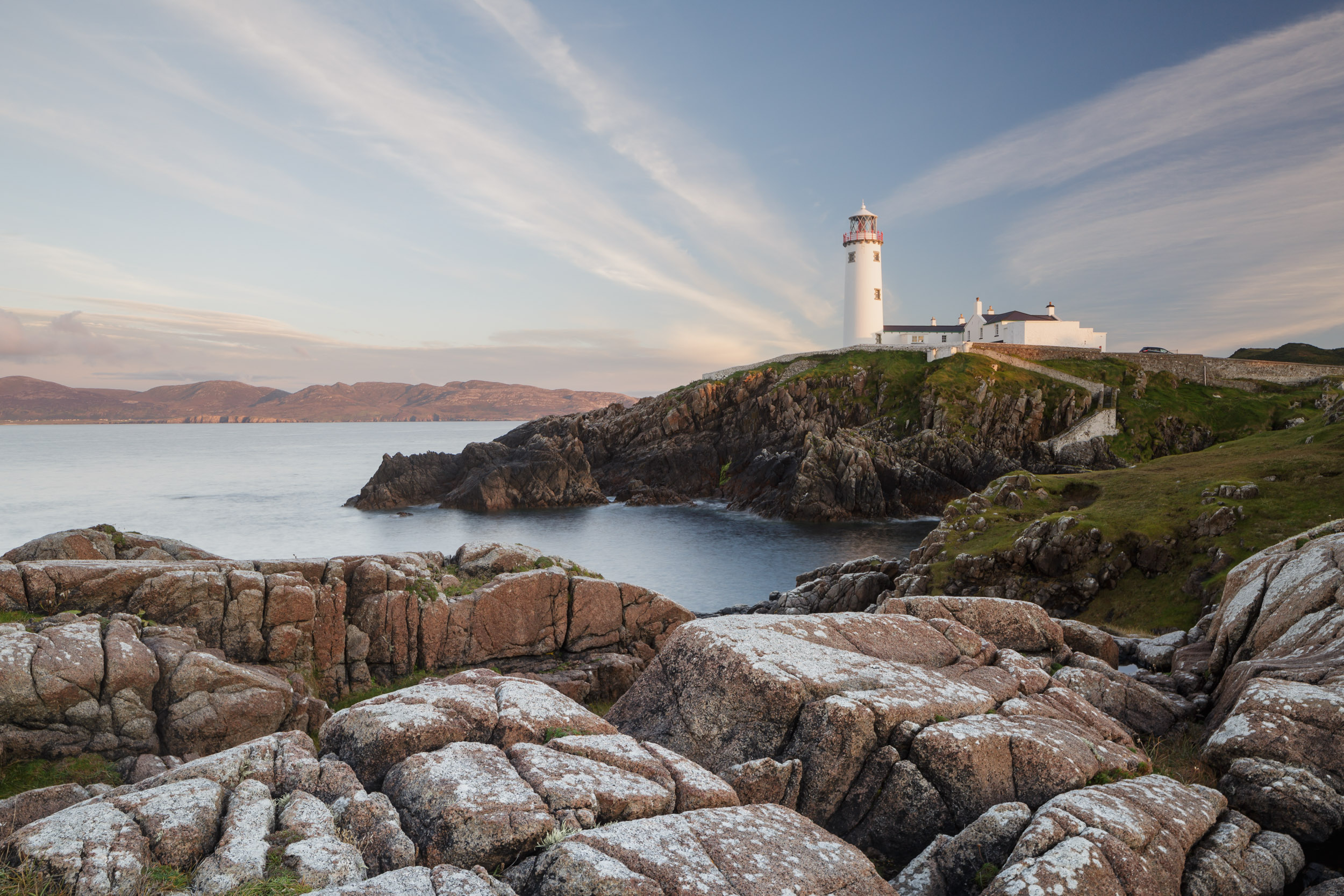
By day three of the Ireland photo workshop recce, I had moved up to the north coast and reached Fanad Head Lighthouse, one of Donegal’s best-known locations. The sun had already dipped below the horizon, leaving a strip of soft purple and pink in the sky. There was still enough colour to keep the scene alive, even though the direct light on the lighthouse had gone.
I had already made some photographs with the waves below, but I stopped when the water became too smooth for my taste. Long exposures can suit some places, yet I often find that the open sea loses its character when it turns into flat mist. At Fanad Head, I wanted to keep some of the coast’s energy intact.
So I moved higher and used the rock in front of me as foreground interest. It had the feel of a limestone pavement, or close to it, and it gave the frame a strong base. That rough texture helped pull the eye towards the lighthouse and out to the last colour in the sky.
The place is popular for obvious reasons. You get a strong subject, dramatic cliffs and a broad view over the Atlantic Ocean. On a tour, places like this matter. I don’t think a photography workshop should only chase hidden corners. Well-known locations deserve their place too, as long as they are mixed with less obvious ones that give people something more personal.
At Fanad Head, that balance made sense to me. It was one of the clearest signs that the trip was working.
One afternoon, we found a small cove that felt too good to rush. It was around five o’clock, the light still had time to improve, and there was no one else around. We decided to stay there for the rest of the evening rather than keep driving.
David headed off higher onto the cliffs while I stayed lower and started experimenting. The light was not spectacular at first, so I borrowed his Lee Little Stopper and tried a few longer exposures. That isn’t normally how I approach most coastal scenes, but on a recce, I wanted to test different options, especially ones that could work well on a workshop.
I didn’t want to give away the exact location, partly because we were still building the trip and partly because some places are better left half-discovered. What I can say is that the geology was brilliant. The rock shapes, layers and edges gave the cove a lot of character, and the views from the cliffs to my right looked every bit as strong as what was directly in front of me.
We had a forecast for broken cloud, so there was still hope for a decent sunset. That kept us there for hours. Sometimes the best decision on a coast road is to stop moving and trust the place you’re in.
Long exposures were part of that evening, but they were not the whole point. I was trying to see how flexible the location was. Could it work in flat light, in mixed cloud, in stronger colour, with detail shots and wider frames? Those are the questions that matter when I’m planning a trip for other photographers.
My final full day in Donegal started badly and ended well. We were up at half past four in the morning to reach a sea arch for dawn, only to find private property signs and confusion over access. After asking around, local people confirmed there was a right of way, but by then we had lost about two hours.
The dawn itself was decent enough, with some interest in the sky, but the delay took the edge off the morning. That sort of thing is part of a proper recce. It is not only about finding good views, but it is also about learning the awkward details that can ruin a shooting plan if you don’t know them in advance.
Later in the day, after more time spent following the Wild Atlantic Way and checking the coast, I reached a viewpoint packed with sea stacks. The scene was superb, but it came with the usual problem of abundance. When there is too much in front of you, the job is to organise it.
These were the choices I kept working through:
The sun was hidden behind cloud, which was frustrating, because a short burst of light would have transformed the scene. Still, even without it, the coastline had shape and drama. I kept shooting because it was my final evening and because scenes like that often reveal their best arrangement only after a long period of trial and error.
That last session summed up the week well. Donegal kept giving me more than I could use at first glance, and the work was in turning that raw material into something clear.
The places changed each day, but a few pieces of kit and a few working habits stayed constant throughout the week. I kept returning to the same tools because they suited the coast and the kind of pictures I wanted to make.
The main setup included:
What mattered even more than the kit was how I used it. I kept the tripod level on rough ground, watched the sea before releasing the shutter, and resisted exposures that felt too long for moving water. For most of this trip, I liked the coast best at around five to seven seconds. That gave me movement without draining the scene of its force.
By the end of the week, the shape of the trip was becoming clear. David Speight and I had gone over to Donegal to search out locations for a joint photography workshop, and the county made a strong case for itself. The coast is the obvious draw, and rightly so, but the real appeal is the range within it. You can move from famous viewpoints to quiet coves, from lighthouses to sea stacks, from broad bays to intimate studies of rock and water.
We were looking at running the workshop in 2018, most likely in April or September. Those months made sense for light, weather and the general feel of the place. Fanad Head would almost certainly be part of it because it is too good to ignore. At the same time, many of the less obvious locations we found during the week were just as important. They would give people a fuller sense of Donegal, not only the postcard view.
That mix is what I wanted from the trip. I never wanted a workshop built only on famous pins on a map. I wanted places that offered mood, variety and room for personal work.
Once I left Donegal, my attention shifted quickly to other work. I had an editorial piece coming up around the Paris-Tours cycle race on Sunday, 8 October 2017. I had accreditation to photograph it, although filming the race itself was restricted, so the plan was to cover my preparation, my approach and the results rather than the full event live.
Not long after that, I had the Dolomites on the horizon. That trip promised mountains, vineyards and, if the weather helped, a touch of snow. I was also taking my wife with me, which would add a different feel to the journey after a week of recce work on the Irish coast.
Donegal, though, stayed in my mind. It had a way of doing that.
What I remember most is not one single frame. I remember the feeling of working hard for each picture, waiting out the rain, reading the sea, setting up a tripod on rough ground and trying to make sense of a coast that never looked simple.
That is why the week mattered. Donegal did not hand me photographs. It asked for patience, care and judgement, and that is often where the best travel and landscape work begins.
We noticed you're visiting from United Kingdom (UK). We've updated our prices to Pound sterling for your shopping convenience. Use Euro instead. Dismiss