 Skip to content
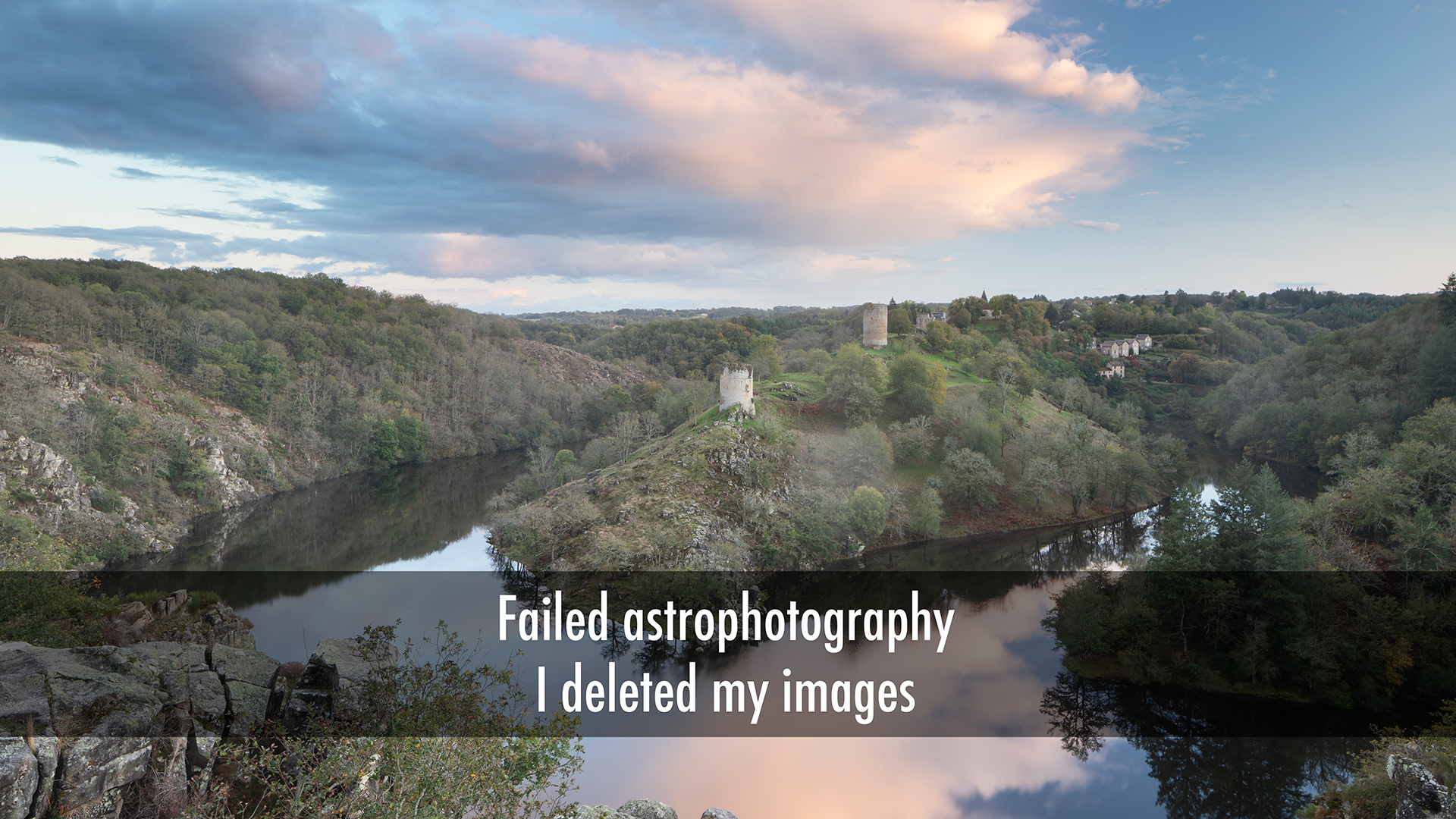

Failed Astrophotography is my latest YouTube video. The horror of forgetting to download one’s work, then wiping the memory card before you realise what you’ve done.
On 12 June 2021, I took my kids out to the beautiful landscapes of the Creuse. The intention was to create some astrophotography, as they had been bugging me to see the night sky.
The Creuse offers superb viewing of the stars as it’s a very rural area of central France.
The evening started off really nicely, and I had taken some long-awaited shots of the setting sun on the old castle. But sadly, the evening disappointed us as the sky clouded over.
Finally, disaster struck me as I completely forgot to download the work that I did during that evening and when I went off to photograph the Tour de France I wiped my card! Not really the best thing, and no amount of recovery software helped either.
Such is life!
My YouTube channel is dedicated to all things landscape and travel photography, so if that’s your thing, then I’d love to have you come along for the ride.
I was back at a spot above the Creuse River that I’ve visited a few times before. The view is one of those scenes that stays in your mind: a river below, an old castle in the distance, and enough open sky to make you stop talking for a moment. I’ve been here a few times, and every visit has felt like it had more to give.
This time, I wasn’t there only for myself. My kids had been asking to see the stars, and I knew this was the right place to bring them. The Creuse is rural, dark, and far from the worst of the light pollution, so it gives the night sky a proper chance to breathe. According to Clear Outside, the area sits around Bortle 3, which is good enough to make an astro night worth the effort.
When I arrived, it was about 9 pm. The sun was still brushing the distant ground with that last warm light that lingers in June. There was cloud around, and that mattered, but I wasn’t ready to write the evening off. The forecast suggested the sky might clear around 10 or 11 pm, so there was still a window.
My plan was simple. I wanted a sunset frame on the castle, then later a vertical composition with the Milky Way rising and arcing above it. From what I could work out, the galactic core wasn’t going to stand straight up at this time of year. It looked more likely to sit at an angle of about 30 to 40 degrees, with a higher position coming later in the season, somewhere around mid-July.
So we settled in for the wait. We had dinner. We watched the light shift. And I kept one eye on the cloud, hoping it would do what the forecast promised.
Astrophotography starts long before the stars appear. By the time the sky is black, I want most of the hard decisions behind me. That was especially true here, because this viewpoint isn’t a place where I wanted to stumble about in the dark trying to work things out from scratch.
The first job was a recce in daylight. Even if I know a place already, I still walk it properly and check the ground, the access, and the exact position I want. This spot looks calm in soft evening light, but it has enough uneven ground and enough of a drop nearby to punish carelessness.
One wrong step in the darkness could have sent me down a slope I didn’t want to test. So I made a point of moving slowly, checking my footing, and marking out the area where I’d set up once the light had gone. A good head torch matters in a place like this, but daylight planning matters more because it removes panic later on.
I also paid attention to focus before the sun went down. That’s one of those small things that saves time and frustration later. I focused the lens where I wanted the scene to be sharp, then took a quick photo of the focus ring position on my phone. That way, when I came back to the setup in the dark, I had a visual reference rather than a vague memory.
A night shoot gets easier when the decisions are made before the dark arrives.
That simple bit of prep doesn’t guarantee success, but it cuts out one common reason for failure.
For this kind of shot, I rely on two apps. The first is Stellarium. I use it on my phone to see where the Milky Way will be at any time of year from the exact place I’m standing. I can hold the phone up, line it with the scene, and get a good sense of whether my idea is possible or whether I’m forcing a composition that won’t work.
On this evening, Stellarium suggested the Milky Way would come into a good position around midnight or 1 am. That meant a long wait, but at least the timing made sense. It also showed that the arc I wanted above the castle was realistic, even if it wasn’t yet at its highest point in the season.
The second app was Clear Outside, which I use to check cloud cover and sky conditions. Its forecast said the sky should become clearer later in the evening, roughly between 10 and 11 pm. That was enough reason to stay put and give the night a chance.
There was another factor to consider as well, the moon. Too much moonlight can wash out the sky and flatten the stars, so I try to avoid bright moon conditions when I want a dark, contrast-rich astro frame. This spot had the darkness I needed, but darkness only helps if the cloud and moon stay out of the way.
The frame itself was already clear in my mind. I wanted the castle low in the image, the sky doing most of the work, and the camera turned vertically so the Milky Way could rise through the scene rather than stretch across it. I had wanted a version of that shot for quite a while.
Because I had photographed the location before, I also knew how good the side light could be on the castle when the sun dropped. That gave the evening two chances to succeed. Even if the stars failed, I might still go home with a strong sunset image.
That mattered more than it might sound. On any trip like this, I don’t want to pin everything on a single moment at midnight. If the place can give me a sunset frame, a twilight frame, and then an astro frame, I want to be ready for all three.
The start of the night was promising. We had our picnic, the light stayed attractive, and the castle caught the last colour of the day in the way I’d hoped. The evening felt slow and settled, which is often half the pleasure of being out with a camera.
I did get the sunset I had wanted at the castle. That part of the trip was a relief because the last time I had visited, I hadn’t managed the sunset version of the scene. So for a while, the outing felt like it was coming together in stages, first the warm light, then the deepening blue, and later, I hoped, the stars.
Then the cloud thickened.
At first, I kept watching the sky and giving it more time because the forecast had suggested it might break. Sometimes it does. Sometimes a line of cloud drifts off and leaves you with a clean window. This time, it never opened enough. The cloud sat over the scene and shut the whole astro plan down.
That was the point when the night shifted from hopeful to flat. My kids had wanted to see the stars, I had wanted that Milky Way frame over the castle, and neither of us got what we’d come for. We waited a bit longer, but the sky didn’t improve, so we packed up and headed home. It was going to be late by the time we got back, and there was nothing to gain by pretending otherwise.
If you’ve ever had a failed astrophotography session, you’ll know the feeling. The planning can be solid, the location can be right, the idea can be clear, and a layer of cloud can still end the whole thing.
I could have accepted the cloud without much drama. The weather does what it wants. That’s frustrating, but it’s part of outdoor photography.
What hurt more came later. After the trip, I forgot to download the images from the evening. Then I went off to photograph the Tour de France, formatted the card, and wiped the files from the castle shoot before I had copied them. That included the sunset frames I had managed to make.
No amount of recovery software brought them back.
That was the real blow of the trip. Losing the astro images was one thing because they had never happened. Losing the images that did exist was far worse because that was avoidable. I had already done the work. I had stood there, waited for the light, made the photographs, and then erased them through a simple lapse in routine.
The cloud ruined the shot I wanted. I ruined the shot I had.
There isn’t a dramatic fix for that kind of mistake. There is only the moment when you realise what you’ve done, try every option you can think of, and then accept that the files are gone. Such is life, but it still stings.
Around the same period, I was busy with other work, so I wasn’t able to finish the story of the trip straight away. Even my voice recorder gave up, which fitted the mood rather well. The whole episode became one of those small chains of problems where each link makes the last one look worse.
Failed nights still teach me something, and this one taught me quite a lot. Some of it was about astrophotography. One part of it was about discipline after the shoot.
The practical lessons were clear:
The first three points helped me get ready for the shoot. The fourth should have protected what I had already achieved. It didn’t, because I skipped it.
There’s also a softer lesson in evenings like this. I took my kids out because they wanted to see the stars, and even though the main plan failed, the night still had value. We ate outside, watched the light change, and spent time in a place that felt far away from noise and screens. I don’t ignore the disappointment, but I don’t ignore that part either.
Photography can make me focus too hard on the missing image. Sometimes that is fair. Sometimes I do need to be hard on myself. But the full memory of a night is usually bigger than a single frame, even when the lost frame is the one I wanted most.
I still go back to places like this because they stay under my skin. The Creuse keeps pulling me back, not because every trip works, but because the place is strong enough to make me try again. If you want to see more of the locations and work behind these trips, you’ll find them on my photography website and on my YouTube channel.
That evening gave me one of the clearest reminders I can remember. I can prepare for the sky, but I can’t control it. I can, however, control what happens to my files when I get home.
So when I think back on this failed astrophotography trip, I don’t remember only the cloud. I remember the castle in the last light, my kids waiting for stars that never came, and the hard lesson of losing the images I did make.
The night was a failure in one sense, but it also sharpened habits I should never have ignored. Sometimes that’s the only photograph a bad trip leaves behind.