 Skip to content
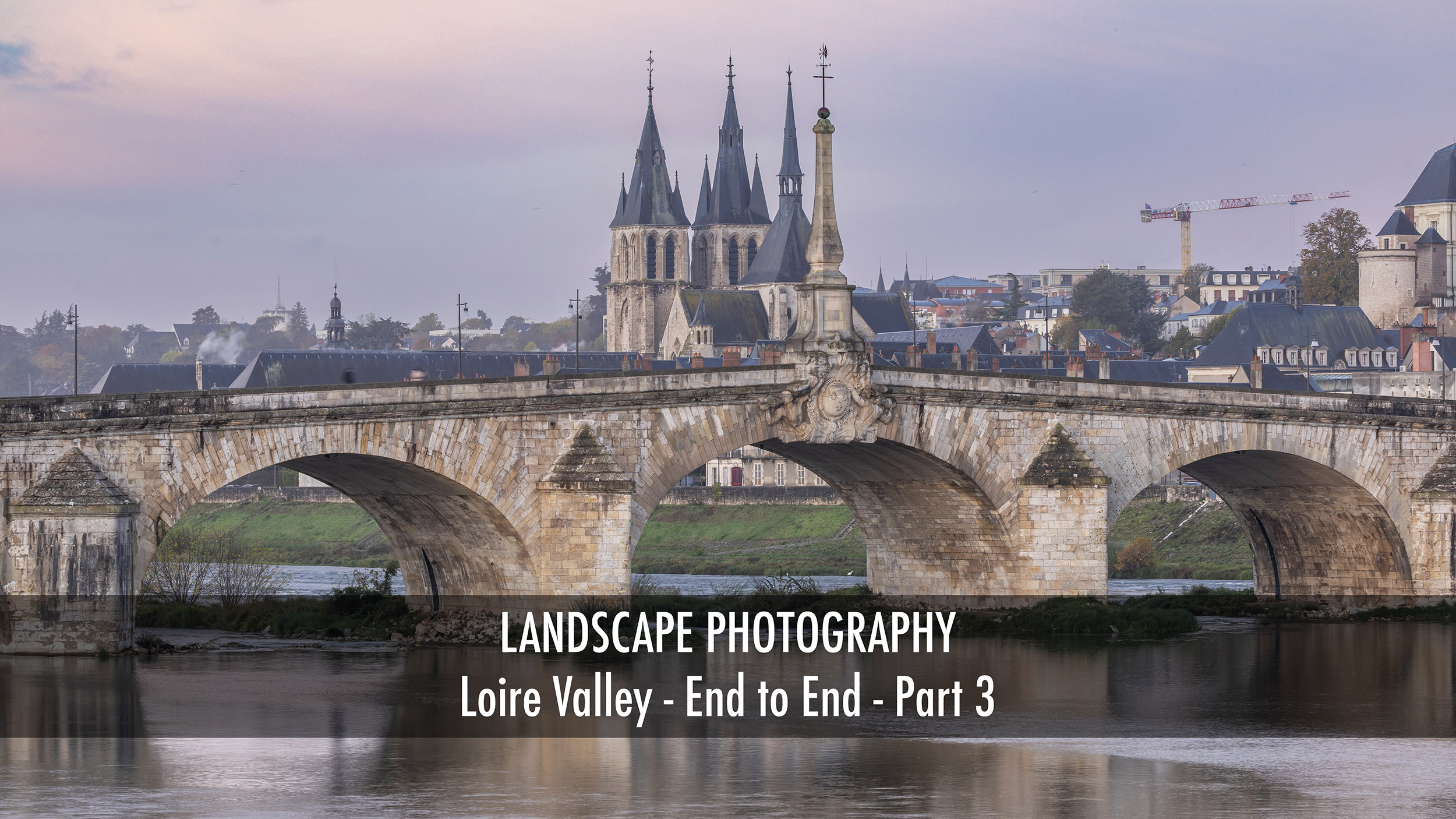

The third instalment of my YouTube vlog, Landscape Photography Loire Valley End to End Part 3, shows you some of the areas from Blois to some woodland near Amboise. This central area of France has been designated a UNESCO World Heritage Site, and it’s not hard to see why.
Starting with the sunrise view over the Loire towards Blois, you’re going to have a very good idea as to why UNESCO made this area of central France a World Heritage Site.
And if you’re interested in discovering the Loire Valley with a camera, then do check out my annual Loire Valley photo tour in May.
I started in Blois, on the edge of the Loire, with one of the best river views in this part of France. From the bank, I could see the city rise above the water, with Blois Cathedral on the hill, Pont Gabriel crossing the river, and an old abbey building tucked behind the bridge. Up above it all, hidden from where I stood, was the chateau.
It was easy to see why this stop had to come first. The view pulled several strong subjects into one frame, and each one had its own weight. The cathedral gave height, the bridge gave structure, and the abbey added depth.
The scene in front of me had three obvious anchors:
A storm had passed through the night before, so I suspected many of the autumn leaves had already come down. That was frustrating, because this stretch of river can be glorious when the colour holds. Even so, there was enough in the sky to keep me interested. Sunrise was only minutes away, and whilst the colour was weak at first, I could already see more warmth building to the east.
This central part of the valley has a rare mix of river, history and architecture. It’s one of the reasons I keep returning here, both for my own photography and when planning Loire Valley photography tours.
I had a panoramic image in mind from the start. Rather than lock myself into one tight composition, I wanted to pull the cathedral, bridge and abbey together in a wider stitched frame. My rough plan was to shoot at about 70mm and build the photograph from around 15 vertical frames.
That sort of image needs calm decision-making, because every small distraction becomes part of the final stitch. In this case, the main irritation came from a road sweeper on the bridge. Its lights kept flashing through the scene, and there was nothing I could do apart from wait.
At first light, patience often matters more than movement.
So I stopped worrying about filming and put all my attention on the photograph. The sky was still changing, the water was taking the reflection well, and the city had that calm, early-morning stillness that only lasts a short while. Blois can give you a lot from one viewpoint, but only if you stay long enough for the scene to settle.
I didn’t have time that morning to head up into the chateau itself. Even so, the riverbank view gave me enough to work with. The best part of that first stop was not one single subject. It was the way the whole place held together as one piece of the Loire Valley, with stone, water and history all sitting in the same frame.
My original plan after Blois was to move straight on through the valley. However, the weather had other ideas. The sky closed in far earlier than I wanted, and the promising start began to flatten into a dull, grey morning.
So I switched to plan B.
While researching the route between Blois and Amboise, I had spent four days studying maps, including the IGN 1:25,000 sheets, which are the French equivalent of the UK’s Ordnance Survey maps. That work had led me to an old abandoned religious site in woodland, either a priory or a small abbey, hidden well away from the usual stops. If I hadn’t spent time researching, then I never would have found it.
The path in was wet and slippery, and I wasn’t wearing walking boots, so I had to take care. Still, this kind of place suits bad weather because the tree canopy keeps the light softer and cuts out the empty grey sky. When conditions fall apart in open country, woodland ruins can still give you something to work with.
The first impression was simple. This ruin was a curiosity more than an obvious classic shot.
I walked into what would once have been the nave, with broken walls rising out of the forest floor. Beyond that, I could make out what may have been the choir and part of a transept, although I wouldn’t claim that with certainty. There was graffiti on some of the stone, which was a shame, but the structure still had presence.
What struck me most was how tightly the woodland pressed in around it. Branches, trunks and fallen trees hemmed in almost every angle. That made the photography awkward from the start, because the ruin had very little breathing space.
Three things stood out as I moved around it:
By then, it was around 10am, and the sun had climbed high enough to start flickering through the canopy. That wasn’t ideal for a first proper attempt. The light was broken, and the ruin felt cramped. Still, a recce like this matters. Once I know the layout of a place, I can decide whether it is worth returning at a better time of day.
There also seemed to be very few photographs of this place online. That made the visit more interesting, because I wasn’t arriving with a fixed mental image from other people’s work. I had to solve it for myself, on the ground, in the moment.
I did make a colour image whilst I was there, and it wasn’t bad. The scene had enough green left in the leaves to hold together, even after the storm. Yet the more I looked at it, the more I felt that colour alone wasn’t quite enough.
Black and white had some promise, but it also showed the problem clearly. There was too much woodland clutter around the ruin, and without stronger separation, the structure didn’t stand out as much as I wanted. The image needed either cleaner surroundings or a different way of seeing.
Infrared came to mind straight away.
With enough foliage still on the trees, an infrared filter could transform the setting. The pale leaves, dark stone and enclosed woodland might work far better in that treatment than in straight colour or monochrome. I also felt the light on the front of the building would be stronger later in the day, assuming the orientation followed the usual pattern of many religious buildings.
So I left with a useful result, but more importantly, with a better idea. On a day when the weather was working against me, the hidden priory gave me something valuable, a place worth returning to with a clearer plan.
From the woods I drove on to Chaumont-sur-Loire, hoping the weather might break. For a while, it looked hopeless. When I arrived, the sky had gone flat and grey again, and the castle lost much of its shape against the dull light.
Rather than rush a poor photograph, I waited.
I had been watching the Clear Outside app, which suggested that around midday the cloud might thin and open. That forecast proved right. After about an hour, the light began to change, the heavy cloud started to burn off, and patches of blue appeared with some high cirrus above.
That short gap made all the difference. The chateau lifted out of the gloom, and the scene finally had depth.
My first photographs at Chaumont-sur-Loire were made with the 24-70mm, set to 70mm. I wanted a tighter view that gave the castle more presence and cut out anything that weakened the frame. With the sky clearing behind it, the stone stood out far better than it had on arrival.
I was happy with those first results, because they caught the moment the weather turned in my favour. The blue sky didn’t last long, but it lasted long enough.
After that, I wanted to get closer and work more selectively. I switched my attention to a tilt-shift lens so I could study the entrance area and control the lines more carefully. I hadn’t photographed Chaumont in that way before, so it felt worth trying whilst the light held.
The only drawback was the number of visitors. That is part of photographing a place like this. People have every right to be there, and if I want clean frames, I have to wait for the gaps. Opening hours also shape what is possible, so I take the opportunity when it comes.
Chaumont-sur-Loire is one of those castles that can look almost too familiar in photographs, especially from the standard viewpoints. Yet when the sky clears at the right moment, it still has plenty to offer. On this day, patience bought me a small window, and that was enough.
After Chaumont, I still had more in mind for the day. I wanted to head towards the vineyards near Amboise and try for some drone footage, then look at Chateau d’Amboise, and later finish at Chenonceau.
The problem was that the weather had turned again.
By the time I reached the vineyards, rain had arrived, and the light was poor. I had no interest in forcing drone work in those conditions, and I didn’t want this part of the series to show the Loire Valley at its weakest. The whole point was to photograph these places when they looked their best.
A little later, I looked towards Chateau d’Amboise. That view can work well in late afternoon during summer, but I had never properly tested it at this time of year. With the sky now thick and lifeless, there was no reason to push it. The castle deserved better light than that.
The same went for Chenonceau. Although it sits over the River Cher rather than the Loire itself, it still falls within the UNESCO World Heritage area. I have photographed it before, and I know how strong it can be when conditions are right. On this day, the conditions were not right.
This was the shape of the day by that stage:
| Location | Plan | Result |
|---|---|---|
| Blois | Sunrise panorama over the Loire | Success |
| Woodland priory | Wet-weather scout and test images | Useful recce |
| Chaumont-sur-Loire | Chateau studies in better light | Short but productive window |
| Vineyards near Amboise | Drone footage | Cancelled by rain |
| Château d’Amboise | Afternoon test shot | Dropped |
| Chenonceau | Final stop | Dropped |
The table says it plainly. Three stops gave me something, and three had to wait for another day.
There is always a temptation to keep shooting because the location is famous, or because you’ve already made the effort to get there. I don’t see much point in that if the light is wrong.
A grey sky can work in some places. It can even help in woodland or on close studies of stonework. Yet for big Loire Valley subjects, especially castles and vineyards, light shapes the whole image. When that light isn’t there, restraint matters.
So I called it there. The day had still given me a strong sunrise in Blois, a hidden ruin I want to revisit, and a brief but rewarding spell at Chaumont-sur-Loire. That was enough.
The Loire Valley gave me both promise and resistance in the space of one day. I began with river reflections and old stone in Blois, found a forgotten priory under the trees, and caught a brief clearing over Chaumont before the weather shut the rest down.
For me, the strongest lesson was patience. Good locations don’t always produce good photographs on command, and some of the best decisions happen when I stop forcing the plan.
That is part of working in the Loire Valley. The castles, bridges and river views are always there, but the day still belongs to the sky.
We noticed you're visiting from United Kingdom (UK). We've updated our prices to Pound sterling for your shopping convenience. Use Euro instead. Dismiss