 Skip to content
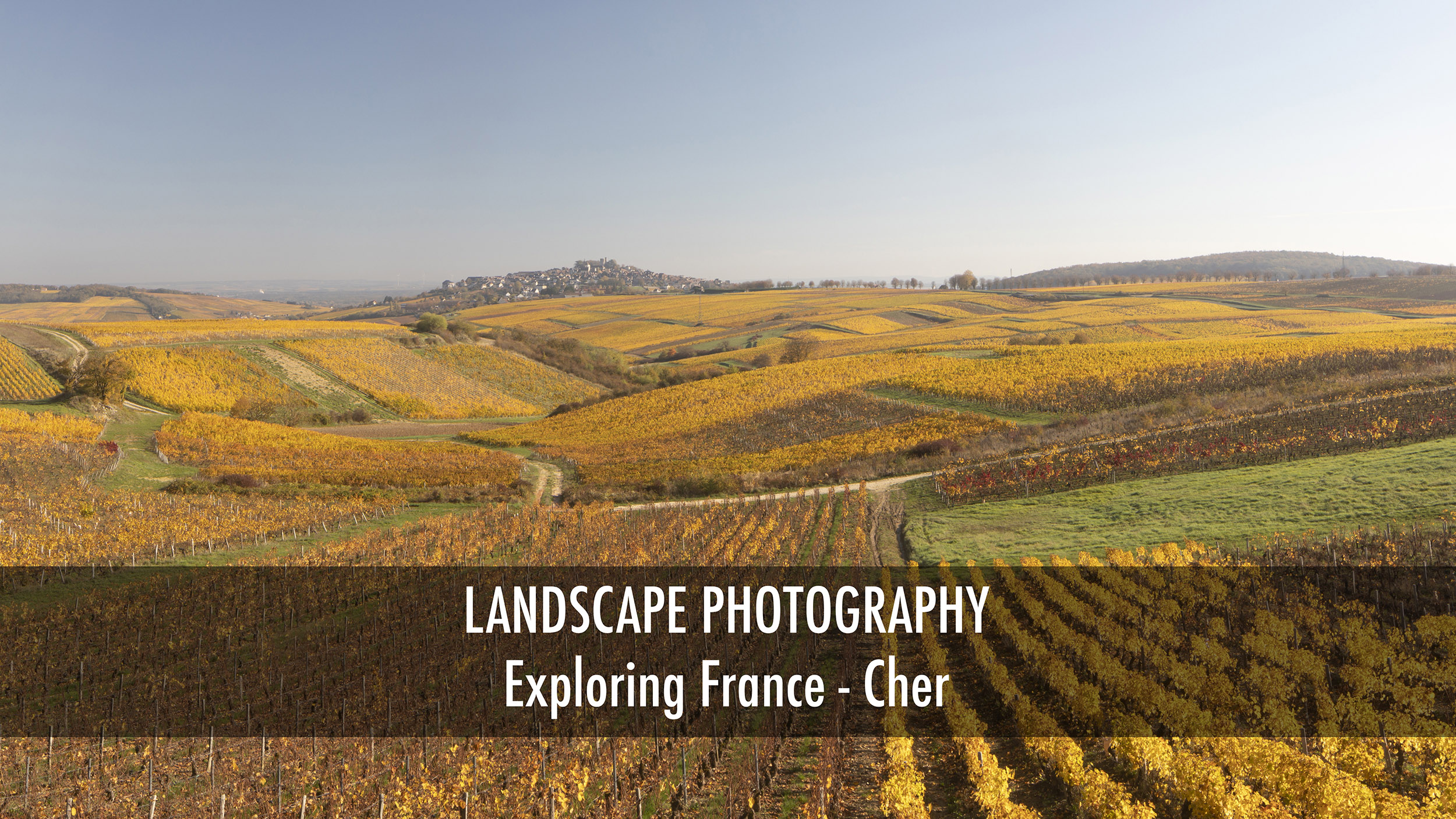

The latest YouTube vlog, Exploring France through landscape photography, sees me in the department of Cher.
The autumn colour is in full blaze in the vineyards, but the weather at first light held me back for a while.
Normally, I’m travelling to other countries, but due to the lockdown, I’ve decided to get out and discover more about the country that I live in.
With each vlog in the series, you’re going to see how I photographed the department that I visited, as well as how I captured some of what was around me.
The department of Cher is in central France and has a number of places to visit, and it’s famous for Jacques Coeur. There is a route dedicated to this historical figure, which I can hopefully cover at a later date.
And if you’re interested in discovering the Loire Valley with a camera, then do check out my annual Loire Valley photo tour in May.
I was back in the department of Cher, in the Centre-Val de Loire region, at a place I’ve visited for around ten years. I keep returning because it is one of those areas that always has something to offer, especially in autumn when the vineyards turn gold, and the whole place takes on a soft, rich colour.
That said, the morning began with frustration. Fog had covered the area so heavily that I could barely see five metres in front of me. Instead of photographing straight away, I had to wait for a couple of hours while it slowly lifted. By about 9.30 in the morning, the cloud was still burning off, but at least I could begin to see the shape of the scene I had come for.
A morning like that tests patience in a simple way:
That wait mattered because the view was strong. Once the fog started to break, the vineyards revealed themselves row by row, dropping into the valley and rising again towards a village on the hill. Even before I set the camera properly, I knew why I had made the drive.
Patience is part of photographing autumn in France. Sometimes the best decision is to stand still and let the weather move first.
One of my favourite spots in Cher looks across a broad sweep of vineyards that run down the slope and then climb towards a medieval village. I know this place well, and because I’ve been coming here for so long, I also know there is a right way to photograph it.
If I want those vineyard rows to pull the eye into the frame, I need to get above the vines. From lower down, the rhythm of the rows is weaker. Once I gain a bit of height, the lines become much clearer, and the image starts to organise itself. The rows bend and guide the viewer straight towards the village, which is exactly what I want.
I pay close attention to the corners in a composition like this. If I can place vine rows so they enter the frame cleanly from the edges, the whole photograph feels more settled. It gives the eye an easy route through the image, and that matters in scenes with a lot of repeated structure.
There was also one curious detail that stood out, as it often does when I visit. On one side of the vineyard, many of the leaves were still hanging on. On another patch, there were hardly any left. We had storms in the previous weeks, so that may have played a part, but it still looked odd when the two sections sat so close together.
The sky, once the fog had gone, turned into a clear blue postcard sort of day. That is not always what I want, but I don’t always get to choose. With a full-time job and only certain days free, I work with what is in front of me.
For this scene, I used my Canon 24mm TS-E Mark II L with a Canon 1.4 Extender Mark III. That might sound like an unusual choice for vineyards, but it made sense here.
The tilt-shift lens helped me keep the posts in the vines looking straight. Without it, the verticals can start to lean in or feel untidy, especially when I am working from a raised position and trying to hold the whole shape of the slope together. Those converging lines can seem minor on location, but they do affect the final image. Keeping the posts clean and controlled gives the frame a calmer structure.
The extender gave me a bit more reach so I could tighten the composition without losing the relationship between the foreground rows and the village beyond. I didn’t need a dramatic crop. I only needed to step slightly further into the scene.
What still surprises me about this location is how quiet it remains. In roughly ten years of visiting, I think I have seen fewer than five other photographers there. For a place with such strong shapes and such reliable autumn colour, that feels strange. Still, the lack of attention is part of its charm. Cher often rewards the photographer who is willing to look past the obvious stops and come back more than once.
Later in the day, I travelled further south in Cher and stopped at a beautiful old castle sitting beside a pond. The water was very still, which immediately made the scene more tempting. Calm water can simplify an image, especially when the architecture and the autumn trees already give plenty to work with.
I couldn’t fit the whole castle into the frame in the way I wanted, at least not from where I was standing. There was another view that may have given a better angle, but it looked as though it might be on private property, so I left that alone. Even with my 17mm tilt-shift lens, I suspected the wider shot would feel like too much in one frame.
Instead, I worked more tightly. I had the lens at around 70mm and started to build the picture around the best parts of the scene. On the right-hand side, there was a lovely golden tree. Nearby, another tree showed strong red tones. Those touches of colour helped balance the stone of the castle and the plain surface of the water.
I also considered switching to my Canon 100-400mm Mark II L and cropping in more. A longer lens would let me simplify the frame and focus on the relationship between the building and the autumn foliage rather than trying to describe the whole setting.
There was a lower position near the edge of the pond that might have improved the shot. From where I stood, I could see a route down the bank. The problem was the return. Going down looked possible. Getting back up was less certain.
When I am out alone, that question matters. There is no point chasing a slightly stronger composition if it means taking a silly risk for no reason. Nobody was around apart from someone cutting grass nearby, and that is not the sort of situation where I want to test a slippery bank on my own.
A better photograph is never worth a poor decision when there is nobody there to help.
The scene still had plenty going for it. The still water was useful, the autumn trees gave colour, and the old castle had character. I also found myself thinking that an infrared filter could produce an interesting version of the image, especially with the tonal split between the foliage, stone, and water. Even so, the light was beginning to flatten, and that changed the day more than the composition did.
As the afternoon moved on, the weather began to close in. I could see breaks in the cloud on the horizon, but years of experience told me not to trust them too much. Often, a small gap looks hopeful, then the wind pushes the cloud together, and the opening disappears before the light improves.
One of the places I still wanted to see was Noirlac Abbey. It is a beautiful abbey in Cher and a historic monument of real significance. I first visited it when I arrived in France about ten years earlier, so it felt worth stopping, even if the conditions were poor.
Because the sky was so flat, I chose a simple option and put the drone up for an overview rather than try to force a ground shot that had no life in it. Using the DJI Mavic 2 Pro gave me a clear sense of the abbey and its setting, even if the light never became what I had hoped for.
By that stage, I knew the day had turned. Autumn in Cher can shift quickly, especially towards the end of the season. One moment the light has shape, and the next it has gone dull behind a thick sheet of cloud. Woodland can sometimes handle that kind of flatness better, but open scenes and architecture often look lifeless when the sun is trapped behind cloud.
I had already come away with strong material from the morning. The vineyards had worked, and I had good drone footage there as well. That helped soften the disappointment because the trip had still produced images and ideas worth keeping.
There is a point in any day out with the camera where pushing on stops being useful. I know that point much better now than I did years ago. Cutting my losses and heading home was the right call.
Trips like this stay with me because they remind me how much of photography happens before I press the shutter. The waiting, the position, the choice of lens, and the decision to stop all shape the result.
This outing reinforced a few things I come back to again and again:
I have spent a lot of time travelling outside France, but periods of restriction pushed me to spend more time exploring the country I live in. That has been no bad thing. Places like Cher reward repeat visits because they don’t give everything away in one go. The photographs come easier once I know how the land folds, where the villages sit, and how the weather tends to gather in the valleys.
If you want to follow more of my work, you can find the latest videos on my YouTube channel, browse my photography on my website, or keep up with new images on Instagram and Facebook.
Cher gave me the sort of day I remember, not because everything went to plan, but because it didn’t. The fog delayed the start, the vineyards still shone once the cloud lifted, and the weather closed the afternoon before I could do everything I had in mind.
That is often how autumn photography works in France. I get a few strong windows, then I have to make sensible choices around them.
The strongest lesson from this trip is still patience. If I wait when the light needs time, move when the composition asks for height, and stop when the weather has gone flat, I usually come home with something worth keeping.
We noticed you're visiting from United Kingdom (UK). We've updated our prices to Pound sterling for your shopping convenience. Use Euro instead. Dismiss