 Skip to content

During the week of 8th April to 15th April 2017, my family and I took a holiday to the department of Finistère in the region of Brittany in western France.
Southern Finistère is known as “Little Cornwall” or Petit Cornouaille and if you’ve ever visited the south west coast of the United Kingdom, then it will be very similar both in terms of geology and also in terms of some of the architecture of houses in the villages.
Each day, we visited a number of places, and I noted some potential spots for the YouTube vlog at the end of the day. Places that weren’t too far away from where we were staying.
The week ended with a visit to La Pointe du Raz, which is the equivalent of Land’s End in Cornwall, including the shops and visitor centre.
I did film more sequences, but I didn’t want the vlog to be too long.
And if you’re interested, I offer photography tours and workshops in a variety of destinations around the world. If you’re interested in learning more from me to help you get the best out of your photography, then get in touch.
*Note that the next vlog will be around the beginning of May.
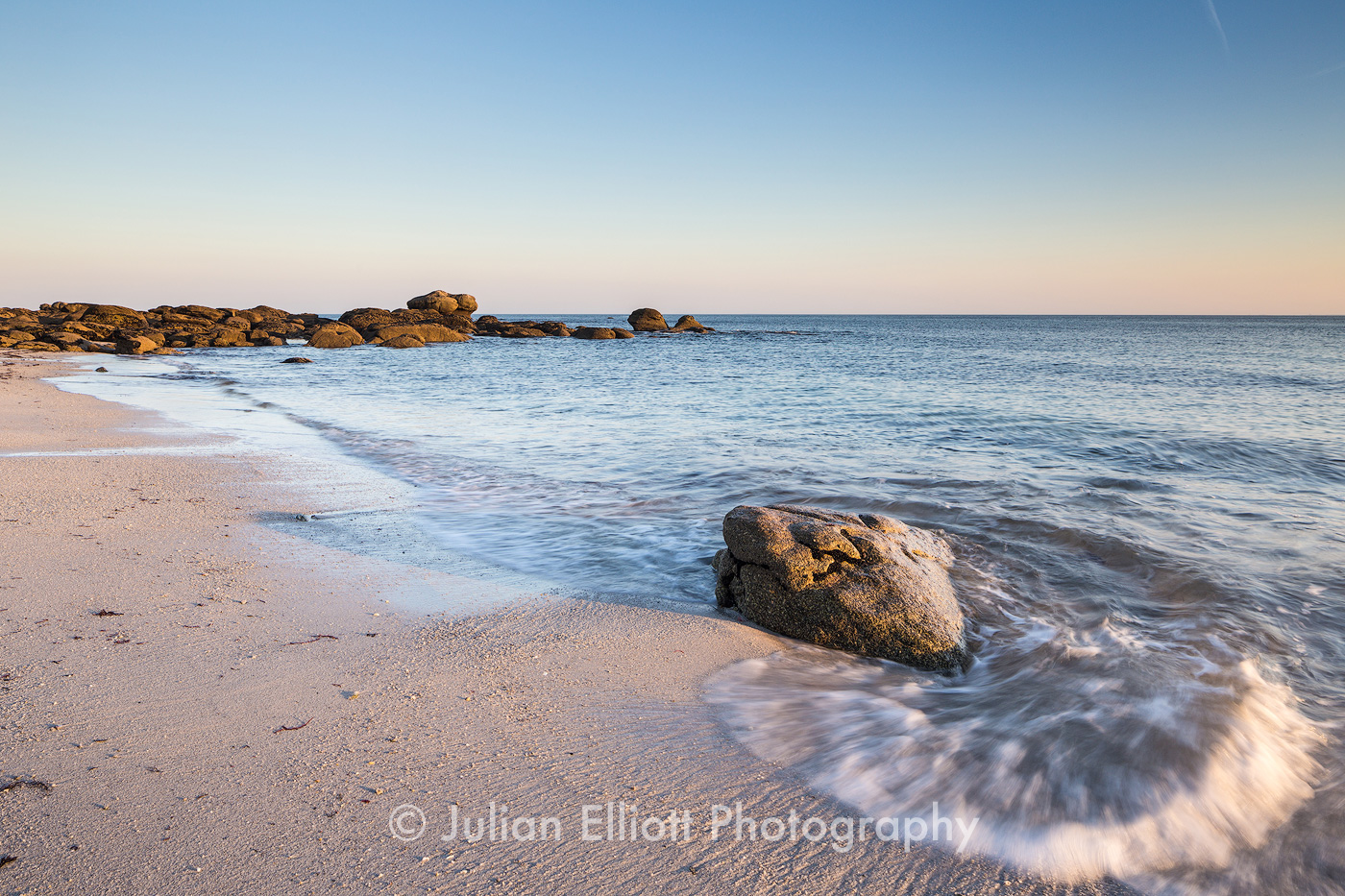
I started one of my favourite sessions of the week on a beach near Beg-Meil in southern Brittany. It was one of those evenings that makes it hard to stay indoors, clear sky, calm weather, and that soft end-of-day light that seems to stretch everything out.
I was there on my own, but only because my family had already had their full share of beach time. We had spent the day relaxing, sitting on the sand, and letting the kids play. Our accommodation was only about 25 minutes away, so when the chance came to head back out with the camera, I took it. I was grateful to get that time, and after a day with the family, it felt like perfect playtime after family fun.
The beach itself was quiet. There was hardly anyone around, which gave me time to slow down and look properly. I hadn’t done much seascape photography for quite a while, nearly a year, and I could feel that familiar rhythm returning as soon as I started studying the shoreline.
With seascapes, the tide often decides the picture before I even unpack the tripod. Earlier in the day, while we were on the beach as a family, I had seen high tide at around 4 pm. Later on, when I came back, I knew the water would be on its way out.
I didn’t have the local tide table in front of me, but I still had enough information to work with. That small bit of awareness mattered because an ebbing tide changes everything. Rocks appear, pools open up, and wave patterns become easier to isolate.
In seascape photography, paying attention to the tide is often more useful than waiting for dramatic weather.
That was the mood of the evening. I wasn’t chasing something grand. I was watching for a small, clean arrangement of rock, water and light.
The scene that caught my eye was simple. One rock sat offshore, and the waves were pushing around it in a way that created a clear pattern. I wasn’t interested in a wide, sweeping view for this shot. Instead, I wanted the rhythm of the water around that one solid shape.
On the back of the camera, the image showed exactly what I had hoped for: a repeated curve and sweep in the water wrapping around the rock. That was the picture. It was minimalist, but it still had movement.
Of course, a more dramatic sky would have added something extra. There wasn’t a cloud in sight, though, and I didn’t mind. I was on holiday, not on assignment, and that changed my approach in the best way. I didn’t need every ingredient to be spectacular. A serene scene was enough.
That shift in mindset mattered. When I stop forcing a location to give me more than it has, I often end up making photographs that feel more honest.
For this scene, I used my tilt-shift lens. I tend to fall back on wider views when I photograph the sea, often with foreground detail and a broad sweep of coastline, so using the tilt-shift helped me work with more intent.
The lens let me keep the composition controlled and simple. Rather than filling the frame with too much information, I could concentrate on the relationship between the rock and the water. That suited the evening perfectly.
It also reminded me why I enjoy these lenses so much. They slow me down. They ask me to think about where the eye should rest, and how much of the frame really needs to be there.
Another evening, after dinner, I headed back out again. The family stayed in, the television went on, and I slipped away to the coast for a second session. We had already visited the spot together earlier in the day, and I knew there was a lighthouse nearby as well as a small cove full of rocks.
This part of southern Finistere is often called “Little Cornwall”, or Petit Cornouaille, and I understood why straight away. The coastline has that same broken, rocky character I love in Cornwall. Even the feeling of the place, the mix of sea, stone and low evening light, felt familiar.
There had been more clouds earlier on, and I had hoped for a stronger sunset. By the time I set up, the sky had cleared more than I wanted. Still, the evening had enough atmosphere for me to keep working.
I began in the cove, where small rocks were scattered across the foreground. The sea was still moving through them, although the tide was dropping and taking some of the energy out of the scene.
Here, I used the tilt-shift lens more aggressively. I shifted it down quite a long way and added front tilt so I could bring the plane of focus from the foreground rocks out towards the horizon. That let me keep the detail where I wanted it without relying on a conventional wide-depth-of-field approach.
The exposure sat at around a second and a half, sometimes drifting closer to two or three seconds. I liked that range because it softened the water without turning it into a featureless sheet. For seascapes, I often find that very long exposures can smooth the scene too much. On this evening, I wanted mist and movement, not blankness.
The rocks, the water and the clear line out to sea all sat together nicely. Even without a dramatic sunset, the cove had enough shape to hold my attention.
One frustration did creep in. As the tide pulled back, the water stopped swirling through the rocks in the way I had hoped. The scene lost some of its life.
That was enough to make me move. I packed the kit down and headed over towards the lighthouse, which was only a short walk away. There was still a faint afterglow building where the sun had gone down, and a band of cloud was moving through the sky. I felt I still had a chance of finding something stronger.
That small decision summed up the week quite well. I wasn’t trying to force one picture. I was staying open to what the evening offered.
By the time I reached the lighthouse, the sun had been below the horizon for about five minutes. The composition I had noticed earlier in daylight no longer worked for me at low tide, so I had to search again. The bay was small, but I still wanted a picture that felt balanced.
Eventually, I found one that pleased me. A large rock gave me a clear foreground anchor, while the lighthouse sat further back in the frame. A patch of cloud above added interest, and the remaining afterglow brought a soft orange-pink tint into the sky.
The water exposure was longer here, around five or six seconds, which felt right for the scene. It smoothed the surface enough to simplify it, while still keeping the image connected to the sea. I was using my Canon 6D with the Canon 28-70mm f/2.8 L, along with a Lee 0.9 hard grad and a Heliopan polariser to cut some of the reflections.
Compositionally, it leaned towards a classic rule-of-thirds arrangement. The rock sat on one third, the lighthouse sat on another, and I tried to remove as many distractions as I could from the edges of the frame.
I still had one reservation. There was a little more water in the frame than I would have liked. Even so, I was pleased with the result because I had arrived there by adapting, not by getting the exact scene I first imagined.
A family holiday doesn’t give me endless time to refine a location, so I try to make the most honest photograph I can with the conditions in front of me.
One of the strongest non-seascape images of the trip came in Concarneau. We had visited the town as a family the previous morning, and I noticed straight away that the harbour had potential. At that time, the water was low, and parts of the harbour bed were visible, so the picture I had in mind wasn’t there yet.
When I returned later, the scene had changed completely. The water had risen, the harbour surface had settled, and the western sky was starting to glow. Suddenly, the reflections I had hoped for were right in front of me.
Concarneau’s old walled town, the Ville Close, is one of those places that draws the eye without effort. Its shape is strong, the harbour gives it breathing room, and the boats in front provide just enough structure to keep the scene from becoming static.
This was one of those photographs that began the day before the shutter was pressed. I had seen the possibility during the family visit, and the return trip was all about timing it better.
That mattered because the picture depended on the water level. At low tide, the harbour told a different story. At high water, with the evening light reflecting back from the surface, the mood changed completely.
The air was still and cool, which helped the reflections stay clean. That calmness gave the whole harbour a quiet feel, and it suited the old town behind it.
For this image, I used the Canon 6D with a Lee 0.6 soft grad, a Canon 24mm tilt-shift lens, and a 1.4x extender. I only shifted the lens down slightly, but that small adjustment helped me place the frame more carefully.
I kept the horizon near the middle, which can work well when the reflections deserve equal space. At the same time, I placed the boats low in the frame, around the lower third, so they acted as an entry point rather than a distraction.
That balance was what made the image work for me. The boats gave scale and shape, the Ville Close carried the history and structure, and the water tied the whole scene together.
This is a simple summary of the main setups I used during the trip:
| Location | Main subject | Light and tide | Key approach |
|---|---|---|---|
| Beg-Meil | Single rock and wave pattern | Clear evening, tide falling | Minimalist framing with tilt-shift control |
| Petit Cornouaille coast | Cove rocks and lighthouse | After sunset, low tide | Front tilt for focus, longer exposure at the lighthouse |
| Concarneau | Ville Close and boats | Calm evening, higher water | Reflections, slight shift, balanced composition |
| Pointe du Raz | Cliffs and chapel area | Moody cloud, weak sunset | Worked with atmosphere rather than colour |
The lesson in Concarneau was simple. Sometimes the picture is already there in your head, but it only comes together when the tide and the light catch up.
The last part of the trip took me to Pointe du Raz, the dramatic headland often described as France’s answer to Land’s End. The comparison made sense as soon as I arrived. There were shops and a visitor area before the point, and the site had that same feeling of reaching the far edge of the mainland.
I was there with about half an hour left before sunset. The light wasn’t spectacular. Cloud covered much of the sky, and there was no strong colour building on the horizon. Still, the weather had enough weight to it that I felt I could make something from it.
The coastline there is what holds you first. It is wild, open and exposed, and you feel the Atlantic straight away.
From where I stood, I could see a small chapel perched near the cliff edge in the distance. It looked promising, but I quickly realised I probably didn’t have enough reach on the lens to do it justice from that position.
That is always a hard call. A subject can look perfect to the eye and still sit too far away for a strong photograph. I considered moving further along the path to improve the angle, but time was short, and the light wasn’t changing in a dramatic way.
So I kept walking, looking for a composition that made better use of the view I could actually photograph.
Although the sunset never really caught fire, the cloud gave the evening a moody quality that suited Pointe du Raz. I didn’t need bright colour to feel that the place was worth photographing.
This is often true on exposed coasts. A dramatic location can carry a picture through shape and atmosphere alone. The headland, the sea beyond it, and the heavy sky were enough to suggest the scale of the place.
Pointe du Raz is often described as the most westerly point in mainland France, and standing there, you can understand why people make that journey. It feels like an ending, or perhaps a beginning, depending on which way you’re looking.
That sense of distance was the real subject more than any single rock or building.
Because this week was a family break, I kept my approach fairly focused. I wasn’t trying to use every piece of equipment in every location. I took what I trusted and adapted it to the subject in front of me.
The kit I had with me on the trip included:
If there was one theme running through the week, it was how often I reached for the tilt-shift lens. On the coast, it helped me organise space and control focus with more care. In Concarneau, it helped me fine-tune the frame in a scene that depended on balance.
That doesn’t mean every photograph needs technical complexity. In fact, the trip reminded me that the strongest choices were often the simplest ones: waiting for the tide, accepting the light I had, and giving myself enough time to notice a better composition when the first one fell short.
This week in Brittany didn’t feel like work, and that was part of its value. I went out in the evenings after family days, watched the tide, stayed patient, and picked my moments carefully.
The strongest lesson was the simplest one. Good photographs often come from attention, not effort alone. On a quiet beach near Beg-Meil, beside the walls of Concarneau, and out at Pointe du Raz, that was more than enough.