 Skip to content
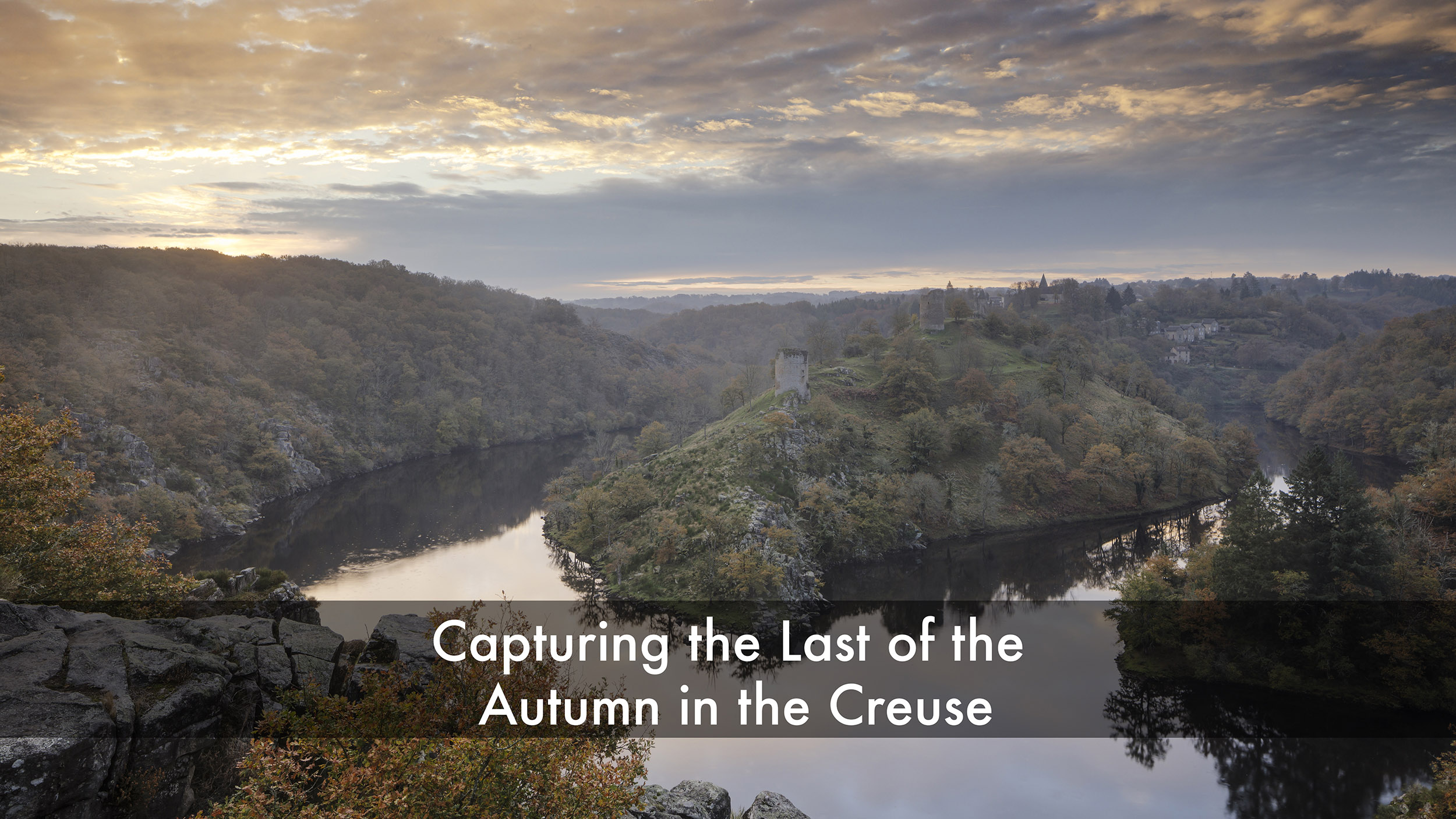

Capturing the Last of the Autumn in the Creuse is my latest YouTube vlog detailing some of my exploits as I travel to various parts of the world.
Last week, I planned to capture the last of the autumn in the Creuse. However, with just a few kilometres of my journey to go, the brakes on the back of my car failed.
For safety reasons, as I was two and a half hours from where I live, I decided to finish the vlog very quickly. It’s not the most ideal of situations, but these things do happen.
Next week’s vlog is going to be a little more of the Creuse, so keep an eye out for that.
Throughout the year, I offer photography tours and workshops in a variety of destinations around the world. If you’re interested in learning more from me to help you get the best out of your photography, then get in touch.
I started the morning in the Creuse at one of those places I never get tired of visiting. In front of me was the broad meander of the river Creuse, with Indre nearby, and beyond it the remains of the old castle at Crozant. It is a view I know well, yet it still has that rare feeling of surprise when I arrive in the half-light and see the shape of the valley emerge.
What makes this spot work so well is its mix of structure and wildness. The river Creuse curves through the scene in a way that naturally pulls the eye, the ruined castle gives the view a clear anchor, and the rough rock in the foreground adds texture and weight. On a good morning, when mist or side light drifts through, the whole place can look almost painted.
A few details always stand out to me here:
I came here for one reason above all, the last of the autumn colour. By this stage of the season, the leaves were close to gone, but there was still enough left to give the valley warmth. That brief in-between moment can be more appealing than peak colour. The tones are softer, the trees look thinner, and the whole scene feels as though winter is already waiting in the wings.
What I love most about the Creuse, though, is the silence. Every time I come here, I seem to have the place to myself. That still feels rare. If I compare it with somewhere like Corfe Castle in southern England, the difference is obvious. Here I get rocks, river, ruins, and open space, and no crowd at all. For a photographer, that changes everything. I can slow down, set up carefully, and watch the light without feeling rushed.
I had driven two and a half hours to get to the Creuse, which is always a commitment when the weather is uncertain. That is part of the job when I head out for a sunrise in France. I look at the forecast, study the cloud, and make the best call I can. Sometimes the sky catches fire. Sometimes it never gets going at all.
This morning sat somewhere in the middle. There was a little colour in the sky, enough to keep me interested, but nothing like the fiery dawn I had hoped for. I could see the sun coming up in the direction I needed, and there was a gap in the cloud that suggested something might still happen. The trick was to stay patient and watch for a small shift.
A lot of travel photography comes down to one simple truth, I take the chance before I know if the light will reward it.
That uncertainty is one of the reasons I keep going back out. If every sunrise were guaranteed, there would be far less satisfaction in the mornings that work. On this occasion, I could tell the sky was close to blowing out in the brighter areas, whilst the land still needed more exposure. The light was uneven, but not hopeless.
I still had my filter holder on the front of the camera, but I was not relying on graduated filters for this shot. These days, I often prefer to make two exposures and blend them later. One exposure held detail in the sky, while the other gave me the land properly exposed. It is a practical way to deal with a scene like this, where the contrast between the bright horizon and the darker foreground is too much for one frame.
Standing there, I kept looking at the break in the cloud and wondering whether the sun might move across and send some side light into the valley. I had not yet worked out the cloud movement with any confidence, so there was an element of waiting and reading the scene in real time. That sort of decision-making is part instinct, part experience, and part luck.
Even without a dramatic burst of colour, the place still held together as a photograph. The curve of the river Creuse, the fortress ruins, the rocks, and the remaining autumn tones gave me enough to work with. Sunrise does not always need to shout. Sometimes it only needs to hint.
The bigger issue of that day in the Creuse had nothing to do with the weather. It arrived a few minutes before I reached the parking spot, when I heard a loud bang from the car. At first, I was not sure what had happened. Then it became clear that something was badly wrong with the brakes, and it felt as though the back brakes, or possibly the handbrake mechanism, had failed.
That is not the sort of thing I can shrug off when I am two and a half hours from home. A mechanical fault is frustrating at any time, but brake trouble changes the mood straight away because it brings safety into the picture. I was suddenly thinking less about colour in the sky and more about how I was going to get back.
There were only a few possibilities. I could try to contact the insurance company and hope for recovery, or I could attempt the journey home with extreme care if the car was still movable. Neither option felt appealing. When you are standing on a quiet hillside in rural Creuse before sunrise, those choices feel even narrower.
The date mattered too. It was 11 November, and in France that meant a bank holiday. Everything was shut. The nearest garage I knew of was about 30 minutes away, and that was closed as well. So the usual solution, limp the car to a local mechanic and deal with it there, was off the table.
That sense of being stuck can settle in fast. A small problem becomes a much bigger one when there is nowhere open, nobody nearby, and a long drive home waiting for you. It was one of those mornings where the stillness of the countryside, which normally feels like a gift, suddenly felt less convenient.
To make matters worse, I had already had trouble with the car days before. The alternator had failed, and I had only just picked up the bill from the garage. So this was not one repair after months of trouble-free driving. It was one fault following another, and that sort of run can wear down anyone who spends a lot of time on the road.
For that reason, I kept the rest of the morning short. Safety had to come first. There is no photograph worth turning a bad mechanical problem into something worse.
Sometimes the right decision on a photography trip is to stop early and deal with the practical problem in front of you.
Even with all that going on, the place itself stayed with me. Crozant has a strong pull, especially in late autumn. The ruins, the valley, and the Creuse together make a scene that feels older and quieter than many better-known locations. It never tries too hard. It does not need to.
I think that is part of why I return. There is beauty here, but there is also room. I can stand at the viewpoint and hear almost nothing. No crowd, no rush, no pressure to work around other people. For photographers who love France, that matters. The best locations are not always the most famous ones. Often, they are the places where time slows down, and the picture reveals itself bit by bit.
The last scraps of autumn colour in the Creuse added to that feeling. They were not bright in a showy way. Instead, they softened the valley and gave the scene a final touch of warmth before winter. That sort of seasonal edge can be more moving than a textbook-perfect autumn day. It feels honest. The leaves are nearly gone, the light is uncertain, and the place still holds up.
I left with mixed feelings, because the morning had not turned out as planned. Yet the view reminded me why I had made the drive in the first place. The Creuse has a way of doing that. Even when the weather is subdued and the day turns awkward, it still gives me something real to respond to with a camera.
What stays with me from this morning is not a dramatic sunrise. It is the mix of hope, patience, and plain bad luck that often comes with photographing places like the Creuse.
I went looking for the last colour of autumn at Crozant and found a quieter sort of reward. The view was still beautiful, the light still had promise, and the day still told its own story, even after the brakes failed.
That is one reason I keep returning to France with a camera. Some mornings give me the shot I had imagined. Others give me something more honest.
We noticed you're visiting from United Kingdom (UK). We've updated our prices to Pound sterling for your shopping convenience. Use Euro instead. Dismiss