 Skip to content

The 31 August 2020 signalled the end of the school holidays for the kids. So I decided that I’d had enough of being locked down and decided to head out into the Loire Valley with my kids to do a little exploring.
Here in my latest YouTube vlog see what we got up to on a day out discovering our local area.
It’s not hard to see why the area is so beautiful and has the name The Garden of France. It is an amazing area to visit with lots to do all year round.
And if you’re interested in discovering the Loire Valley with a camera, then do check out my annual Loire Valley photo tour in May.
One of the best things about living near the Loire Valley is that I don’t need a grand plan to come home with something worthwhile. The region has earned its name, “The Garden of France”, for good reason. Castles, vineyards, old churches, river views, quiet lanes, and small towns all sit within easy reach. On a day when I couldn’t go far, that mattered.
I was out with my son and daughter on the final day before school started again. That gave the whole trip a loose, casual feel. There was no pressure to spend hours in one place, and there was no chance of a long wait somewhere remote. Instead, I went looking for scenes that worked quickly, especially places where late afternoon light could do most of the hard work for me.
That kind of local outing has real value for photographers. When you know an area well, you start to notice how light changes it. A place you’ve driven past ten times can suddenly become interesting because the sun is lower, a cloud breaks at the right moment, or a field that was empty a month ago is now full of flowers. Familiar ground becomes less ordinary when you give it proper attention.
For anyone who wants to spend more time photographing this part of France, I also put together Loire Valley photography tours. The appeal is simple: there is always something to photograph here, and the light keeps giving you reasons to come back.
The first stop was close to home, only a short walk from where I parked. Waiting there was an old 16th-century church, abandoned and partly in ruin. I’d known about it for quite a long time, but I had never found the right moment to give it proper attention. That afternoon felt right.
At first, the sun had slipped behind a cloud, so the façade looked flat. Even so, the church still had a presence. The age of the stone, the broken structure, and the height of the tower made it stand out immediately. What caught my eye most was the architecture. When I looked up, the vertical lines were pulling in hard. It was exactly the sort of subject that benefits from a tilt-shift lens.
I also knew the light would improve. The sun looked as though it might break through within ten minutes or so, which changed the mood completely. Instead of rushing, I waited. That patience paid off. After about half an hour, the light came through and lit the front of the building well enough to make the scene work.
Good light can turn a nearby subject into a photograph that feels far more special than the journey it took to reach it.
For this church, I used my Canon 24mm TS-E Mark II. It was the obvious choice because I wanted to control the converging verticals rather than correct them later. With old buildings, especially when you’re standing close, that control matters. The effect is subtle when it works well, but the picture feels calmer and more honest.
My composition was simple. I framed the façade cleanly and let the structure do most of the talking. I wasn’t trying to be clever with the shot. I wanted a straightforward architectural image with the best light I could get. Sometimes that’s enough.
There was one frustration, a branch creeping in at the edge of the frame. I could have removed it later, but I don’t usually like building a photograph around the idea of fixing it on the computer. I would rather solve it in camera if I can. In this case, I wanted to get a little closer, but that would have called for something wider, which is why a 17mm tilt-shift still sits firmly on my wish list. In towns, cities, and tight spaces, that extra width would make life easier.
Even so, the 24mm did the job. Once the sun hit the stone, I had the image I came for.
I had my drone with me as well, so I sent it up for a look at the church and the surrounding ground. An old ruin can look strong from the front, but an aerial view often tells the fuller story. You see the setting, the shape of the site, and how the building sits within the wider countryside.
That mattered here because the place isn’t only about the façade. It’s also about isolation, age, and the feeling of something left behind. The drone helped me record that without overcomplicating things.
We were heading towards vineyards after the church, but then I passed Chateau de Chinon in beautiful light and stopped without much debate. I live about half an hour away, and I’ve photographed it many times. Still, when the sun lands on that façade at the right angle, I always want another frame.
The timing was good, around quarter to five in the late afternoon. The sun was hitting the front of the château cleanly, and there was enough cloud in the sky to give the scene some shape without turning it heavy. It had that look so many Loire Valley photographers know well, warm stone, side light, and a sky that gives the building some breathing room.
For this stop, I kept things straightforward. I worked with a wide zoom set at about 30mm and took a clean, simple composition. I didn’t need the tilt-shift this time. I could have used it, but the shot didn’t ask for it. Sometimes the best decision is to leave the specialist lens in the bag and respond to what is in front of you.
I like this kind of stop because it reminds me how much repeat visits matter. A place isn’t finished because you’ve photographed it before. In fact, familiar locations often improve your eye because you stop chasing novelty and start responding to light, weather, and timing.
“How can you not stop and take a photo?”
That was the feeling here. Chinon looked beautiful, so I gave it the few minutes it deserved and moved on.
The original plan was to find vineyards. Instead, after crossing into the neighbouring department of Vienne, I found something I hadn’t expected at all, a sunflower field still in flower right at the end of summer. That surprise was enough to change the route and the mood of the afternoon.
I hadn’t seen this field before, and that made it even better. There are moments like this in the Loire Valley when the countryside hands you something that feels timely. The flowers were still strong, the sky was clear blue, and the sun was shining across the field from the side. It wasn’t sunset, but the light still had shape and direction.
When I photographed the field, I kept the approach simple. At eye level, the rows created lines that pulled the eye into the frame, and those lines were what mattered most. I wasn’t looking for a complicated foreground or a dramatic trick angle. I wanted the order of the plants, the sweep of yellow, and the contrast with the sky.
The composition settled into a rough thirds split. I used a little over a third of the frame for the sunflowers and gave the rest to the blue sky and cloud. That balance felt right because the sky had enough interest to hold its own. I considered going wider, and I tried a few variations, but the main idea stayed the same throughout.
There are always options with a field like this. You can go higher, get low between the stems, or isolate a single flower. On this occasion, the broad view made more sense. The field worked because of its shape and repetition.
I wasn’t going to stay for sunset. I had my kids with me, and we had other plans for the evening. Still, I had waited all summer to find a sunflower field that looked this good, so I sent the drone up again. From above, the geometry becomes clearer, and the patch of yellow against the surrounding land gains more strength. I also shot a bit of stock footage while I was there, and the same composition ideas carried across from video to stills.
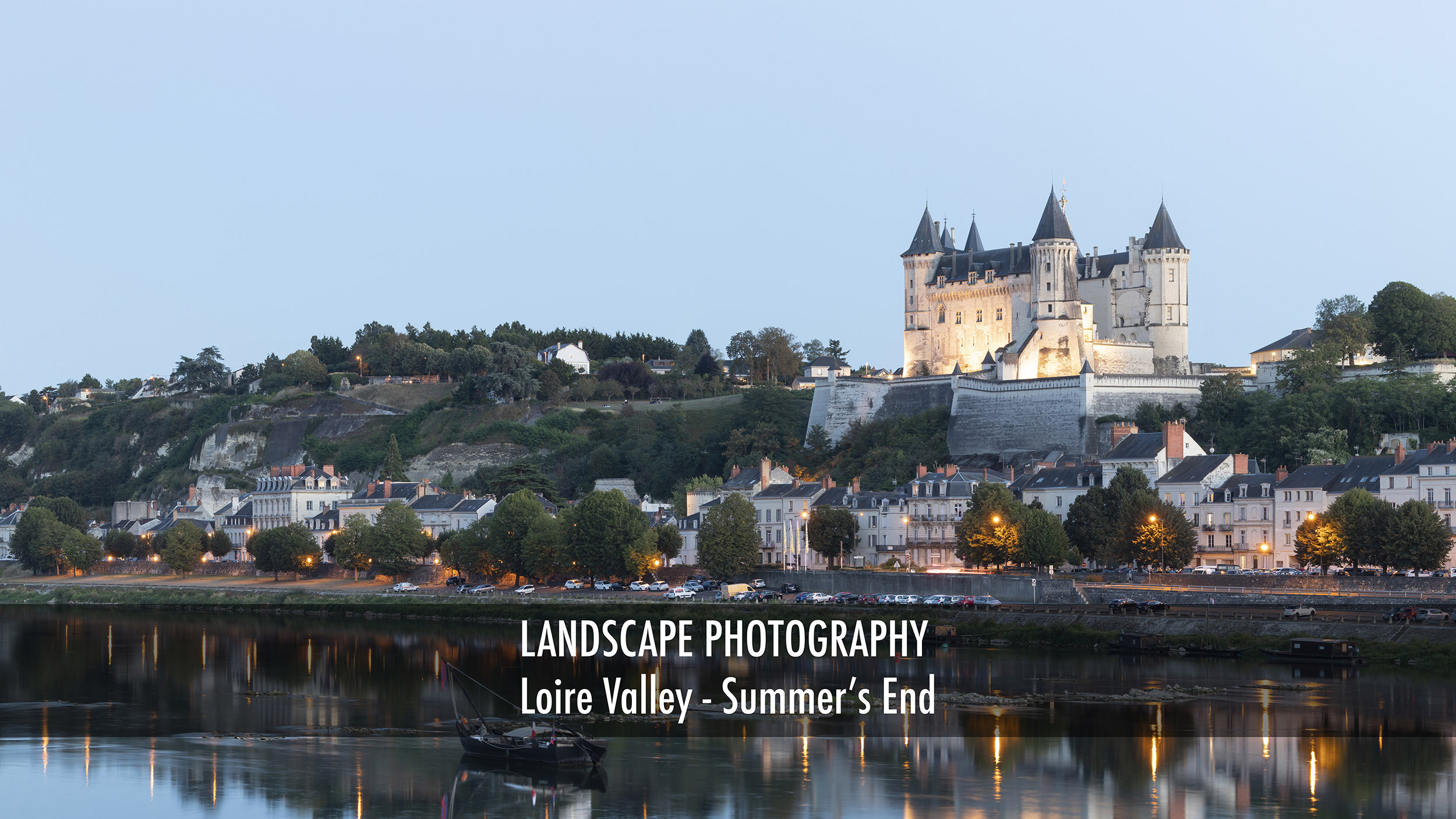
By the end of the day, we reached Saumur, with the château sitting above us and catching the last light. It felt like a fitting final stop. After ruins, roadside views, and sunflowers, finishing with a Loire Valley château at dusk tied the whole outing together.
I took one regular 3:2 frame and then made a quick panoramic image as colour started to build in the sky. The light was brief, but it was enough. At that stage, I wasn’t trying to force a big session. I wanted a clean record of the place in good evening conditions, and I knew the next phase would come after sunset.
So we waited a little longer for darkness to settle and for the lights to come on around the château. That shift from warm evening light to illuminated stone can change the whole character of a building. During the day, the structure belongs to the sky. After dusk, it begins to glow against it.
There was a practical limit, of course. My kids had school the next day, so I couldn’t stretch the evening too far. That gave the stop a nice discipline. I took the photographs I wanted, watched the colour fade, and left without turning it into a marathon.
It also felt right that they were part of the day from start to finish. They even helped hold the camera during the vlog. There is something satisfying about a family outing that also gives you a set of photographs worth keeping.
Although the trip stayed local, I still had a useful range of kit with me. The Canon 24mm TS-E Mark II was the standout lens for the church because it solved a clear problem. My drone helped whenever I wanted to show how a subject sat in the wider scene. For Chinon and Saumur, a wide zoom gave me enough flexibility to work quickly, especially when the light was changing fast.
That balance matters more to me now than carrying gear for the sake of it. A short local drive doesn’t need every lens in the cupboard. It needs a practical setup and a clear idea of what each place asks for. On other days, I might carry longer lenses, a tripod, or one of my other camera bodies, but this outing proved that simple decisions often lead to better photographs.
More than anything, the afternoon reminded me that the Loire Valley doesn’t need much introduction for photographers. It keeps offering small variations on subjects I already know, and it also throws in the occasional surprise, like that late sunflower field. That mix is why I keep going back out, even when I only have a few hours.
I’m also tempted to build more from this. A full series on the Loire Valley would make sense because the region rewards slow, repeated visits. One afternoon at the end of August was enough to confirm that.
That last day of the school holidays gave me four different subjects within a modest local outing, an old church, a familiar château, an unexpected field of sunflowers, and Saumur at dusk. None of it required a long journey. It only needed time, patience, and a willingness to stop when the light looked right.
For me, that is the lasting lesson of local light. You don’t have to go far to make photographs that feel fresh. In the Loire Valley, even a short drive can turn into a full day of good pictures if you pay attention to what the afternoon gives you.
We noticed you're visiting from United Kingdom (UK). We've updated our prices to Pound sterling for your shopping convenience. Use Euro instead. Dismiss