 Skip to content
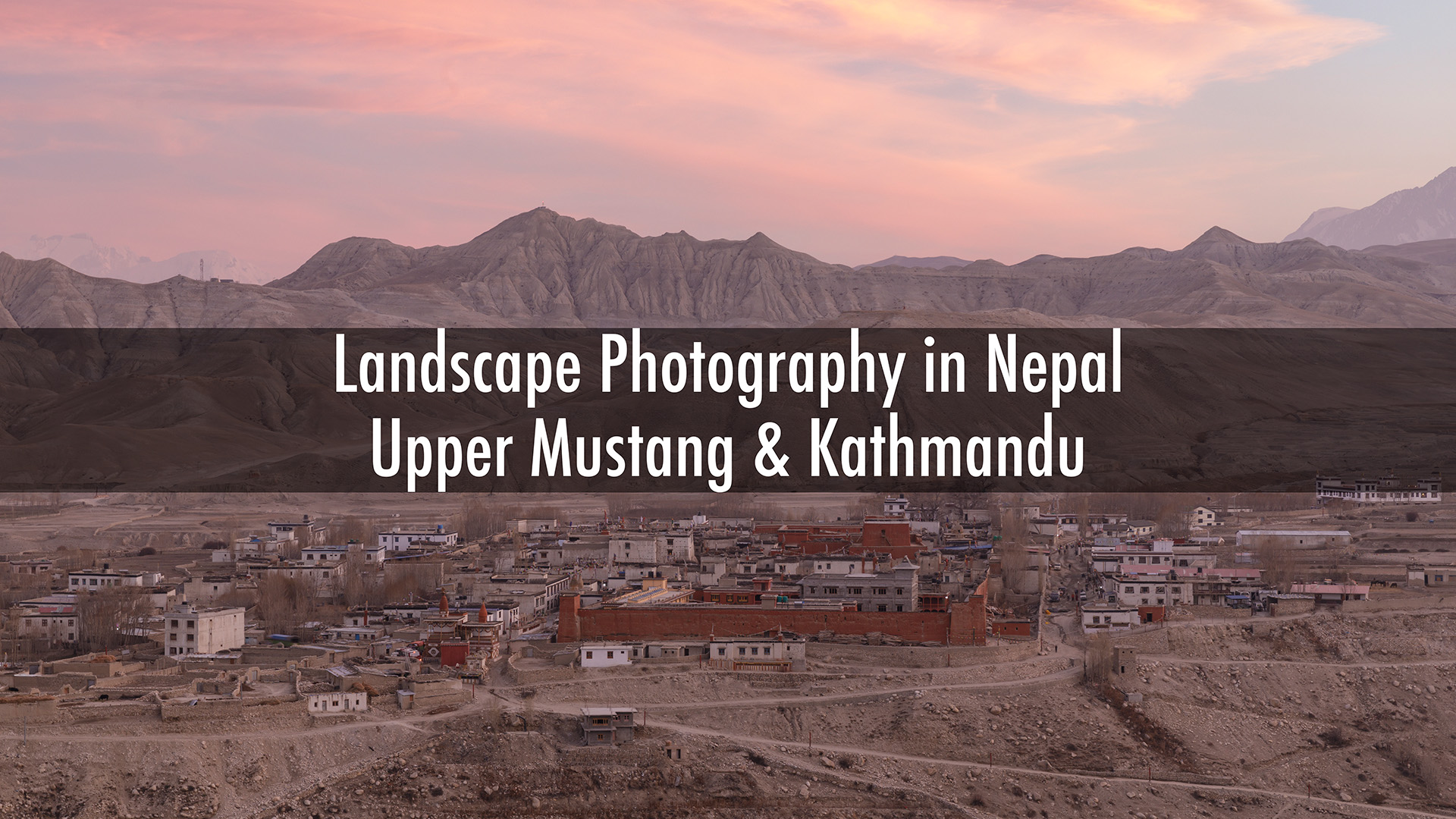

My latest YouTube vlog shows some of what I did during a three-week trip to Nepal in April 2022.
The principal reason for my trip to Nepal was to recce locations in both Upper Mustang and Kathmandu for a photography tour of the two areas.
Nepal is a travel photographer’s dream with so much culture and landscapes that you could spend a lifetime here and still not do it all.
Upper Mustang, in the northern part of the country, is a heavily controlled area that requires a special permit to enter. Without it, you won’t get past the various police checks and so it is an obligation before you go.
It is little visited by tourists and receives around 6000 visitors per year in the area.
So take a ride in Nepal and Upper Mustang to see some of the stunning scenery and culture on offer.
Upper Mustang sits in the Himalayas of northern Nepal, close to the Tibetan border, yet it feels itself fully. The setting is stark and beautiful at the same time. There are cliffs shaped by wind, villages tucked into the earth, and long open views that make the eye travel far beyond the frame.
My first proper view looked down towards the village of Gami. I was standing at roughly 3,800 metres, with dry mountain air around me and an enormous sweep of terrain ahead. That first stop gave me the tone of the trip. It felt remote, exposed, and rich with photographic possibility.
Getting there is not simple. Upper Mustang is a controlled area, and a special permit is required to enter. It is also expensive, so access alone changes the way the place feels. You do not drift into this part of Nepal by accident. According to the trip information I was working from, the area receives around 6,000 visitors a year, which helps explain why it still feels so little touched by mass tourism.
Three things hit me straight away:
I arrived with a guide and a driver, and that mattered from the start. In a place like this, local knowledge shapes the trip. It affects where I stop, when I stop, and how much I can understand beyond the obvious view in front of me.
I also had one word ready for the people I met, namaste. It is a simple greeting, but in Upper Mustang, it was a small way into a much bigger world.
My guide, Babu, was central to the whole experience. He helped film parts of the journey, kept me moving to the right places at the right times, and brought a local understanding that I could never have found alone.
Babu is from Lo Manthang, so this was not a guidebook version of Upper Mustang for him. It was home. He speaks Nepali as well as his own local language, and he told me that the language is disappearing. That detail stayed with me because it said a lot about the fragility of culture in places that still look timeless from the outside.
That is one of the things I loved about travelling with him. I was not only moving through a visually striking part of Nepal, but I was also hearing about the people who belong to it. Even a short exchange, a greeting, or a moment of translation changed the way I saw the villages.
Babu also told me that he had been educated as a monk before leaving the monastery. That background made a difference later, because it gave him a connection to people and places that I would otherwise have passed by as an outsider.
At one point, we were invited in for tea with monks. That kind of moment cannot be forced. It happens through trust, timing, and respect. I was able to make some photographs there, both of the monks and of the people helping around them, and those pictures mattered to me because they came from real contact rather than quick observation.
He kept me in the right place at the right time, and in a place like Upper Mustang that changed everything.
Lo Manthang itself was special for him, and because of that, it became special for me as well. When your guide knows the streets, knows the rhythm of the day, and knows when to pause, you work differently as a photographer. You stop chasing and start noticing.
When we reached Lo Manthang, the light was harsh. It was around midday, and that is not the easiest time to work if all you want is soft, flattering light. Still, the village had too much going on to ignore. People were working with wool, moving through small tasks that carried generations of habit in their hands.
That is one of the joys of travel photography in Nepal. Even when the light is difficult, the human detail can hold the frame. I was walking the streets with Babu, helping him with his own photography, whilst making the images I needed. The work felt shared, which gave the day a nice rhythm.
One woman was working with wool in front of me. Nearby, another was sorting it. The process moved from one pair of hands to another, and the picture was not in a dramatic expression or a perfect pose. It was in the action itself.
In Lo Manthang, I spent more time watching than pressing the shutter.
That is often the difference between a rushed photo and a useful one. If I move too quickly, I get only the surface. If I wait, the structure of the scene starts to show itself.
I did not want to intrude, and I did not want to reduce people to props in a striking location. So I kept my attention on gesture, rhythm, and context. In one scene, I watched for the moment when the woman’s hands came together. That was the photograph.
My process was simple:
Patience mattered more than speed. Babu used a local word for patience during the trip, and whether I caught the pronunciation properly or not, I understood the point. Upper Mustang does not reward a frantic style of working. It gives more to photographers who sit still long enough to see what is happening.
Later in the day, I also photographed sadhus on the way up to a temple. That added another layer to the photography trip. One hour I was working with craft and texture in the village, and the next I was making portraits connected to faith and place. For me, that range is what makes Nepal such a strong destination for photography. It is never only about grand views. It is also about the people who give those places meaning.
For all the beauty of Lo Manthang, the altitude hit hard. The village sits at close to 4,000 metres, and over a couple of days, I developed altitude sickness. It stopped being a background concern and turned into the main fact of the trip.
I had to come down. In the end, I also needed oxygen to get myself going again. It was not pleasant, and there is no romantic version of that part of the journey. When altitude sickness strips away your energy, even simple things feel heavy. Breathing changes, talking changes, and the camera can feel far less important than it did a day earlier.
That physical side of Upper Mustang is part of the truth of photographing here. The place is beautiful, but it asks something of you in return.
To recover, we descended to around 2,300 metres before coming back up slowly. Even after I started feeling better, I could hear it in my voice. The altitude still left me short of breath, and I had to accept that recovery would take time.
I was grateful for the people around me. My guide and driver kept the trip moving in a way that felt sensible rather than forced. I was also touched by the messages I received on Instagram and Facebook from people wishing me well. When you are far from home and feeling rough, that support means a lot.
The episode changed my pace, but it did not ruin the trip. If anything, it reminded me that travel photography is tied to the body as much as the eye. You can only work with what the day gives you.
Once I was back on my feet, we headed to a viewpoint that my driver knew well. It felt like a secret spot, not because it was hidden by magic, but because local knowledge had put us there at the right moment.
In front of me was the Annapurna range, stretched out in a huge arc. Wind moved through the mountains and the cloud, and every so often a peak would reveal itself. That changing cover made the scene more interesting. Instead of a fixed postcard view, I had a living one, where the shapes came and went.
I shot a panorama there because the width of the range demanded it. A single frame would have felt too narrow for what I was seeing. At the same time, Babu was filming, which gave me space to focus on the rhythm of the light.
By then, it was close to ten to six, and the light was starting to go. My camera was clicking through a time-lapse whilst I watched the peaks shift in and out behind moving clouds. Even the wind had a role in the picture. It was stripping back the view in stages.
That moment summed up a lot of what I love about mountain photography. The scene was massive, but the work was quiet. I was waiting, listening, and making small choices. Then, in the middle of all that apparent remoteness, a car passed by. It was a reminder that even in a place that feels far from everything, life keeps moving.
The routine at that viewpoint was straightforward:
There was nothing fancy in that. The location did most of the work. My job was to be ready when the mountains gave me something.
Upper Mustang stayed with me because it gave me more than one kind of subject. I had big mountain views, village life, portrait work, religious spaces, and long, empty roads. Few places hold that much variety without feeling scattered.
The people mattered as much as the scenery. My time with Babu, the tea with monks, the women working with wool, and the smaller moments between destinations all shaped the experience. Those encounters stopped the trip from becoming a collection of pretty frames. They gave it weight.
For photographers, that mix is hard to ignore. Nepal can be overwhelming in the best possible way, and Upper Mustang has its own mood within that. It is remote, permit-only, culturally distinct, and visually rich. It also asks for patience. I do not think that is a drawback. I think it is part of the reason the place feels so rewarding.
Soon after this section of the trip, I was due to head back to Kathmandu and continue looking around there. Upper Mustang still felt like the emotional centre of the journey, though. It had the kind of pull that makes me want to return with more time and a slower plan.
I share more of that work through my YouTube channel and on my website, where Nepal continues to be one of the places I come back to in both photographs and planning.
Upper Mustang reminded me that the best photo trips do not always go smoothly. Sometimes the strongest memories come with thin air, rough days, and the need to slow down.
What stayed with me most was the balance of scale and intimacy. I could spend one hour looking across vast Himalayan space, then the next watching a pair of hands work wool in a village street. That contrast is what made this part of Nepal so memorable, and why I know I will think about it for a long time.
We noticed you're visiting from United Kingdom (UK). We've updated our prices to Pound sterling for your shopping convenience. Use Euro instead. Dismiss