 Skip to content
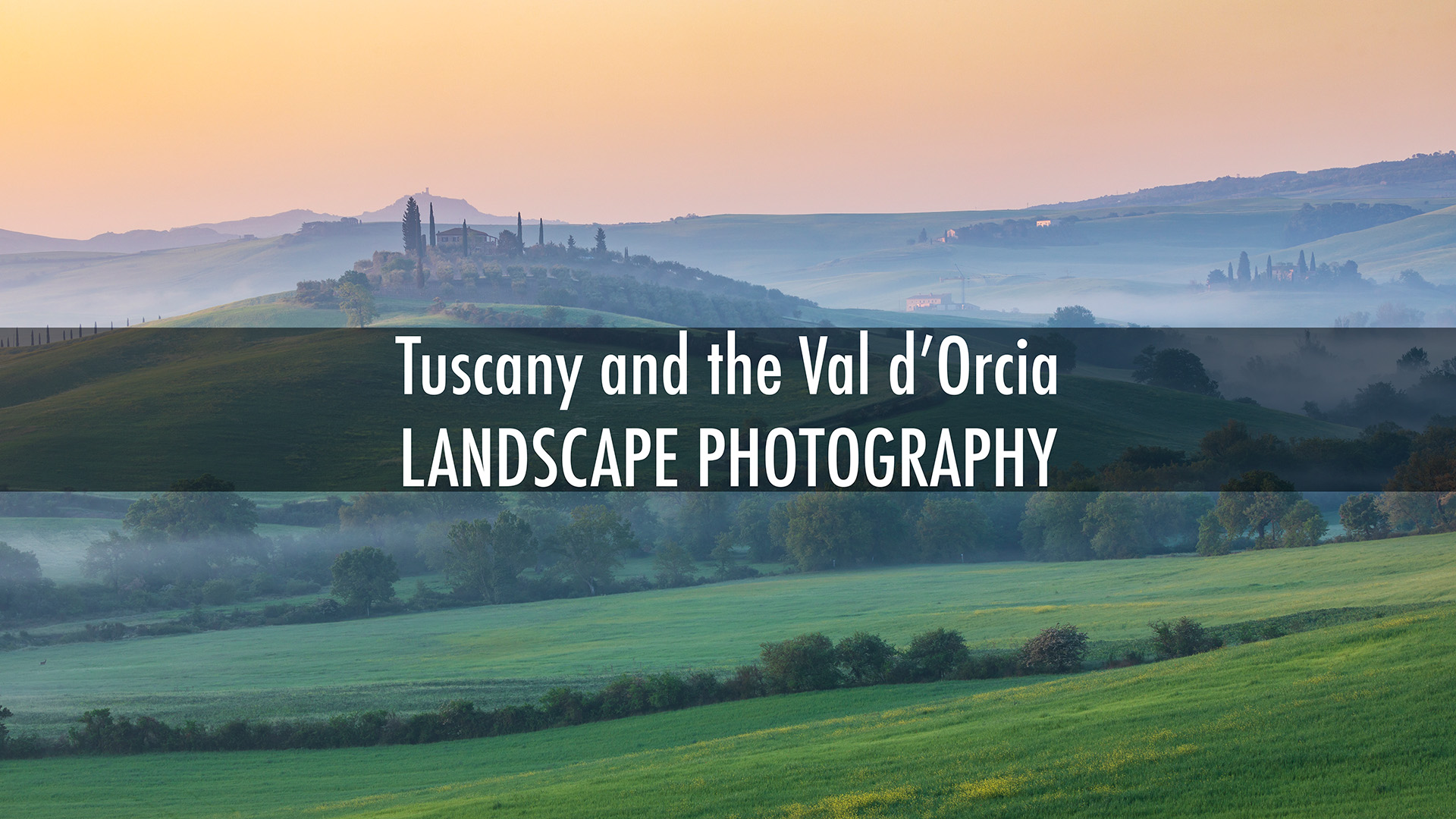

The landscapes of Tuscany and the Val d’Orcia are on the list of many landscape and travel photographers’ bucket lists.
This beautiful area of central Italy is stunning at any time of the year, but certainly, in May, the area comes alive with mist-filled mornings and wildflowers too.
A few weeks ago, I made what is something like my 8th journey to the Val d’Orcia. And it didn’t disappoint.
My YouTube channel is dedicated to all things landscape and travel photography, so if that’s your thing, then I’d love to have you come along for the ride.
And if you’re interested in discovering Tuscany and the Val d’Orcia with a camera, then do check out my annual Tuscany photo tour in May.
Our first morning started at the famous Il Belvedere viewpoint in the Val d’Orcia. We had probably waited an hour and a half for the sun to clear a bank of cloud and finally put some shape and light into the land. That sort of wait can feel long when nothing seems to be happening, yet in Tuscany the whole scene can change in a few minutes.
When the light finally touched the rolling hills, the view came to life. The sky was poor, so I ignored it. That was the right call. The strength of this scene was never overhead, it was in the folds of the ground, the tracks through the fields and the soft spring growth that gives the Val d’Orcia its look in May.
There were poppies in the foreground too, although not the huge fields people often hope for. Even so, a few flowers in the right place can be enough. In a scene like this, the shape of the land does most of the work, and the flowers simply add a touch of colour and season.
A few simple choices helped here:
If the sky adds nothing, I don’t force it into the frame. In the Val d’Orcia, the curves of the land are often the picture.
It was a beautiful May morning, and the temperature was kind to us as well. Better still, this was only the start. We still had more locations ahead, and later in the week I planned to get beyond the Val d’Orcia too, with places such as San Gimignano on the list.
After breakfast we moved on to another location, one I know well but don’t share publicly. It took me some time to find, so I keep the exact position to myself. The draw here was a beautiful lone tree, set against a field that had turned into a patchwork of spring colour.
In front of the tree were blue flowers, perhaps flax, mixed with rapeseed and the odd poppy. Above it all sat a lovely spread of cumulus cloud. It was close to half past eleven in the morning, a time many photographers dismiss, yet this scene worked because the subject was built on colour, form and contrast more than low-angle light.
That matters. There is a habit in photography of treating anything past early morning as wasted time. I don’t see it that way. Mid-morning light can be harsh on some subjects, but it can also be perfect when the scene has strong colour and a clean shape.
I had to wait for a couple of people to move out of the shot, so whilst they were there I fine-tuned the composition. That’s often a better use of time than standing still and hoping. By the time the frame was clear, I knew exactly where I wanted the poppy, the flowers and the tree to sit.
One of my favourite frames from that stop used a lone poppy near the edge of the field, with the blue flowers and rapeseed leading the eye towards the tree. It was simple, but it had layers. That is often what I want in Tuscany, a clear subject, then small details that keep the eye moving.
The tree on its own was strong enough, yet the flowers changed the image. Without them, it would have been a clean study of shape. With them, it became a picture about spring in the Val d’Orcia.
The cloud cover mattered too. I was waiting for the sun to break through a cloud bank and light the scene more cleanly. When the sun is half-hidden, the land can look flat. Once it comes through, even briefly, the colours gain separation and the tree gains presence.
For that composition, I used a tilt-shift lens and stopped down hard, to around f/22, at roughly 1/30 sec. I tilted the lens to bend the plane of focus from the flowers in front of me towards the tree. Even with the tilt applied, I still needed the smaller aperture to hold enough depth through the frame.
That combination gave me the sharp version of the scene, but there was another option as well. The wind was moving through the flowers, and I spoke with my client about treating that as a creative choice rather than a problem.
I saw two possible pictures there:
That second approach can work beautifully in spring. The tree stays mostly stable, though the leaves may move a little, while the flowers turn into streaks of colour. It creates a painterly feel, especially when the colours are strong. Tuscany suits that kind of photograph because the shapes are simple and the tones are gentle.
The third morning brought us to one of the best-known scenes in Tuscany, the house often linked with the film Gladiator. The surprise was not the location itself, but the fact that we had it to ourselves. We had been there since about 5.15 in the morning, and nobody else appeared.
That still feels unusual in a place this well known.
Rain had arrived late the previous afternoon, so we hoped it would produce mist by dawn. It did. Bands of mist drifted through the low ground, and every few minutes the look of the scene changed. There was no cloud catching behind the hill in the way I had hoped, which was a slight frustration, but the mist gave us enough to work with.
The house sat above a line of cypress trees, and the valley below kept filling and thinning as the air moved. Earlier, one section had been full of mist, then it cleared, then a fresh wave rolled through. That constant movement is what keeps mornings like this alive. No frame lasts for long.
The sun was still hidden behind the ridge for a while, though shafts of light were already starting to touch parts of the land. I could see where the light would come from, and I knew that once it reached the trees it would rake across the scene from the side.
That side light is what makes this view work. The leading line of the track and the cypress trees already give the composition structure. Once the sun hits from an angle, the scene gains depth as well.
I was using tools such as The Photographer’s Ephemeris and PhotoPills to judge when the sun might clear the ridge, but even with those apps you still have to respond to what the place is doing in front of you. They tell me where the sun should be. They don’t tell me what the mist will do.
And if you know the film, the pull of the location is obvious. It is easy to picture Russell Crowe walking down towards the house. Even so, the photograph only works if the light and atmosphere show up. Fame alone never carries the image.
The next misty dawn may have been the best of the trip. We went to another famous house, one with a line of cypress trees, and within minutes of sunrise, the valley started to glow. The sun had only been up for about five minutes, but that was enough. Golden light caught the mist and turned the whole scene soft and luminous.
What struck me most was how quickly other photographers gave up. At one point the house disappeared behind the mist, and I watched a group on a nearby hill leave. I never understood that. In the Val d’Orcia, the mist is rarely static. It drifts, opens, thickens and clears, sometimes in less than a minute.
When the house vanishes into the mist, I wait. Quite often the best frame comes after the subject disappears for a moment.
That happened here. The mist shifted, the house came back, and the sunlight began to catch it more cleanly. Traffic passed on the road nearby, including a bus, but the valley still felt magical. The moving fog below the house, lit from the side, was the sort of thing people come to Tuscany hoping to see.
I was there with my client, and there were other photographers around too, including Vince and Alex. Yet even with people nearby, the place never lost its calm. This is one of the reasons I like the Val d’Orcia in spring. The conditions can look dramatic, but the mood stays gentle.
On our last full day in Tuscany we found the best poppy field of the entire trip. We had seen poppies here and there all week, but this one stood apart. The field was broad, rich in colour and, best of all, quiet. There were hardly any people around.
I had already packed the camera away by the time I recorded a few thoughts, but I had spent a good stretch working the field first. Poppy fields can be chaotic if you stand upright and try to take everything in at once. I prefer to get low, let the flowers catch the light, and simplify the shape of the scene.
That morning I used a 1.4x extender with my 50mm tilt-shift lens so I could build depth through the frame and still isolate the best part of the field. I made a panoramic image as well, then worked both portrait and landscape orientations. That gave me different ways to use the same subject without repeating myself.
The beauty of a field like this is that it offers both scale and detail. I could shoot across the poppies and show the broad sweep of the countryside, or I could bring the frame down and let the flowers dominate. Both approaches made sense because the light was clean and the field had enough structure to hold the eye.
This was the sort of scene that sums up spring in Tuscany. The mornings and evenings had both been consistently beautiful, but a field like this gives the season a clear signature. The Val d’Orcia is famous for its roads, farmhouses and cypress trees. In May, the flowers deserve equal attention.
By the end of the week, the reason I return to this part of Tuscany felt obvious again. In May, the Val d’Orcia offers more than a well-known postcard view. It gives me variety. One morning can be about waiting at Il Belvedere for light on rolling fields. Another can be mist around a farmhouse, then the next day a field of poppies or a lone tree with spring colour under a cloud-filled sky.
It also rewards patience more than speed. Several of the best moments came after a long wait, whether that meant standing for ninety minutes for sunlight, holding my position whilst mist moved through a valley, or waiting for people to leave a frame. Good conditions often arrive late.
That is why I keep running Tuscany landscape photography tours when I can. The area changes through the week, and I enjoy helping other photographers respond to those changes rather than chase a fixed shot list.
The Val d’Orcia is famous for good reason, but it still asks something of me every time I visit. I have to look harder, wait longer and stay open to what the weather gives me. When that happens, Tuscany rarely disappoints.
The strongest lesson from this trip was simple. In the Val d’Orcia, I get the best photographs when I stop forcing the scene and let the place reveal itself in its own time.
Il Belvedere needed patience. The hidden tree needed careful composition. The Gladiator house and the cypress house both needed faith in the mist. Then the final poppy field reminded me that sometimes the week saves one of its best moments for the end.
That is why May in Tuscany keeps pulling me back. The light is never guaranteed, but the chance of mist, flowers and fresh green hills makes every early start feel worth it.
We noticed you're visiting from United Kingdom (UK). We've updated our prices to Pound sterling for your shopping convenience. Use Euro instead. Dismiss