 Skip to content
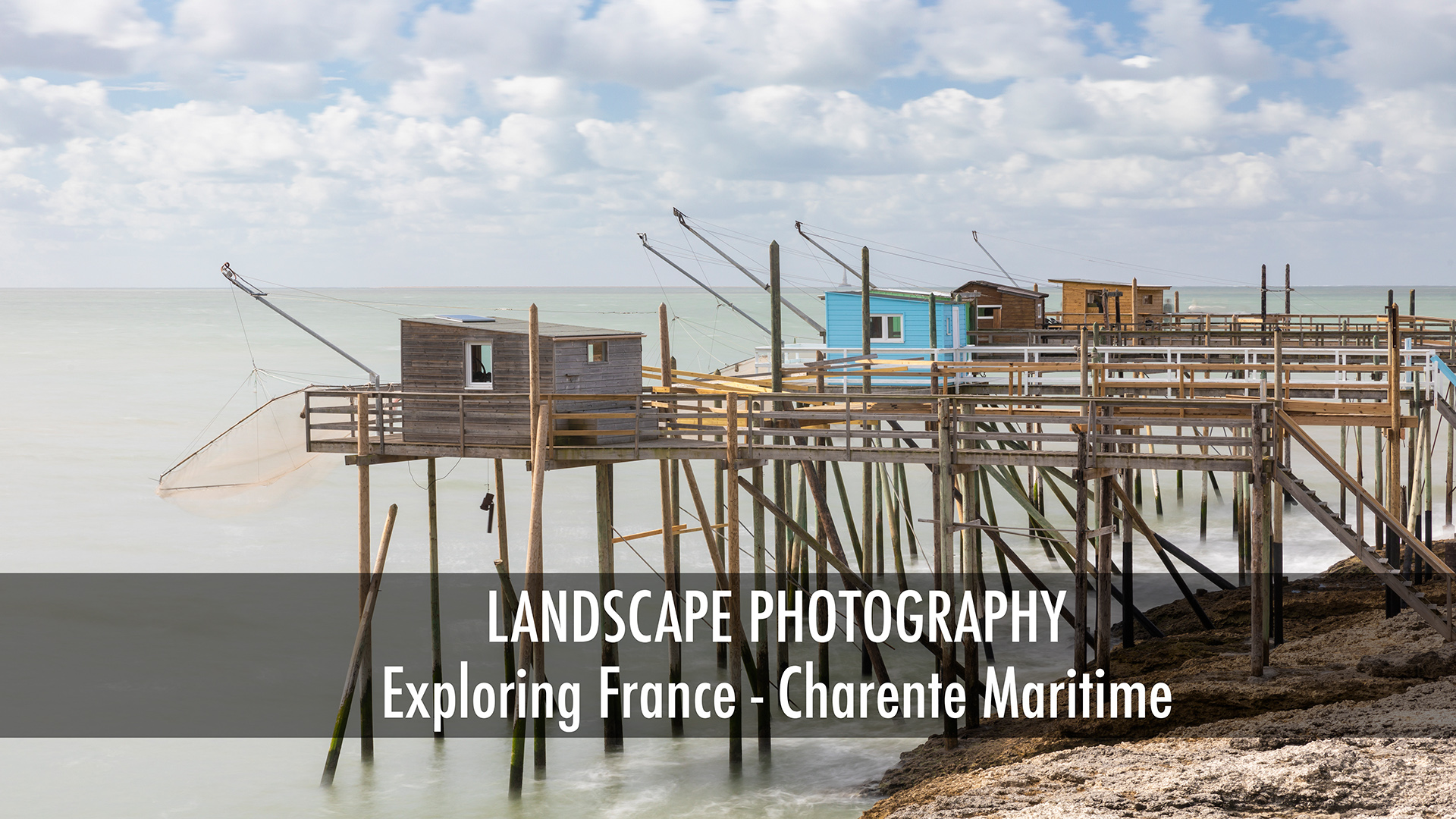

This week’s YouTube vlog on exploring France through landscape photography takes me to the department of Charente-Maritime. As I can’t travel as I normally do due to the lockdown, I’ve decided to get out and discover more of the country that I live in.
With each vlog in the series, you’re going to see how I photographed the department that I visited, as well as how I captured some of what was around me.
The department of Charente-Maritime is on France’s Atlantic coast. There are some excellent opportunities for seascape photography, as well as old towns and architecture, that you can visit.
There’s a lot to do; in each episode, I can only scratch the surface due to time constraints.
The day started fine, although the sunrise didn’t happen. Throughout the day, some nice cloudscapes started coming along, but then it went quite stormy by the end. But still, it was an enjoyable day of discovery.
The day began with a two-and-a-half-hour drive to Saintes in the department of Charente-Maritime. In one sense, it was an easy run, because most of it was straight down the motorway. Still, a drive feels a lot longer when the alarm has gone off at four in the morning, and you’ve been on the road non-stop.
I arrived tired, but Saintes has a way of waking you up. The city has a strong character, and from the first viewpoint, I could already see why it deserved more time than I had given it. I had a vague thought that Saintes might be twinned with my home city of Salisbury. I wasn’t certain, but the thought stayed with me as I looked out across the rooftops.
The cathedral that dominated the view was Saint-Pierre, and even in flat early light, it gave the skyline a clear focal point. Saintes has more than one reason to stop, too. There are the religious buildings, of course, but also the remains of a Roman amphitheatre, with the lower section still there. That alone makes the city feel layered in the best way, as though each period of its past still has a seat at the table.
My plan at first light was simple. I wanted a view over the rooftops, then I intended to go and find the amphitheatre later. Dawn, however, had other ideas.
By eight o’clock, I had made the image I came for, even if the conditions were less exciting than I had hoped. The composition was fairly straightforward. I had the houses in the foreground, the cathedral rising behind them, and a line of roofs that led the eye into the frame.
What interested me most was not the complexity of the composition, but the small corrections that made it work. A tree branch was creeping into the shot, so I shifted the camera slightly to clear it. That small movement mattered. Without it, the frame felt untidy.
I also noticed how different the rooftops looked here. The rooflines were flatter than in other places I often photograph in France, and that changed the feel of the scene. There was also a fair amount of reflection coming off the roof surfaces, so I put on a polariser to cut that glare down. It was one of those quiet adjustments that doesn’t shout for attention, but improves the picture all the same.
The bells of the cathedral rang out whilst I was working, which gave the whole scene more presence. Yet the sky never joined in. A thick bank of cloud sat on the horizon and blocked the sunrise completely. I had seen a hint of colour earlier and thought there might be a decent dawn, but it never arrived.
Some mornings don’t give much back. I still make the picture, then move on and make the most of the next chance.
That was the tone for the rest of the day. I had plenty of daylight ahead of me and a long list of locations still to visit, so there was no point forcing disappointment into the frame.
After Saintes, I headed to another location inland. I spent longer in the city than expected because I found a couple of extra views that caught my eye, and that alone told me I need to go back. Even so, the next stop had been on my list for a long time.
I won’t name the exact place, because I put a lot of time into researching locations and prefer not to hand every spot over on a plate. What mattered more than the pin on the map was the subject itself, a beautiful Romanesque church in an area full of them.
By then, it was around half past ten in the morning, and the light had turned. Autumn had only just started, but that lower, softer feel was already there. It gave the stone a warmth that suits old churches so well.
At first, I worked from slightly farther back. Then I moved forward because there were a few distractions in the foreground, including a pale patch of stone and a bench that pulled attention away from the church. Once again, the real work was in refinement rather than reinvention. I used my 24mm tilt-shift lens for the shot because it gives me the control I want for architecture and keeps vertical lines from leaning all over the place.
I talk about tilt-shift lenses a lot because for subjects like this, they solve a real problem. If I want a church to feel solid and upright, I need the lens to behave with the building, not against it.
I made a photograph that I was reasonably happy with, but the cloud cover never quite settled into the pattern I wanted. Too much cloud flattened the scene and took the life out of the stone. So I waited, hoping the sun would break through for a moment.
It nearly did, then hid again. That kind of stop-start light can test your patience, especially when the composition is ready, and all you need is one clean patch of sunshine.
I wasn’t interested in solving that later on a computer. If a certain cloud shape or burst of light isn’t there, I don’t add it afterwards. That isn’t how I work, and it isn’t how I want to remember a place.
This was the balance I kept dealing with all day:
| Condition | Effect on the photograph |
|---|---|
| Heavy cloud cover | Softer contrast, flatter stone, less separation |
| Brief sunlight | Better depth, more shape in the church facade |
The church was still worth the stop, even without perfect light. In Charente-Maritime, these Romanesque buildings have a quiet confidence. They don’t need drama to hold your attention.
By early afternoon, I had left the inland churches of Charente-Maritime behind and driven out to the Atlantic coastline. Along this stretch of coast, there are traditional fishing huts scattered here and there, and they make brilliant subjects because they sit between man-made structures and the open sea.
The light at around half twelve or one o’clock was fairly harsh, but the sky had enough cloud to stay interesting. I liked the mix of colours as well. A few of the huts had soft pastel tones, and those worked nicely against the more muted sea and rock.
I wanted to slow the water down, though not too much. That decision mattered. Long exposures can be beautiful, but they can also flatten everything into one smooth sheet if you are not careful. On this day, the Atlantic had a nice swell and some lovely patterns in the incoming tide, so I wanted to keep some of that motion visible.
I tried a 10-stop filter first. That gave me a 30-second exposure, and it was too much. The sea lost its character. Then I switched to a 6-stop filter, stopped down to f/16, and ended up at around 3 to 4 seconds. That was far better.
The difference was simple:
| Filter choice | Exposure time | Result |
|---|---|---|
| 10-stop ND | 30 seconds | Water too flat, with less structure in the waves |
| 6-stop ND at f/16 | About 3 to 4 seconds | Softer water, but with wave detail still visible |
That shorter exposure gave me what I wanted. The movement looked controlled without looking empty. For this kind of seascape, I prefer that balance. Water should still feel like water.
From the coast of Charente-Maritime, I headed on to Phare de la Coubre. The drive was short, about 10 to 15 minutes, and I had a clear picture in my head before I got there. I had seen an image of the staircase inside and knew I wanted to photograph it by looking straight up into the spiral.
The staff were kind enough to let me set up a tripod inside, which made all the difference. Better still, there was a table in just the right place, so I could rest the tripod on it and get the camera base aligned neatly for the shot.
By the time I was ready, I was out of breath. There are around 300 steps in that lighthouse, and you feel every one of them on the way up.
Still, the effort was worth it. The composition was simple and satisfying, the staircase circling above me in a clean spiral, drawing the eye round and round into the centre. It is a classic image for a reason. Sometimes a photograph works because the subject already has strong geometry built into it. My job was to keep the framing tidy and let the shape do the work.
I also used my GoPro to show the setup, which helped record the process. Yet the final photograph was all about restraint. It didn’t need extra ideas piled on top. The staircase already had enough rhythm, enough form, and enough pull.
Phare de la Coubre was one of the clearest highlights of the day. If you’re travelling through this part of Charente-Maritime with a camera, it is hard to ignore.
Later in the day, I arrived at a beautiful abbey, but by then the weather had become much less friendly. The wind had picked up hard, with gusts around 50 km/h, and that forced me to scrap two drone locations I had hoped to shoot.
For my Mavic 2, those conditions were simply too rough. There is no picture worth taking if the flight is unsafe. So I dropped the drone plan and switched to what I could make from the ground.
That was the pattern all afternoon, adapting rather than insisting. I waited outside the abbey for the sun to come out from behind the cloud, but the gaps were brief and irregular. I stood there for around half an hour, hoping for a better break, and the light never fully settled.
The abbey itself was still worth photographing. It remains a working abbey, which meant access was limited. I could go into the nave, but not the cloister. That was a shame, because cloisters often give lovely lines, depth and repetition, and I always enjoy photographing them.
Even so, I made an interior image and worked on an exterior view whilst I waited for the cloud to move. I got something usable, though not the picture I had imagined. That happens more often than people like to admit.
The hardest part was not the lack of access or even the wind. It was the teasing quality of the light. The sun looked close to breaking through, then disappeared again. With architecture, especially pale stone buildings, that can make the difference between a good frame and one that feels flat.
In the end, I accepted what the conditions gave me and moved on. Some places ask for a return visit. This abbey was one of them.
During the final stop in Charente Maritime, the sky had turned heavy and threatening, and I wasn’t sure how the last part of the day would end.
Even so, the reason for stopping was obvious. Another beautiful Romanesque church stood there, and it fitted the wider mood of the trip. This part of France has them everywhere. You can spend a day moving between old stone facades, towers, arches and quiet village squares, and never feel short of subjects.
What struck me at that final stop was something small but memorable. For the first time all day, I saw another photographer out working. That sounds odd, but when I’m travelling around parts of France like this, I often don’t cross paths with many others carrying cameras.
The sky looked grim inland, though farther west, towards the coast, there seemed to be breaks in the cloud. I still had one more place in mind, and I wasn’t sure whether it would work when I got there. Sometimes the weather gives you a final gift. Other times it shuts the curtain early.
Either way, the day had already given me enough.
What I liked most about this journey through Charente-Maritime was the variety. Saintes gave me rooftops, history and a cathedral skyline. The inland roads brought Romanesque churches and soft autumn light. The Atlantic coast changed the pace with sea air, fishing huts and moving water. Then the lighthouse added a strong graphic subject, before the abbey and final church brought the day back to stone and weather.
It was also a reminder that a good photography day does not depend on a perfect sunrise or easy conditions. My dawn never arrived. The wind killed the drone plan. The cloud blocked the light more than once. Yet the day still worked because the places themselves were rich with possibility.
That is often what I find in France. If I keep moving, keep looking, and stay open to change, the photographs begin to gather on their own terms. Charente-Maritime gave me exactly that kind of day, one that asked for patience, rewarded curiosity, and left me wanting to return.
We noticed you're visiting from United Kingdom (UK). We've updated our prices to Pound sterling for your shopping convenience. Use Euro instead. Dismiss