 Skip to content
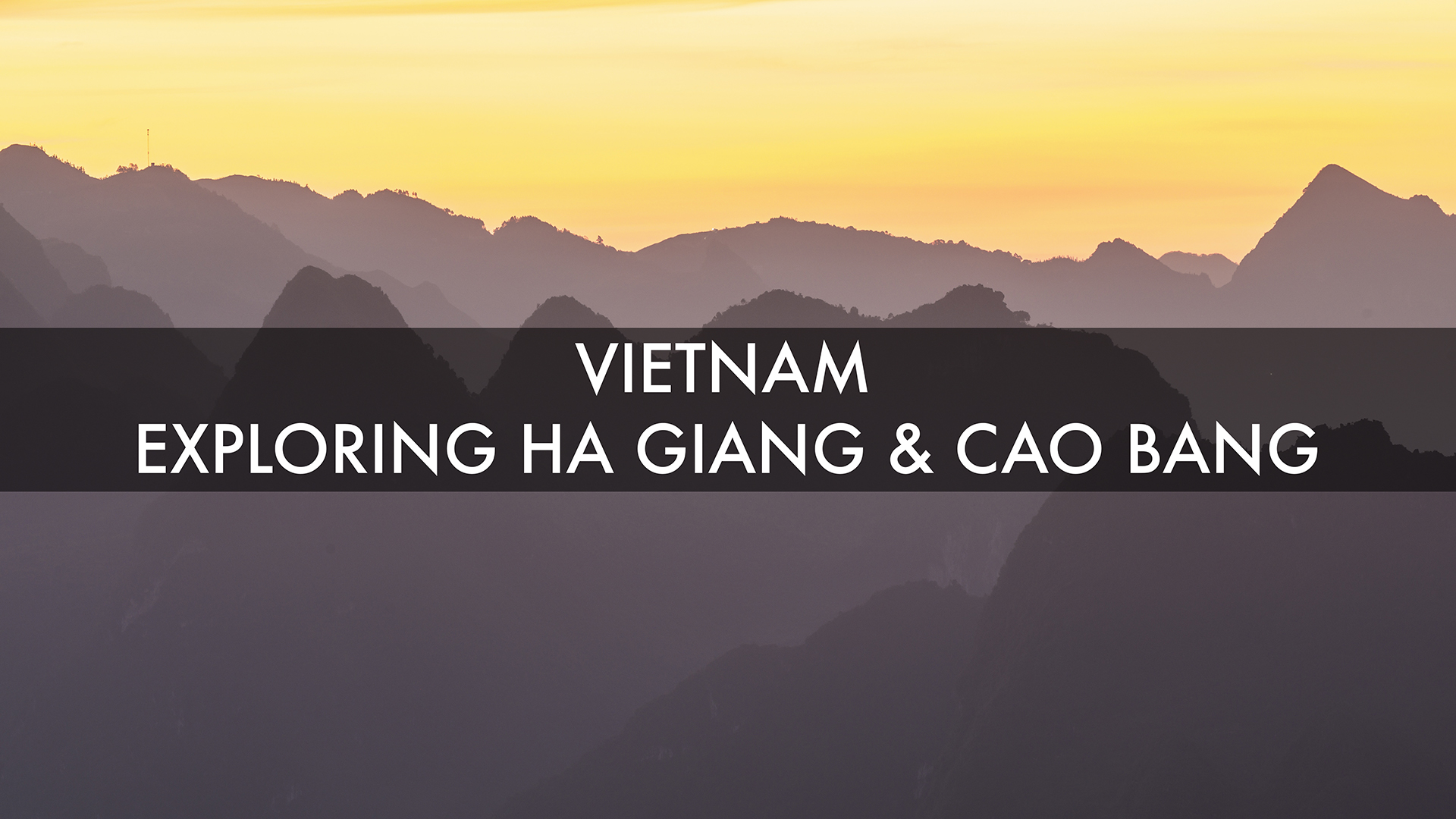

Exploring Ha Giang and Cao Bang in Northern Vietnam is the latest vlog from my travels to this stunning country.
Vietnam has much to offer photographers and certainly those, like me, who are dedicated to travel photography.
In early November I made my way up to the north of the country which borders China. Two provinces were given a little exploration but I would have loved to have had more time.
Enjoy a little of an area of Vietnam that isn’t inundated with photographers.
My YouTube channel is dedicated to all things landscape and travel photography so if that’s your thing then I’d love to have you come along for the ride.
My first proper morning in Ha Giang began with one of those views that doesn’t need much explanation. I looked down into a mist-covered valley, with the sun only just peering over the ridge, and the whole scene felt half hidden and half revealed.
That balance is what made it so good. The mist kept shifting, the sun slowly started to pick out small groups of trees, and every few minutes the photograph changed. I had my 24-70mm on the camera with a polariser, and that was enough for the scene in front of me. I didn’t need anything complicated. I only needed to stay still and watch the light move.
This was also my first time exploring this part of northern Vietnam in depth, although I wasn’t on my own. I was with my guide, Trang, whom I’d worked with before. She knows the north well from her motorbike work, and although some of these exact spots were new to her too, that mix of local knowledge and shared curiosity made the scouting process far better.
I could already see why this area belongs in my Vietnam photography tours. Ha Giang has scale, atmosphere, and daily life all close together, which is exactly what I look for when I travel with a camera.
I stayed at that first overlook longer than I had first expected. The valley had more mist when I arrived, then the sun started to come through and touch parts of the slope in narrow bands. A few illuminated trees were enough to hold the frame together.
Nearby, another view opened out towards a river and a run of distant hills. With a longer focal length, it became a study in layers, dark foreground shapes, lighter ridges behind, and then soft silhouettes fading into the background. That sort of scene rewards patience because the difference between a flat frame and a strong one can be ten minutes.
There was another detail I loved. One ridge line in the distance marked the border with China. That gave the whole view an extra sense of place. I wasn’t only looking at a beautiful valley in Ha Giang, I was standing at the northern edge of Vietnam, with another country just beyond the hills.
Travel photography is rarely tidy, and that became clear once we pushed on towards the mountain pass between Ha Giang and Cao Bang. We couldn’t get straight through because the road had been blocked by a major rockfall. Workers had even used explosives to clear part of it, and I caught the end of that operation as we arrived.
So we waited with everyone else. Cars, motorbikes, and local traffic all held in place on a mountain road whilst the route reopened. I always enjoy these moments, not because delays are pleasant, but because they become part of the memory of a place. The photographs matter, but so do the stories that come with them.
That road itself was part of the attraction. Even before I reached the viewpoint, I could see a ribbon of tarmac twisting through the mountains in tight turns. I’ve seen dramatic roads in other parts of the world, including the Dolomites, but this one had its own character. It looked almost improbable from above, as if someone had drawn it straight onto the hillside.
From the parking area, I walked up to the viewpoint with only one lens. For me, the 24-70mm was the right choice again. Carrying a full camera bag on that path would have been a poor decision, because the route was rough, uneven, and slippery in places, even though conditions had been dry.
The walk itself wasn’t the problem. The condition of the path was. At points, it narrowed, dipped, and tilted enough to demand attention with every step. I could see why this view has become an icon of the area, but I could also see the risk.
I loved photographing this pass, but I wouldn’t take a group up there. The path was too uneven, and the chance of someone slipping felt too high.
Once I reached the viewpoint, the scene was worth the effort. The pass coiled back on itself below me, the mountains rose in folds beyond, and the afternoon light worked well across the road. From the top, I could also see that the obvious stopping place wasn’t enough. I had to move higher to clear a roofline and open the full view.
That is often the reality of mountain viewpoints. The famous frame is only part of the job. Getting into the right position safely matters just as much.
In Cao Bang, the trip shifted from grand views to something more intimate. We found a small village where women were making incense by hand, not as a show for visitors, but as part of daily work. I could have stood there for ages simply watching. The repeated movements, the colour of the materials, and the rhythm between the people working made the whole scene hypnotic.
This is the sort of place where I slow down at once. I don’t want to rush in and point a camera at people before I’ve understood what is happening. So I watched first. I paid attention to how the women worked, how they interacted, and how the light was falling around them.
For this set of portraits, I used my Canon 5D Mark IV with the Canon 24-70mm F2.8 L Mark II. I also had a reflector, and Trang helped me by blocking some harsh light that was hitting the ground and the lower part of the frame. That small change made the scene easier to handle.
At one point, I was lying low on the floor to get the right angle as one woman worked with an axe nearby. Because this was their home, not a staged space, every detail mattered. The tools, the doorway, the way one family member glanced at another, all of it added to the frame.
I also liked showing people the photographs afterwards. It changed the mood at once. There was curiosity, then smiles, and then a sense of shared interest rather than distance.
Cao Bang gave me plenty outside the main subjects, too. Around the village, I spent time with local children, exchanged greetings with people heading out to the fields, and worked with the little Vietnamese I know. Even a few words can break the ice.
That mattered more than perfection. I wasn’t trying to make a performance out of the interaction. I was simply acknowledging people properly, and in return, the atmosphere became warmer and more open.
For photographers, that is one of the best things about rural northern Vietnam. The pictures are there, of course, but the human side is what gives them depth. A child coming over to see the camera, a farmer passing on foot, a mother and daughter working side by side, those details shape the day as much as the mountain views do.
Later in the trip, I reached the great waterfall on the border, with China visible across the river. It was one of those places where the scale does most of the talking. Even without dramatic weather, the falls had presence, and the afternoon was a good chance to experiment with longer exposures.
I spent time comparing filter strengths and watching how the water changed in the frame. A polariser helped first, then I worked through stronger neutral density options to extend the shutter speed and smooth the flow.
I had neutral density filters in the bag for that session, and the effect changed quickly as I increased the strength.
The main point for me was simple. The waterfall gave me several different photographs from the same position, and each one depended on how much motion I wanted to keep.
The border setting added something I hadn’t thought about until I stood there. On the Vietnam side, it was one time, and across the river in China, it was an hour later. That small fact made me smile. Borders can feel abstract on a map, but in places like this, they become tangible in an instant.
The setting around the waterfall also reinforced something I’d felt throughout the trip. Parts of Cao Bang still feel lightly visited, at least compared with the better-known stops in Vietnam. There are tourists, yes, but there is also room to work, observe, and spend time with scenes that still feel rooted in local life.
That mix is one reason I enjoyed this area so much. I could move from long-exposure landscape work to travel portraiture without ever feeling I had left the character of the place behind.
On my last morning of filming in northern Vietnam, I went up to a beautiful temple for sunrise. The setting had all the promise in the world, but cloud along the horizon blocked the best of the early light. It was one of those frustrating moments every photographer knows well. You get yourself into position, the place is right, and the sky refuses to cooperate.
Even so, the previous evening had given me some good light across the temple, so the stop wasn’t wasted. That is another part of working on the road. One session may disappoint, but another, hours earlier or later, often saves the location.
After the temple, I returned to the waterfall area, this time to photograph from what I understood to be the older entrance path. From there, I could look down the route towards the falls and make a longer lens composition from above.
That angle worked well because it gave the scene shape. The path led the eye forward, the water sat further back, and the frame felt different from the broader views I’d made the day before. I also had to stay aware of a government building nearby, so positioning mattered.
By then, the trip had reached that familiar point where I knew I was at the end of one phase of the journey, even though more work still lay ahead. As far as the landscapes of Ha Giang and Cao Bang were concerned, I felt I had seen a side of Vietnam that many photographers still miss.
I didn’t need a huge amount of equipment in northern Vietnam. In fact, the trip reminded me how often a simple setup works best when the terrain is awkward and the light changes fast.
A few items carried most of the load:
The pass viewpoint was the best reminder of all. There are times when carrying less isn’t a compromise; it is the sensible way to work.
Ha Giang gave me atmosphere and scale. Cao Bang added people, border stories, and quieter rural moments. Put together, they showed me a side of Vietnam that felt generous, varied, and still full of space for photography.
What stays with me most is the mix of mist, mountains, and human life. One hour I was waiting for sunlight to touch a ridge near the China border, and the next I was lying on the floor in a village house photographing incense makers at work. That range is what made the journey so strong.
For me, northern Vietnam isn’t only about dramatic roads or famous viewpoints. It is about how quickly the grand and the personal sit side by side, and how rewarding that is when I have a camera in my hand.