 Skip to content

The Châteaux of the Loire are famous worldwide and rightly so. From old medieval fortresses such as those at Chinon to more stately castles dotted around the area, they make great subjects for both landscape and travel photography.
In this latest episode from my YouTube channel, I show you three castles in the Indre-et-Loire department of France. I’ll show you three castles that probably haven’t been on your list of places to visit, but hopefully, you’ll change that with these beauties. This central area of France plays host to some 144 castles that are registered as historic monuments.
With this series, I aim to introduce some of the well-known as well as lesser-known castles that are here in central France. Do be aware, though, that not all of them are accessible to the public and remain behind high walls sealed off from public gaze. But those that are visible will be covered where I can.
And if you’re interested in discovering the Loire Valley with a camera, then do check out my annual Loire Valley photo tour in May.
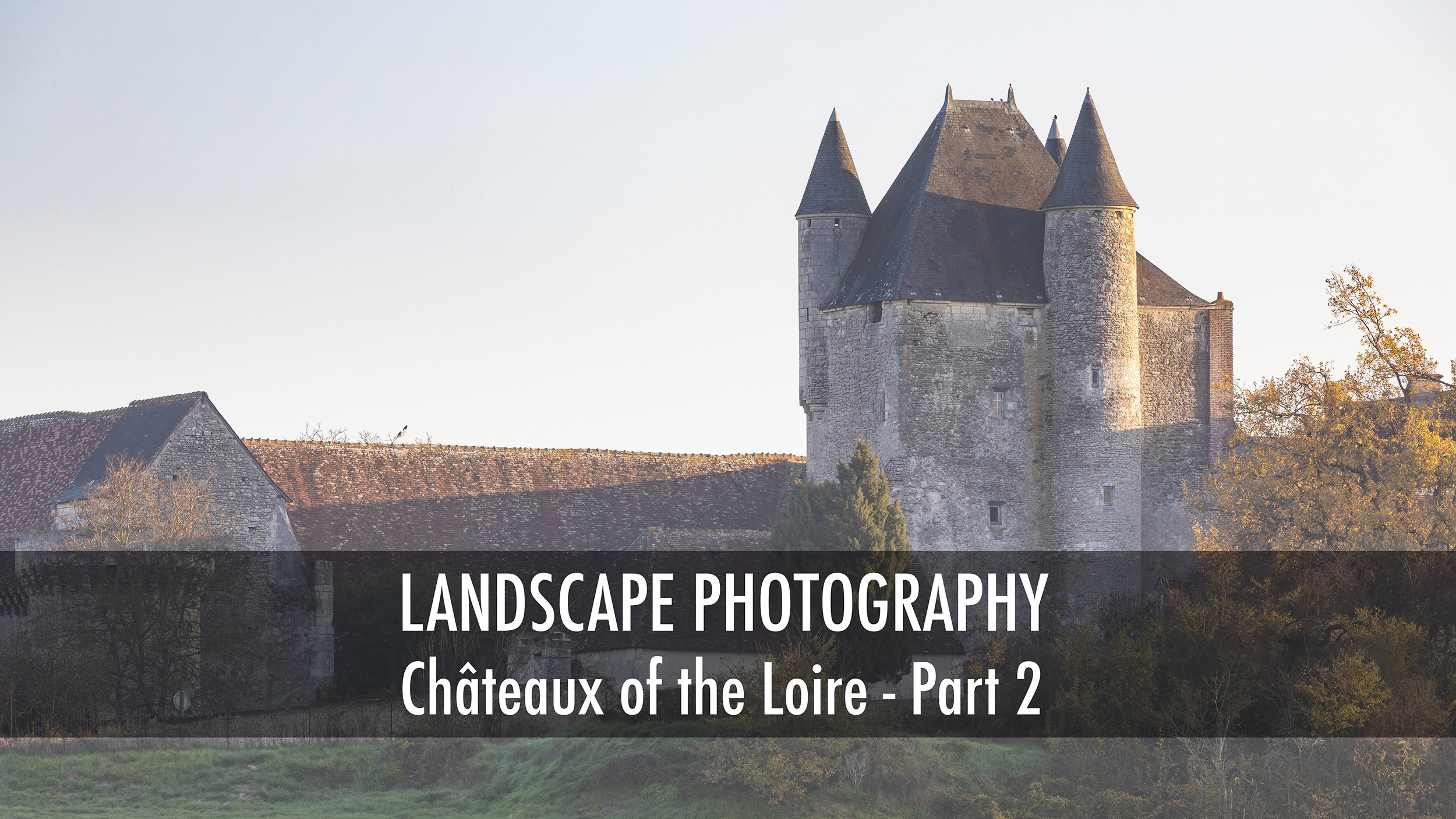
Montresor is one of those places that feels generous to photographers. I arrived on a bitterly cold winter morning, parked easily off the roadside, and walked to a viewpoint where two castles sit close together. One is the Renaissance castle that most people notice first. Beside it is the 11th-century castle, older, rougher and more defensive in character.
That pairing says a lot about the Val de Loire. The region is a UNESCO World Heritage Site for good reason. It is not only about grand showpiece châteaux. It is also about layers of history, where one period sits beside another, and the whole setting still feels tied to the river, the village and the land around it.
At first light, the scene was washed in a soft pink dawn. The sunrise was off to one side, so I had enough contrast in the sky to think carefully about exposure. My first setup was simple: a 24-70mm lens on the camera, framed towards the Renaissance castle. Because of the angle, I knew I would need a touch of vertical correction later, but not enough to worry me. I would much rather accept a small correction than force a filter into a scene where it does not belong.
A graduated filter would have cut into the trees. In this case, blending exposures was the cleaner choice.
The river in front of the castle gives me an obvious compositional option, a full reflection. Whether I include all of it depends on what I want the photograph to say. Some mornings, the reflection is the point. At other times, it is extra information that weakens the frame.
When I looked at the scene in Montresor, I had two clear choices:
In a landscape format, I could include more of the river and show the reflection as part of the setting.
In a portrait format, I could give more weight to the height of the castle and the trees around it.
I leaned towards the wider feel of landscape orientation because the river helped anchor the castle. Even so, I did not feel I had to keep every inch of reflection. The shape of the building mattered more than ticking a box marked “complete mirror image”.
I could also have gone wider, but that would have reduced the castle’s presence. When a building sits high on a slope and carries that much visual weight, I prefer to move in closer. I treat it much like a mountain. I want it to feel large and confident in the frame, not pushed backwards by too much empty space.
The older castle in Montresor is larger and far older, but it is harder to photograph well from ground level. From where I stood, the foreground was cluttered and unhelpful. Frost on the ground added texture, but it was not enough to rescue the mess of shapes and distractions below the hill.
So I changed tactics and fitted a longer lens, working at around 135mm. That focal length let me compress the scene and isolate the castle against the slope. It was a cleaner, more respectful way to photograph it.
When the foreground is full of distractions, I do not force it into the picture. A long lens often gives the subject the dignity it needs.
From that lower position, I felt the main weakness of the shot was the angle. The castle sits on a defensive hill, which means the strongest view would likely come from somewhere higher up. A drone might have opened up options, but I was not prepared to risk flying there without being certain of the rules and permissions. In a village setting, caution matters.
There was also some scaffolding on the older castle because of repair work. Thankfully, it was limited. Even so, to my eye, the Renaissance castle was still the stronger subject that morning. The medieval fortress had presence, but the combination of angle, clutter and repairs made it more of a record shot than a fully satisfying image.
My second Châteaux of the Loire was Château de Bridoré, a 14th to 15th-century castle that rises above the village. What caught my attention here was not only the building itself, but the fact that its intact defences are said to be unusual in France. It has a tougher, more military feel than many of the refined Loire chateaux people know best.
I did not go right up to the castle, even though it sits close to the road. The better photograph at that time of day came from outside the village, looking from the south-west towards the north-east. The sun was in the right place and cast light across the face of the castle with far more shape than I would have had from close range.
That is one of the recurring lessons with architecture. Nearer is not always better. Sometimes the best way to photograph a castle is to step back until the structure starts to sit properly in the land.
This was a proper telephoto shot. I needed more than 200mm, and on a full-frame camera, I would want a 100-400mm lens to frame it well from that public path. A crop-sensor body would make the job easier, but on a full-frame camera, there is no getting away from the need for reach.
Because the central keep rises so strongly, portrait orientation made the most sense to me. The vertical frame gave the keep room to dominate the composition without wasting space to either side.
I kept the process straightforward. There was no need for a complicated breakdown of the back-of-camera settings because the composition did most of the work. The key choice was position, not technical trickery. Once I found the right place, the photograph became simple.
For photographers who enjoy this sort of trip through central France, my Loire Valley photography tours focus on exactly this mix of castles, villages and strong viewpoints.
The final Châteaux of the Loire of the day was Château de Leon, a 14th-century castle set above a village with an abbey below. It is one of those hilltop scenes that feels made for a camera. The castle sits clearly above the roofs, and the village gives the whole place context without stealing attention.
This is also the sort of place I would tell any visitor to put on their list, even without a camera. There is more than one reason to stop:
the castle above the village
the abbey below
the wider setting on the hillside
I was not certain whether the interior of the castle was open to visitors, although there was an information board near the entrance that would explain the access details on site. For photography, though, the main challenge was clear before I even raised the camera. I was looking up at the building from below, and that meant converging verticals would be severe with a standard wide-angle lens.
For this view, I fitted a 24mm tilt-shift lens. That choice had one purpose: to keep the castle looking upright and believable.
Without the shift, the walls and towers would have leaned backwards as soon as I tilted the camera up. That sort of distortion can work in some scenes, but it rarely flatters a historic building. With the camera level and the lens shifted upwards, I could keep the verticals under control and hold the proper shape of the architecture.
This is one of the reasons I return to tilt-shift lenses so often when photographing castles and churches. They let me preserve the sense of height without making the building look as though it is falling away from me.
A normal wide-angle lens would have given me the coverage. It would not have given me the same discipline in the lines.
A tilt-shift lens does not change the subject. It lets me show the subject without the camera distorting it.
Leon also needed a little more care with exposure. The morning light was striking one outbuilding much more strongly than the rest of the scene, and that bright area pushed the histogram hard. If I exposed for the highlights, I lost too much in the darker parts of the castle and village. If I exposed for the shadows, the lit wall blew out.
So I treated it the same way I had treated Montresor at dawn. I took multiple exposures and planned to blend them later. It is not the kind of scene where I would reach for a grad filter with much confidence, because the architecture and surrounding shapes are too uneven. Exposure blending gives me far more control and avoids ugly transitions.
The useful thing about this viewpoint is that it is not limited to one narrow moment. I photographed it in the morning, but the subject itself could work at different times of day as long as the light shapes the stone well. What mattered most was not the hour on the clock, but the direction and intensity of the light on the building.
This short run of locations reinforced several things I already knew about photographing the châteaux of the Loire. First, the region is incredibly rich, but access is uneven. In Indre-et-Loire alone, there are about 144 castles. Yet only around a third are easy to photograph from public roads, paths or places that make practical sense. Many sit behind high walls, private woodland or seasonal access restrictions.
That is worth remembering if you are planning a route. France may have around 6,000 castles across different periods, but the number you can photograph well on any single trip is much smaller. Access, angle and light matter every bit as much as the name on the map.
These were the biggest technical takeaways from the day:
A long lens is often the best answer when the foreground is messy, or the castle sits awkwardly on higher ground.
Exposure blending is often cleaner than using a graduated filter around trees, roofs and broken skylines.
A tilt-shift lens is a huge help when I am forced to shoot upwards at a building.
Early and late light still matter most, because stone needs shape and direction to come alive.
I also came away reminded that not every castle gives the same reward. Some locations hand me an obvious composition within minutes. Others ask me to accept that the best view is not available from where I stand. That is part of the work. It stops me from trying to force a photograph that was never there.
This morning reminded me why I keep coming back to the Châteaux of the Loire. In a few hours, I moved from pink dawn light and river reflections to defensive walls and a hilltop castle that needed careful control of perspective. That variety is the region’s great strength.
The strongest lesson was not about gear. It was about placement. When I stood in the right spot, the picture became clear. When I accepted the limits of a location, the photographs improved.
That is what keeps the châteaux of the Loire so rewarding. They do not all give themselves away at first glance, but when the light, angle and lens choice line up, they are hard to beat.
We noticed you're visiting from United Kingdom (UK). We've updated our prices to Pound sterling for your shopping convenience. Use Euro instead. Dismiss