 Skip to content
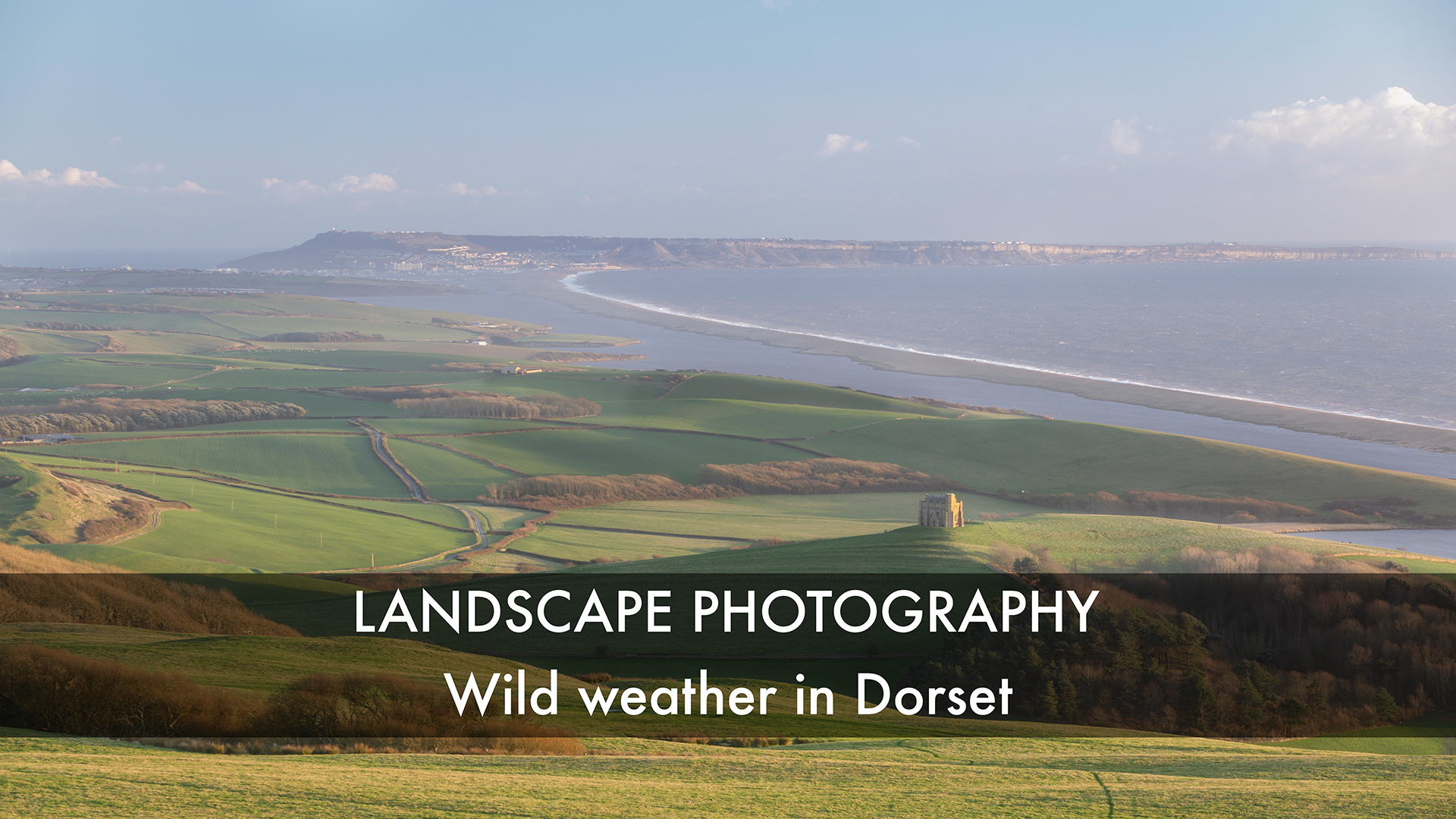

My latest YouTube vlog sees me photographing wild weather in Dorset on the 10th December 2018 during a day spare on a brief visit to the UK.
Never one to miss an opportunity, I thought I’d go out and about. Dorset was an obvious choice for me as I was staying in Salisbury. But of course, the British weather likes to have a say too, and the forecast was wrong.
High winds that were supposed to subside during the day only got worse. Although mentioned in the vlog about visiting Portland Bill to see the waves, it wasn’t worth it. The waves were crashing on Chesil Beach but not around the Bill.
And if you’re interested, I offer photography tours and workshops in a variety of destinations around the world. If you’re interested in learning more from me to help you get the best out of your photography, then get in touch.
I started the day at Knowlton Church, right on the Dorset and Wiltshire border. Sunrise was the plan, although “sunrise” was doing a lot of work that morning. It was wet, windy and cold, and the light never fully settled into anything generous. I could see the sun trying to push through in the distance, but each gap in the cloud was brief, and the wind was so strong it was shaking everything, including the gimbal.
Even so, Knowlton Church is a place I always enjoy visiting. There is a strange feel to it, and that probably explains why it has such a reputation. It’s often described as the most haunted place in Dorset, with stories of ghosts and spectres hanging around the ruined church and the earthworks that surround it. Whether you believe any of that or not, it certainly has presence, and in poor weather, that mood becomes even stronger.
I’d been there before and had made a sunrise image I liked around eight years earlier. I still want to re-process that older photograph at some point. Returning to a location like this is always interesting because it reminds me that places change, but so do I. My eye changes, my standards change, and sometimes the picture I once liked no longer feels finished.
For that first shot of the day, I had a Canon 5D Mark IV fitted with a Canon 24mm TS-E Mark II L, plus a Canon 1.4 Extender Mark III. I was around f/11, with an exposure of roughly one second, and the setup gave me an angle of view closer to about 35mm. I had also tried a wider view at 17mm to include more of the earthwork ring, but it felt too wide, and the church lost its strength.
The gear matters, of course, but only up to a point. Settings on their own never teach you how a place feels, and they don’t teach you what to do when the weather turns awkward.
The key to landscape photography is getting out there and experiencing it.
I believe that more each year. Too many people spend too much time watching other photographers instead of going outside themselves. If you want to learn, get out in the cold, get out in the rain, get out when the forecast is wrong, and make your own photographs.
After Knowlton, I took my friend over to Win Green, another spot on the Dorset and Wiltshire border. It is a lovely location, and on the right day, the views are superb. On this day, the scene had potential, but not much more than that. Heavy cloud kept sliding over the sun, the light stayed flat, and the northerly wind grew harsher rather than calmer.
That mattered because one of the hardest parts of photographing wild weather is knowing when not to bother. It can be tempting to unpack the camera because you’ve driven the distance, climbed the hill, and invested the time. Still, if the light is dead and the scene isn’t saying anything, forcing a frame rarely helps.
At Win Green, I looked at the conditions and decided it wasn’t worth getting the camera out. That wasn’t a defeat. It was the right call.
Because I don’t live in the UK any more, trips like this are often short and fixed around whatever time I have. As a travel photographer, I take what the day gives me. Sometimes that means making the best of difficult conditions. At other times, it means accepting that a good location is not enough on its own.
The weather forecast had promised the wind would ease later in the day. Instead, it got worse. The cloud thickened too. That is winter photography in Britain in one neat lesson. Forecasts are useful, but they are never a guarantee.
By the time we reached the Dorset coast, the day still felt unsettled, but at least the sea had energy. I went up to the viewpoint above Chesil Beach, the one you reach by turning left at the roundabout as you come up the hill on the road from Weymouth towards Portland Bill. From there, the view opens right out, with Chesil sweeping away and the Fleet stretching inland.
The wind was savage. It was strong enough that I took the camera off the tripod whilst I was filming, because I didn’t fancy watching it blow across the viewpoint. That sort of condition changes how you work straight away. You stop thinking about slow, careful tripod work and start thinking about body position, shutter speed and how little time you want to spend with the camera exposed.
Still, the sea looked promising. Waves were crashing in from the English Channel and, from a distance, they had real shape and force. The light also improved for a spell. I began to think less about the classic shot from up there and more about a wider composition that showed more of Portland and the Fleet.
The pattern was simple; I kept adapting. Some locations gave me nothing. Others gave me half a chance, and half a chance is often enough if I stay patient.
From the viewpoint, the plan was to head down to Portland Bill for lunch, then see whether the lighthouse, Pulpit Rock and the sea around the Bill were worth photographing. In weather like that, those subjects can look dramatic, but they can also become impractical or unsafe.
That day, the strongest wave action was on Chesil Beach, not around the Bill itself. So, although Portland Bill was on the schedule, it didn’t produce the picture I wanted. Sometimes the sea looks wild from one part of the coast and strangely flat from another, even over a short distance.
This is another part of photographing wild weather that people don’t always see. The day isn’t a straight line from one perfect scene to the next. It is often a process of checking, rejecting, moving on and keeping enough energy for the place that finally works.
The final stop was St Catherine’s Chapel, and this is where the day came together. The chapel sits high above the coast, with Chesil Beach curling away in the background, Weymouth off to one side, and Portland Bill out on the far end of the strip of land. On a clear evening, it has a huge sense of space. Even with gusts still coming through, it felt like the best chance I had.
There is a parking spot close by, and from there it would have been easy to step out of the car, walk a few paces and take the obvious shot. Plenty of people do exactly that, and fair enough, it works. But I wanted to see whether a higher viewpoint would give me something better.
So I followed the public footpath up the hill. My friend stayed down by the car because of an ankle problem, but I carried on alone to see how the shape of the land changed. That short climb made all the difference.
From higher up, I could separate the chapel from the land below it. Down by the roadside, the view compresses the lower ground, and the chapel doesn’t stand apart as clearly. From the hill, the building lifted into the frame and had more presence.
For this composition, a wide-angle lens would have made the chapel look too small. Yes, I could have included foreground detail, including a weather-beaten tree lower down the slope, but the chapel would have lost its role in the image. I wanted the structure to matter.
So I used a long lens to pull the chapel into the frame and hold it in context with the coast behind. That is often the difference between a record shot and a proper composition. The wider view tells you where you are. The tighter view tells you what matters.
I also placed the chapel off-centre, though not strictly on a rule-of-thirds point. That was deliberate. If I’d pushed it too far across, I would have brought in too much visual clutter on the other side of the frame. Composition is not about obeying a grid. It is about deciding what deserves space and what doesn’t.
Once the chapel was in the right place, the rest of the frame began to work around it. Chesil Beach ran diagonally through the scene, and that diagonal gave the image its movement. Diagonals are powerful because they carry the eye through a frame without feeling stiff. Here, that long shingle bank linked the chapel to the wider coastline and gave the picture structure.
The sky, on the other hand, was less helpful. Earlier in the day, I had seen more cloud on the horizon, but the wind had blown much of it away by evening. That left me with a cleaner, simpler sky than I would have liked. Still, the sidelight on the land was lovely, and it gave the scene enough shape to hold together.
One small choice improved the shot a lot; I put a polariser on the front of the lens. Turning it cut through the haze and gave the fields more saturation. It also helped the smaller details in the scene stand out, the hedges, roads and zigzagging lines across the land all became easier to read.
That is the kind of change that can look minor in isolation but becomes important once the whole frame is working. When the sky is quiet, the land has to do more of the work. Every line, tone and shift in colour counts.
By then, the wind had eased a little compared with earlier stops, although it was still gusty. I stayed there until sunset because the composition had enough strength to deserve the wait.
A day like this strips photography back to the basics. Forecasts can fail, conditions can turn against you, and some locations simply won’t give you anything when you arrive. That doesn’t mean the day is lost.
Three lessons stood out for me:
Because I no longer live in the UK, I don’t get endless chances to revisit Dorset on a whim. That makes these trips feel more urgent, but it also sharpens my thinking. I have to work with what is in front of me, not what I hoped would happen.
Once this trip was done, my next stop was Scotland for a Glencoe winter workshop. After that, there were more plans for an Isle of Skye photography workshop, a Tuscany photography tour, a Provence photo tour and a Dolomites landscape photography tour.
I also kept updates on my main website and newsletter, along with regular posts on Instagram and Facebook. After a day like this, that connection matters because not every photography day is clean or easy, and that is part of why I enjoy it.
The best moment from this Dorset trip didn’t come from the cleanest light or the easiest location. It came after a string of compromised stops, a wrong forecast and hours of wind that kept changing the way I worked.
That is why I keep going back out. Wild weather forces me to pay attention, make better decisions and stop relying on routine. When the conditions are awkward, I don’t get lazy, and sometimes that is when the strongest photographs appear.