 Skip to content
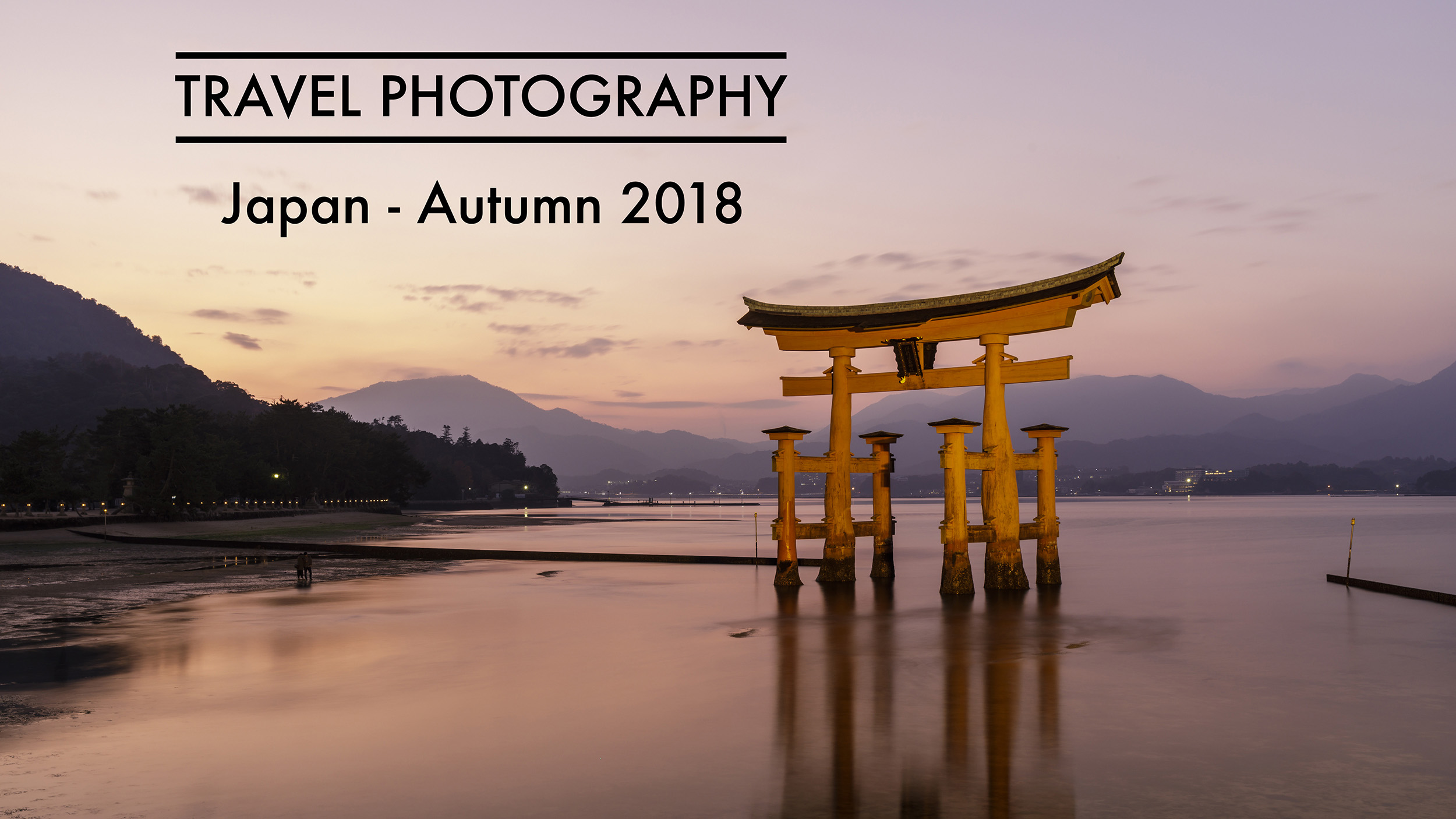

Travel Photography – Japan Autumn 2018 is my latest YouTube vlog detailing some of my exploits as I travel to various parts of the world.
The end of the year saw me travel halfway across the World photographing Japan in Autumn.
During 12 days, I found autumn colour aplenty in Kyoto. Amazing cityscapes in Osaka. A beautiful lake with many temples and a strategically placed torii gate as well as going to the island of Miyajima.
Now, as it was my first time there, I was concentrating more on my work rather than vlogging. So this is a half-and-half job whereby there is half a vlog and then the last part is some imagery and footage from some of the places I visited.
And if you’re interested, I offer photography tours and workshops in a variety of destinations around the world. If you’re interested in learning more from me to help you get the best out of your photography, then get in touch.
Some locations stay with me long before I ever set foot there. This was one of them.
I had found this lakeside temple a couple of years earlier and had seen only a handful of photographs of it. That made it more appealing, not less. When a place hasn’t been photographed to death, there is still room for surprise, and there is still room to feel that you have found something for yourself.
The morning I arrived, the weather was dull, heavy and overcast. Many people would have looked at that sky and wished for sunshine. I didn’t. The flat cloud, the soft light and the quiet feel of the lake gave the whole place a mood that suited it perfectly. The old temple sat on the edge of the water with that slightly unreal feeling some Japanese scenes have, where architecture, history and weather all seem to settle into one frame.
I had already been in Japan for three days by then. I was staying in Osaka, photographing temples and city architecture, and I planned to head back there later in the day if the weather lifted. Still, standing by that lake felt different from anything I had photographed so far on the trip. Walking through the small town and arriving by train, I had the strong sense that I was probably the only Westerner around. That made the whole visit feel more personal and a little surreal.
What I loved most was how little fuss there was. The entry fee was modest, around the equivalent of £3, and the reward was this centuries-old building sitting quietly by the water. A thin patch of light showed on the horizon, but I barely noticed it. I had waited two years for this view, and the conditions in front of me felt right.
At the temple, I knew the photograph I wanted before I put the tripod down.
I was using my Canon 5D Mark IV with a 6-stop ND filter and a polariser. The polariser helped remove the sheen from the surface of the water, and the ND filter gave me the shutter speed I needed. My Benro GD3WH head and Benro TMA38CL tripod kept everything stable for a 30-second exposure.
That long exposure did two simple things. It smoothed the water and gave a little movement to the clouds. I didn’t want anything overworked. I wanted the scene to stay calm and believable, with the old temple holding the frame together whilst the lake and sky softened around it.
This is where I think the weather can change the whole feel of a photograph. Bright sunlight would have given me detail and contrast, but it would also have pushed the image in a different direction. On that morning, the cloud flattened the light in a way that made the temple feel older, quieter and more isolated. That was far closer to the image I had imagined.
I often find that anticipation sharpens my focus. Because I had waited so long to get there, I wasn’t chasing endless options. I had one clear idea, and the conditions supported it.
That matters more than people sometimes think. A strong image often comes from recognising when a place is already giving you what you wanted.
Later, I moved further down the lake and found another scene that caught my attention, a torii gate standing near the water by the side of a main road.
This wasn’t the famous gate at Miyajima, the one that appears in so many photographs of Japan. It was another gate, less known and less celebrated, at least from a Western point of view. Most of the people I saw around me were Japanese visitors. I think I only saw a couple of Western cyclists pass through the area.
The weather still looked poor, which suited me again. So I made another long exposure.
A long exposure is only a technique. The effect can be beautiful, but the photograph still has to work without the label.
I feel strongly about that because people often attach too much meaning to gear or process. A long exposure does not turn a picture into “fine art”. In this case, it gave me smoother water, softer cloud and a more settled atmosphere. That was enough. I wasn’t trying to make the image sound bigger than it was.
For this frame, I switched to the 70-200mm lens. I added a 6-stop ND filter and a 1-stop ND grad to hold back a little brightness in the sky. On the rear screen, I set live view to black and white, which helped me judge shape and balance without colour distracting me.
The composition was precise. I wanted the top bar of the torii gate to sit neatly across the frame. I also had to control the mountain shapes in the background, because one of them pulled attention away from the subject. Another smaller mountain, seen between the uprights of the gate, gave me a stronger arrangement and helped tie the background to the foreground.
Then one small detail made the frame better. A bird landed on the edge of the gate and stayed almost still. That little presence gave the picture life and scale. It changed the photograph from a clean study of form into something more memorable.
Once I had that image, I knew I was done. I packed up, faced the half-hour walk back to the station, and headed for Osaka with a dead phone battery and a good frame on the card. In black and white, the shot felt right for the day. I could see a colour version working too, but the moody monochrome matched the scene in front of me.
Back in Osaka, I returned to a temple complex I had visited a few days earlier. The first time I had been there, it was around 9 in the morning, and I had already taken the photograph I had come for. Still, I wanted another look.
I often do that when I can. A second visit rarely gives me the same feeling as the first, but it can show me details I missed or confirm that the earlier frame was the best one. Both outcomes are useful.
On this return visit, I wasn’t convinced there was a stronger wide shot to be made. The larger scene was difficult because of the city around it. Once the sun rose above the high buildings, the light became less helpful, and the structure I wanted to photograph needed a cleaner perspective than I could manage with the lens I had.
That became obvious when I tried to make one of the images work. What I really wanted was a 50mm tilt-shift lens. Without it, I knew I would have to rely on perspective correction in Photoshop or Lightroom to get closer to the frame I had in mind. That’s fine to a point, but there are times when the right lens makes the difference between an acceptable file and the picture you truly wanted.
Even so, going back mattered. It reminded me that photography isn’t only about finding new places. Sometimes it is about checking your first instinct against the reality of a second visit. If the image still holds up, you can move on without doubt. If it doesn’t, you might find something quieter and better in the details.
After a few days in the country, a few practical things stood out straight away.
That last point stayed with me throughout the trip. On the train, I had one person say hello, which was a small thing but a warm one. In Osaka, when I first arrived at Shin-Osaka Station, I got completely lost. Five men from a delivery company helped me find my way, even though I spoke no Japanese and they spoke no English.
That kind of help changes how a place feels. It removes the hard edges of travel and makes the unfamiliar easier to carry.
I also came away thinking that the basics matter. A short greeting, a thank you, and a bit of patience made most interactions easier. Nothing about the trip felt hostile or closed off. Quite the opposite, in fact. Japan felt open, polite and generous, even when I was struggling with the language or trying to work out where I was going next.
One of my favourite Osaka moments came whilst wandering near the castle complex.
I found a scene that pulled together two things I wanted from this trip: autumn colour and modern city architecture. In the lower part of the frame, I had rich leaves in seasonal colour. In the upper part, I had the high-rise buildings of Osaka, stacked behind them with that dense urban feel I had wanted to photograph for years.
I’ve always admired Asian city skylines. There is a scale and rhythm to them that is hard to ignore, especially when they sit behind an older park or historic site. In this case, the contrast worked well because the foreground felt soft and seasonal, whilst the background felt sharp and built up.
Technically, the scene needed a bit of care. I had a polariser on the lens, and there was enough difference in brightness between the foreground and the sky that I decided to blend two exposures later. The sun was more or less behind the camera, so I could have reached for a graduated filter, but I wanted finer control than that. I also didn’t want the risk of an awkward transition line in the frame.
So I made the two exposures with blending in mind and kept the composition simple. That was the right call. It let me hold the colour in the leaves and keep the city from washing out, which gave me the balance I wanted.
That picture mattered to me because it felt like a small piece of the trip coming together. I had come to Japan in autumn, hoping for that mix of season, place and structure, and Osaka gave it to me.
Some mornings on the road feel lost before they begin. You look out, see the colour building in the sky, and know you have almost no time.
That happened to me on the way to Himeji. I could tell the dawn had real potential, and for once, I was close enough to do something about it. I got off the bullet train, checked how long it would take me to reach the viewpoint, and realised walking would cost me the shot. So I took a taxi, showed the driver the map, and got up the hill with only about three minutes to spare.
It was absolutely the right decision. I made the photograph and started the day with that sense of relief only photographers know, where the rush, the lack of sleep and the tight timing all feel worthwhile because the frame is there.
Himeji itself had been on my list for obvious reasons. The castle is one of Japan’s most recognisable landmarks, and I had another reason to visit, too. If, like me, you grew up with the older Bond films, Himeji Castle also carries that extra link to You Only Live Twice.
I had permission to photograph around the castle later that day, which made the visit even more exciting. I was also still trying to catch autumn colour in south-west Japan, so Himeji offered both a major subject and the chance of seasonal detail around it.
After my dawn shoot on the hill, I met a local amateur photographer called Makoto. He was a businessman on his way to work, but each morning he climbed the hill for exercise and for the view. He suggested another vantage point near the base of the castle, from a car park that offered a clean line towards the building. That sort of encounter is one of the best parts of travel. A local doesn’t hand you a secret in some grand way. He simply points you towards something useful because he knows the place.
The climb itself had been tiring. I had gone up a long staircase in the dark at around 4 in the morning, and I hadn’t had much sleep. Still, by then I knew the day had promise. I was due to meet someone around 9 o’clock to go into the castle, and I had also found a monastery in the hills that I hoped to visit before the day was over. My rough plan was to explore it around midday, come back down, and then return for sunset in the hope of catching side light on the castle.
Cloud mattered again. I wanted some, but not so much that the whole afternoon turned flat grey.
The car park view Makoto suggested was not glamorous. It was a practical place, slightly elevated, with a few distractions around it. Yet it gave me a clean view towards Himeji Castle, and sometimes that is all a photograph needs.
I set up the Canon 5D Mark IV with the 70-200mm at around 135mm. That focal length brought the castle closer and helped me crop away the mess around the edges, including a roof that I didn’t want in the frame. The sun was over my left shoulder, so I didn’t need a grad filter. What I did need was discipline, because the composition only worked if I stayed tight on the main subject.
The air was hazy, which meant I could already see part of the processing path in my head. I knew I would probably add a touch of dehaze later, put a little more blue into the sky, and perhaps work the file more than usual to help the final image along. I don’t do that often, but this was one of those scenes where a careful edit could help restore what the haze had softened.
I had hoped for stronger colour in the trees at the base of the castle, but there wasn’t much I could do about that. On the western side, though, I could see a Japanese garden that looked far richer in autumn colour, and I was keen to get there if time allowed.
By that point, I had settled into the rhythm of the trip. Long train journeys, early starts, small adjustments, and brief conversations with strangers all fed into the work. It also reminded me why I enjoy planning Japan photography tours, because the mix of temples, city scenes, autumn colour and chance encounters gives me more than one kind of photograph in a single trip.
What stayed with me most from this journey was not one single image. It was the feeling of finally standing in places I had imagined for years, then finding that grey skies, haze and awkward timing often gave me more than clear blue weather would have done.
Japan in autumn gave me old temples by still water, a quiet torii gate, Osaka’s hard lines against soft colour, and the rush of making dawn in Himeji by a matter of minutes. More than that, it gave me the kind of mood I had hoped for long before I ever boarded the plane.
That is why this trip still matters to me. The best photographs came when I stopped asking for perfect conditions and paid attention to the atmosphere already in front of me.
We noticed you're visiting from United Kingdom (UK). We've updated our prices to Pound sterling for your shopping convenience. Use Euro instead. Dismiss