 Skip to content
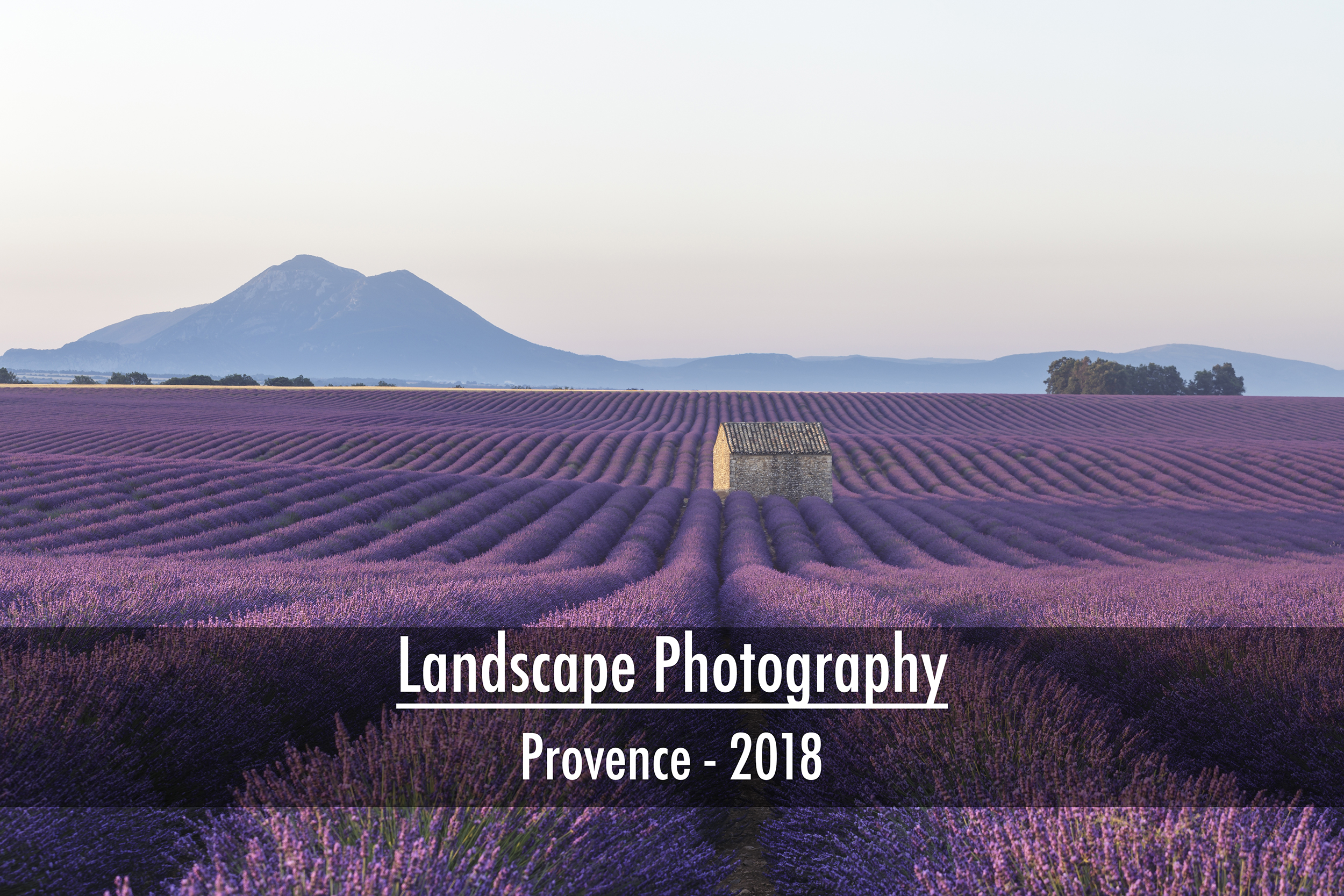

Landscape Photography – Provence 2018 is my latest YouTube vlog detailing some of my exploits as I travel to various parts of the world.
Provence. The very word conjures up images of lavender and old rustic villages.
Each year in July, this southern corner of France becomes a mecca for people wanting to see the endless lavender fields on the Plateau de Valensole. But there is more to see than rows of this fragrant purple flower. The aforementioned villages can offer up many things to photographers, such as doors and windows or even lazy cats that lounge around in the heat of the day.
This year, David Clapp and I hosted our first Provence photo workshop together, and we split our time between two parts of the area. The first took in the Plateau de Valensole, and this is where you will get those classic shots of lavender fields. We do visit some of the surrounding villages, but for most workshop attendees, their priority is the lavender fields.
For the second part of the photo tour, we base ourselves near Avignon. Avignon is, of course, on the agenda with its stupendous Palais des Papes, but again, there are other things that we take people to, such as old abbeys and abandoned villages.
And following on from the success of this Provence photography tour, we’ve launched Provence 2019, so if you’re interested in joining us for a week of photography in this beautiful corner of France, then check out the photography workshop page for more details and the dates.
Our first full day began in a small village near Manosque, and the heat hit us early. Rather than race straight to the headline locations, I like to ease people into Provence with somewhere more intimate. A village like this gives me a chance to slow the pace, get everyone looking carefully, and remind the group that good photographs do not always need grand views.
I was there with David Clapp, who was out walking with some of the others on the Provence photo tour, whilst I wandered with one participant through the lanes. We were looking for the kind of subjects that make these villages so rewarding: old doorways, worn shutters, textured walls, faded paint, and those little pockets of shade that break up the hard midday light.
That kind of session matters because it tunes the eye. In a famous landscape location, it is easy to stand where everybody else stands and make the obvious frame. In a village, I have to work a bit harder. I look at shape, colour, repetition, and small details. I pay attention to how the light falls across a doorway, or how a pale wall throws back warmth into the shadows.
For me, Provence is not only about sweeping views. It is also about these quieter corners, where age and colour sit together so naturally. The villages in the south of France have a softness to them, even when the light is harsh. Stone reflects warmth, paint fades gently, and every alley seems to offer a new arrangement of lines and tones.
That is why I often begin a photography workshop this way. It gives everyone a chance to settle in, shoot without pressure, and see how much is available before we even reach the fields.
Street photography in a village like this is a good reset. People stop worrying about whether they have found the biggest scene, and they start noticing what is in front of them. That is useful on any photography tour, because patience and observation matter as much as location.
I also find that these early walks help the group get comfortable with each other. Cameras come down more often, people talk, compare what they are seeing, and ask questions without feeling rushed. By the time we head out to the bigger landscapes, there is already a shared rhythm.
In Provence, the subject changes fast, but the best results still come from slowing down and seeing properly.
If I had to sum up this workshop in one word, it would be colour. Provence in summer gives me colour in blocks, bands, and layers. Yellow sunflowers sit against blue sky, lavender runs in long lines through the fields, and the warm tones of the villages tie everything together.
The sunflower session brought that home straight away. We took the group out into the fields with the flowers backlit, and that backlight made all the difference. Once the sun catches the edges of the petals, the flowers start to glow. That is when I like to show people how much range there is in the same location.
Some frames worked with long lenses, because they let me compress the field and isolate a single head or a cluster of blooms. Other frames worked at close range, where macro details became the subject, the centre of the flower, the curve of a petal, the way the light picked out tiny textures. I spent time taking people through those choices so they could move beyond the obvious wide shot.
For me, that is one of the pleasures of teaching in a place like this. A sunflower field is simple at first glance, but once I start paying attention to the direction of light, focal length, and distance, it opens up. I can shoot graphic patterns one moment and intimate detail the next.
Backlit sunflowers can look messy if I am not careful. The trick is to keep the frame clean and decide early what the picture is about. Sometimes I want a single flower standing proud with the light wrapping around it. Other times, I want a dense field of repeating shapes, where one flower pulls focus, and the rest create rhythm behind it.
Long lenses help because they simplify. They let me cut out distractions and pull distant flowers together into tighter patterns. Close-up work does the opposite in a good way, because it makes me study texture and form. Both approaches are useful, and showing that contrast is a big part of how I teach these sessions.
The wider setting, of course, is what brings so many photographers here in the first place. The Plateau de Valensole has become one of the best-known areas in Provence for good reason. When the lavender and sunflowers are both working, the place feels saturated with summer.
That popularity is easy to understand. Everywhere I look, there is a subject with strong shape and clear colour. Even so, the challenge is to make something personal rather than copy the same frame everyone else is making.
That mix of iconic scenery and room to experiment is why I keep returning on my guided photo tours in Provence. The famous views are there, but the real reward comes when I start looking past the postcard version and work the scene properly.
By the middle of the trip, the days had begun to blur in the best way. At one point, we were standing in a lavender field debating whether it was day three or day four, and somebody confirmed it was Wednesday, 4 July. It felt much later in the week, mostly because those early starts and long sessions make time stretch.
That is often a good sign on a photography workshop. It means we have been full of light, weather, conversation, and miles on foot. It also means the group has relaxed enough to stop treating the schedule as sacred. When everyone is up before dawn in a lavender field, the only thing that really matters is whether the light is doing something interesting.
One of the participants, who had come from Sacramento by way of Ascot, was wearing a hat that made her an easy target for a bit of banter. A few minutes later, she was my model, pressed into service as a teaching aid. That kind of moment says a lot about the trip. We were working hard, but nobody was trying to make the workshop feel stiff or over-serious.
Dawn had already passed by about fifteen minutes when we were out there shooting, and the field still looked gorgeous. Lavender at that hour has a softness that disappears quickly once the sun gets higher. The colour holds, the lines stay clean, and the whole place has room to breathe before the crowds arrive.
I remember glancing across the field and spotting another photographer, or perhaps an aspiring Instagram star, planted somewhere ahead of us. There is always somebody chasing their own version of the same scene in Provence. I never mind that. Places this good are meant to attract people.
Meanwhile, our group kept working, laughing, and getting on with it. Gillian was having a lovely time, and that summed up the mood. We were there to make strong photographs, but we were also there to enjoy the place and each other’s company. That balance matters. When a photography workshop becomes too tense, people stop seeing.
The atmosphere that morning felt right for Provence. The field was calm, the light was kind, and nobody was pretending that photography had to be solemn to be taken seriously.
The last part of the photography trip to Provence gave me a reminder I always value. Even here, even on a good photo workshop, not every plan works. One of our final mornings began with a long drive and a fair bit of hope. We had moved away from the busy Plateau de Valensole, and I was looking for weather with a bit more drama.
We headed towards Mont Ventoux, but the mountain sat behind clouds and refused to give us the stormy scene we had hoped for. That sort of thing happens. I can do the planning, get people out early, and read the conditions as well as I can, yet the sky still makes the final decision.
The disappointment was real because a long journey with no reward can drain the energy from a morning. Still, I never want to let one missed scene define the session. If the original idea fails, I keep looking.
That is exactly what happened when we came across a small old windmill. It was not the dramatic weather shot we had set out for, but it gave us a subject with character, form, and a sense of place. Once I started working with it, the mood shifted. The frustration of the drive began to lift because we were making pictures again.
The sequence of that morning was simple:
I like that lesson because it is honest. Good photography is not only about finding perfect conditions. It is also about adapting fast when the plan falls apart. In a workshop, it matters as much as technical skill, because the people travelling with me need to see that a disappointing start does not mean the day is finished.
That windmill became our answer to a difficult morning. We had gone a long way and nearly came away empty-handed, yet by staying flexible, we found something worth shooting.
When I look back on this trip, I do not think first about kit or settings. I think about how varied Provence felt over a short stretch of days. One moment, I was wandering through a village near Manosque looking for old doors. Next, I was standing in front of backlit sunflowers, then ankle-deep in lavender at dawn, then trying to salvage a cloudy morning with a windmill.
That mix is what makes the region so good for photographers. I can teach composition in a village, focal length choices in the fields, and adaptability when the weather turns against us. The place does not force me into one kind of picture.
I also come away remembering the people. Working with the group, the banter in the lavender, the participant in the hat turned into a model, and Gillian clearly enjoying herself, all of that is part of the experience. A workshop lives or dies on atmosphere as much as scenery.
For me, the best trips are the ones where strong pictures and good humour sit side by side. Provence gave us both.
What stays with me most is how Provence keeps rewarding attention. The famous fields are there, and they are every bit as striking as people hope, but the quieter moments matter too: the village walls, the backlit petals, the missed storm, and the old windmill that saved the morning.
That is why I keep returning. In a few days, I can move through colour, texture, weather, and people, and each part of the trip asks me to see a little differently.