 Skip to content

My favourite images of 2019 is my latest YouTube vlog detailing some of my exploits as I travel to various parts of the world.
The year 2019 was an incredibly busy one. Traversing the World from Europe to Asia and back again. Many miles were travelled and many people and their cultures were taken in.
From getting stuck in Vietnam to watching Mongolian eagle hunters at work. I haven’t seen it all, but I’ve definitely had my horizons broadened yet again.
This video is both a small showcase for some of the places I’ve been to, as well as a look over what I feel are some favourite images from the year. And do take note that I said favourite and not best. Why? Because whenever I travel, I always come back with many stories.
So do take a look and do comment. And here’s to 2020 as it’s already shaping up to be a blast!
Finally, if you want to see where I am heading next or join me in the field, details sit on my Photography Tours & Workshops page. That is where I keep the current trips and workshop information together.
My first pick came from Glencoe in the north-west of Scotland, and it remains one of my strongest memories from 2019. It was the first proper good day that a client and I had on that trip, and the light felt clean, calm and promising.
The day before, we had met another photographer who dismissed the coming conditions as “boring”. I remember chuckling to myself. When I photograph a place, I am not always chasing drama for its own sake. I am often trying to make images that work, images that have a chance of selling through the agencies that represent my work. Good light does not need to shout.
This scene was near the more famous waterfall below Buachaille Etive Mor, a spot so popular that the ground around it has taken a beating. Instead of settling for the obvious view, we scrambled down to a smaller, less-known waterfall. It took a bit more effort to reach, but that was part of its charm.
To the right sat the bigger fall, but compositionally, it never felt convincing. The foreground became too messy, and the balance with the mountain behind it was weak. So we moved up the stream, found a rock that immediately made sense, and I said to my client, “If you want the image, that’s the image.”
What made that frame hold together was not one dramatic feature, but several quiet ones working in step. The rock in the foreground had a diamond shape, and the upper edge of it ran diagonally towards the mountain on the right. That line almost cut through the frame and gave the whole scene structure.
I also liked the water because it did not need the usual treatment. A lot of people love long exposures with rushing water, but I do not apply that approach by habit. In this case, the flow was already gentle, gliding over the rocks in a calm way, so I kept the shutter around a quarter of a second. That was enough to soften the water without stripping out all of its texture.
It was shot around midday, which surprises some people. In a Scottish winter, middle-of-the-day light can work beautifully, especially in places where the sun takes time to clear the mountains. The scene was well-lit without feeling harsh.
When I look back at my Scottish work from that year, this is one of the images that rises straight to the top. It has shape, stillness and memory, and that is often more than enough.
One of my favourite city images from 2019 came from Osaka, viewed from Tsutenkaku Tower. There are several viewpoints across the city, but this one gave me the right mix of height, density and atmosphere.
Getting the shot was not as simple as stepping onto an observation deck and pointing the camera. The first level was enclosed, and the glass sat at such a steep angle that it was difficult to press the lens against it cleanly. Higher up, there was an open-air platform, which solved one problem and introduced another, because that section closed at around six in the evening. Timing the visit mattered.
I went back there several times. By the end, the staff had started to recognise me, and I was grateful that they turned a blind eye to the tripod. Without it, making a night-time panoramic image with traffic trails would have been much harder. The final frame was built from several shots, and it carried the look I love in Japanese cities once dusk falls, high-rises, neon, roads threading through the blocks, and that slightly futuristic glow that Osaka wears so well.
This image stays with me because of the persistence behind it. I had to return, wait, and work with the constraints of the tower. Those efforts became part of the photograph.
Tokyo gave me another favourite, this time from Shibuya Scramble. Most people know the crossing at once. It is one of the most photographed places in the city, and that alone can make a picture feel too obvious. Yet this frame meant a lot to me because of the technical problem it solved.
The view came from the station, looking down over the crossing. Between me and the scene were two obstacles, glass and a fine metal grille. Both could ruin the shot. To reduce the effect of the grille, I worked at f/4, as wide as I could, and I also used an Allen’s camera skirt to block stray reflections around the lens. A polariser helped as well.
The finished image was a blend of two exposures in Photoshop because the adverts and surrounding lights pushed the dynamic range hard. That part of the city glows from every direction, so one frame rarely holds everything cleanly.
Even now, when I look back at that image, I remember how improbable it felt. I returned to try it again later in the year and could not quite repeat what I had managed the first time. That first visit to Tokyo also brought a good friendship with another photographer who showed me different parts of the city. So whilst the composition itself may not be complex, the memory and the technique behind it make it one of my favourite images from the trip.
I returned to Japan in April because I wanted cherry blossom photographs. In truth, Tokyo was not the best place for that, and Kyoto would probably have suited me better. Still, I spent time around Mount Fuji and had the freedom of a car, which gave me far more flexibility than most visitors get.
The day before this photograph, the whole area was hit by a heavy snowfall. That was unusual for mid-April, and it transformed the scene. By the following morning, traces of that fresh snow still clung to the hills, whilst Fuji itself rose behind them with its own familiar white cap.
This was a classic panoramic composition with a straightforward rule-of-thirds structure. Sometimes the classic solution is still the right one. I made the image before sunrise because once the sun came up fully, the contrast became brutal. The eastern face of Fuji caught the light, the snow flared bright white, and the balance of the scene collapsed.
I did not make field notes then, and I still rarely do. I prefer to stay in the act of photographing. From memory, I used no ND filter here, probably only a polariser. What I do remember with certainty is why I kept this frame. It was quieter than the obvious blossom scenes, and it felt more complete. It also came from an area near Lake Kawaguchi, which remains one of the most rewarding places to photograph Mount Fuji.
Oddly enough, I had not put this one up for sale at the time. Some images take longer to find their place, even when they are favourites.
March 2019 was one of the busiest months I had all year. I was in the UK twice, spent a few days in Berlin, headed to Mongolia, and then went back to the Highlands of Scotland for Lewis and Harris. Out of all that movement, one image from Mongolia still hits me the hardest.
I photographed this eagle hunter during the March eagle festival in the Altai. Most people know the autumn version of the festival, but the spring event is smaller and, for me, more intimate. The hunter sat in front of me wearing a fox-skin coat, whilst his eagle tore at meat in his arms. We did not share a spoken language, yet he gave me time and patience, and that mattered.
What I love most is how little in the frame belongs to the present day. There is no modern object shouting for attention. There is just a man, his bird, and the open country around him. Because of that, the image feels untethered from a date. It could have been made years ago, or far earlier.
Mongolia also changes the way I work. At the eagle festival, travel photography starts to brush against sports photography, because so much of the event depends on action, timing and position. Beyond the festival itself, the country gives me something I value more and more, space. You can travel for long stretches there and feel how lightly humans sit on the land.
That sense of scale, along with the culture and generosity I experienced, is why Mongolia keeps pulling me back.
Not every memorable image from 2019 came from a long-haul trip. One of my favourites was made about ten minutes from my house, looking across the village and chateau of Luynes in the Val de Loire.
Living in a place like this has one big advantage: I can watch the weather, wait for the right pattern, and react quickly. On this evening, the light did exactly what I hoped it might do. The sun dropped below the cloud before disappearing beyond the horizon, and that brief window sent a streak of warm light across the scene.
I shot it on my Mavic Pro, and the final image came from two RAW files blended in Photoshop. The horizon is flat, so the blend was simple and clean. I was not trying to squeeze every ounce of drama out of it. I wanted it to look natural, because that is how I remember it.
The broader area is often labelled the Loire Valley in English, which is fair enough in a general sense, but I have always liked the more precise feel of Val de Loire. Around Luynes, the land has a true valley form. It dips down across the plain and rises again towards places such as Villandry.
That geography matters, but so does restraint. I did not want to over-process the file or push it into that heavy HDR look that so often strips a real scene of its credibility. We are all bombarded by pictures every day, and I think a photograph still has power when it looks believable. This one did, and because it was so close to home, it means even more to me.
I went to Austria in July 2019 to do work for a client in the mountains. After that, I took the chance to visit Vienna, a city I had wanted to photograph for years. One rainy day, I headed into the Austrian National Library.
The first visit did not go smoothly. Staff saw the tripod and stopped me at the desk. I had to leave it there, which left me working from a tiny tabletop tripod on the floor. I made a few pictures, but they were not the ones I wanted.
Then luck stepped in. On my way out, I met a photographer who was using a tripod inside the library. She worked there, and after a quick conversation, I was pointed towards the right office. I explained what I wanted to do, paid the required fee, and arranged to return the next day. At first, they refused my request to photograph from the upper level. I pushed back a little, politely, and in the end, they relented.
From above, the room opened up beautifully. It felt almost like looking down the nave of a cathedral. The top corners were filled with lines from the bookcases, the lower corners echoed that pattern, and the balcony near the lower third pulled the eye into the room. Above it all sat the fresco, giving the upper part of the frame weight and detail.
I used a Canon 5D Mark IV with a 24mm tilt-shift lens to build a slightly panoramic view. When I look at that image now, I still remember both the fight to get access and the relief of finally making the frame I had seen in my head.
A month later, I was in the Netherlands working for a client near Zaanse Schans, north-west of Amsterdam. The famous windmills are no secret, but the conditions still decide everything.
The previous morning, I had made a similar image. The client liked it, but a band of cloud on the horizon had blocked the rising sun, and I knew it could be better. We had already waited two weeks for the weather to line up for that job, so I was not about to settle if I had another chance.
The next morning my train ran late. I watched the time slipping away and knew sunrise would not wait. As soon as I got off at the station, I ran to the windmills, reached the location out of breath, set up fast, and made the picture before the sun climbed too high.
It is not the most dramatic image ever made there. I have seen moodier and more atmospheric conditions from that spot. Still, this frame means a lot to me because it shows the mindset I need when I am working for a client. If I know I can improve a shot, I should try.
It also reminds me how good that area feels before the crowds arrive. By nine in the morning, tourists begin to fill the paths. Earlier than that, the place feels calm, almost hushed, with locals moving through their routines and the mills holding the skyline.
In September 2019, I was in Vietnam working for a travel company based in Hanoi. Like many photographers, I headed north with thoughts of Sapa and golden terraces. The problem was timing. Much of the rice around Sapa had already been harvested, so instead of rich yellow fields I found muddy, stripped-back slopes.
A local guide told me the place I really wanted was about four hours farther south. He shared details, I got in touch with the company, and within a couple of hours, they had arranged a private driver. It was not expensive either, around EUR40 to EUR50 for the day, which felt more than fair for the access it gave me.
That journey turned into one of the highlights of my whole time in Vietnam. The area was far more rural, and on the road down, I did not see Western tourists at all. By the evening, it was mostly me, my driver, and another traveller I met there, a man from Slovakia who helped point me towards the exact spot.
We arrived as the sun slipped behind the mountain in the background. Then the sky lit up with colour, and the terraces took on that soft, layered depth I had hoped for all along. The panoramic format suited the valley. The curve of the river pulled the eye through the frame, and the terraces created diagonals on both sides.
This is one of those photographs that captures why I still love making landscape work. When it comes together, the image can make someone stop and say, “I want to go there.” I had messages afterwards asking where it was and how to reach it. That response told me the photograph had done its job.
My time in Vietnam stretched longer than planned because of an issue with my MacBook Pro and a recall that left me stuck there for a while. After spending two nights in Da Nang sorting practicalities, I chose to return to Hoi An. It was simply a place I preferred. It had more character, more people to photograph, and more life in its streets.
Whilst I was there, I made friends with a woman who worked in the local tourist office. One day, she offered to take me out on her scooter to see if we could find some pictures. We crossed to one of the islands linked to the mainland and moved through a village where daily life still set the rhythm.
At one point, I asked her to stop because I had spotted an elderly woman tending her garden. We made a few photographs there, then another inside a workroom, but that frame was softer than I wanted. Then the woman sat on a bed in the front room, a space that seemed to double as a bedroom, and the whole scene changed. Light came through the window and fell across her face and the blue wall behind her.
That was the image.
I had left my flash back at the hotel, so I put the camera on a tripod and asked my friend to explain that I needed the woman to stay as still as possible. She did exactly that. I shot at around ISO 1250 and roughly f/5.6, and the frame held.
Afterwards, she thanked us, gave me a cup of tea, and we spoke for a while. It was one of the kindest moments I had in Vietnam. When I think about my favourite portrait from that trip, this is the one I return to, not because it was staged, but because everything in it arrived honestly, the room, the colour, the light, and her calm presence.
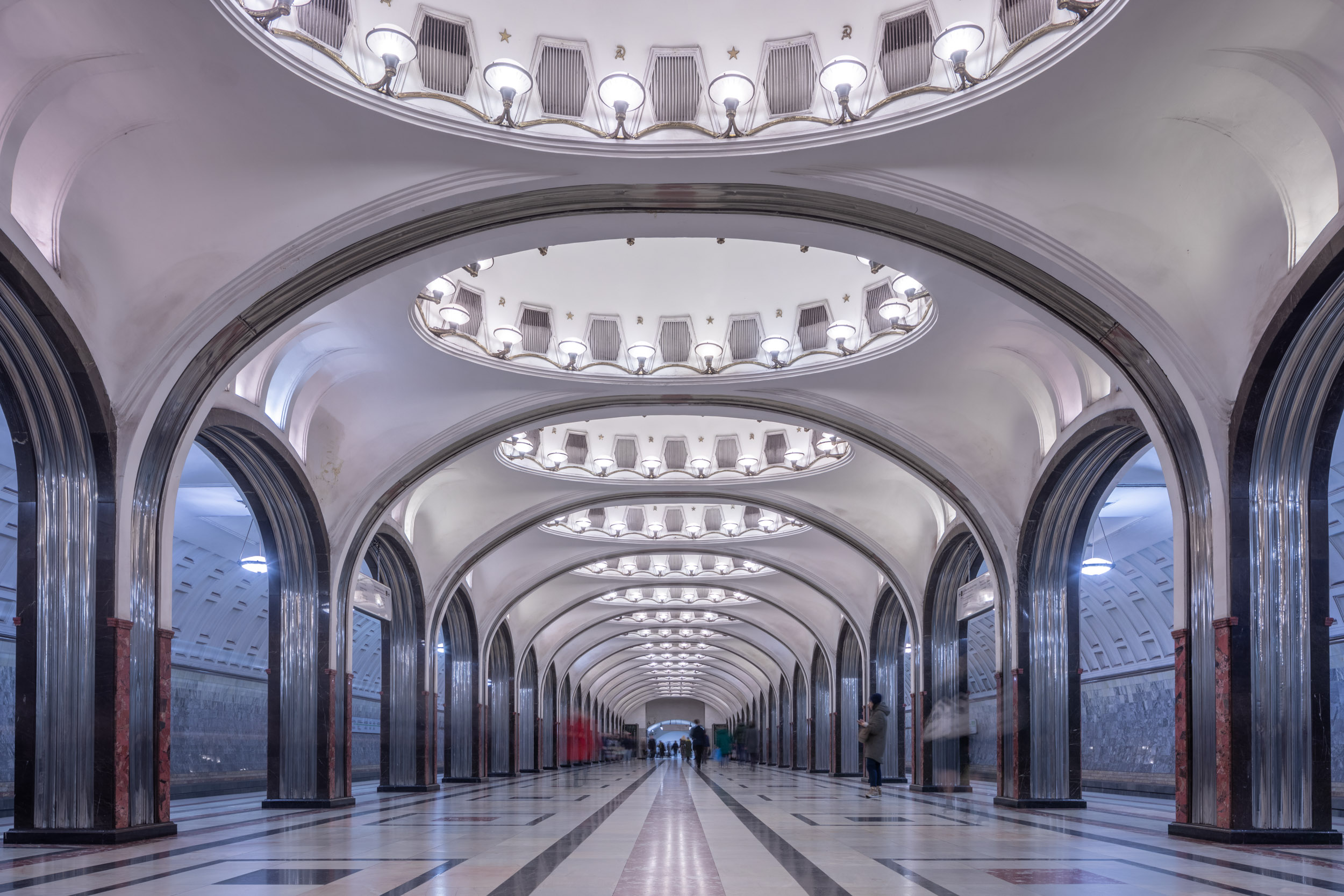
My final favourite from 2019 came from Moscow, where I travelled in November to learn some Russian. I came back knowing more than I did before, though not enough to claim much fluency. What stayed with me even more than the lessons was the Moscow Metro.
The stations are extraordinary. You can read about them in advance, but that does not prepare you for what it feels like to stand underground and see what was built there. This image was made at Mayakovskaya, a station dating from the late 1930s. The whole place has that polished, theatrical confidence that so many Moscow stations carry.
Photographing the metro, however, is rarely easy. Rush hour makes clean images nearly impossible, especially between seven and ten in the morning. So I often stayed out late, sometimes until half past midnight or later, waiting for platforms to empty. Security was inconsistent as well. Some people told me to pack away the tripod. Others glanced at me and walked on.
For this image, I used the information board in the middle of the platform as cover. It was wide enough to hide both me and my tripod, which I kept very low, about 45 cm off the ground. I used my 24mm tilt-shift lens, and I may also have added the 1.4x extender, though the metadata does not help me there. The exposure was probably around 15 seconds.
What I wanted was symmetry, and Moscow made that possible. The architecture is aligned so cleanly that I could use the tiles and platform edges to centre the frame with precision. With the lens shifted upward from that low viewpoint, the station took on a stronger sense of height and perspective.
There is also a small figure in red down the platform, and that touch of colour matters. Against the blues and polished surfaces, it gives the eye somewhere to rest. This is easily one of my top three images from 2019, and one I still enjoy returning to.
When I think back to 2019, the strongest lesson is simple. My favourite images were rarely the easiest ones. They came from persistence, from problem-solving, from local knowledge, from kind strangers, and from staying alert when the light shifted for a few seconds.
Some were made on the far side of the world, and one came from ten minutes down the road. That contrast matters. A good photograph is not defined by distance travelled. It is defined by what I saw, how hard I worked for it, and whether the final frame still feels alive when I look at it later.
That is why these images stayed with me long after the year ended. They are not a list of perfect pictures. They are a record of where I went, what I noticed, and the moments that still feel worth keeping.