 Skip to content
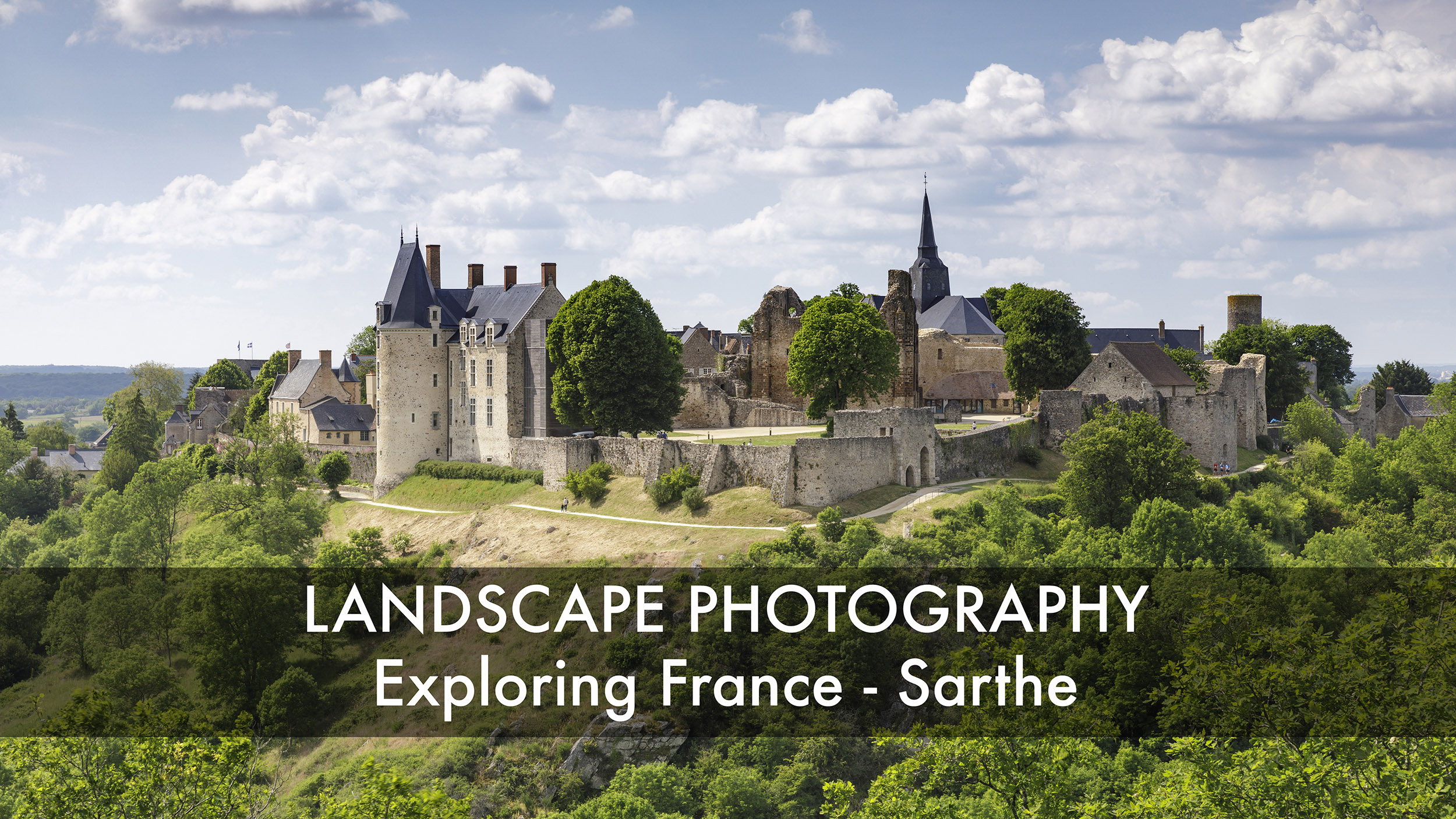

Central France has some gorgeous scenery that just doesn’t get photographed very often at all. The department of Sarthe is one of those areas that doesn’t get a huge influx of tourists, which is nice as it means you’re not jostling for the best spots to take photos.
Here in my latest YouTube vlog, I’ll show you some of the Sarthe and why it is you should consider paying a visit to the area.
As well as the landscape, there are also a number of historic buildings that are worth visiting, such as the abbey at Solesmes and the Beaux Villages de France of Sainte Suzanne. Both of these are visited in my latest vlog, and you’ll soon see why it is that these places are a must to visit.
Throughout the year, I offer photography tours and workshops in a variety of destinations around the world. If you’re interested in learning more from me to help you get the best out of your photography, then get in touch.
Enjoy the vlog and don’t forget to comment. I always try and respond to every person who comments on my work as I feel it is important to do so.
What appealed to me most that afternoon in the Sarthe was the lack of pressure. I wasn’t trying to complete an assignment, chase a famous viewpoint, or tick off a list of planned shots. I simply felt fed up with sitting in front of a screen, and the weather was too good to waste indoors.
That kind of mood matters. When I go out without firm expectations, I often see more. My mind doesn’t get stuck trying to recreate an image I’ve already imagined. Instead, I respond to whatever is in front of me, whether that’s a small chapel on a windy hill, a field of buttercups, or a pattern in crops that only starts to make sense from above.
This part of France is ideal for that sort of wandering. The countryside opens out in broad views, and old stone buildings appear where you least expect them. One minute it’s rolling farmland and quiet lanes, the next it’s a 15th-century chapel or a fortified village sitting on a rise.
Earlier in the day, I had already been to Sainte-Suzanne, a place I had visited a couple of years before and wanted to see again at this time of year. From there, I looked at an ordinary road map, spotted a marked viewpoint with a 360-degree panorama, and decided to drive up to it. That decision set the tone for the whole afternoon.
When I stop trying to control every frame, I usually end up making better photographs.
The first proper stop was a chapel on top of a hill, which I understood to be the Chapelle de Montaigu. Whatever the exact name on the sign, the setting was the thing that mattered. It sat in open country, exposed to the wind, with room all around it and a strong sense of age. I was told it dated from the 15th century, and it had that solid, weathered presence that France does so well.
I love this contrast in the French countryside. There are wide spaces, soft agricultural lines, and a calm rhythm to the land. Then, set amongst all that, there are buildings that have been standing for centuries. It gives a scene structure before I even lift the camera.
Even on a relaxed afternoon, my thought process stayed the same. I wasn’t “working”, but I was still trying to make the strongest frame I could from what was in front of me.
My first thought was the tilt-shift lens. If you’ve followed my photography for any length of time, that won’t be a surprise. I had the Canon 24mm TS-E on the camera with a 1.4x extender, and that combination felt right for isolating the chapel without dragging in weak edges.
A wider frame was possible, but it didn’t improve the image. There was a tree off to one side, yet it didn’t separate well from the chapel and didn’t add enough balance to justify including it. So I kept the composition tighter and let the building do the work.
I lined up the edge of the chapel near one of the grid lines in the frame. That gave the image a cleaner balance and stopped the subject from feeling stranded in the middle.
My exposure choices were simple:
That gave me an exposure of 10 seconds at f/16. For this scene, that was enough. I didn’t want a heavy, smeared sky. The cloud had shape, and I wanted to keep it that way while still adding a little motion.
The wind was strong up there, and there isn’t much to do about that apart from working carefully and accepting the conditions. Still, the chapel made a fine first subject for the afternoon.
After the chapel, I headed in the general direction of Solesmes. In practical terms, it was only about half an hour away. In photographic terms, I was prepared to take four hours to get there.
That meant using the smallest roads I could find and turning off whenever something caught my eye. I wasn’t hunting one exact subject. I was watching for small possibilities, the kind of scenes that often disappear if I drive too fast or stick to the main route.
A few things were on my mind as I wandered through the lanes:
That kind of roaming took me back to my early days in the UK. Before I became a full-time landscape and travel photographer, I used to borrow my dad’s car and spend weekends or evenings driving without much purpose beyond seeing what I could find. Those drives taught me a lot. They trained me to scan the land, notice changes in light, and recognise when a scene had potential, even if I couldn’t yet see the final image.
I still work that way now. Experience helps, of course, but the method hasn’t changed much. I drive, I look, I stop, and I ask myself whether there is a photograph there.
As the day went on, the light began to improve, so I found myself back near Sainte-Suzanne. That was a good decision. The evening sun was starting to skim across the hill, and the chateau looked stronger with that softer, lower light than it had earlier.
I had come down a tiny country road with the castle visible up on the rise behind me. What caught my eye first was the field in front of it. One nearby field looked fairly ordinary, but the next one was full of yellow flowers, probably buttercups, and the colour changed everything. Suddenly, the scene had a foreground worth working with.
There was also a small section of fencing in the field that gave me a minor point of interest and helped stop the foreground from becoming a flat sheet of colour. That matters in scenes like this. A field of flowers can look wonderful in person and still turn into a weak photograph if there is no structure.
The problem was height. At the normal tripod level, I couldn’t see enough of the flowers. The field lost impact because the blooms sank into one another, and the view flattened out.
To solve that, I put the tripod on the roof of my car. That lifted the camera to roughly 2.5 metres, well above head height, and the change was immediate.
From a standard tripod position, the buttercups hardly read at all. From head height, I could see a little more. Once the camera went onto the car roof, the field opened up properly and the yellow spread through the frame in a much clearer way.
The comparison was simple:
I even considered reversing the car a little farther down the road to pull in more of the yellow field. That is often how composition works in practice. A small move can matter more than a lens change.
A photographer friend of mine, Simon Byrne, had recently been talking about changing perspective in woodland by getting down low and shooting through plants. The idea stayed with me. In this case, I did the opposite and went high rather than low, but the lesson was the same. Eye level is only a default. It is not automatically the best angle.
Perspective can change a photograph faster than focal length. Sometimes half a metre is enough.
That was the strongest lesson of the stop at Sainte-Suzanne. I wasn’t chasing a grand technical solution. I was trying to improve the composition by changing where the camera sat.
Before I finally committed to Solesmes, another scene pulled me over. Earlier, I had driven uphill past a field and thought it looked promising without having time to stop. On the return, I approached it from the opposite direction, going downhill, and the geometry became clearer.
The tractor lines running through the crop looked graphic and clean. They weren’t dramatic in the usual sense, but they had rhythm, and I could see that a drone might turn them into something more intentional.
That is one of the pleasures of slow driving in the countryside. A scene can look forgettable from one angle and far better from another. Light changes, slope changes, and suddenly a pattern appears.
So I sent the drone up to see whether the field worked from above. I had no guarantee it would. Sometimes a scene that seems promising from the road collapses in the air. Other times, the height reveals exactly what was missing from the ground.
I didn’t put pressure on the result. It was my free time, after all. Still, I always want to see whether I can make the best image available to me, even on days that begin as a casual drive. That instinct never really switches off.
The last stop was Solesmes, and the reason for going there was obvious as soon as I arrived. The abbey is beautiful. It has presence, scale, and that unmistakable sense of old stone catching the last light of the day.
Solesmes Abbey doesn’t have the international pull of Mont-Saint-Michel, and I think that is part of its charm. Outside France, many people barely know it. For a photographer, that can be a gift. A place with this much character, and without the same level of tourist pressure, feels calmer and easier to work with.
By the time I arrived, the sun was already dropping. That meant less talking and more photographing. I had enough time to make a couple of frames, but I didn’t want to waste the light explaining too much when the real job was to keep shooting before the glow disappeared.
It had also been a while since I had last visited, which made the return more satisfying. The abbey brought together everything I had enjoyed throughout the afternoon in Sarthe and nearby Mayenne: open space, old buildings, quiet roads, and small decisions made on instinct rather than schedule.
That felt like the right place to finish. After a day that began with mental tiredness and no detailed plan, I ended up with a chapel, a chateau above buttercups, field patterns from the air, and an abbey at sunset. That is a good return for a lazy afternoon.
I took a few clear reminders away from this drive, and none of them was complicated.
There was also a gentler lesson underneath all of that. I don’t need a dramatic destination every time I go out. Sarthe and the surrounding area rewarded patient looking rather than frantic searching. A road map, an hour or two of light, and a willingness to stop were enough.
That is one reason I enjoy France so much as a place to photograph. The countryside is generous if I give it time. Old architecture rises out of ordinary farmland, colours shift as the light drops, and a quiet road can become the whole point of the day.
By the end of the evening, I also felt grateful to the people following my work. Passing the 5,000 subscriber mark around that time was a lovely milestone, and it added a warm note to an already satisfying day out.
I left the house because I needed a break from editing, and Sarthe gave me exactly that. More than that, it reminded me that some of my favourite photographs begin with no strong plan at all.
When I stay open to what is in front of me, I notice more, move more carefully, and compose with more honesty. That kind of spontaneity is still one of the best tools I have.
A lazy afternoon in the French countryside was enough. Sometimes, that is where the strongest pictures start.