 Skip to content
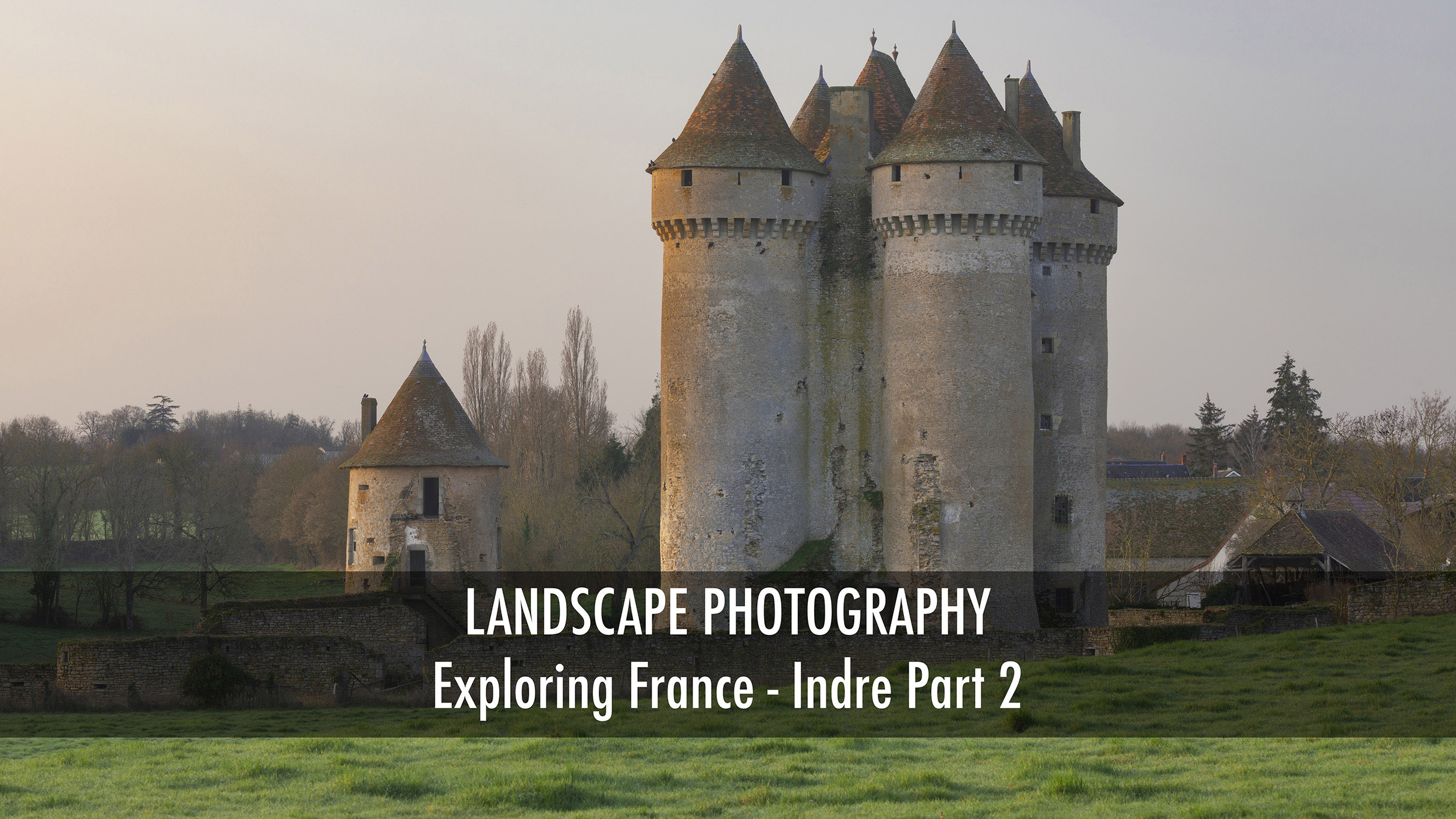

In my latest YouTube vlog, Landscape Photography in France Exploring Indre, part 2, shows you more of some of the beautiful places to go in this often bypassed area of the country.
Indre is a very rural area of central France, but that doesn’t mean there’s nothing to see. In fact, if you start delving deeper into the area, you’ll find it has beautiful rolling landscapes, river gorges with castles and beautiful villages.
So take a look at what I got up in this week’s episode. I was lucky enough to be invited to photograph the Château de Sarzay. If you’re ever in the area, then do pay them a visit as they are open to visitors.
Throughout the year, I offer photography tours and workshops in a variety of destinations around the world. If you’re interested in learning more from me to help you get the best out of your photography, then get in touch.
I started the morning in the department of Indre with the Château de Sarzay behind me. It is one of those castles that makes an instant impression. Even before the sun hits it, the shape is strong, the towers are elegant, and the setting feels properly rural and French.
“Good morning and welcome…”
I had hoped for some cloud at sunrise, but the sky stayed clear. Still, the light had promise. The sun was rising behind a distant tree line, and I knew that if I waited a few minutes, the castle would catch that first warm light.
My set-up was simple because the scene didn’t need much more than careful timing and good placement:
That kind of photograph can look easy when you see the final frame, but it often depends on patience. A small shift in light changes everything. With the sun still hidden, the castle had a softer, flatter look. Once the light reached it, the structure gained shape and presence.
What struck me again that morning was how much there is to photograph in Indre. It is easy for people to pass through central France and focus on the better-known names, but this part of the country rewards time and curiosity. Castles rise out of farmland, villages sit quietly with old churches and stone houses, and there is often far more within a short drive than most people expect.
I had only most of the day available rather than the full day, so I had to keep moving. Even so, it already felt promising.
By late morning, the day had changed completely. I had spent a good amount of time photographing Château de Sarzay from outside, working through different views and waiting for the light to settle. Then the owners noticed what I was doing and invited me in.
That sort of generosity can transform a day out with the camera. One moment I was photographing the castle as any visitor might see it, and the next I had access to views I could never have planned for in advance.
Once inside, I could photograph the chateau from all sorts of positions. The outside had already given me strong compositions, but access to the grounds and interior approach opened things up. A building like Sarzay changes as soon as you can move around it more freely. Towers align differently, walls begin to layer into one another, and the sense of scale becomes clearer.
Better still, I was also allowed to fly the drone around the castle. That meant I could add aerial photographs to the set, which is a real gift with a building like this. From the air, the castle’s form reads in a completely different way. You see how it sits in the surrounding land, how the defences and layout make sense, and how isolated and striking it still feels in the countryside.
For a photographer, that was one of those moments you don’t forget. I arrived hoping for a decent sunrise shot. Instead, I left with ground-level images, new viewpoints, and drone work that added another layer to the story of the place.
What makes Château de Sarzay even better is that it is not some inaccessible private estate hidden away behind closed gates. It is a place that people can visit. You can pay to go in, spend time around the property, and appreciate it properly rather than only seeing it from the road.
If you’re planning a trip, the official Chateau de Sarzay website is the best place to check visitor details.
There are also places to stay connected with the property. Although you do not stay in the castle itself, there is bed and breakfast accommodation, and there is also a gite, which is the classic French holiday house rental. That makes it more than a quick stop. It can be part of a slower trip through the area, which suits Indre well.
I was genuinely grateful to the owners for the invitation. Their kindness gave me one of the best experiences of the day, and it reminded me how often travel photography depends on people as much as place.
After Sarzay, I moved deeper into Indre and on to a religious building dedicated to Saint-Pierre. I referred to it as a priory church, although it also had the feel of a priory or abbey church, depending on how you approached it. The name was clear, but the exact village name was not, and I didn’t want to force certainty where I didn’t have it.
The exterior was the real draw for me. From outside, it was a beautiful building with the kind of weathered stone and solid form that often works so well in photographs. Even under a bright sky, it still had presence.
Inside, it felt more sparse than I had expected. That isn’t a criticism, only an observation. Some churches win you over through detail and atmosphere indoors. This one, for me, worked better from the outside.
Still, by that point, I didn’t mind the clear blue sky nearly as much as I might have done earlier. After the experience at Sarzay, the day already felt successful. Sometimes one unexpected moment changes your whole mood, and everything after that becomes easier to enjoy on its own terms.
Later on, I found myself looking at another beautiful old castle, this time perched above a village. It had that classic defensive position that tells its own story. You can imagine why it was built there. The castle overlooks the settlement below, and even now the relationship between the two is easy to read.
The weather had shifted a little by then. I had white cloud moving through gaps of blue sky, with the sun coming and going. That made the scene much more interesting because the cloud was thinning over the top of the castle, and I could see the light improving in stages.
At that location, I worked on two ideas:
This is the sort of moment I enjoy most, where the subject is strong but the weather gives the image its mood. The castle itself was enough to make the stop worthwhile. The changing sky gave me options. I knew that once the sun reached the stone at the right angle, the whole composition would lift.
Before that hilltop castle stop, I had also visited another church that felt special to me. I described it as unique in France, and it was one of those places I wanted to photograph without turning every moment into part of the day’s filming.
That choice matters sometimes. I enjoy showing the places I visit, but I don’t want to record every single preference or every step of the day if it pulls attention away from the work itself. I have a real interest in Romanesque and Gothic churches, and I know not every viewer wants every detail of that.
“I don’t want to show everything.”
So I photographed the church, had some lunch, and carried on. That pause in the middle of the day helped. It gave me time to reset, sort through what I had already seen, and keep enough energy for the afternoon and evening.
By evening, I had left Indre and moved into Indre-et-Loire. If you know France, the change in department matters because it was a practical decision as much as a photographic one. I needed to get back within a reasonable driving distance that night, and I still had to sort out dinner and the rest of the evening.
The final stop was at another castle in the Loire area. I was already working on a book about the Loire Valley, so the detour made sense. Earlier in the evening, there had been some cloud above the castle, and I made a time-lapse as well as a few short video clips because the scene looked promising.
By the time I was speaking at the end of the day, most of that cloud had gone. The light was slowly fading, and the sky had emptied out again. That happens. You wait, you hope the weather holds, and sometimes it drifts away just before the final colour arrives.
Even so, I was content with the day because I had already come away with good material.
Earlier on in Indre, I had also filmed a different ending at another castle, a medieval ruin on top of a hill. Only the east front still remained, with little behind it, but even as a fragment, it photographed well. Ruins like that can still carry a lot of character, especially when they dominate a small town or village.
Down below, there were more details worth stopping for. I photographed a collegiale church and an old timber-framed building with decorative sculpture on the outside. Buildings like that are easy to miss if you rush, yet they often become some of the most satisfying photographs of the day because the textures, lines, and carving give you so much to work with.
The sun was in a good position, there was enough cloud to keep the sky interesting, and I felt pleased with what I had managed across the day. Not every stop produced a masterpiece, but the overall run of locations worked well.
The strongest thought I carried home was simple. Central France and the department of Indre deserve far more attention from photographers than it usually gets.
Indre may be rural, and it may be easy to overlook, but that is part of the appeal. The roads are quieter, the scenery opens out, and the historic buildings often feel less crowded and more personal. You can move from a major château to a priory church, then on to a hilltop ruin or a village street with carved timber façades, all in the same day.
Paris will always have its place. Provence has its light, and the Dordogne has earned its reputation. Yet there is much more to France than the obvious circuit, and Indre proves that. For anyone who loves photographing castles, churches, villages, and rolling countryside, this part of the country gives you plenty to work with.
A clear sky at sunrise could easily have made this a frustrating day. Instead, Indre gave me one of those outings that stay with you because the places were strong and the welcome at Château de Sarzay made it even better.
What I took from it most was that central France keeps rewarding a slower eye. If I keep returning, it is because places like this still surprise me.