 Skip to content
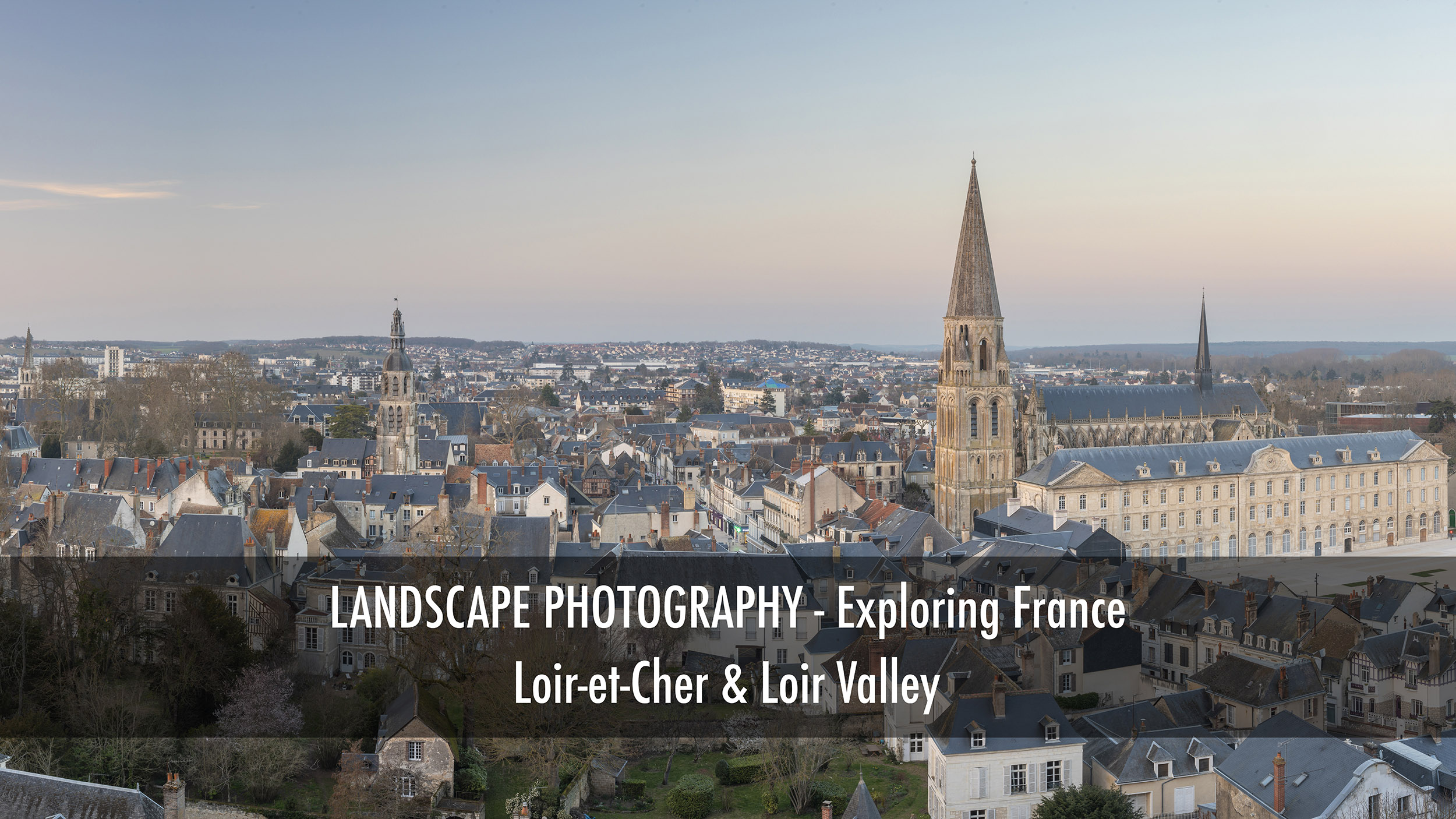

Exploring France Loir-et-Cher & Loir Valley is my latest YouTube vlog detailing some of my exploits as I travel to various parts of the world.
This week’s vlog on Landscape Photography Exploring France shows some of the Loir-et-Cher department, along with the other Loir Valley. Yes, there is another Loir Valley, but note the spelling.
France has two rivers with the same name but a different spelling. The Loire Valley, with an e, is the main river as well as encompassing the UNESCO World Heritage Site. But there is a smaller river, the Loir, which flows into the Loire. Confused?
The Loir Valley is more undulating than the Loire Valley itself and also has some gems tucked away if you know where to look.
So take a look at what the alternative has to offer. And if you’re interested in a Loire Valley photo tour then check out my annual trip.
My day in Loir-et-Cher and the Loir Valley began in Vendome, with the abbey behind me and one of the best viewpoints in town in front of me. If you’ve seen my earlier piece on photographing Gothic cathedrals and architecture, you’ll know I have already spent time working the streets and church views here. This spot felt different because it gives the whole city room to breathe.
The morning in the Loir Valley was cold but clear and bright. It was 1 March, there wasn’t a cloud in the sky, and the park gates happened to be open earlier than usual, which felt like a small gift. I normally expect to wait for a place like this, so walking straight in at first light was a good start.
The draw of the viewpoint was simple:
For the first photographs of the day, I used a 24mm tilt-shift lens with a 1.4x extender. That setup let me keep the buildings upright and still fill the frame with the abbey and the rooftops. Rather than try to force everything into one file, I planned to merge two images and blend them later. I also had a panoramic frame in mind because the view suits a wider crop.
Blue-sky mornings can look plain on paper, but I never dismiss them outright. Good side light across old stone can carry a picture on its own, and that was the plan here. All I needed was the sun to rise enough to brush the side of the abbey and bring out the texture in the town.
From Vendome, I headed deeper into the Loir Valley towards Lavardin, one of the most photogenic villages in this part of France. It is also one of those names that can catch you out until you hear it spoken. Set above the village is a ruined castle, and the place has that mix of stone, slope and river that always makes me slow down.
The viewpoint is easy to reach. A sign points the way to the panorama, and from the village centre it only takes a couple of minutes on foot. From there, I could look across to the castle and church with the Loir valley opening out beneath them. The light was good on the castle, although much of the village itself was still in shadow because the sun had only just begun to clear the hill behind it.
This was also a good moment to clear up the local geography. I was in the Loir Valley, not the Loire Valley. That small missing “e” matters. The river Loir winds through a quieter, more rolling part of France, and it eventually joins the Loire, which is why the names so often get mixed up.
I had hoped to photograph the church interior in Lavardin because I knew there were painted walls inside. From the outside, it looks like a Romanesque church, and I expected the interior to hold more character than the stone exterior suggests.
When I arrived, it was closed for works. That happens. There is no sense wasting time getting annoyed, so I moved straight to plan B.
My second composition in Lavardin was the medieval bridge with the castle behind it, and that was the stronger image of the two. I had photographed the spot years ago, but returning to a place after time has passed is often useful. Your eye changes, your standards rise, and you stop settling for the first version that worked before.
For this scene, I used my 24-70mm and zoomed in rather than reaching for a wide-angle lens. That choice mattered. A wide lens would have made the bridge dominate the frame while the castle shrank into the background. By compressing the view, I kept the ruined castle looking solid and imposing above the river.
I made both landscape and portrait frames, and I took two exposures for blending. The brightness range was too wide for a clean single exposure, and I prefer blending here rather than using a graduated filter. It is quicker for me in the field and gives me a better file later.
The composition itself was built around a clear structure. I used the bridge low in the frame, land through the middle, and then let the tree and castle balance the upper thirds. That sort of order matters with old villages. Without it, the scene can turn messy quite quickly.
My next stop in Loir-et-Cher was another castle town. I had seen only a couple of photographs beforehand, so I went in with an open mind. Using a 1:25,000 map on my phone, I found a path behind the castle and climbed up to test the higher viewpoint.
From up there, the back profile of the castle against the Loir Valley and the town was decent. The horizon sat above the building rather than slicing through it, which helped, and the side light was good. I could also see the potential for a misty dawn one day, with vapour hanging in the Loir valley and the castle rising out of it. That sort of possibility is worth storing away even when the current picture falls short.
Still, the more I looked, the more I felt the better view was from the town below. The high angle ticked some boxes, but not enough. That is part of photographing France well, especially in the quieter parts of the country. You need to know when to bank a place for another season and when to walk away.
Back in the old town, I found a scene that made far more sense. By the river stood a half-timbered house lit cleanly by the sun, with the castle higher up at the end of the road. The side light gave the house shape, and I added a polariser to control glare and strengthen the stone and timber.
Nearby stood a Gothic church that looked flamboyant in style. What caught my eye was the shape of the tracery and arches. They had that flame-like feel that often gives Flamboyant Gothic its name, pointed and curling rather than simple and severe. I photographed the street scene first, waiting for a gap in the traffic, then turned my attention to the church.
The greatest surprise of my day in Loir-et-Cher came inside another church later on. From the outside, it did not shout for attention. Then I stepped in and found a painted interior with frescoes and an old timber roof shaped almost like the hull of a ship.
The church dates from the 12th century. That means I was standing in a building around 900 years old, looking at surfaces that had survived layer upon layer of time, plaster and repair. The frescoes had been uncovered in the 18th or 19th century, and what remained was enough to stop me in my tracks.
I keep coming back to the same lesson: do your research, because some of the best places in France hide behind the plainest doors.
This is why I spend so much time looking at maps, local heritage listings and scattered references before I go out. You drive past dozens of churches in rural France. Most look pleasant. A few hold something extraordinary once you step inside.
Loir-et-Cher has more than one church like this, and that is part of what makes the department so rewarding. The obvious locations are worth visiting, but the quieter, tucked-away places often leave the deepest mark. I photographed the roof, the frescoes and the interior details, taking my time because the place deserved it.
One of the places I had researched in the Loir Valley beforehand was the château de Montdoubleau. It has a tower with a clear lean to it, strong enough that you notice it the moment you arrive. On paper, it sounded promising. In person, from the angle I could reach easily, it did not quite come together.
That was not the fault of the building. Sometimes a place is interesting without being photogenic from the ground. I looked, I walked, I checked for a higher angle, and I still felt the frame lacked shape. Rather than force a weak picture, I moved on. Restraint matters as much as enthusiasm.
A little later, I reached a ruined chapel or priory, and this one gave me a different problem. The light was harsh, the sky was bright, and a straight colour file felt flat before I had even taken it. So I reached into my bag for an infrared filter.
That changed the whole mood of the scene. I put the filter on the lens, set the camera to black and white, and made a four-minute exposure at f/11. It was part calculation, part guesswork, which is often how infrared goes in the field. I also used the tilt-shift lens with the 1.4x extender again, which helped keep the old walls and lines controlled.
The result suited the subject far better than a normal file would have done in that hard light. More than that, the place gave me another idea for later in the year. Under a clear night sky, with stars above the ruin and perhaps the Milky Way arcing overhead, it could be superb.
Near the end of the day, I reached Freteval, where the remains of a feudal castle still stand above the village. There is not much left in complete form, but what remains is enough, a fragment of wall, part of the structure, and the tower that still holds the eye.
I made a portrait-oriented image from the ground first. Then I sent the drone up, keeping well clear of the monument itself and giving it the distance it deserved. A small ruin can often look stronger from above because the pattern of walls makes more sense from the air.
I finished my day in Loir-et-Cher, where I had started, back above Vendome. That felt right. Morning light had given me one version of the city, and evening side light promised another.
There was only a thin trace of cirrus in the sky, so I had no guarantee of colour. Still, I was there, and that is what counts. If you are not standing in the right place when the light changes, the sky can do whatever it likes, and it will not help you.
I repeated some of the morning work with a different feel. I made a 15mm panoramic view, then a 50mm frame concentrating more tightly on the abbey. I also put the tilt-shift and extender back on for a more structured composition that included the castle near the viewpoint.
The day had given me a healthy mix of things: places I had never seen, places I knew but wanted to revisit, one or two disappointments, and a few ideas to return for under better conditions. It also reminded me of the limits of time. I can only give about one full day a week to YouTube because photography is my day job, and when I am out, I am usually thinking first about the pictures I can make and sell, not about filming elaborate bits of filler.
If this blend of castles, villages and old churches appeals to you, my Loire Valley photography tours follow that same thread of strong scenery, history and careful image-making.
A day like this does not hand you easy pictures, but it does reward clear decisions. I changed lenses often, blended exposures where the contrast demanded it, and stayed open to the idea that some places were worth noting down rather than forcing.
The main lesson was not about gear, though. It was about flexibility. When the church in Lavardin was closed, I went to the bridge. When Montdoubleau failed from the first angle, I stopped pushing it. When the light was too hard for a normal file at the ruined chapel, I switched to infrared.
Research was the other key part. Without it, I would never have found the painted 12th-century church, and that interior was one of the finest moments of the day.
The strongest places in Loir-et-Cher were not always the grandest ones. They were the ones that combined good light, strong shape and a sense of discovery.
That is why I keep returning to the Loir Valley. It asks for more patience than some of the better-known parts of France, but it pays that back with quieter roads, old stones, and the feeling that there is always one more church, bridge or ruin waiting around the next bend.
On days like this, the photographs matter, but so does the reminder that good work often comes from adapting, not insisting.
We noticed you're visiting from United Kingdom (UK). We've updated our prices to Pound sterling for your shopping convenience. Use Euro instead. Dismiss