 Skip to content
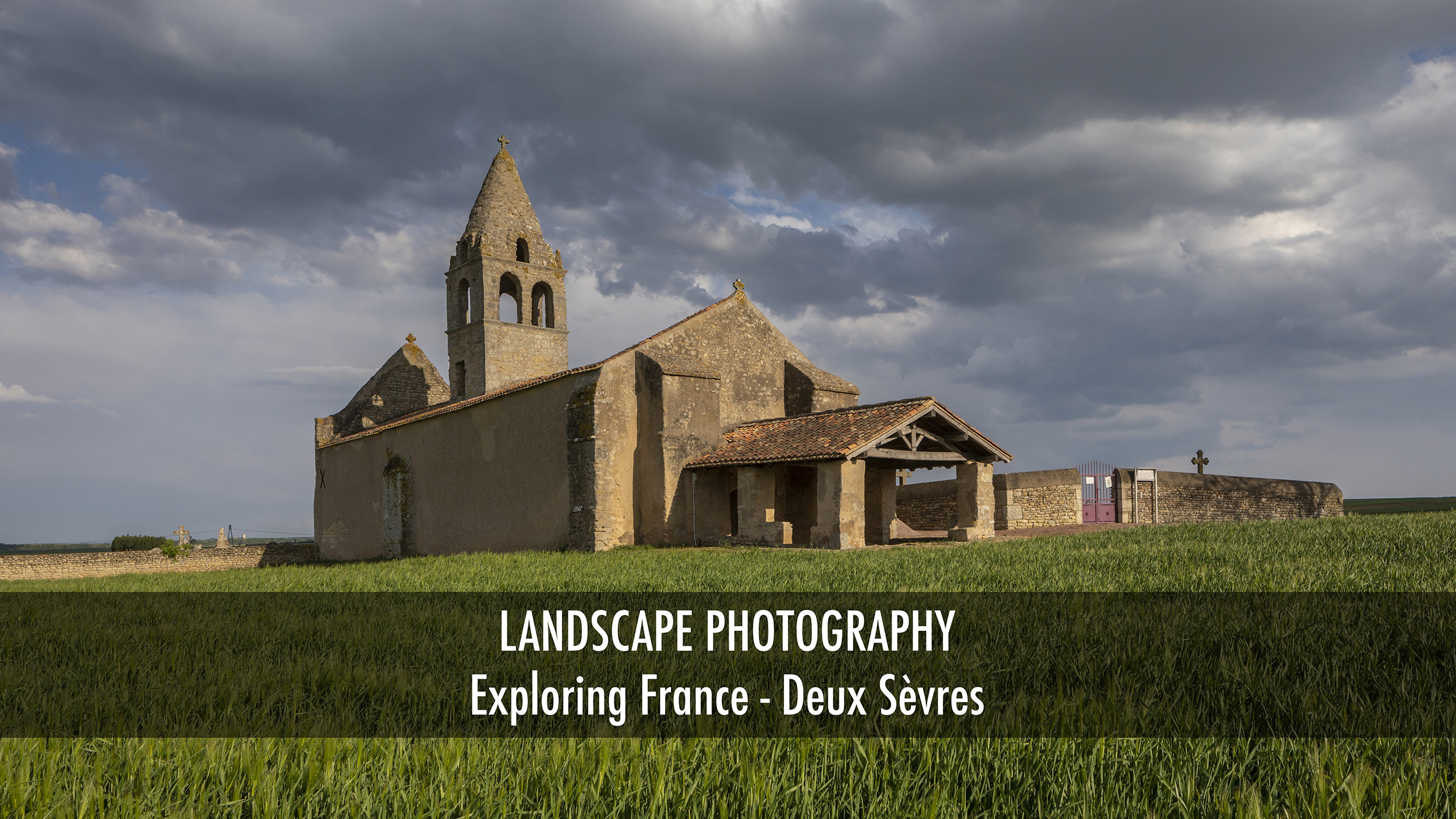

Landscape Photography Exploring France Deux-Sèvres is my latest YouTube vlog detailing some of my exploits as I travel to various parts of the world.
Deux-Sèvres is a department of central France that has much to see and do. It is a favourite of mine due to the huge variety of subjects to photograph. If you love architecture, then you’ll find stunning examples of Romanesque buildings dotted throughout the department. Deux-Sèvres also has huge, wide open spaces for those who love landscape photography.
There wasn’t much time to do an extensive photography trip here. I was out with my kids, showing them the country they never get to see. But hopefully, you’ll enjoy the short ride along with us.
And if you’re interested in discovering central France with a camera, then do check out my annual Loire Valley photo tour in May. The photography tour visits part of Deux-Sevrès.
I hadn’t managed a vlog the previous week because work got in the way. That happens. Photography is my job, and some weeks the time simply isn’t there. Still, I had been out looking around, and one place had stayed in my mind enough that I wanted to return to it.
This time I had my two children with me. Part of the joy of days like this is showing them corners of France they don’t often get to see. It changes the pace of the outing, of course. I can’t spend half an hour refining one composition when one child is restless, and the other is wandering into the frame. Even so, that family rhythm adds something honest to the day.
We moved between several very different locations in a short space of time:
That mix is why I enjoy exploring rural France so much. In a single afternoon, I can move from decay to architecture to open farmland, and each place asks for a different kind of attention.
I found the abandoned house whilst I was out looking for old railway lines. It appears to have been the house for a level crossing, which makes sense once you see where it sits. Places like that always catch my eye because they hold a trace of ordinary life. They weren’t built to impress anyone. They were built to be used, and when they’re left behind, they carry a strange tension.
Before we went in, I warned my children that it had an odd atmosphere. I wasn’t exaggerating. Inside, the place felt eerie, and the mood was made stronger by a skeleton behind me in one of the rooms. My daughter clearly felt it. My son, on the other hand, brought the kind of energy children always do, moving through the scene in a way that cuts straight through the seriousness of a place.
I didn’t take photographs there on this visit, but I could see the potential straight away. The interior had the kind of rough, worn character that would work well for a gritty photo shoot. There was texture on the walls, uneven light, and that sense of uncertainty that abandoned places often carry.
Some locations work because they’re beautiful. Others work because they make you feel something the moment you step inside.
Another surprise that day was the number of flax fields in the area. We found about half a dozen large fields, which immediately made me think ahead rather than only looking at what was in front of me. When flax is ready, it can transform a simple scene, but timing matters. A field that looks plain one week can be full of colour the next.
That is often how local photography works. I don’t always come home with the finished frame. Sometimes I come home with a note in my head that says, “Come back in ten days.”
After leaving the abandoned house, we headed to the Abbatiale de Saint-Jouin-de-Marnes. This is one of those places that stays with me long after I leave. I first found it a year or two earlier when I was out around Christmas, trying to decide what to do with the day. Then I walked in and was stunned by it. Returning felt no less special.
The church is a late 11th-century Romanesque abbey, and it is beautiful. I have always loved Romanesque architecture, so spaces like this pull me in straight away. The weight of the stone, the calm of the nave, and the carved capitals all create a feeling that is hard to fake in later buildings. Romanesque interiors don’t need decoration piled onto them. The structure itself has presence.
The capitals in the abbey are carved with the kinds of figures I look for in Romanesque work. I wasn’t there to make a long study of them this time, but I still paid attention. These details matter because they give shape to the building’s character. They also give me options when I don’t want to make only the obvious wide shot down the nave.
It looked as though the abbey had been restored fairly recently, which was good to see. According to the information board, the building took around 40 years to complete. For a place of that age, it felt cared for without losing its age. That balance matters. Restoration can flatten a building if it’s handled badly, but here the work seemed to respect the original character.
If you are in this part of Deux-Sèvres and you care about old churches, this abbey is worth a stop. It has scale, detail, and a strong sense of place. Even on a quick visit, it leaves an impression.
I didn’t take many photographs in the abbey that day, mostly because time was short and I had the children with me. One of them had reached that point where patience had run out, so I kept things simple.
I made the photographs I usually start with in a place like this. I took a view down the nave, because that line of sight is too good to ignore, and then I picked out a couple of capitals for closer studies. That was enough for the day. Not every visit has to turn into a full shoot. Sometimes I only need a few frames to reconnect with a place and remind myself why I want to come back.
There is a lesson in that, too. A short visit can still be useful if I know what I want from it. I don’t need to photograph every angle to feel that the stop mattered.
From the abbey, we drove on and stopped at another church, one I already knew was there. I treated it as a quick final stop before heading back, but it turned into the strongest photographic moment of the outing.
The church sat in the middle of a field, and what interested me most was the crop around it at this time of year. The field was full of wheat, and I immediately started thinking ahead to poppy season. In central France, when I see wheat like that, I often start watching for poppies in mid-May and after. I had already noticed a few lone poppies whilst driving through other parts of the region, though not full fields yet.
I went carefully into the field because I wanted the lines in the crop, but I had no intention of damaging anything. That balance matters. A strong composition isn’t worth trampling somebody else’s work.
Earlier in the day, I had made a portrait of my daughter in the fields, so I was already thinking about how the farmland was shaping pictures. At the church, I looked for something extra, perhaps a lane or a tree, to give the scene another anchor. There was a lone tree off to one side, and I considered bringing that into the frame.
Then the light changed, fast. One moment, the scene looked flat, then a dominant cloud moved into place, and the church caught a burst of sun. I managed to get the frame before the light went out again.
What made the image work for me was simple:
That side light is what I respond to most. When the sun strikes from an angle, I get shape and shadow at once. The side of the church facing the light lifted out, while the rest held enough shadow to show form. That is the kind of depth I always want in my photographs.
My son wandered past as I was working, which felt perfectly in keeping with the day. Family outings and careful compositions rarely stay separate for long.
Although I got a frame I liked, the place still felt unfinished. I kept looking at that wheat and thinking how much stronger the scene could become if poppies appeared around the church in a week or two. Because there is a fair amount of organic farming in the area, I am hopeful there will be more colour soon, though I can’t count on it.
We returned to the flax fields as well, but I couldn’t find a composition that worked. The flax wasn’t fully out yet, so the fields were full of promise rather than at their best. Again, that is part of the process. I don’t mind leaving empty-handed if I know a location is close.
I ended the day in another field that I want to revisit later in the season. I have seen that same area with sunflowers before, so it may become a strong summer photograph. There is a grain silo behind the church there, which isn’t ideal, but I would rather solve that with composition than depend on Photoshop. For me, that is half the fun, finding the angle that removes a distraction before I ever press the shutter.
This outing was brief, and I knew the finished vlog would be short as well, probably around 10 minutes. Still, these quick local trips matter because they build familiarity. I learn where the flax is. I notice where poppies may arrive. I remember which church works best with side light, and which field may carry sunflowers later in the year.
That kind of knowledge doesn’t come from one grand trip. It comes from repeated visits, small notes, and patience. A place in Deux-Sèvres can look ordinary in passing, then become excellent when the crop changes or a shaft of sun breaks through at the right second.
I try to keep a regular rhythm with filming, but work always comes first. Some weeks I can get out properly, and some weeks I simply can’t. That was the case here. I had missed the previous week, and this outing had to fit around everything else.
There is no point pretending otherwise. Photography on YouTube can look effortless from the outside, but most of it is done around weather, travel, family, and paid work. I suspect many photographers will recognise that balance straight away.
The place I had really hoped to film next was Château du Rivau, where I have started to become friendly with the owners. I wanted the weather to do the place justice because a good castle deserves good light. The sky on this outing looked promising at times, but it stayed changeable, and I didn’t want to force it.
That is another part of photographing France well. Some places ask for patience. I would rather wait for the right conditions than rush back with photographs that feel half-formed.
A few spare hours in Deux-Sèvres gave me more than enough to work with. I found atmosphere in an abandoned crossing house, calm in a Romanesque abbey, and one fleeting piece of side light on a church in the fields.
What stayed with me most was the reminder that timing shapes so much of rural photography. The right field can be early, late, or perfect for only a few days. That is why I keep returning, because France rarely gives everything at once.