 Skip to content

Part 1 of the Abandoned Railways and Disused Stations of France shows what’s left of the stations between Chinon and Loudun.
France is famous for its high-speed TGV, but beyond this, there are many rural lines that have been closed but are still intact, as well as the infrastructure that goes along with it.
This isn’t my usual YouTube vlog content, but when I’m out and about, I come across so much of it that I thought I’d document it.
And if you’re interested in discovering the Loire Valley with a camera, then do check out my annual Loire Valley photo tour in May.
I started in Chinon, a place that has appeared in many of my films and one I never get tired of visiting. Behind the town sits the Château de Chinon, and, beside it, one of the old railway bridges still cuts across the scene. Even before I set off properly, the contrast was there in front of me, medieval stone above, railway engineering below, and nature slowly taking both back on its own terms.
This part of the abandoned railway looks as though it was once double track, then reduced to single track. Some sections of track still survive, although getting close to them is another matter. The vegetation is so thick in places that it feels less like a disused railway and more like a corridor through a small jungle. I could see the old embankment, but I could not get far on foot without fighting through heavy overgrowth.
That challenge is part of the appeal for me. I was not out there looking for polished, postcard-perfect views. I wanted to see what still exists, what the line looks like now, and what kind of photographs these remains might suggest. Old bridges, rusting rails and station platforms have their own kind of beauty, especially when they sit in good light.
I have spent a lot of time photographing the Loire region, and this quieter side of the area is one more reason I keep coming back. It also sits well alongside the places I explore on my Loire Valley photography tours, because the region is full of strong contrasts, castles, vineyards, towns and these forgotten traces of industry.
To make the route easier to follow, this is the stretch I explored on the day.
| Place | What I found | Current state |
|---|---|---|
| Chinon | Old bridge, embankment, split in the line | Heavily overgrown |
| La Roche-Clermault | Station building, platform, loading gauge | Building reused as a pharmacy |
| Beuxes | Woodland track bed, signs, telegraph pole, station area | Mostly hidden by vegetation |
| Basses-Sammarçolles | Station, platform remains, clearer line | Less overgrown |
| Loudun | Large station site, junctions, and old wagon | Reused by local organisations |
Even in summary form, one thing stands out. A surprising amount is still there.
At the time, I was spending more time in France and far less time travelling abroad. Rather than chase distance for its own sake, I started asking a simpler question: What is sitting in my own backyard that I have never properly explored?
That shift changed how I worked. I began researching old railway lines, vineyard locations, quiet corners of the Loire Valley and places I might want to return to later for a book project or for future shoots. There is something satisfying about building that sort of local knowledge. It gives me a better sense of the region, and it opens up ideas that would never appear on a standard tourist map.
Photographically, these old railways have a lot to offer. I could easily picture a fashion shoot on one of these disused tracks in low side light, or a documentary series comparing what stations looked like in their working lives with what remains now. On this day, the light was fairly harsh, so I was not chasing finished portfolio shots all the time. I was scouting, documenting, and seeing what might be possible later.
A short distance outside Chinon, the old route divides. One branch heads towards Loudun, which was my main destination, and another heads towards L’Ile-Bouchard. Before reaching L’Ile-Bouchard, there was also a branch that ran as a single-track line to Richelieu, with several stations along the way.
That small network says a lot about rural rail in France. What now feels remote and forgotten was once tied together by a useful, practical system. Looking at it on the ground, I found it hard not to think about how much infrastructure had already been built, only to be left behind.
The section towards L’Ile-Bouchard has at least found a second life. From the junction onwards, that former railway has been turned into a cycle path, which is a good outcome and far better than letting the whole route disappear under scrub. If I were visiting the area for cycling as well as photography, I would make a point of following it.
The Richelieu branch is a little different. I remember coming to this area not long after I moved to France and finding a preserved railway there. From what I recall, it survived into the 2000s, perhaps later, before it was ordered to close and the railway heritage was removed. The station building at Richelieu is still there, and if you look at satellite imagery, you can still trace parts of what used to exist.
Much of the sadness here comes from how visible the old line still is. The earthworks, bridges and poles remain, so the loss never feels complete, only neglected.
I also found another bridge a few hundred metres from the first one near Chinon, and there the old doubling of the line was still visible. That was one of the moments when I stopped thinking only about exploring and started thinking about record-making. Even if these structures continue to decay, at least there will be photographs showing what survived.
There is also the wider question of transport. Central France still moves a lot of agricultural goods, and vineyards sit close to parts of this line. Seeing an old railway next to active farmland makes the whole thing feel more wasteful. So much is said about reducing lorry traffic, yet here is an existing route, partly intact, that once did exactly that job.
I was told in one nearby village that the national railway still owns sections of the old line and has refused local attempts to buy it. I cannot verify every detail of that, but it fits the strange half-life of many old railways in France, not active, not reused, and not quite allowed to vanish.
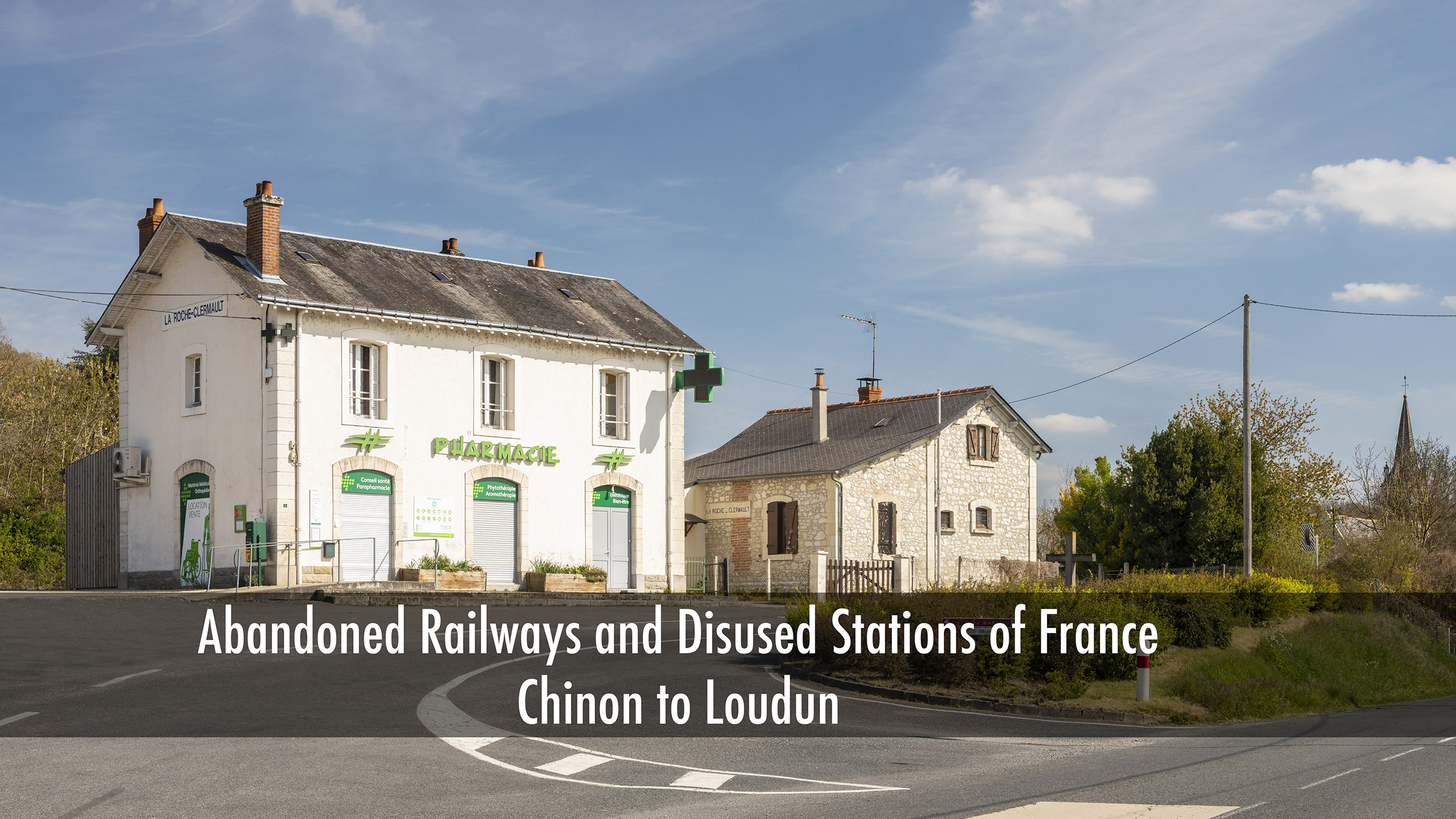
My first proper station stop was La Roche-Clermault, a small village where the old station building has found a new use as a pharmacy. Reused station buildings always interest me because they keep one foot in the past and one in the present. The railway function is gone, but the shape of the place still gives it away at once.
Around the station, I found a few details that made the stop worthwhile. The old platform edge still survives, and so does a loading gauge. Telegraph lines are still visible nearby as well. Those details matter because they anchor the station in its railway past. Without them, it would be easy to see only a village building and miss the line that once ran through it.
I also wanted to make a photograph that echoed an old postcard view I had seen. I chose not to reproduce those historic images directly because I could not be certain about copyright, but they were useful as a guide. Standing where the earlier photographer had once stood and making a modern version of the same scene gave me a strong sense of time passing.
The station at La Roche-Clermault opened around 1875 and closed to passenger traffic in 1970, which gave it roughly 95 years of service. That is a respectable life for a rural station, although it still feels abrupt when measured against how long the building itself may yet survive.
The setting is good for photography in other ways, too. In summer, the surrounding fields fill with sunflowers, and that changes the mood of the whole area. A former station framed by bright agricultural colour has a very different feel from the tangled, green overgrowth nearer Chinon.
From La Roche-Clermault, the line follows the road for about six kilometres towards Beuxes, and in places you can still keep track of it almost continuously.
Beyond the village, the railway begins to disappear into fields and woodland. From the road, it is still possible to trace where it ran, but once I walked towards the track bed, the line became much harder to read. There were stretches where I was not sure if I was looking at the railway at all, until the ground shape snapped into focus and the route became obvious again.
In the forest, the old line survives more as a form than as an open track. The embankment is there, the corridor through the trees is there, and in some places the rails are still buried below the undergrowth. What stops it from being legible at first glance is the sheer volume of growth on top.
That said, there were enough clues to make the effort worthwhile. I found ballast, a surviving telegraph pole, and an old sign that would once have meant something to engine drivers. I also came across what looked like a bridge over a small channel or river, though the area was so overgrown that it was hard to read the structure properly from the ground.
This stretch also revealed what the route does not have. I had checked maps before setting out, hoping I might find a large viaduct or a tunnel, but the land here is fairly flat and those dramatic structures never really appear. Instead, the appeal is subtler. It is about telegraph poles leaning into the trees, rails swallowed by weeds, and embankments that still cut clean lines through the countryside.
The station at Beuxes survives as a private residence, so I was careful about how I photographed it. That is often the balance with old railway buildings in rural France. They are still there, but they are now part of somebody else’s daily life. Even so, the old station setting remains clear enough to picture what it once looked like.
Nearby, the line appears to have stayed in limited use until about ten years ago for access connected to a grain silo beside the road. That helps explain why some sections here look less lost than others. The route was not entirely dead for all of its later years, only reduced to a very narrow purpose.
The next station I visited was Basses-Sammarçolles, the second-to-last stop before Loudun. I could not find the same kind of historic imagery for it that I had found for La Roche-Clermault, but the site still has presence. The station building stands behind the old platform, and one side of the platform remains easy to read.
This part of the line is in better shape than some of the earlier sections. It is still overgrown in places, especially nearer the grain infrastructure, but the route itself is far clearer. By this stage of the day, I no longer felt as though I was searching for a vanished line. I was following something that still exists, even if it no longer works.
For my photograph of Basses-Sammarçolles, I used a 50mm tilt-shift lens. My thinking was simple. If I ever do find an old postcard or large-format image of the station, that focal length and rendering may sit closer to the feel of older work. I cannot prove that connection, but it felt like the right way to photograph the building.
From Basses-Sammarçolles, the approach to Loudun is much easier to imagine as a living railway. The track corridor is clearer, the station spacing makes sense, and the line begins to gather itself for its arrival in town.
Loudun is where the exploration opened up again. The old station is a substantial site, larger and more important than the smaller halts to the east. There were several buildings, a wider railway footprint, and the sense that this had once been a proper local hub rather than a simple stop on a minor branch.
One route came in from Chinon, and another junction nearby once led south towards Châtellerault. That southern line has since become another cycle path, which immediately made me want to return and see what remains of the stations on that route as well. Old railway lines tend to lead to more old railway lines. Once I start following them, one day out quickly turns into a longer project.
The station building at Loudun has not been left empty. It now houses local organisations, which means the structure is maintained and still part of the town. That is encouraging, even if the railway’s purpose is gone. A building with a new use, at least, has a better chance of staying upright.
There was also an old railway wagon on site. I wanted to photograph it, but sometimes a subject simply does not come together visually, and this was one of those cases. The wagon had interest as an object, yet the setting around it did not give me much to work with.
Even so, Loudun felt like a strong finish to the route. The rails, platforms and buildings all suggested possibilities, especially for staged work or low-light portraiture. On a line that has seen no train for years, there is room to think differently about how a railway setting can function in photographs.
The town offers more than the station, too. I had also found a ruined castle nearby and an old town gate worth seeing, which reminded me that these railway explorations rarely stay limited to railways. They tend to pull in everything around them, local history, architecture, agriculture and the shape of the wider landscape.
Walking and driving the abandoned railway from Chinon to Loudun left me with one clear thought. So much of it is still legible. The bridges, platforms, embankments and poles are not gone. They are waiting under grass, scrub and small acts of neglect.
That is what makes these abandoned railways so compelling to photograph. They are neither preserved museum pieces nor total ruins. They sit in between, and that in-between state says a lot about rural France, about memory, and about what gets left behind when a line falls silent.
I will keep returning to places like this, because they reward patience. The more closely I look, the more the old railway comes back into view.
We noticed you're visiting from United Kingdom (UK). We've updated our prices to Pound sterling for your shopping convenience. Use Euro instead. Dismiss