 Skip to content
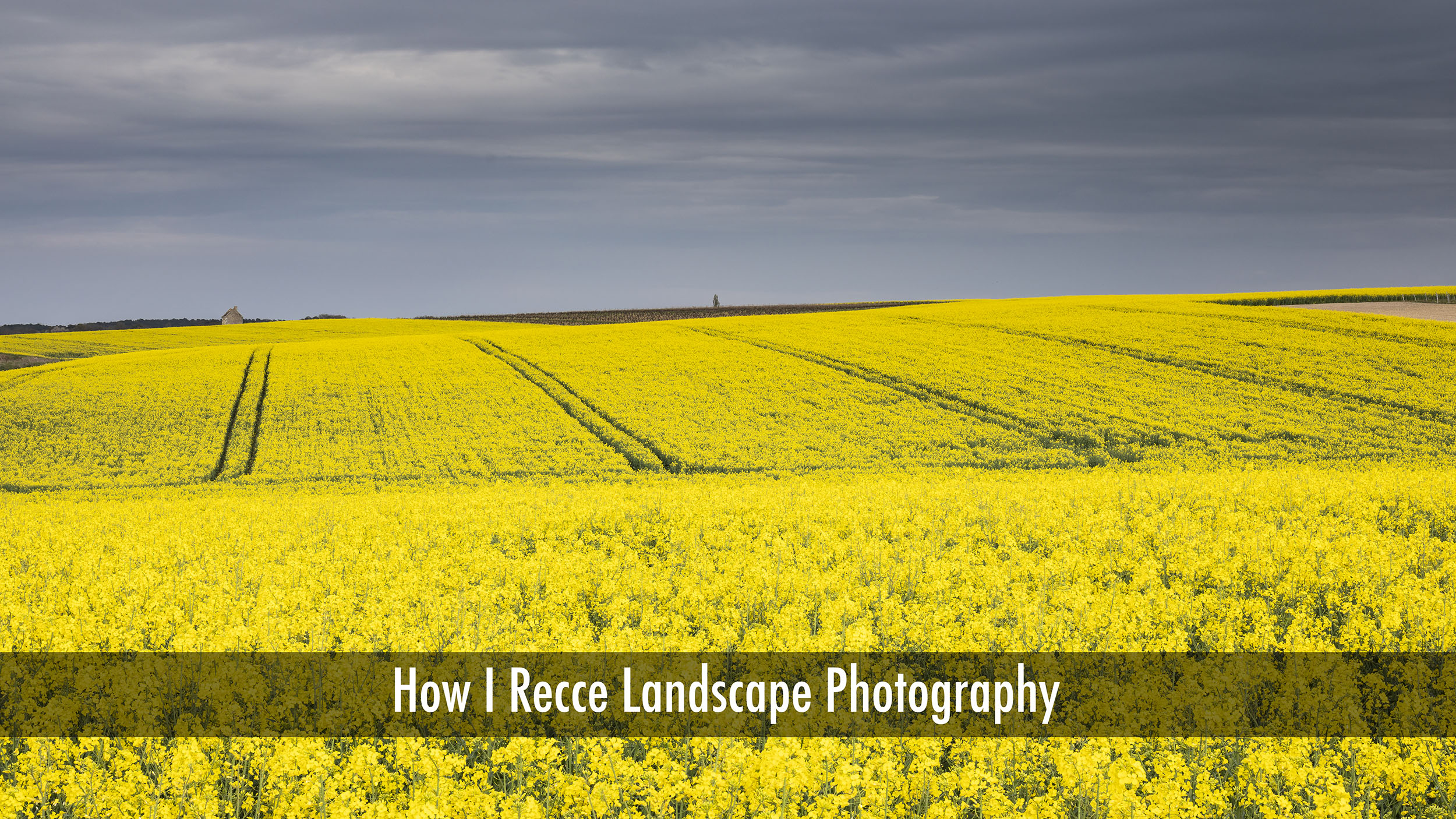

My latest YouTube vlog is entitled How I Recce Landscape Photography. It’s a warts-and-all look at what goes through my mind when I see a scene. What I am thinking with regards to the composition and the execution of the final image.
What you see here isn’t an image that I deem a success, but it’s useful to at least try and make a scene work. You just have to get out there at times and see if these things are worth pursuing or not.
Throughout the year, I offer photography tours and workshops in a variety of destinations around the world. If you’re interested in learning more from me to help you get the best out of your photography, then get in touch.
I had been driving towards the beginning of the Loire Valley when I spotted it out of the corner of my eye. There were rapeseed fields on both sides, and one section had a lovely dip in it that fell away and then rose again behind it. From the road, it looked full of shape, and shape is often what makes a field photograph more than a simple block of colour.
What grabbed me was the sense of movement across the land. The yellow sweep dropped into a shallow hollow and then climbed again, and I could already imagine the first light of day catching that form. The direction mattered too, because the view was facing east. Straight away, I thought it could make a strong sunrise photograph.
My original plan had been to get up early and head back for dawn. However, the day before had involved a long drive, about two and a half hours from Sully-sur-Loire to my home on the far side of Tours, and the weather had been wet for most of the day. I decided not to force the early start. Instead, once the rain eased in the afternoon, I went back to recce the scene properly.
That choice mattered. A scene can look fantastic from a car window, but the roadside view is only a first impression. I have driven this road for about 15 years, and although I have lived in France for a little over 10 years, I still know that local knowledge only takes me so far. I know the feel of the area, I know where the road sits, and I know the direction of the light, but I still have to walk the ground.
Spring in central France helped the scene as well. The rapeseed was bright, the fields were full, and the whole area had that fresh seasonal colour that makes even an ordinary stretch of countryside look full of promise. A few weeks earlier, I had been photographing Château de Cheverny with kind permission, and this field felt like the other side of the same season, less formal, more fleeting, and far less certain.
When I arrived, I was between the two rapeseed fields, with the main road close by and cars passing often enough to remind me how near I was to it. My gimbal was also refusing to behave, so the camera movement was a bit rough from the outset, but the job in front of me was simple. I needed to find out whether the shape I had noticed from the road still held together once I stood in the field and looked through a camera.
I did not know the access, because I had never been in that field before. So I walked up the edge rather than through the crop. That was important to me. A rapeseed field is not a backdrop in the abstract; it is somebody’s livelihood, and I had no interest in trampling through it for the sake of a speculative image.
That respect for the ground is part of the process. I often hear people talk about scouting as though it is only about finding a composition, but it is also about how you move through a place. In this case, the edge of the field was uneven, the footing was poor, and I was clambering rather than strolling. Even so, it was still the only way to test the idea without damaging the crop.
As I went higher, I kept checking whether the original thought still made sense. The dip was there, the lines of the field were there, and the general feeling had not disappeared. Yet a promising scene does not become a photograph simply because it looked good in passing.
Once I climbed further up, more of the structure started to show itself. The tractor lines became visible, and that changed the picture in my mind straight away. Those lines gave the field direction, and they offered something for the eye to follow into the frame.
I could also see a small hut, or what looked like an old shelter for people working in the vines. There were vineyards nearby, and that little structure gave the scene a focal point that the sweep of yellow alone did not have. It was a modest detail, but modest details can carry an image if they sit in the right place.
So the field had several things going for it:
That sounds promising, and in some ways it was. Still, the problem revealed itself quickly. I was too low. To show the dip properly, and to let the photograph describe the land the way my eye had read it from the road, I needed to be about 3 metres higher. Without that extra height, the hollow in the field flattened out.
A field can look wonderful in person and still fail once the camera is in place.
I did briefly think about height in practical terms. I have a step ladder at home, but the ground here was so uneven that using one would have been a poor idea. Even if I had brought it, I doubt I could have set it safely on the edge of that field. So the limitation was clear. The camera position I needed was not available to me.
My first proper test was with a 50mm focal length. That told me almost at once that the scene was not working in the way I had hoped. The frame felt broad, but not in a useful way. Too much of the lower part of the image sat there without doing much, and the line through the scene landed awkwardly across the middle.
The photograph lacked balance. The horizon, or rather the line that mattered visually, cut through the centre of the image with a wide band of yellow beneath it. The hut was present, but it sat too far off to the side to anchor the shot. More than anything, the dip I had come to photograph was not speaking clearly enough.
That is often the first sign that a scene looked better in memory than it does on the back of the camera. Memory keeps the strongest shape and edits out the mess. A test frame does the opposite. It shows everything, including the parts that do not help.
At that point, I knew it was not a 50mm photograph. The wide-ish view left too much dead space and did not compress the important parts of the field. The scene needed tightening, and it needed a lens that would draw the lines and the hut closer together.
The light was also changing while I worked. Dark cloud still hung overhead, but the sun had started to break through in places. I could see the brightness shifting on the field. That gave the scene a bit more life, yet better light was not going to solve a structural problem in the composition.
I switched to my 100-400mm and started at around 100mm. Straight away, the composition improved. The tighter frame reduced the weak foreground, brought the distant hut into a more useful position, and let the tractor lines work harder inside the picture.
The shelter no longer felt stranded off to one side. It pulled closer into the frame, and the lines in the rapeseed began to create more order. I could also see that, if I wanted, I might be able to focus stack the image and keep more of the field sharp from front to back.
For a moment, it looked as though I might salvage something.
This quick comparison sums up where I landed:
| What improved | What still failed |
|---|---|
| The tractor lines became clearer | I still lacked the height to show the dip |
| The hut felt more balanced in the frame | The hut remained a bit too small |
| The crop looked more structured | The scene still did not have enough depth |
| The foreground became less distracting | It was not strong enough to justify a sunrise return |
The longer lens made the image better, but it did not make it good enough. I even found myself thinking that the right answer might sit somewhere between 70mm and 100mm, which made me consider whether a 70-200mm would have been a better fit for this subject. That said, lens choice was only part of the issue. The bigger problem remained the same. I could not physically get high enough to reveal the shape of the land.
Rain started again whilst I was packing up, which rather settled the matter. I made a few more small adjustments, trying to place the field lines on a third and pull the composition into the corner of the frame, but the result still fell short. Each tweak improved one small part and weakened another. If I went higher in the frame, I lost the dip. If I held on to the dip, the hut stayed too slight. The picture never locked into place.
There is a plain truth in this sort of outing. Some scenes are beautiful, but they are not photographs, at least not from the position available on the day. That was the case here. I liked the field. I liked the season, the colour, the shape, the vineyard shelter, and the possibility of sunrise. Yet liking a place is not enough.
This is the part of the job I value most. A recce is not only about finding pictures. It is also about ruling them out with confidence. Once I had stood there, walked the edge, tested the view, and changed lenses, I knew I did not need to come back at dawn. That saved me time, and it saved me from chasing a picture that was never quite there.
I am picky about what I keep, especially with landscape photography. If an image does not feel resolved, I would rather leave it than pretend it works. That may sound harsh, but it keeps the standard clear in my own head. The field did have photogenic elements. It simply did not come together as a full image.
That balance between instinct and discipline is a big part of why I enjoy working in this part of France. The Loire Valley gives me plenty to look at, from castles to villages to open countryside, and it is also why I spend time leading Loire Valley photography tours. The region is generous, but it still asks the same question of every idea: does the photograph hold up once I stop and look properly?
This field reminded me that the answer can be “not this time”, and that is completely fine.
The strongest part of this outing was not the final frame, because there was no final frame worth keeping. The value was in the process of seeing a scene from the road, walking back to it, testing it properly, and accepting that the idea did not survive contact with the camera.
That is still a successful recce in my book. I left knowing more than I knew when I arrived, and I did not have to drag myself out for sunrise to learn the same lesson. For me, how I recce landscape photography comes down to that honesty. A fast first impression matters, but the careful second look matters more.
If you want to keep up with more of my work in central France, you can find it on my YouTube channel and through my photography website.
We noticed you're visiting from United Kingdom (UK). We've updated our prices to Pound sterling for your shopping convenience. Use Euro instead. Dismiss