 Skip to content
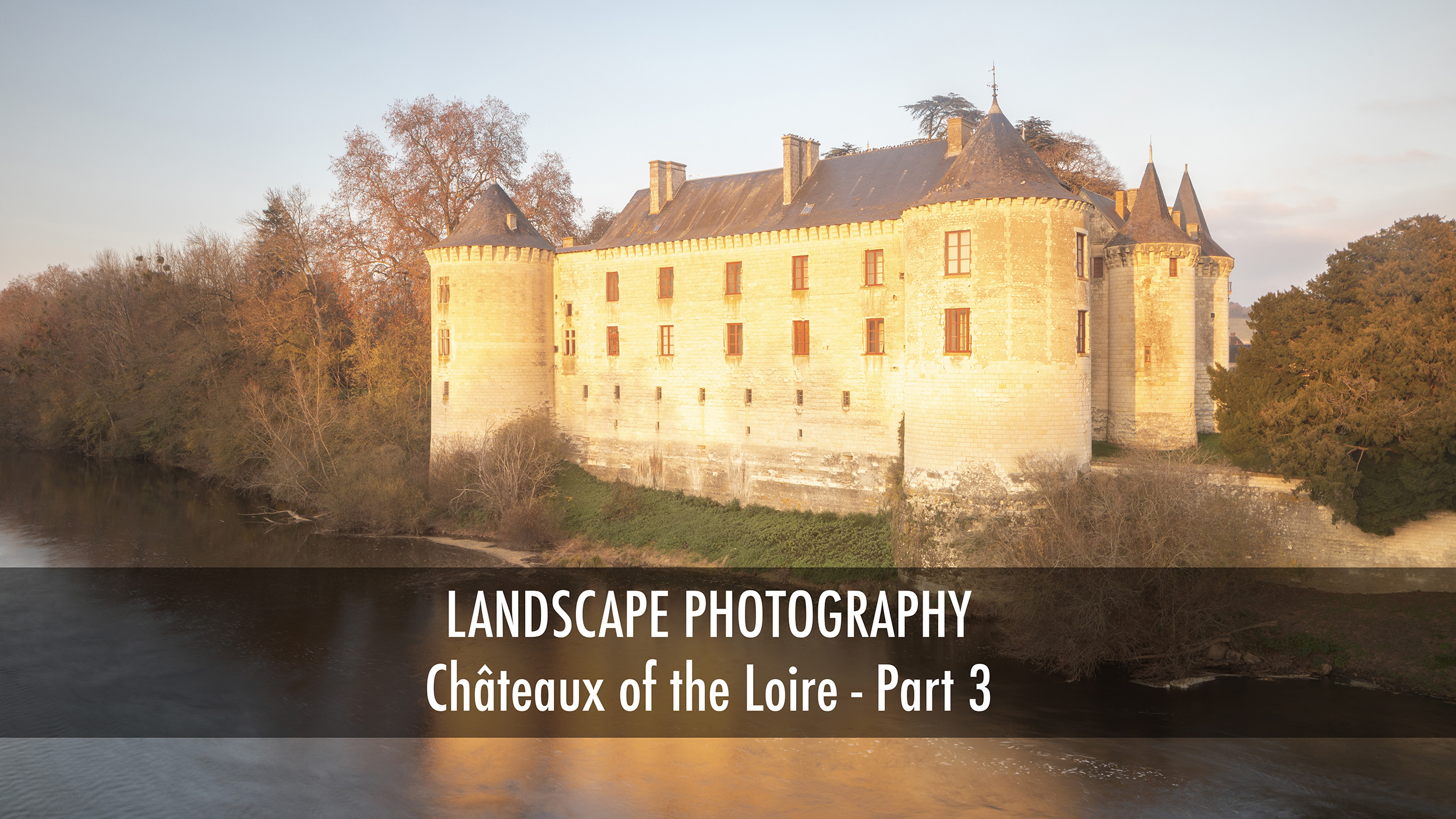

The Châteaux of the Loire are famous worldwide and rightly so. From old medieval fortresses such as those at Chinon to more stately castles dotted around the area, they make great subjects for both landscape and travel photography.
In this latest episode from my YouTube channel, more castles are the subject of my lens in the Indre-et-Loire department of France. I’ll show you three castles that probably haven’t been on your list of places to visit, but hopefully, you’ll change that with these beauties. This central area of France plays host to some 144 castles that are registered as historic monuments. You’ll get to see castles from throughout the ages and some, apparently, even have a network of underground tunnels too!
With this series, I aim to introduce some of the well-known as well as lesser-known castles that are here in central France. Do be aware, though, that not all of them are accessible to the public and remain behind high walls sealed off from public gaze. But those that are visible will be covered where I can.
And if you’re interested in discovering the Loire Valley with a camera, then do check out my annual Loire Valley photo tour in May.
When people think of the châteaux of the Loire, they often picture the grand headline names. I love those, too, but there is another side to this region. It is more rural, less crowded, and full of places that reward research, patience and a willingness to stop when something catches your eye.
This part of the route took me through a sequence of castles from different centuries, each with its own problem to solve. One had a glowing pale stone that needed careful exposure. Another needed a frame within a frame. One sat behind a private gate, and another only really worked if I arrived before the sun dropped behind a tree line to the west.
What tied them together was timing. None of these places felt random. Even when I made an unplanned stop, the photograph still depended on knowing where the light would be and what access I had once I got there.
Château de Boussay was not one of the castles I had built the day around. It had crossed my radar before, but I had not given it much weight. Then, whilst driving around and doing a bit of a recce, I realised I could walk around the grounds between 9 in the morning and 5 in the afternoon.
That changed everything.
The approach alone made the stop worthwhile. Walking through the estate towards the castle, I had that feeling some places give you at first sight, where the scene already feels composed before you even lift the camera. The castle sits beautifully in the landscape, and the whole view has that polished, almost fairytale quality that some photographers dismiss too quickly.
I do not. It looks very Disney, and that is fine. If a place is that photogenic, I am not going to pretend otherwise.
According to the information board at the entrance, the castle dates from the 14th century and has remained in the same family throughout that time. It sits on the edge of Indre-et-Loire in a rural area that does not feel heavily visited, which made the setting even better. There was space to look, to think, and to try a few ideas without any sense of rush.
Boussay is beautiful, but it is not effortless to photograph. The pale, whitish stone that looks so good to the eye can become difficult once sunlight hits it. The brightest parts lift fast, while the darker parts of the frame fall away. That contrast means a single exposure is not always enough.
The pale stone of Loire castles can fool your eye. If the light is strong, I often need more than one exposure to hold detail across the frame.
I was there at around 11 o’clock in the morning, but it was winter, so the light still had a lower, gentler angle than it would in summer. That helped. I chose a longer-lens view looking directly towards the castle, because compressing the scene gave the building more presence and reduced distractions in the surrounding ground.
This was one of those straightforward postcard views that works because the subject is strong enough on its own. There is no need to overcomplicate every composition. Sometimes the best thing I can do is recognise that the castle itself is carrying the image, then expose carefully and keep the frame clean.
The next stop was Château de Betz-le-Château, a 15th-century castle on private property. I stayed on public ground by the road, because the driveway and the entrance clearly looked like a place not to push my luck. That restriction shaped the photograph straight away.
At first glance, the angle felt awkward. The castle was there, but the obvious viewpoint did not give me a satisfying composition. Then the answer became clear. Near me was a gate, described on site as a 17th-century gate, and that gate gave me the structure I needed.
I had also read that this castle is associated with underground tunnels, and the information on the wall referred to restoration work on the castle and underground areas. Even without seeing those spaces, that detail added another layer to the place. Betz-le-Chateau has the kind of history that sits below the surface as much as above it.
For this image, I used my 24mm tilt-shift lens with a 1.4x extender. The idea was simple, but the execution mattered. I framed the castle through the arch of the gate and kept the composition tight enough that there was no sky above the top of the gate, only the sky visible through it behind the castle.
That small decision made the frame cleaner and stronger.
The light was in the right place because I had timed the visit for the afternoon. Sunlight came across the side of the castle well, and a polariser helped settle the reflections and improve the colour in the scene. Then I lowered the camera on the tripod, bent down to change the perspective, and used the tilt-shift movement to bring the top of the castle into view without letting it run awkwardly into the top of the arch.
A few details made the image work:
I arrived in the afternoon, so the side of the castle had direct light.
I kept low to separate the top of the building from the top of the gate.
I respected the private property signs and built the shot from where public access allowed.
Restrictions often improve a photograph because they force a decision. In this case, the gate gave the image its shape.
La Celle-Guenand was on my wider list, though not on the original plan for that day. It was nearby, it was there, and that was enough reason to pull in and have a proper look.
The château is private, so the photograph comes through a gate rather than from open ground. It is the sort of place where a long lens and a bit of patience make all the difference. I got the impression that people must stop here to take pictures fairly often, simply because the setup almost invites it.
The information on the site describes it as a 14th-century chateau built on top of an older one. I liked that immediately. You are looking at a building from one era standing over the traces of another. Even when the access is limited, that kind of layered history gives the place weight.
There was another reason the stop felt worthwhile. Nearby stood a beautiful Romanesque church with a spire leaning off to one side. That detail gave the whole village more character and made the unplanned stop feel richer than a single quick castle grab. It was not the centrepiece of the day, but it added texture to the route.
Behind the camera at my next stop was Château du Chatelier, a 12th-century feudal castle with a moat, a drawbridge and a dungeon. Some castles feel stately first and defensive second. This one felt defensive from the moment I saw it.
The timing mattered here as much as anywhere else. I had worked out that the afternoon would bring the sun across the face of the castle at close to a right angle, and that side light gave the stone depth straight away. When the sun is ninety degrees to the subject, the structure starts to speak more clearly. Edges, textures and recesses all become easier to read.
The scene also had a bit of cloud by then, which I was glad to see after so much plain blue sky earlier in the day. Blue sky is not a problem by itself, but a little cloud can stop the frame from feeling empty above a strong building. With a polariser in place, the whole scene tightened up well.
What I liked most was the shape of the site. You could read the layers at a glance: the main body of the castle, the bridge crossing in front, the moat, and the old dungeon section beside it. It felt larger than I expected, and it had far more presence on location than a map or a satellite view would suggest.
Chatelier was one of those castles I only found through patient research. I spent time plotting locations, checking likely sun positions, and working out the best part of the day for each stop. That process is rarely glamorous, but it is the reason many of these photographs happen at all.
In this case, the research paid off twice.
First, it gave me the afternoon composition I had come for. Second, whilst driving in, I spotted another angle that looked even better for dawn. If mist formed as it had that morning, the castle from that position could look superb. Those accidental discoveries often become the reason I return.
I also thought this was a place where a drone might work well, provided the airspace allowed it. My plan was to check the drone map and, if there were no restrictions, fly from the car park behind the tree line. An aerial view here would show the relationship between the castle, moat, and surrounding ground much more clearly than the ground-level shot alone.
This stop summed up a lot of what I enjoy about photographing the châteaux of the Loire and the nearby tributary valleys. You arrive with one idea, then the place gives you another.
The final castle of the day was Château de la Guerche, in the village of La Guerche beside the River Creuse. It sits near the edge of Indre-et-Loire, and although it falls outside the usual mental map people have for the main Loire showpieces, it still has that familiar Loire Valley elegance.
By the time I filmed the scene, the best light had gone. That did not matter, because I had already taken the image. I always make the photograph first when the conditions are right, then deal with the rest once I know I have the frame.
This location had a strict timing window. To the west, beyond the castle, there is a line of trees and a dip in the land. As a result, the sun disappears earlier than you might expect. I needed to be there at least an hour before sunset to catch the last proper light on the building, and I arrived with little time to spare.
At Château de la Guerche, late afternoon is not enough by itself. I needed to beat the tree line, not the sunset clock.
The viewpoint I found was strong, but awkward. I had the river in front of me and limited space to set up, so I ended up balancing the tripod in a plant pot by the water to get the framing right. It was one of those slightly ridiculous field solutions that makes sense when the photograph is in front of you.
I also had to move fast. Clouds were building behind the castle, there was still a touch of light left on the stone, and I grabbed a shot during filming because the moment was slipping away. Alongside that, I made a blended version as well, so I could manage the changing brightness more carefully later.
The frustrating part is that this feels like a one-shot wonder from that side. I could not find any access to the opposite bank, even though it looked as though a lower angle from there might have produced something special. Everything appeared to be private gardens and private grounds.
Still, this is exactly why I research access before setting off. There is no point dreaming up compositions from a map if I cannot stand where the picture needs me to stand. La Guerche gave me one good option, and in the right light, that was enough.
The famous sites earn their reputation, but these quieter castles give me something different. They ask for more thought. I have to work around gates, roads, walls, tree lines and patchy public access. Because of that, the final pictures feel earned.
They also show a broader version of the region. The Loire is not only its headline chateaux. Its tributaries, villages and outlying departments hold castles with medieval grit, family history and surprising beauty. That wider view is one reason I keep coming back, both for my own photography and through my Loire Valley photography tours.
This part of the series also came with a practical reason for filming ahead. I knew I had to travel back to the UK for family reasons, so I planned extra episodes in advance to keep the series moving. That urgency pushed me out the door, and I am glad it did, because this route turned into one of those days where every stop offered something worth remembering.
The strongest lesson from this day was simple. Timing mattered more than anything else. Light, access and angle decided the success of every stop, whether I was standing in open grounds at Boussay or squeezing a tripod into place by the Creuse at La Guerche.
What I enjoy most about photographing the châteaux of the Loire is that the region keeps widening the more I explore it. The well-known names are only part of the story, and these quieter castles prove it.