 Skip to content
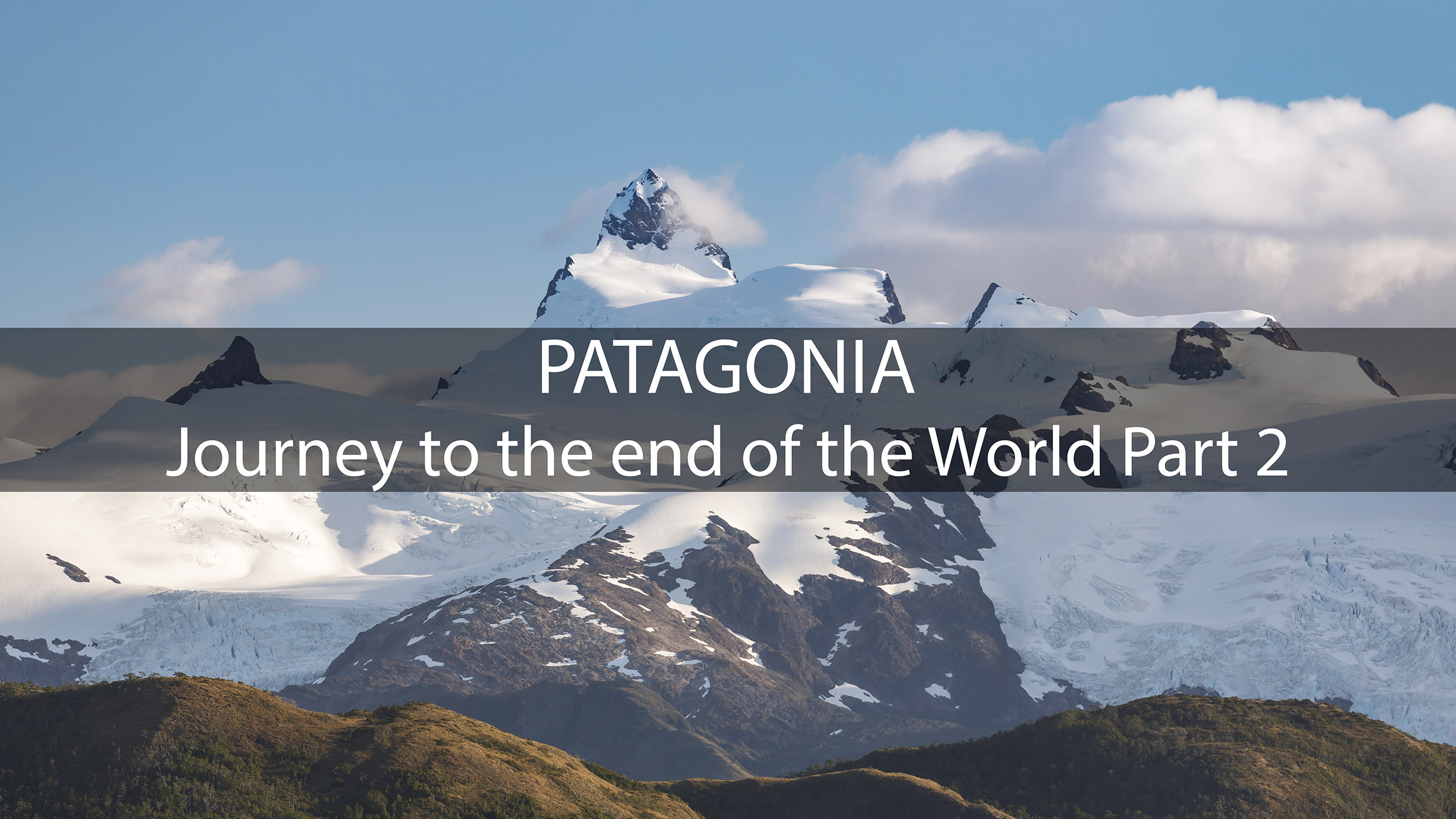

My latest YouTube vlog is entitled Patagonia – Landscape Photography at the end of the World Part 2 highlights the second part of an epic journey I took down to the fjords of Chile in South America.
On a commissioned trip for a cruise liner, I had the opportunity to see stunning mountain scenery, glaciers, and get up close to some of the wildlife that inhabits this part of the world.
To say the scenery was mind-blowing is an understatement. Even breathtaking seems not to do it justice. It was quite simply awe-inspiring down there, and it’s a journey that can only be described as epic.
So, take a seat and take a look at the second and final part of this adventure.
As the sun came out over Punta Arenas, I set off on the second part of my cruise through the Patagonian fjords. The morning was cold, the sky was clear, and the mountains already looked sharp and bright in the first light. New passengers had joined the ship for the next few days, and there was a sense that the trip was building towards something bigger.
I had been told what was coming would be breathtaking, and that proved to be no empty promise. Even before breakfast was over, the scenery had already taken hold. I tried to sit down for a simple meal, looked out of the window, and immediately gave up on the idea of taking my time. When the light is good and the mountains are right there in front of you, breakfast can wait.
That became the pattern of the trip. Dinner the night before had already been cut short because there was too much happening outside, and now the same thing was happening again in the morning. Whilst most people were still enjoying breakfast, I was back out on deck with the camera, chasing the light and trying to make the most of every minute.
The day ahead held plenty. There was a walk planned with what I was told would be superb views, and later on we were heading towards Tucker Islet for penguins. In a place like Patagonia, the day never feels fixed. You know the route, but you never quite know what the weather, the light, or the wildlife will give you next.
One of the early highlights was Ainsworth Bay. The mountain scenery there was stunning, with broad, cold slopes rising around the water and clear light sitting on the peaks. It was one of those mornings where everything lined up. The sun was out, the air was crisp, and the fjord looked clean and bright.
That sort of light makes it hard to stay still. I found myself leaving meals half-finished and heading straight back outside, because the view simply wouldn’t let me sit indoors for long. If you’ve ever travelled with a camera in a place like this, you’ll know the feeling. You tell yourself you’ll eat first and shoot later, then the light changes, the ship turns slightly, and a whole new composition opens up in front of you.
The other challenge was the wind. Photographing from the deck of a moving ship is one thing, but photographing into strong wind is another. At times, I had to tuck myself behind parts of the ship to shield the lens and keep it as steady as possible. Even then, picking out sections of the Patagonian mountainscape needed patience and a lot of frame-by-frame adjustment.
From Ainsworth Bay, we carried on through the fjords towards Tucker Island, where the main draw was the penguins. We were told there might also be condors around, which added another layer of interest to the trip. This wasn’t a landing. Instead, we would head out in Zodiac boats and stay on board whilst photographing from the water.
That brings its own set of limits, of course. You’re dealing with wind, movement, distance, and wildlife that doesn’t always sit where you want it. Still, those limits are part of the appeal. They force you to work harder and pay closer attention.
For much of this section of the journey, my main lens was the Canon 100-400mm with image stabilisation, and at times I added a 1.4x extender to get a bit closer. That reach mattered when I wanted to isolate details in the mountains or pick up wildlife from the ship. Focus could be tricky because the boat was moving all the time, so I often had to switch between autofocus and manual focus depending on the subject and the conditions.
Technique mattered as much as gear. If the light was low and soft, especially early in the morning, I could still get sharp results with careful handling. I also shot panoramas in sequence, which worked better than many people might expect. Even on a moving vessel, those images are possible if the shutter speed is high enough and your movement stays controlled.
Patagonia asks a lot of your camera technique, but it gives back more than almost anywhere else I’ve photographed.
Later that evening, at around quarter past eight, we reached the start of Gabriel Channel. I had already eaten dinner early because the light was looking too good to ignore, and I wanted to be on deck before we entered the channel. That turned out to be the right call.
We had been told the route through Gabriel Channel would be a particularly interesting one for the captain. The navigation there was meant to be unusual, and there was a sense on board that something memorable was coming. I spent as much time as I could filming and taking stills as we moved through.
The beauty of that part of the evening was not only the route itself, but the way the light sat on the water and the mountains as the ship continued south. Patagonia often gives you scenes that look almost arranged, as if the whole place has been built for landscape photography. Then the ship turns, the angle changes, and you realise you were only seeing one part of it.
One thing that became clearer as the trip went on was how fortunate we were to be on a smaller ship. Ours carried around 200 passengers. In Punta Arenas, I had seen another vessel that held roughly 2,000 people, and the difference mattered. A smaller ship can reach places more easily, can feel calmer, and can create a much better rhythm for photography.
That rhythm shaped the whole journey. Every mealtime risked interruption because the view outside kept changing. Breakfast, lunch, and dinner were never only meals. They were moments where you glanced out of the window, saw fresh light on a ridge or glacier, and felt that familiar urgency to get back outside.
By this point, I had already taken around 4,000 images. That sounds excessive until you’ve spent time in Patagonia with clear weather. Then it feels almost conservative.
At one point, someone asked me what use a tripod was on a moving ship. It’s a fair question, but the answer is simple. If your shutter speed is fast enough, a tripod can still help. I used mine for b-roll footage, and I also used it for panoramas when the conditions allowed.
Of course, the ship was still rising and falling gently on the water, so now and then the horizon line gave away that movement. Yet that didn’t stop me from getting usable frames. Some panoramas were handheld, others were tripod-based, and both approaches worked.
For me, this part of the voyage wasn’t about teaching in the usual sense. I wasn’t breaking down settings every few minutes because the scenery itself was the story. We were surrounded by mountains all day, with snow on one side, bare rock on the other, and that endless southern light shifting across the water.
When we returned to Pia Glacier, the timing was different from my first visit. Earlier in the trip, I had seen it in the morning. This time we approached in the afternoon, and I preferred that light. In the morning, the sun had been sitting more directly above the glacier. In the afternoon, the scene had more shape and felt easier to photograph.
We couldn’t get off the boat there, but that didn’t reduce the impact. In some ways, watching from the ship added to the sense of scale. The glacier sat ahead of us with that heavy, cold presence only big ice can have, and the whole fjord around it seemed to fall quiet.
One of the strongest moments of the trip came near the glacier when a guide asked us for one minute of complete silence. No talking, no camera clicks, nothing. We stood there and listened. It was beautiful and hard to explain. The place already looked unreal, but in silence, it felt even further removed from normal life.
Later, around six in the evening, we were moving along the Beagle Channel towards Glacier Alley. Over my right shoulder was one of the finest mountain ranges I had seen on the whole journey. I had photographed it earlier in the morning light and managed a panorama then. Seeing it again in the evening, I had to shoot it once more.
Every day on the cruise had brought unusually good weather, which people kept saying was rare for this part of the world. I believed them. Day after day, we had blue skies, clean visibility, and mountain views that stretched in every direction. It was one of those trips where the conditions kept matching the place.
Some destinations look good on camera. Patagonia often looks better in person, and that is saying something.
If anyone ever asked me whether to go to the fjords of Patagonia if the chance came up, my answer would be simple: say yes. Even in the rain, I suspect it would still be beautiful. With the weather we had, it felt almost unreal.
On Friday, 7 Feb 2020, we returned to Cape Horn. That alone made the day special for me because I was the only passenger doing the full return journey. A few others were continuing on, but for me, this was a genuine return to one of the most storied points in the southern oceans.
The first time I had been there, the weather was already turning, and rain was moving in. This time, the conditions seemed much calmer. We were told the wind was around three knots, which sounded almost gentle by Cape Horn standards. Even so, Cape Horn is Cape Horn, and nobody takes a landing there for granted.
The first Zodiac went out with the team to check the conditions before the rest of us made any move towards the island. That wait built the tension. When you are standing there, looking at that famous headland and hoping to set foot on it, even a short delay feels longer.
The island itself had strict limits on where we could go, which is fair enough in a place so exposed and so fragile. One detail stayed with me in particular. I was told that some of the white flowers growing there are found only on the island. Standing at Cape Horn is one thing. Realising that even the plant life is rare and isolated gives the place another kind of weight.
Back at Wulaia Bay, I returned to one of the most memorable spots from the first part of the trip. The great draw there is the sub-Antarctic forest, which lies behind the bay and feels like the last line of trees before the world gives way to ice and sea.
Because I had already visited, the guides kindly gave me time to work on my own. That freedom made a huge difference. I could settle into a viewpoint, wait for the light, and move at the pace photography often needs. I was also allowed to use my drone there because the company owned the island, which opened up more options.
The sun kept appearing and disappearing behind the clouds, and shafts of light moved across the scene in a way that made every few minutes feel different from the last. By then, I had turned noticeably red from the strength of the sun down there. I had read in Punta Arenas about the ozone issue in that part of the world, and after a few days outside, I had no trouble believing it.
I spent time at a viewpoint first, then worked my way back down to look for images inside the forest itself. There were plenty of possibilities, twisted trunks, filtered light, and those layered woodland scenes that reward slower looking. Wulaia Bay gave me both the big view and the smaller compositions, which is not always the case in a place known for dramatic scale.
By then, the trip was nearing its end, and we were heading back towards Ushuaia. It felt strange to be thinking about returning to civilisation after days spent in such an open, remote place.
Trips like this are never only about the scenery. The people on board matter as much as the route, especially when I am working. Good conditions help, but good people make the work lighter, the atmosphere stronger, and the long days more enjoyable.
I came away grateful to the crew, the guides, and the passengers who made the voyage what it was. Sebastian stood out, both as a guide and as a photographer. He sees this part of the world all the time, yet his enthusiasm for it hasn’t faded, and that says a lot. His photography is well worth a look on Instagram.
I also wanted to thank Catalina, Juanita, Roger, Mark, Herman, and Miguel, who had helped me earlier on the trip when I was filming near a waterfall. Support like that matters when you’re trying to produce images and video in difficult conditions.
The passengers added plenty too. People such as Wally from the Pacific Northwest, Bill and Cheryl from San Antonio, Flip and his wife, Martin and his wife, Ernest from Hong Kong, Knollys from Canada, and others I met along the way all helped create a warm, positive feeling on board. When you are working commercially whilst travelling, that kind of atmosphere makes a genuine difference.
For anyone who wants to keep up with my photography after this journey, I’m also on Instagram and Facebook. At the time, more travel was already ahead of me, with France, Norway, the UK, Berlin, and plenty more still to come.
Patagonia gave me the sort of days that stay with you long after the memory cards are full. The mountains, the glaciers, the wildlife, and the shifting light all made the trip memorable, but the strongest impression was the scale of the place. It feels remote, raw, and far larger than any photograph can fully hold.
What I remember most is the pull of it. A half-finished breakfast, an early dinner, a hurried step back onto the deck, all of it came from the same thing: the light kept changing, and I didn’t want to miss a second of it.
That is what this journey felt like from start to finish: a place so beautiful that standing still for too long felt like a mistake.