 Skip to content
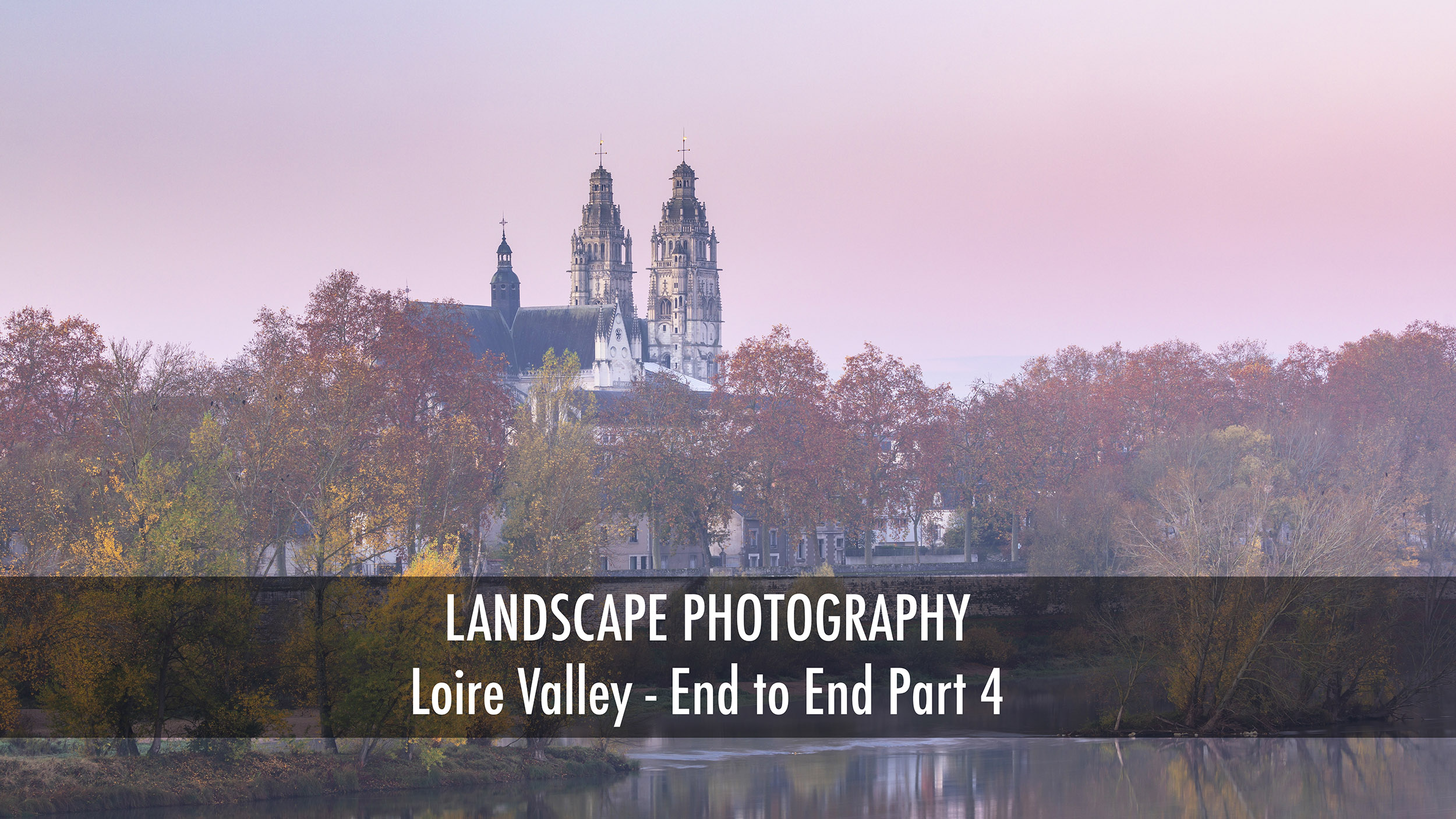

The fourth instalment of my YouTube vlog, Landscape Photography Loire Valley End to End Part 4, shows you some of the areas from Tours to Chinon. This central area of France has been designated a UNESCO World Heritage Site, and it’s not hard to see why.
Starting with the sunrise view over the Loire towards Saint Gatien cathedral in Tours, you’re going to have a very good idea as to why UNESCO made this area of central France a World Heritage Site.
The day ends with a whimper in Chinon as a huge bank of cloud descends over the area. But that’s not a problem as there’ll be more to come.
And if you’re interested in discovering the Loire Valley with a camera, then do check out my annual Loire Valley photo tour in May.
I started my morning in the Loire Valley where I had wanted to be on the previous outing, on a bridge over the river Loire in Tours, looking towards the beautiful Gothic cathedral of Saint-Gatien. It sits right on the edge of the historic centre, and from this viewpoint it rises cleanly above the riverside trees. When the fog stays away, it is one of the best dawn views in the city.
Tours matters to me for another reason as well. It was the first city I lived in when I came to France. I now live in a village to the west, but coming back into Tours still feels familiar. There is plenty to see here, and the city has enough character to keep both travellers and photographers busy for days.
I would have liked to show the inside of Saint-Gatien, but the cathedral opens later in the morning. The exterior was my focus instead, and the timing mattered. Early light was building in the east, so I fitted a polariser and worked with a 100-400mm lens to pull the cathedral closer across the river.
Composition was simple, but deliberate. I placed the cathedral on a third, while keeping the towers close to the centre of the frame. That gave the building enough weight without making the whole view feel static. Autumn colour still clung to some of the riverside trees, and there were faint reflections in the Loire below. The river level was low, with a large sandbank visible beneath my line of sight, which changed the feel of the foreground.
There are a few useful reference points from this bridge. Off towards the old part of town sits Place Plumereau, where the half-timbered buildings draw most visitors. Some of those old facades have carved details, and the whole area has more texture than many people expect from a city centre. In another direction, I could make out the dome of the Basilica of Saint-Martin. Near it stand the remains of the original basilica and an old clock tower, signs of how layered the city is once you start looking beyond the main postcard view.
The bridge itself creates one practical problem. Traffic makes it move. If a bus or heavy vehicle crosses while the shutter is open, you can lose sharpness straight away. That means timing matters as much as light. There is also a footbridge nearby, and Pont Wilson gives another angle towards the cathedral, but on this particular morning, this spot gave me the cleanest composition.
In places like Tours, a strong image often depends on small local details, opening times, bridge vibration, river level, and the direction of first light.
After Tours, I headed down the Loire Valley towards Luynes. The village sits above the river Loire, and the Château de Luynes dominates the hill. Rather than photograph it front-on, I went for a long-lens view down the road leading up into the village. I know this location well enough to know what the sun can do there. In the morning, or later in the day, light cuts through the avenue of trees and sends bright shafts along the road towards the castle.
That kind of local knowledge is hard to replace. You can look at maps, and you can arrive full of hope, but returning to the same place in different conditions teaches more than any app does. On this morning, low mist drifted through the fields below the chateau without covering it, which gave the scene a soft base layer without losing the main subject.
The shot was not straightforward. Three things got in the way:
The road traffic was only a waiting game. The wires were harder to ignore. This is one of those rare cases where I look at a frame and know that, for a finished commercial image, the electricity lines would have to come out in post-processing. I do not say that lightly, because I do not like removing things for the sake of it. Here, though, the lines damaged the image more than they described the place.
Even with fewer leaves than there had been a couple of weeks earlier, the view still worked. Morning side light gave the castle form, while the avenue of trees framed the approach. There is always a balance in autumn between catching colour at its peak and waiting for cleaner branches and softer structure. On this day, I was somewhere between those two stages, and the result still felt worth making.
Later in the morning, I went back to the edge of the Loire near home, to a spot I often use. I know the light there, I know how the river behaves, and I know what the weather can do to it when there is mist on the water. On the previous outing, people had commented on a boat they had seen through the fog. That boat was still afloat and sitting further off to one side. The subject I was working with this time was the real sunken boat in the foreground.
I first thought about using a tilt-shift lens and building something more formal out of the scene. Once I looked properly, though, it was clear that the composition needed compression rather than width. A 50mm tilt-shift would have suited it far better than a wider option. Since I did not have that, I used my 24-70mm at around 50mm and kept things simple.
The main strength of the image was the angle of the boat. Diagonals carry a lot of force in composition, and the boat gave me one naturally. I placed part of it near a third, then allowed its line to run across the frame. A second boat sat further back near the horizon, which helped create a sense of depth without overcomplicating things.
Light was doing a lot of the work. There was cloud low on the western horizon, and the morning sun was giving clean side light across the scene. A polariser helped as well. It cut glare and gave shape to the water and timber. What I was less sure about was the right edge of the frame, where the riverbank and a small tree or shrub were creeping in. From one point of view, they acted as a frame. From another, they were a distraction.
I liked the result, but I was not fully convinced by it. Some photographs feel right as soon as the shutter closes. This one stayed in the maybe pile. It would be stronger, I think, with a little mist at dawn and the first sunlight breaking through it. Thick fog without light makes a river scene flat. A thin layer of mist with directional light gives it life.
One of the biggest surprises of the day stood in open countryside, a Roman aqueduct near Luynes, roughly 1,800 years old. I had lived in the Loire Valley for more than five years and had never photographed it properly. That says something about how easy it is to overlook what is close to home, especially when you spend so much time travelling elsewhere with a camera.
The aqueduct dates from the second century, according to the information board on site. It has been restored more than once over the centuries, and six of the arches are still original. Water came from sources to the north, travelled along this raised structure, and then, at some point further on, continued underground.
The structure looks striking because it appears almost without warning in a field. There is no dramatic mountain backdrop or sweeping urban context. It is stone, arches, grass, and sky. That simplicity gives it presence. I photographed it in the morning, even though I think afternoon light would suit the stone better overall. What I did gain from the earlier hour was long shadows passing through the arches, and that gave me another layer to work with.
Because of the contrast, I knew I would probably need to blend two exposures. The shadows had shape, but the brighter areas needed control. That is a technical choice rather than a stylistic flourish. Sometimes one file is enough. Sometimes the light tells you it is not.
One awkward detail stood out for the wrong reason. A house sits too close to part of the aqueduct. It is hard to look at a structure this old and not wonder how anyone thought that was a sensible planning choice. The aqueduct also continues for some distance beyond what first appears visible, stretching further behind the viewing point.
I found myself thinking how often photographers travel thousands of miles for history and then drive past something extraordinary on their own patch. This aqueduct is one of the finest remains of its kind in western France, and it deserved my attention far sooner than it got it.
After lunch and a short rest, I went back out and made my way west again. By early afternoon, I was near Luynes once more, this time on the banks of the Loire looking towards the suspension bridge. The light was harder by then, and on a normal day, I would not pretend that midday sun is my first choice. Still, that does not mean the camera stays in the bag.
There is a muddy path down to the riverbank on one side of the bridge, and I had never photographed from there before. Cars rattled over the bridge joints above me, which added a steady clatter to the afternoon. I made an initial exposure at f/11, one-third of a second, ISO 100, and the file looked decent enough. The scene had structure, but it did not yet feel distinctive.
That was when I decided to try infrared. A subscriber, Gerard Ferry, had reminded me that midday can suit infrared work far better than standard colour photography, especially when there is still green in the trees and grass. He was right to prompt me. Bright overhead light, which can be dull in colour, can become much more useful once an infrared filter goes on the lens.
The filter I used cut around ten stops of light, turning a short exposure into something around 30 seconds. If I added the polariser as well, I would push the exposure to about two minutes. That longer shutter speed would smooth the water and strip out some of the visual noise in the surface. Meanwhile, the foliage would take on that pale, luminous quality that makes infrared interesting in the first place.
This was also a good reminder that difficult light is not wasted light. It only asks for a different response.
Later on, after driving a few of the Loire Valley’s country roads, I stopped at a ruined priory. I had visited before, but never with enough focus to make photographs I cared about. This time I gave it the attention it deserved.
The priory dates to about 1067 and is Romanesque rather than Gothic. You can see that straight away in the weight of the stone and the shape of the surviving architecture. From the information on the site, it remained standing until at least the late 1700s, although I could not see a clear explanation of when the ruin took the form it has now.
What I liked most was the quiet of the place. White stone can look good even without dramatic shadow, and the softer, flatter light lets me concentrate on details rather than broad contrast. Instead of chasing a grand wide shot, I switched to the 100-400mm and worked on the sculptural elements in the masonry.
The old carvings were the real draw. Time had worn them, but not erased them. A telephoto lens let me isolate those details and ignore the less helpful modern elements around the site. Some places invite sweeping views. Others work better when you stay close and look carefully.
I ended my day in the Loire Valley at Chinon on the banks of the River Vienne. It was not the ending I had hoped for. A broad bank of cloud rolled over and flattened the light. I had wanted to finish in the vineyards to the north, towards Saumur, but the weather made that plan pointless.
That is autumn. Some days close with glowing colour and mist over the water. Others fade under a grey sky and leave you with less than you wanted. I do not mind admitting the frustration, because it is part of photographing the Loire Valley honestly. The region gives a lot, but it does not hand it over on command.
Still, Chinon was a fitting place to stop. The day had already given me Tours at dawn, Luynes in side light, a boat on the Loire, a Roman aqueduct in a field, and a priory full of texture. One bank of cloud could not undo that.
The next stretch west, towards Saumur and perhaps on towards Angers, has its own questions. Angers sits outside the official UNESCO boundary of the Loire Valley, yet it would feel wrong to ignore it completely. Some places matter whether or not a line on a map includes them.
The strongest lesson from this day was simple. The Loire Valley is at its best when I give time to the places between the famous stops, and when I return often enough to understand the light.
Tours, Luynes, the riverbank, the aqueduct, the priory, and Chinon all asked for a different approach. Some scenes needed patience. Some needed compromise. A few needed me to accept that the photograph was only almost there.
That is part of why I keep coming back. In the Loire Valley, even an imperfect day can produce more than enough to remember.
We noticed you're visiting from United Kingdom (UK). We've updated our prices to Pound sterling for your shopping convenience. Use Euro instead. Dismiss