 Skip to content
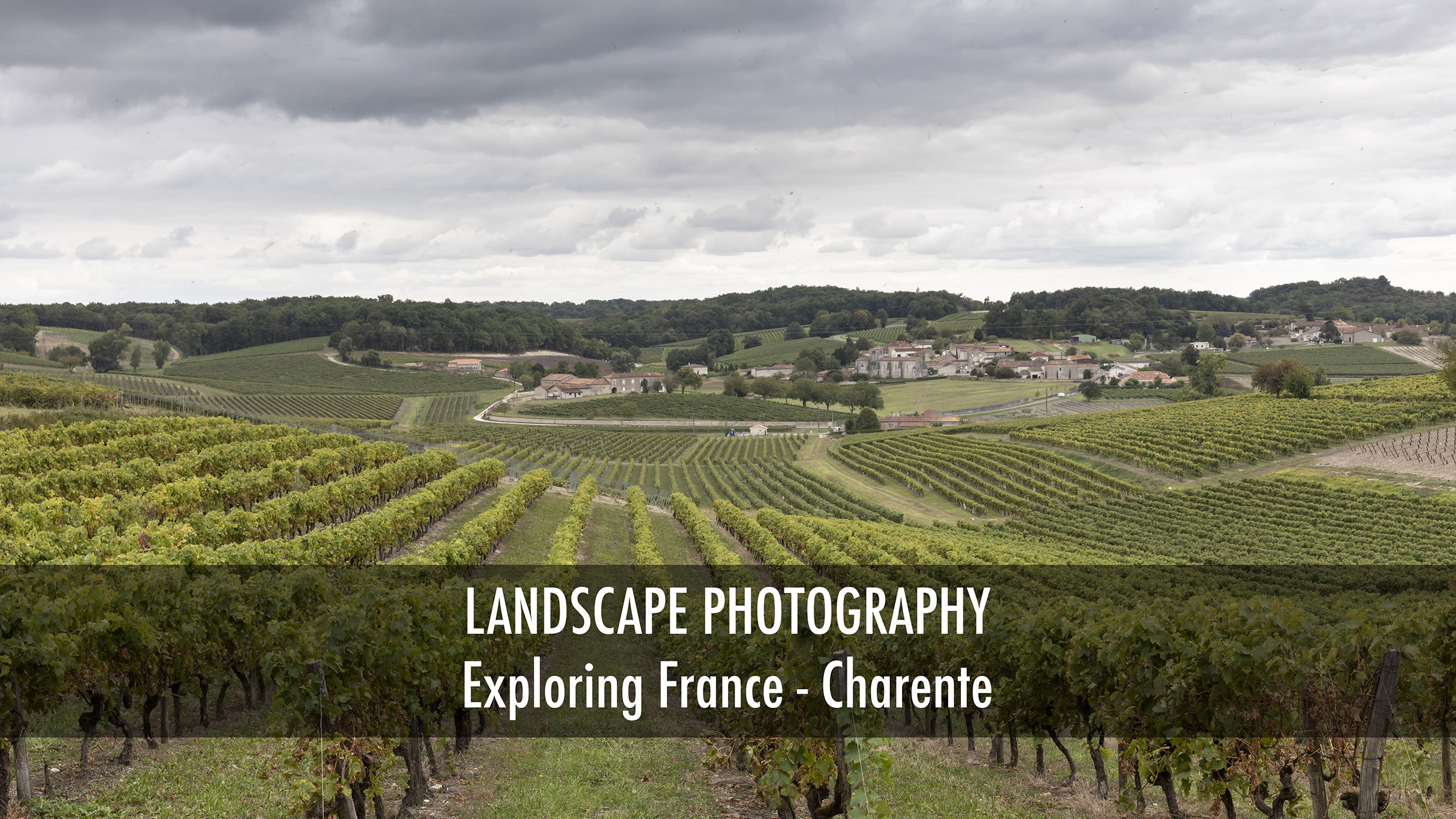

This week’s YouTube vlog on exploring France through landscape photography takes me to the department of Charente. As I can’t travel as I normally do due to the lockdown, I’ve decided to get out and discover more of the country that I live in.
With each vlog in the series, you’re going to see how I photographed the department that I visited, as well as how I captured some of what was around me.
The department of Charente has some beautiful landscapes as well as old towns and architecture to visit. There’s a lot to do, and as in each episode, I can only scratch the surface due to time constraints.
What you’re going to see in this episode is the reality, though, of the French weather service getting it completely wrong. They showed one thing, and it was doing the complete opposite, even when I checked again and again. So the trip turned into more of a recce, so I have an excuse to go back.
And if you’re interested, I offer photography tours and workshops in a variety of destinations around the world. If you’re interested in learning more from me to help you get the best out of your photography, then get in touch.
I left early and drove for 2 hours and 50 minutes to reach the vineyards around Cognac. It is a broad area, and after a fair bit of research, I had picked out a spot that looked full of promise. The problem was the sky. According to La Chaine Meteo, this counted as a clear day. To my eye, it was a thick, overcast blanket with only the faintest trace of sunrise pushing through.
Even so, I didn’t write the morning off. The view faced in a southerly direction, so I felt it might work better later in the day if the weather changed. Failing that, I knew straight away that it would be worth returning in a few weeks, once the vines had turned fully yellow. At that point, with a bit of autumn mist, the scene could be superb.
What drew me in was easy to see:
At this stage in autumn, the vines were still mostly green. There was a faint yellow tinge here and there, but they had not reached that rich late-season colour I wanted. So I took a recce shot and treated the place as one for the notebook rather than one for the portfolio.
I don’t tend to hand out exact locations when I’ve spent hours researching them. That work is part of the process, and I think every photographer gains something by doing their own digging. I do plan to talk more about how I research places, because so much of a successful trip starts long before the camera comes out.
One thing I always use on days like this is GPS geotagging in the camera. I keep the GPS switched on, and when the camera is active, it records where I was standing. Later, back in Adobe Lightroom, I can see the location on the map or pull the coordinates into Google Earth.
For recce work, GPS data saves me from guessing later. I know where I stood, where I parked, and which angle I liked.
That sort of practical detail matters more than people think. A recce is not only about the picture, but it is also about making the return trip faster and smarter.
My next stop was along the River Charente, and the weather had not improved. I had checked it again 40 or 45 minutes earlier, and it was still promising sunshine. What I got was flat grey light with no shape in the cloud at all.
The view itself, though, was lovely. I had been speaking with two local ladies there, and they told me that when the trees along the river turn, the whole scene looks beautiful. I believed them at once. Even under a dull sky, I could see the potential. This was another place that went straight onto the return list for later in autumn.
That is often how a day like this works. I don’t always come home with finished images, but I do come home with knowledge. I learn where to park, how long the walk is, which way the view faces, and what the distractions are. Because I am not trying to cram everything into a short holiday, I can bank those details and return when the conditions line up.
I have had this discussion before with people who think a professional should be able to make anything work. There is some truth in that, but there is also a limit. I can make a moody image in poor weather. What I cannot do is turn a dull tourism scene into a strong commercial file if the light is wrong from the outset.
This is how I look at it:
| Conditions | How the scene feels | How useful it is for my work |
|---|---|---|
| Flat grey light | Moody, subdued, sometimes appealing to photographers | Limited for tourism and stock use |
| Good directional light | Inviting, clear, full of depth and colour | Far stronger for commercial use |
That difference matters. A vineyard scene in Charente is often a touristic image. If it looks bleak and lifeless, why would a tourism client choose it to promote the area? They would not. A photographer might enjoy the mood, but that is not always what sells.
Patience pays off more often than forcing a file that was never going to work.
So although the morning was frustrating, it was not wasted. I found another strong location, and I knew exactly why I needed to come back.
By midday, I had not done much shooting. I had lunch, made a few business calls, and spoke with a friend. Then I headed to an old ruined abbey I had wanted to see. It looked beautiful from the outside, but access was another matter. The nave seemed locked up, and much of the place was fenced off.
That did not stop me from having a look around. I spotted part of a torn fence and wandered off to see whether there might be a way in from the back. That turned into a brief bit of urban exploring through a patch of bamboo, which was not what I expected to find in rural Charente. For a moment, I thought I might get lucky and find a route in. Instead, I ended up near the abbey wall at the back of a garden, with no easy access and no grand reveal waiting for me.
Still, even that told me something useful. It showed me the limits of the place, the angles that might work from outside, and the fact that I would need to return with lower expectations or better information.
It also suited the way I have been thinking about filming these trips. Lately, I have wanted to simplify the vlog side of things. Too many photography videos feel overdone to me. I am a photographer first, and I would rather keep the filming honest and direct than dress every outing up as something bigger than it is.
That is one reason I enjoy the work of Bald and Bankrupt. His style is simple, and that simplicity keeps the focus on what is happening. I like that. It feels closer to how travel and photography work in real life, especially on days when a plan goes sideways.
In the end, I went back round to the front and peered through the grille for a better look. The gate was still locked, and the abbey remained one for another day.
Later in the afternoon, the day finally gave me a small lift. I arrived at my next stop and found myself side-lit by the sun. There was blue sky showing through the cloud, and after the morning I took that as a good sign. If the weather was shifting, there was still a chance I might get back into the vineyards for something stronger by evening.
This stop was another result of careful research, a hilltop village with a castle at one end and a Romanesque church at the other. It had that storybook quality that certain parts of France can produce without warning. You turn a bend, look across a field, and there it is, as if it has been waiting for you all along.
From where I stood, I could not get the drone angle I had in mind, but I thought I might manage it from the far side. On the ground, I worked with a long lens to tighten the view. I had my Canon 5D Mark IV paired with the 100 to 400 mm lens, zoomed to a little over 200 mm, and it was perfect for this sort of scouting work.
I have used that lens enough to know how useful it is when I am exploring. It lets me test ideas at a distance, isolate buildings, and judge whether a location has enough structure to justify a return. If someone asked me whether to buy a 70 to 200 mm or a 100 to 400 mm for this kind of work, I would take the extra reach first.
The light was still a bit harsh, so I never treated the frame as a finished image. It was another recce shot. Yet it was a good one, because it confirmed that the village had shape, depth, and real potential once the light softened.
By mid-afternoon, I found the view that best summed up the day. I was back amongst the vineyards, slightly elevated above the rows, looking towards a village in the distance. For me, this was the strongest scene of the trip. The setting felt classic Charente, with the vines climbing towards the buildings and the church giving the whole frame a natural focal point.
I had to work at about 40 mm to pull the foreground vines closer and give them enough weight in the composition. That worked well, but a couple of problems showed up straight away. There was a telephone or electricity line running through the middle ground, and a newer parcel of vineyard land sat off to one side where the vines had not grown in yet. Both broke the rhythm of the scene.
The line was the more annoying of the two. I am not keen on removing things, but this was one of the rare cases where I could justify cloning it out for a commercial image. It would clean up the frame without changing the nature of the place. The bare parcel of land was different. That one needed a change of position rather than software.
So I walked a little further along to see whether a slightly different angle would solve it. I also considered whether a longer focal length might produce a stronger crop. Those are small choices, but they are the kind that turn a promising view into a finished photograph.
I knew I would stay in the area for another couple of hours, even if sunset never truly happened. More important than the light, at that point, was locking the location down. I took the recce shot, marked it with GPS, and made the decision there and then that I would be back.
That was the thread running through the whole day. The forecast had gone wrong, the light had missed the mark, but Charente had still given me a list of places worth returning to. The river needed autumn colour. The first vineyard needed yellow leaves and perhaps morning mist. The hilltop village needed gentler light and maybe a drone angle. The abbey needed access, or at least better knowledge of what was possible from outside.
This is the reality of photographing France on a regular basis. Some days are productive in the obvious way, and some are productive because they set up the next trip. That is the job. I would rather come away with four strong return locations than force four weak images.
I have been sharing these France explorations on my YouTube channel, along with stills and updates on Instagram and my Facebook page. People have said they enjoy the historic buildings that keep appearing in these trips, and I can see why. France is full of them. There is plenty more to come, whether that is in Charente, the Loire Valley, or further south in places like Perigord.
A failed forecast does not always mean a failed day. In Charente, it gave me something else, a map of return visits that now make far more sense than they did before I set off.
The strongest lesson from this trip is patience. When the light is wrong, I would rather recce properly, mark the spot, and come back ready than pretend a weak file is good enough. Charente earned that patience, and I know I will be back.