 Skip to content
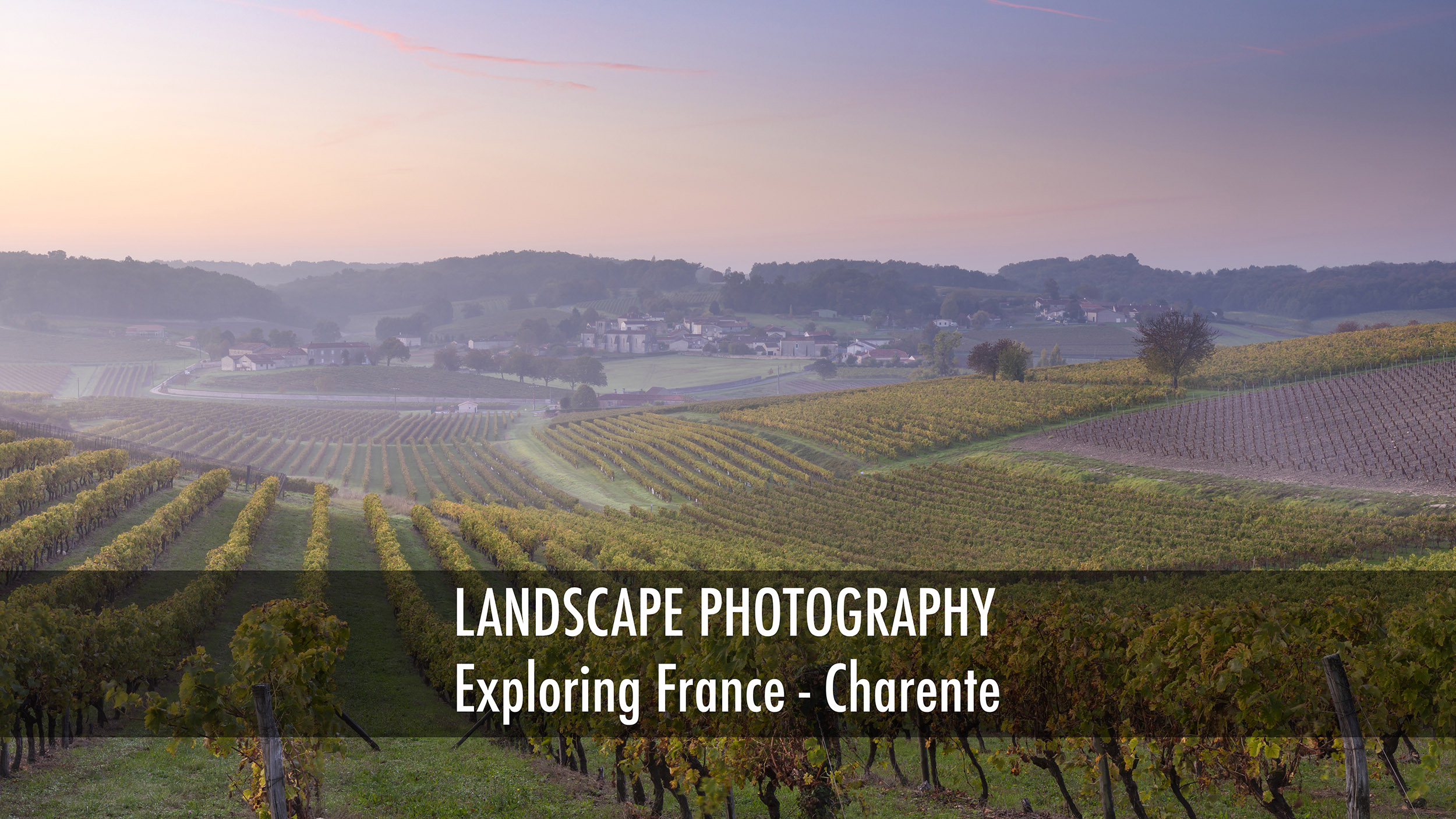

For this week’s YouTube vlog on Exploring France through landscape photography, I go back to the department of Charente. Normally, I’m travelling to other countries, but due to the lockdown, I’ve decided to get out and discover more about the country that I live in.
With each vlog in the series, you’re going to see how I photographed the department that I visited, as well as how I captured some of what was around me.
As you saw in the previous video, in the department of Charente, there are some beautiful landscapes as well as old towns and architecture to visit.
However, unlike the previous vlog, this time the weather was glorious, which meant I felt more inspired to capture the area. And so I found my excuse to go back to this beautiful corner of France.
And if you’re interested, I offer photography tours and workshops in a variety of destinations around the world. If you’re interested in learning more from me to help you get the best out of your photography, then get in touch.
I was back in the department of Charente, out in the countryside and trying to decide how to make the most of the day. After the greyer conditions on my previous visit, this felt like a gift. The vineyards had started to turn; the colour was there in patches, and the whole area looked far more alive.
One of the first scenes I found had everything I usually want in this part of France. There were rows of vines sweeping across the land, warm autumn tones through the Cognac region, and an old castle sitting on top of a hill in the distance. I still don’t know what the castle was, and I wasn’t there to research it. I was there to work out whether the light would do what I needed.
There was one obvious flaw in the frame, a telephone line running through the scene. I don’t usually like removing things in post if I can avoid it. Still, when a scene is strong enough, and the distraction is that clumsy, I will bend my own rule. Photography in the field often feels like a balance between ideals and reality, and that morning was a good example of it.
The colour in the vines made the decision easy. Even with the line, it was worth stopping. Charente has that effect when the light is right. The land feels simple at first, then you start noticing the folds, the texture of the rows, the little churches, the old stone buildings, and suddenly a quiet agricultural area becomes full of shape and rhythm.
Landscape photographers often talk about “waiting for the light”. Sometimes I can do that. On this day, I couldn’t.
The view with the castle had promise, but the sun wasn’t yet high enough to throw the shadows I wanted through the vines. At that moment, the light was only brushing the tops of the rows. It looked pleasant, but it didn’t have the depth I was after. I wanted the sun at a slightly higher angle, high enough for the shadows to run through the vineyard and give the whole slope a stronger sense of form.
If I’d had all morning to spare in this part of Charente, I would probably have stayed put and waited until around ten o’clock. That might have brought the angle I wanted. Then again, by that point, the light could also have become harsher, and I’d still be gambling. That is the trade-off with outdoor photography. The “perfect” moment doesn’t always fit the rest of the day.
So I made a note of the time and the conditions instead. That’s often more useful than forcing a frame that isn’t ready. I knew I could come back another day, or at a different time of year, and test the idea again with better timing.
Because I didn’t have the luxury of waiting, I went back to the first place I’d photographed before dawn. The sun had climbed above the tree line by then, and that changed everything.
Good photography in the field often comes down to one decision, wait longer or move on.
Back at the earlier viewpoint, the scene had come alive. The vineyards were falling away across the countryside of Charente, and the sun was now striking them from the side. That side light gave the rows shape and pulled out the autumn colour far better than the flat pre-dawn view had done.
A polariser helped too. With the light coming from the side, the vines started to “polarise up” nicely, and the colour separation improved. Greens, golds and russets all stood apart more clearly. It was the sort of light that makes a simple farming scene look elegant.
There was a problem, though. As soon as I adjusted my position, I could see flare creeping into the edge of the frame. In bright low-angle light, that can ruin a clean image faster than almost anything else. Rather than assume it would be fine, I checked it properly.
That small check saved time. Instead of leaving myself a messy problem for Adobe Photoshop, I solved most of it there and then. I prefer that approach whenever I can. The cleaner I get it in the camera, the less time I spend repairing things later.
This sort of scene can look easy when you first arrive. Rows of vines, soft autumn colour, a bit of morning light, it all sounds straightforward. Yet the difference between a usable frame and a strong one is often a tiny shift in sun angle, a touch of flare, or the way the lines in the vineyard pull the eye.
I rely on planning tools for travel and landscape photography. Apps such as The Photographer’s Ephemeris and PhotoPills are helpful because they tell me where the sun will be, when it will strike a building, and what sort of light I can expect across the day.
Even so, getting to the location is still the only way to know what I am really working with.
Earlier that day, I went to look at an old church in Charente that I thought might sit neatly amongst the vines. From older images and online views, it looked promising. Once I arrived, the setting had changed. The vineyards I expected to find around it had been dug up, and the scene no longer matched what I had pictured in my head.
That happens all the time when I travel with a camera. A place can look ideal on a screen and feel flat in person. Or the opposite happens, and a place that looked ordinary online suddenly opens up when I walk into it. The point is simple: planning gives me a start, but the ground tells me the truth.
By then, the weather here in Charente had shifted a little. More clouds had moved in, but not enough to spoil the evening possibilities. If anything, it softened the feel of the day without killing the light.
The church itself was beautiful. I am always drawn to Romanesque and Gothic architecture, and this one had the kind of old stone presence that makes me stop, even when the setting isn’t perfect.
The problem sat behind it. A barn, plain and awkward, kept pushing into the background and spoiling the cleaner view I wanted. My first composition felt too straight-on, too static, and too compromised by what was behind the church. I took the photograph anyway, because some scenes are still worth recording even if they don’t fully satisfy me.
I worked with a tilt-shift lens and tried to edge my position around to improve the angle. A slight change helped, but not enough to solve everything. Sometimes a subject is good, and the setting lets it down. That doesn’t mean I give up on it, but I do accept that the image may end up as a record rather than a favourite.
The light, at least, was doing its part. Afternoon side light across the old stone is hard to resist. It pulls out the texture of the masonry and gives shape to every recess and edge. Even with the barn behind it, the church still held a lot of character.
One useful thing with old churches is that the structure often tells me how to time the shot. If I can read the nave, transepts, ambulatory and west front, I can usually work out how the light will move across the building through the day.
With east-west orientation, it becomes easier to judge when a façade will catch direct light and when it will sit in shade. That doesn’t solve every compositional problem, but it does remove some guesswork.
I also had to make a practical decision at that point. Vlogging takes time, and there are moments when I need to stop talking and get on with the work. I still wanted to photograph, possibly fly the drone, and gather some stock images before the day was gone.
Before finishing, I returned to the place where I had started earlier in the day. This time, the light was falling well on a village church I wanted to photograph across the vineyards. The side lighting was good, and from a distance, the church sat nicely in the frame.
I made a longer lens composition at around 115mm. That tighter view compressed the scene and helped the church stand out against the rolling vines. Yet the shot came with another problem, and it was one many people underestimate in vineyard photography: the angle of the rows.
For vineyard scenes to work well, I usually want the lines to lead into the subject. Here, many of the rows were moving across the frame instead of towards the church. That weakens the flow. The eye doesn’t travel as cleanly, and the composition feels more stubborn than graceful.
Earlier in the morning, closer to the village, I had found another possible angle. To make it work, I had to put the camera on the roof of the car to get enough height. Even then, I wasn’t sure whether it had come together. Other vineyards further up the road had the same issue; the lines cut across the scene rather than drawing me into it.
On top of that, there were two heaps of gravel sitting in the frame, and they looked dreadful. There is not much I can do with that in the field. I can’t move them, and I don’t want to build my day around repairing everything later on a computer.
Still, the view had something. Some vines were fully in autumn colour, others were still green, probably because of the different grape varieties. That patchwork gave the scene a sense of change, and it said something honest about the season in Charente. Autumn doesn’t arrive all at once. It moves through the vineyards row by row.
This visit felt very different from the last one because the light changed my mood and my choices. Charente under grey skies can be subtle, even muted. Charente in sunshine, with the vineyards turning, is much easier to respond to with a camera in hand.
That does not mean every subject falls into place. Some scenes still need more time, a different season, or a better angle. Yet the day gave me enough, and it reminded me why this part of France is worth returning to. Between the Cognac vineyards, the village churches and the old stone architecture of Charente, there is more depth here than people often expect.
I finished the day planning the next outing. If the weather held, I was heading towards the Loire Valley the following morning and working my way towards Blois, with the possibility of ending near Chambord. If the forecast changed, I’d go somewhere else. That’s the rhythm of this kind of work. The map matters, but the light gets the final say.
If you want to follow more of these trips through France, I share them on my YouTube channel. I also post updates about photography and future workshops and tours on my website, along with regular posts on Instagram and Facebook.
The strongest part of this day in Charente was not a single finished image. It was the reminder that light decides almost everything.
I started before dawn, changed plans more than once, worked around telephone lines, flare, barns and gravel heaps, and still came away with photographs that felt true to the place. That is often how Charente works for me. It asks for patience, clear observation and a willingness to adapt.