 Skip to content
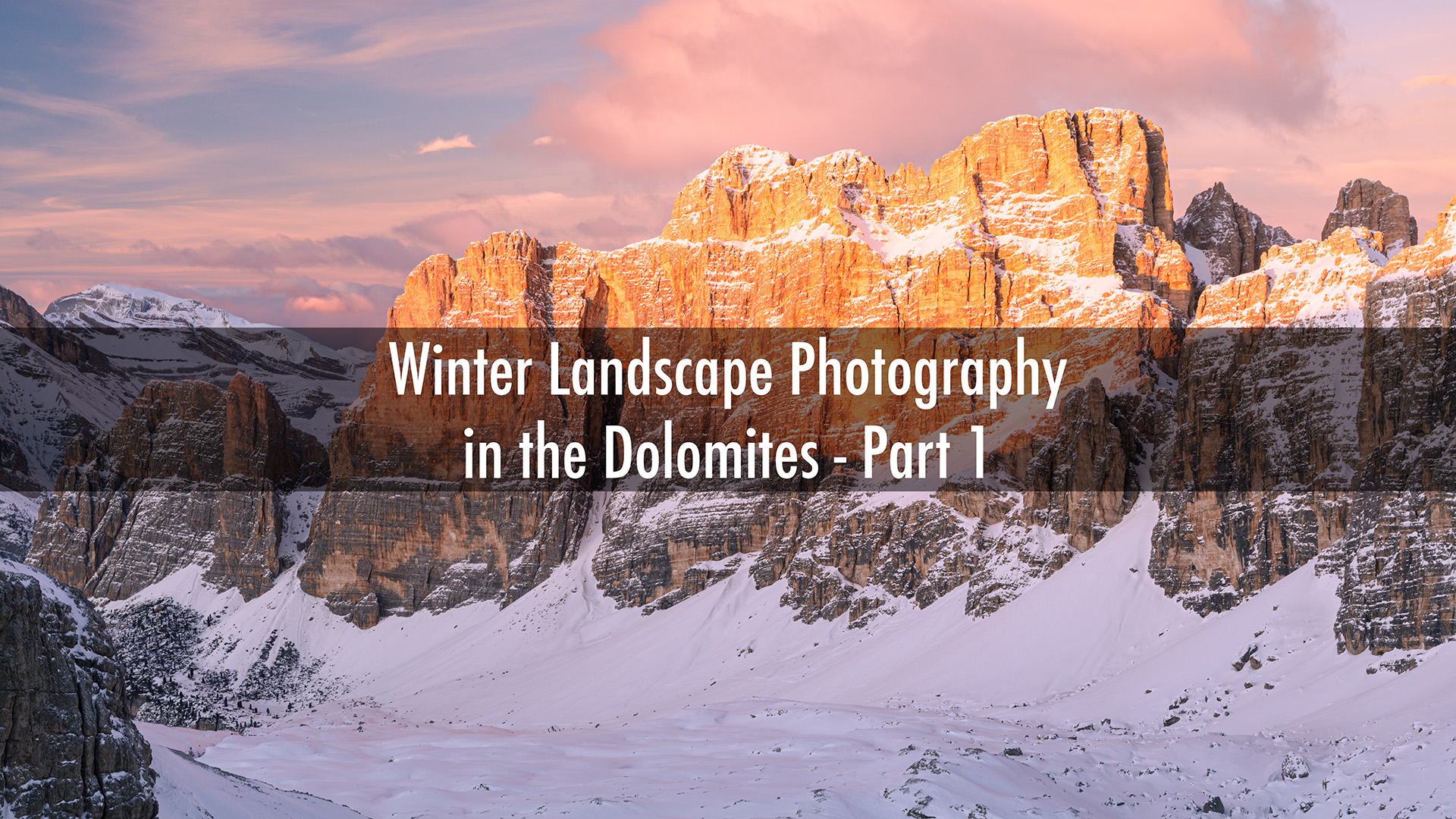

My latest YouTube vlog, Winter Landscape Photography in the Dolomites Part 1, shows you some of what I got up to in the north of Italy during the second week of January 2022.
Known as one of Europe’s premier ski destinations in winter, it’s also a stunning place to visit for winter landscape photography.
With snow-covered mountains and beautiful sunrises and sunsets, what’s not to like about this beautiful corner of Italy?
My YouTube channel is dedicated to all things landscape and travel photography, so if that’s your thing, then I’d love to have you come along for the ride.
And if you’re interested in capturing this beautiful part of Italy during winter, then I run a Dolomites winter tour each January. You’ll get to see just why it is that I love returning here time and time again.
I began my Winter landscape photography trip in the Dolomites at Lago di Braies, and the contrast with my previous visit could not have been clearer. When I had been there in October, the place was full of people. This time, in the middle of winter, it was almost empty. I was alone for a while, apart from one other photographer who was walking out across the frozen lake.
That change in mood affects everything. The same location can feel familiar, yet completely altered by season, weather, and silence. At Lago di Braies, the ice had covered the whole lake, and the usual open water was gone. Instead of ripples and reflections, there was a flat white surface stretching to the edges. It had a calm, stark beauty that only winter can give.
The morning itself was hazy, and I had hoped for more colour in the sky. It never quite arrived. Still, there was enough blue early on for me to take two exposures, one for the sky and one for the foreground, with the intention of blending them later. That small patch of cool tone was worth holding on to.
A few first impressions stayed with me from that first stop:
I waited another 15 minutes, hoping the sky might lift. It did not. Yet even without dramatic light, Lago di Braies still looked superb. Winter had changed the whole scene, and that alone made it worth photographing.
I was also struck by how easy it was to get around. I had expected winter driving to be awkward, but the roads were fine. What surprised me more was how busy the wider area was. Autumn had felt like a shoulder season. Winter was clearly high season.
Not every day in the mountains goes to plan. On the first full day, I spent far too long chasing a scene I had seen years ago in a book. The coordinates were there, but when I reached the area, what stood in front of me did not match the photograph I had in mind. The result was simple: I lost half a day.
That kind of frustration is part of photography, especially when a picture has lived in your head for a long time. You think you know what you are going to find, and then the place says otherwise. By the time I gave up on it, I had missed the location I had really wanted for the end of the day.
So I settled for a different view, looking towards what I believed was Monte Civetta. Even though it was not the exact scene I had planned, it still had that unmistakable Dolomites drama. The mountains were jagged, the snow was building, and the sky carried just a hint of sunset off to one side.
Two lessons stood out from that detour:
Even so, the drive itself gave me something worthwhile. On the way, I passed through Passo Giau and made an image there that stuck with me. The whole area looked like a winter wonderland, full of snow and layered mountain forms. I found myself wishing I had stayed there longer, and I knew I would return a few days later.
I had originally been meant to be in Scotland at that point, but travel restrictions had changed the plan. Standing there in the Dolomites, with fresh snow coming in and the mountains fading into the evening, I could not complain too much.
The second full day began in the Dolomites with much better spirits. The weather was clearer, and I was back somewhere familiar, Lago di Misurina. In autumn, I often think of Misurina as a reflection scene. In winter, that idea goes out of the window.
The lake was frozen solid. When I had first arrived in the area after flying in, I had already seen people walking across it, which still felt strange. Only three months earlier, it had been open water. Now it had become a sheet of ice.
Without the reflection, my usual way of framing the scene no longer worked. A standard 3:2 composition felt empty, so I switched to a longer lens and built a panorama instead. That let me tighten the frame around the mountain and reduce the amount of featureless foreground.
I stayed on firm ground. I could have walked onto the lake, but being alone changes those decisions. If the ice gives way under someone else, that is bad enough. If it gives way under me when there is nobody nearby, the risk is far harder to justify.
The mountain beyond the lake was snow-covered and beautiful. Even though the reflection was gone, the scene still had plenty to say. It simply asked for a different kind of photograph.
From Lago di Misurina, I moved only a few minutes up the road to another frozen lake. This stop gave me one of the strongest moments of the trip so far, because from there I could see Tre Cime di Lavaredo, or at least the less photographed side of it.
The famous rock face that most people know sits on the other side. From where I stood, I was looking at the back of the formation, with the morning light beginning to rake across the peaks. That low winter sun gave the mountain shape and texture, even without the rich cloud colour I had hoped for.
For that composition, I used a 50mm tilt-shift lens rather than my 24-70mm. I wanted the trees in the frame to stay upright and clean, and the tilt-shift gave me better control over the verticals. I also had a polariser on the front, which helped tighten the tones in the scene.
The snow made exposure trickier, so I had to watch the highlights closely. As the sun touched the mountain, I dropped the exposure a little and kept shooting. That narrow band of morning light was the whole point.
In winter, a scene can change in seconds. When the light arrives, I want to be ready before it disappears again.
That stop summed up why I keep coming back to the Dolomites. Even when the sky does not give me much colour, the mountains and the light can still carry the image.
Some of the images that stayed with me were not the obvious postcard scenes. They were the ones I noticed from the road, or the places that only worked because I stayed put long enough.
While driving the day before, I had caught sight of a lone tree set into the snow on a mountainside. Around it were soft folds of terrain, all layered in white. It looked simple and graphic, and I knew I wanted to come back if I could find somewhere safe to stop.
That proved harder than expected. Winter changes roadside photography in a practical way. Places where I might easily pull over in autumn were buried in snow. Parking spots had vanished, and the road margins were often unusable.
Still, I found a safe place in the end and framed the tree with the snow folds dropping away beneath it. The appeal of the scene was not in scale. It was in shape. The single tree stood against all that snow with enough presence to hold the frame on its own.
A few things made that image harder than it might appear:
That sort of subject can easily be missed if I only look for famous locations. In winter, small graphic scenes can be just as strong as the grand mountain views.
Later, I found a composition I had wanted for months. I had seen the church and mountain pairing on an earlier trip, but I had not known where I could safely stop and get the height I needed. This time, I had done enough searching to reach the right place.
Then I had to wait.
For 45 minutes, the cloud sat where I did not want it. The wind was pushing it across from the north, and I could see that if I held on a little longer, the light might break cleanly over the scene. That is the kind of moment that says a lot about how I work. I do not want to replace the sky later. I do not want to fake the light with heavy-handed editing. I want the weather to do what weather does, and I want to read it properly.
When the cloud finally shifted, the whole composition came alive. It was around half past twelve, which many people would dismiss as poor light. In winter, though, the sun stays lower, and the shadows still have length and shape. The church, the snow, and the mountain all sat together with enough contrast to give the scene depth.
I made two exposures because the sunlit snow was so bright, and I wanted to keep texture in the clouds as well. That balance mattered to me. White snow without detail rarely says much.
If photographing the Dolomites in snow appeals to you, I also run Dolomites winter photography tours during the colder months, because this kind of light and weather is worth planning for properly.
By the third morning, the temperature in the car read minus 14°C. That sort of cold changes the pace of everything. Even simple tasks take longer, and handling gear becomes more awkward. Still, there was less wind than the previous day, so it felt more bearable than the number suggested.
I started beside another frozen lake, with mountains rising behind it. Once again, the ice changed the scene. I was not interested in showing a large slab of empty foreground, so I kept the lake to a minimum in the frame and used a tree to help structure the composition.
The sun had started to kiss the highest peaks, adding a slight red tone to the snow near the top. I wanted more colour, of course. Most photographers do. But the light I had was still good, and there was enough warmth on the mountain to separate it from the colder foreground.
I was working at 50mm again, with a polariser on the front. The focal length felt right for compressing the scene slightly without making it look cramped. Snow depth around me varied, but in places it was around 15 inches deep, and getting into position meant trudging through it.
The frozen surface tempted me, yet I stayed off it. Alone, in that temperature, caution mattered more than a slightly different foreground line.
The worst part of the morning was not the cold itself, but what it did to my GoPro batteries. I would leave with them fully charged, start filming, and watch them die in less than a minute. On one earlier attempt, a battery went from 98 per cent to nothing in no time at all.
That made recording the trip far more awkward than I had expected. At one stage, the only way I could show what I was doing was to film the rear screen of my main camera. Frustrating does not quite cover it.
Winter photography often looks calm from the outside. Behind the scenes, cold has a way of picking off all the little things first.
At one location, I had gone looking towards a church behind me, but another subject pulled my attention away. Off in the opposite direction were frost-covered and snow-covered trees, with some stark trunks standing out amongst them. They had a skeletal look that caught my eye straight away.
I switched to the 100-400mm and zoomed in to around 200mm. On the Canon 5D Mark IV, that gave me a tighter, more selective view. I liked the mix of dense white foliage and those bare, darker trunks cutting through the frame. It felt more intimate than the grand scenes, but still unmistakably winter.
That was another reminder that the best image at a location is not always the one I arrived expecting to make.
Later, outside Brunico, I finally made an image I had wanted for years, a strong photograph of the castle from a distant viewpoint. To get it, I needed a proper long-lens setup. My 100-400mm on its own was not enough, so I added a 1.4x extender and worked at an effective focal length of around 460mm.
Because the extender cost me light, I stopped down to f/16 and built the frame carefully. It was a highly compressed view, and that compression gave the castle real presence against the surrounding landscape.
I had been coming back to the Dolomites for about five and a half years by then, and that image was a good example of why repeated visits matter. Sometimes I do not find the shot on the first trip. Sometimes it takes years.
I finished the day at Passo Giau. The direct sunlight had gone from the mountains, but the sky to the north still held lovely colour. That was enough for a panorama, even if it was subtler than the dramatic end to the day I might have wanted.
The moment was not perfect. Someone nearby was flying a drone, and the noise cut through the stillness in a way that felt oddly out of place. Yet the colour remained, and the broad mountain view still had presence. Winter evenings often work like that. The light is less obvious, but if I keep looking, there is usually something to respond to.
That brought the first half of the trip to a close. Three full days in the Dolomites had already given me frozen lakes, hard mornings, failed plans, and a few images that made all the effort worthwhile.
The strongest lesson from this part of the trip was not about gear or settings. It was about patience. In winter, the Dolomites can look incredible even in flat light, but the best moments still come from waiting, watching the cloud, and letting the place settle.
That is what made the difference at the church, at Tre Cime, and even in the smaller roadside scenes. The cold, the missed locations, and the battery failures were all part of the trip, but they did not define it.
What stayed with me was simpler than that. Frozen lakes, low winter sun, and snow-covered peaks gave me a fresh way of seeing places I thought I already knew.