 Skip to content
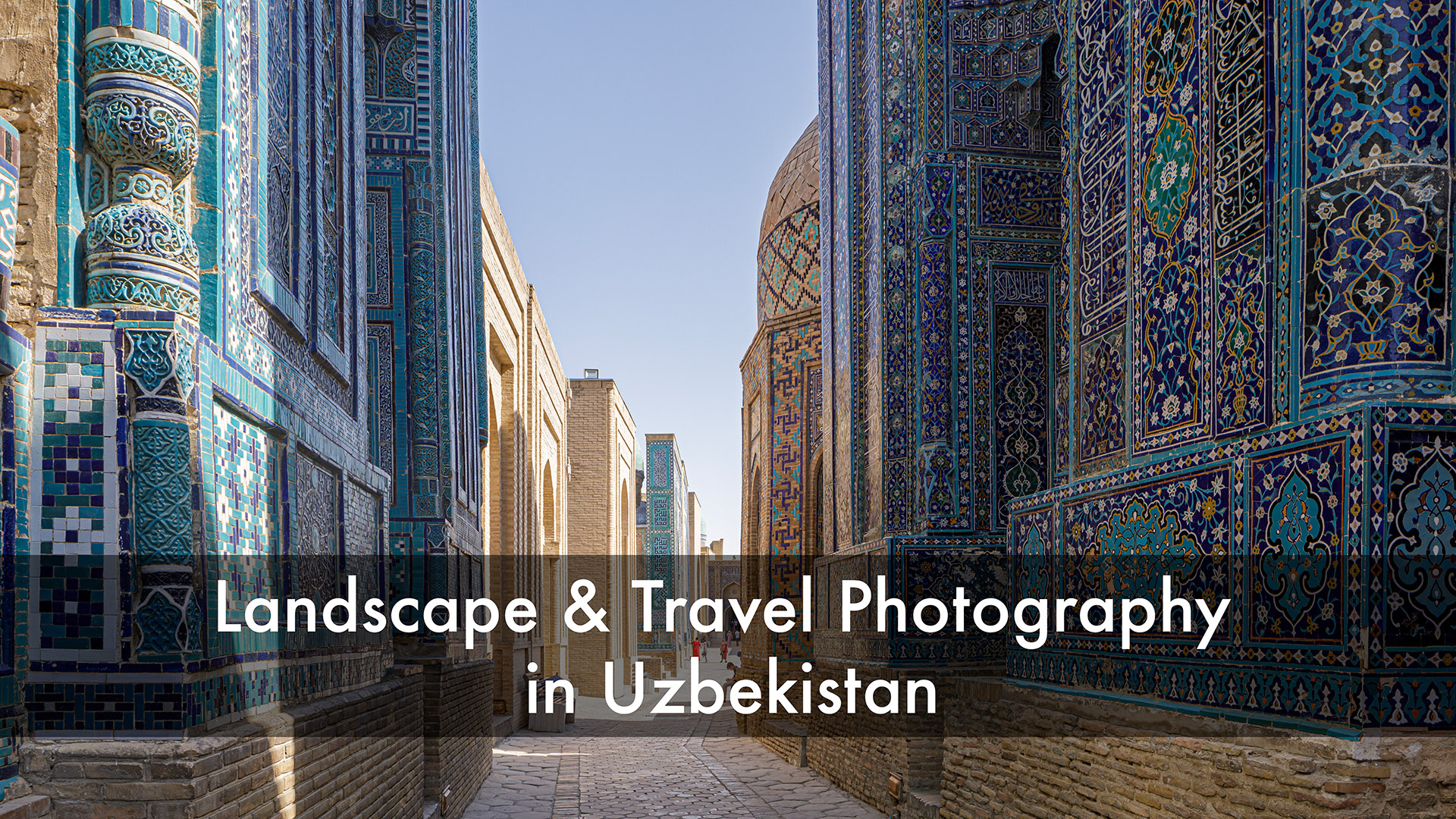

My latest YouTube vlog, entitled Landscape & Travel Photography in Uzbekistan is a short video with some sobering thoughts.
In August 2021, I was commissioned to photograph Uzbekistan on a journey that circumnavigated the country.
About 2/3 of the way into that journey, the team and I were in the town of Termez, which borders Afghanistan. During our stay, Afghanistan fell into the hands of the Taliban. One of the team had a friend who was in Kabul and was worried about his safety.
It was an extremely sobering experience to be on the border, looking over from safety to what for others had become hell on earth.
My channel is dedicated to all things landscape and travel photography, so if that’s your thing, then I’d love to have you come along for the ride.
Each year, I run an Uzbekistan Photography Tour whereby we take in many of the places that I visited during my epic journey there. It is a fascinating country for sure and there are many opportunities for those willing to make the journey.
Around two millennia ago, parts of southern Uzbekistan grew along the old Silk Road trading routes, at a time when movement across this region felt freer than the hard borders we know now. That sense of history was with me from the start. I wasn’t only moving through a country, I was moving through layers of exchange, faith, empire, and memory.
A publishing company invited me to create photographs for The 100 Experiences of Uzbekistan. The idea was simple and exciting. I would look at the country as a foreign photographer and try to make images that felt fresh, honest, and alive. I had about two and a half weeks to work, so the pace was full-on from the moment I landed.
What struck me early on was how open and warm people were. In places far from the main postcard cities, I met children who wanted to chat, laugh, and try out bits of English with me. In Moynaq, I spent time with local kids, teaching them a few words, learning a little Uzbek back, and sharing that universal travel greeting of goodwill, “Assalomu alaykum”.
I was also lucky to have help from Feruz, an Uzbek photographer who travelled with me and made the whole experience easier to understand. He knew the rhythm of the country, the places, and the people. That mattered because a commission like this isn’t only about ticking off locations. It’s about reading a place properly, then making photographs that feel true to it.
The work also sat close to the sort of travel photography in Uzbekistan that I care about most, where architecture, landscape, and daily life all belong in the same frame.
My route circled a huge part of the country, and each leg brought a different mood.
That route gave me a broad view of Uzbekistan. I saw urban life, Silk Road grandeur, damaged landscapes, remote communities, and ancient sites that still feel heavy with silence.
One of the most striking early chapters of the trip took me to the old Aral Sea region. The story there is well known, but standing in it is something else. A vast body of water was drained during the Soviet period to support cotton production, and the result is still written across the land. In Moynaq, the old boats remain as relics of a vanished shoreline, and they carry a kind of blunt honesty that doesn’t need much explanation.
Photographically, that part of Uzbekistan is fascinating because it resists easy beauty. The old hulls, the dry ground, and the human cost behind them all force you to slow down. A frame can look beautiful on the surface, but the story under it is harsh. That tension stayed with me for the rest of the journey.
Then the country kept changing. Khiva gave me old walls and a sense of enclosed history. Samarkand offered scale, detail, and the sort of architecture that stops you in your tracks. Bukhara had its own pace and character. As I moved from place to place, the assignment widened in my mind. I wasn’t only collecting scenes. I was trying to understand how many different sides of Uzbekistan can exist inside one nation.
What also stood out was the variety of beliefs and heritages. Across the country, I saw signs of Islamic tradition, Christian presence, and, in the south, older Buddhist history. That mix mattered later, because by the time I reached Termez, the word that kept returning to me was freedom.
Uzbekistan is not a perfect country, no country is, but what I saw was a place where people moved, worked, worshipped, joked, and welcomed strangers with ease. That everyday freedom can look ordinary until you stand beside a border and realise how fragile it is.
By the time I reached Termez, the trip had shifted. The scenery was still beautiful, the archaeological sites were still fascinating, but the mood changed because of where I was standing.
The first place that hit me was Fayaz Tepe, a Buddhist temple complex dating to the 1st century BC. In the morning light, it felt calm, spare, and almost detached from time. There was very little noise, only that stillness you sometimes get at old sites before crowds arrive. Yet the geography of the place gave that silence a different edge, because the international border was only about 500 metres away.
That contrast was impossible to ignore. I was standing among the remains of a Buddhist site in modern Uzbekistan, in a country where I had also seen Islamic life and Christian tradition. The layers of belief were right there in front of me. So was the fact that they could exist in the same country.
Later, I moved on to Kara Tepe, another ancient Buddhist site of a similar age. It sits close to the Amu Darya, and once again, the silence was striking. There wasn’t much around us apart from the ruins, the river, and a sense of exposed space. On the previous day, when I had visited with the group, I had noticed something in the distance. That line beyond the river wasn’t abstract geography. It was Afghanistan.
Standing among ancient ruins is one thing. Standing there while history turns violent across the water is something else.
That is where the whole trip sharpened. These weren’t only historical locations any more. They had become viewpoints on the present.
The Amu Darya is a natural border there, and on the far side lies Afghanistan. When I looked across from Uzbek soil, I wasn’t looking at a distant idea on a map. I was looking into a place where events were unravelling in real time.
During our stay, Kabul fell to the Taliban. One member of our group had a friend in Kabul and was worried about his safety. That changed the atmosphere at once. News stories can feel remote when they are filtered through screens and headlines. They don’t feel remote when someone beside you knows a person caught inside the collapse.
From where I stood, Mazar-i-Sharif was not far away, roughly 90 minutes by road. That knowledge was hard to sit with. I was in safety. Across the river, people were losing the freedom they had tried to build over 20 years. Overnight, rights, security, and hope had shifted into fear.
The contrast was brutal because it was so immediate. The day before, I had been eating breakfast with friends and colleagues, chatting and joking as travellers do. Across the border, there was no room for that sort of ordinary ease. That thought stayed with me more than any photograph I made.
It also stripped away the nonsense of minor complaints. If you’ve ever grumbled because the coffee order was wrong, or because a train was late, you know how quickly those problems shrink when placed beside a real catastrophe. I felt that with force on the border.
Stop, look, contemplate what freedom means when you can see its absence from the same riverbank.
What I had seen in Uzbekistan made the contrast sharper. I had watched women move freely in public life. I had seen religious variety in daily practice and in the country’s historical sites. I had met welcoming people in city streets and remote places alike. On one side of the river, life carried on with ordinary human dignity. On the other hand, that dignity was under immediate threat.
People often assume travel photography is about beautiful light, grand views, old streets, and well-timed human moments. Of course, it can be that. Uzbekistan gave me all of those things. The architecture in Samarkand and Bukhara is extraordinary. The old boats in Moynaq are unforgettable. The archaeological sites near Termez are rich with history. There was no shortage of visual material.
But photography doesn’t shield me from what sits beyond the frame. Sometimes it does the opposite. It forces me to pay more attention.
That was the truth of this trip. I arrived to make images for a publication. I still did that. Yet one of the strongest memories I carried home had little to do with composition or kit or technique. It came from standing in a place of peace and looking into a place of fear.
There is a “good” side to travel photography, if I can put it that way. I get to see astonishing places, meet kind people, and share stories through pictures. There is also a harder side. Sometimes the camera is in my hand while history is happening next door, and the beauty of where I am does not cancel the pain of what I can see.
That is why this journey in Uzbekistan stays with me. It reminded me that photographs can record beauty, but they can also mark a moral contrast that words struggle to hold. In Termez, with the Amu Darya between one country and another, that contrast felt unbearable and impossible to ignore.
When I think back on this commission, I remember far more than a route across a country. I remember the old trading paths, the drained Aral Sea, children in Moynaq, the great cities, the Buddhist sites near Termez, and the river that marked a line between safety and terror.
Most of all, I remember freedom as something ordinary until it suddenly isn’t. Uzbekistan gave me beauty, hospitality, and history. The Afghan border gave me perspective, and I haven’t forgotten it.