 Skip to content

In this episode of my YouTube vlog, Landscape Photography Exploring France, I take a quick look around my Local Area in the Loire Valley of central France.
Normally, with great weather, I’d be inspired to spend the whole day out there. To explore and find new things, but I just wasn’t feeling it today. You know, it does happen at times. Sometimes that spark just isn’t there.
At the time of writing, I should have been finishing up a photography tour of Japan, capturing the autumn colour, but it just wasn’t meant to be. But hopefully next time the spark will be back.
And if you’re interested in discovering the Loire Valley with a camera, then do check out my annual Loire Valley photo tour in May.
I started the day on the banks of the River Loire with no proper agenda. The weather looked decent, I had the time, and that is one of the joys of doing this full-time. If the conditions look promising, I can go. There is no need to overthink it.
That said, I nearly stayed in. I had one of those slow starts where the bed feels like the better option and motivation is thin on the ground. Still, I pushed myself out the door because I know that some of the best local mornings begin with no great expectations.
I also like working close to home because it strips things back. There is no long drive to justify, no pressure to come back with something spectacular, and no sense that the day has to become more than it is. I can simply look around, respond to the weather, and see what turns up.
A few things make this part of my local area especially appealing:
That last point matters. I do have favourite places along the Loire, and one of them was my first stop that morning. It had worked well for me a few weeks before, and I wanted to see if it would give me something again.
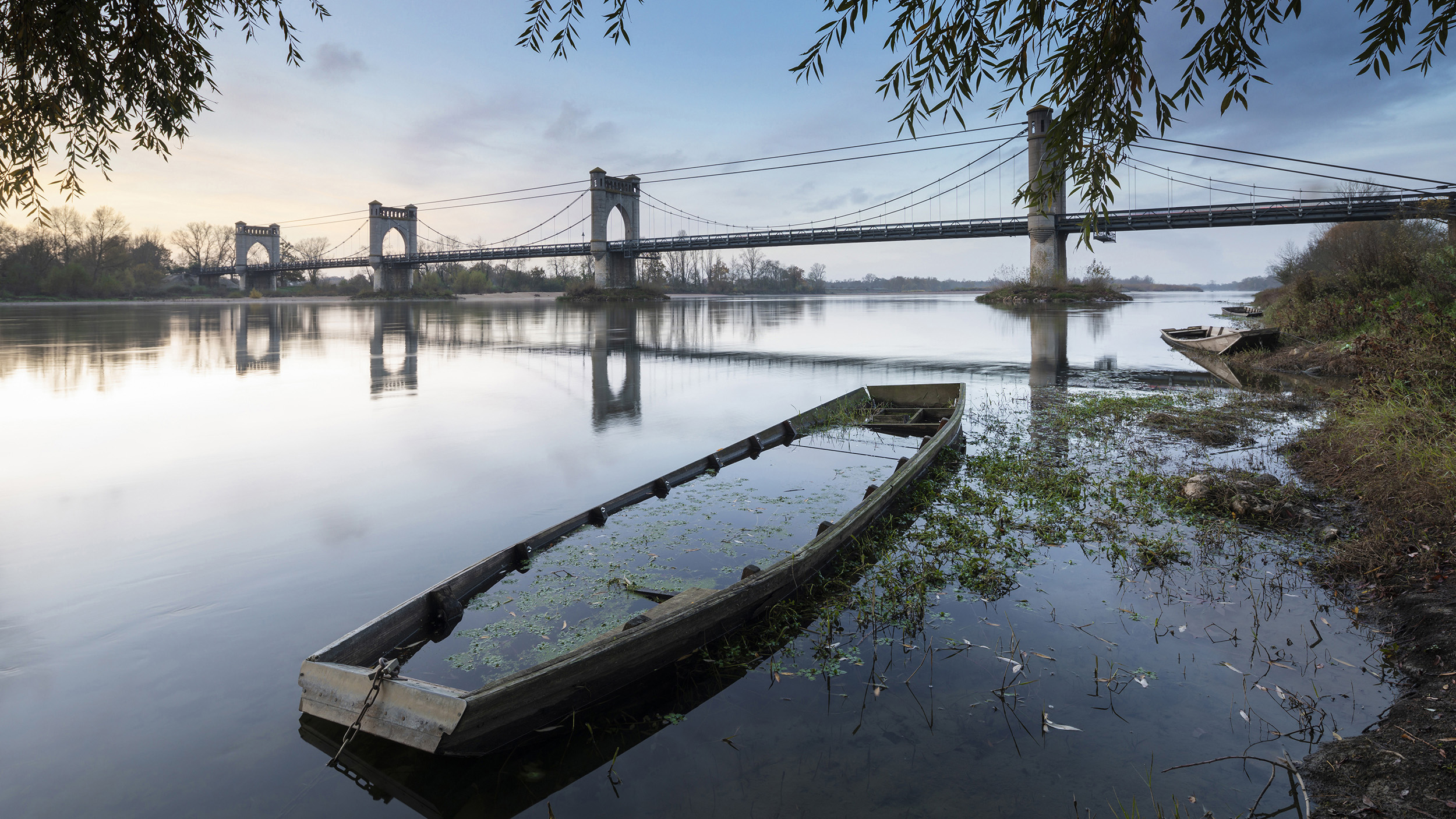
The first image of the day from my local area was across the river towards a favourite viewpoint, where a sunken boat sits in the Loire. It is one of those scenes that has real character without trying too hard. The boat gives me a strong foreground subject, and the bridge behind it adds shape and structure.
The dawn never turned into anything dramatic. There was no fierce colour, no blazing sky, and no big moment that made the whole river glow. It began with a little promise and then faded away. Even so, I didn’t mind. I still liked the scene, and I still wanted to photograph it.
My composition was simple and deliberate. I framed roughly one-third sky and two-thirds land and water, then let the boat do the work in the foreground. The bridge sat cleanly behind it, and I waited for gaps in the traffic so I could avoid car light trails crossing the frame.
Not every good photograph needs a fiery sunrise. Sometimes a quiet structure and balanced light are enough.
That matters more than people often admit. A lot of mornings in real life are modest. The value is in going out, paying attention, and making the most of what is there.
For this shot, I used my 17mm tilt-shift lens, mounted on my Canon body. If that sounds like an odd choice for a river scene, there was a good reason for it. The bridge is a strong part of the picture, and I didn’t want the supports leaning in or the verticals distorting. With a tilt-shift lens, I could control that neatly in camera.
I often find that architectural elements in a wider landscape frame benefit from that kind of precision. A standard wide-angle would have worked, but this gave me more control over the lines. If you’re curious about the lens itself, this is the Canon 17mm TS-E lens I was using.
The exposure difference between sky and foreground was about two and a third stops, so the processing was always going to be straightforward. I knew I could solve it with a simple blend in Photoshop.
My quick workflow was this:
Because the horizon line was fairly clean, this wasn’t a difficult edit. It was one of those situations where the composition does most of the heavy lifting, and the processing only finishes the job.
After the Loire, I thought I might head into the woodland. I had found a spot recently that seemed worth another look, and it wasn’t far away. Once I got there, though, it simply wasn’t doing anything for me.
Part of the issue was practical. The woodland sat right on the edge of an army firing range, and that didn’t exactly encourage me to wander off with a tripod. More than that, the place felt flat. The light wasn’t helping, the scene wasn’t pulling me in, and I know by now that if I don’t feel anything at the car, I rarely find it after a forced walk.
So I moved on, stopped somewhere else, and felt the same thing again. No spark. No desire to get out and start working a scene that wasn’t speaking to me. That is a normal part of photography, although people don’t often say it plainly enough.
Eventually, I drove to Saint-Epain, on the edge of the Loire Valley UNESCO World Heritage area. I had passed through before on journeys south and kept meaning to stop. This time I did.
Saint-Epain gave me more to work with. The church had presence, and the remains of the old built environment around it, including one of the old gateways into the village, helped shape the scene. I liked the way the lines pulled the eye inward, and I set up with the church and the older structure working together in the frame.
I still had problems. The main one was a parked car sitting exactly where I didn’t want it. That car disrupted the balance of the composition and stopped me from framing the gateway as loosely as I wanted. I could have tried to crop tighter, but then the gate felt cramped. I could also have cloned the car out later, but I didn’t want to turn a simple photograph into a repair job in Photoshop.
This was the balance I was dealing with:
| Problem | My response |
|---|---|
| A parked car sat in the frame | I worked around it and accepted that I may need to return |
| The 17mm view felt too wide | I adjusted the framing rather than forcing the whole scene in |
| The sky was brighter than the foreground | I shot separate exposures for a later blend |
The leaves on the trees were still partly green and partly yellow, which told me the scene might improve in a few days. That gave me another reason to leave the image as it was and come back under better conditions.
Standing there, I found myself thinking about something that often amuses me in photography. Some people talk about collecting compositions as if they are ticking off train numbers. I don’t enjoy that approach. I don’t want photography to become a checklist of places and frames that someone else has already decided matter.
For me, composition is personal. It comes from what I notice, what I respond to, and how I arrange a scene in front of me. That is why I don’t mind driving past a famous view if it isn’t working, and it is why I will happily stop in a quiet village that barely anyone talks about.
France gives me plenty of room for that way of working. There is so much here that remains under-photographed, especially once I move beyond the obvious tourist stops. That sense of discovery is one reason I enjoy putting together Loire Valley photography tours around places that still feel authentic and personal.
The exposure at Saint-Epain needed the same broad approach as the Loire shot, but the blend was less tidy. I made one frame for the foreground and another about one and a third stops darker for the sky. Because the skyline was broken by the church, rooflines, and trees, a simple mask would need more care.
In a case like that, I would usually use a more selective blend, sometimes with luminosity masking, sometimes by hand. The job was still simple enough, but it needed more patience than the river shot.
After leaving Saint-Epain, I drove on without much of a plan. At one point, while crossing a bridge over the River Indre, I glanced to the side and spotted a mill. That unplanned moment became the final photographic stop of the day.
The light was harsher by then, and I knew it wasn’t ideal. Even so, the mill had enough charm to make me pause. On another day, I might have spent more time with it, but that afternoon, it felt more important to stop, look, and take a breath than to force another finished picture.
There is something useful about those accidental stops. They remind me that the camera isn’t the only reason to be out. Sometimes I need the day itself more than I need the photograph.
By that stage, I knew what sort of day it was. I had started with good intentions, but the motivation never fully came together. That happens, and I think it matters to say so plainly.
At the time, I should have been wrapping up a photography tour in Japan, photographing autumn colour. Instead, I was at home in France, working in my local area and feeling the absence of travel more than usual. I missed other countries, different cultures, the movement of being on the road, and the simple fact of being physically present with people.
I spend a lot of time on my own with this job, and most of the time I am fine with that. I am used to working alone. Still, there are days when solitude feels heavier, especially when most meetings happen online and not face-to-face. A screen is not the same as being somewhere with people.
Some days I lose the spark. That doesn’t mean the work has gone. It means I need a pause.
That was the truth of this outing. I could have kept driving and filled the day with more locations, but I didn’t need that. I needed a bit of rest, and I needed to accept that this one wasn’t a high-energy day.
I also knew the feeling would pass. I planned to head out again at the weekend, perhaps a little farther afield. If I could have escaped straight to the mountains, I would have done it without hesitation. I missed the mountains more than anything.
The best part of getting out in my local area wasn’t a dramatic photograph or a perfect sequence of locations. It was the reminder that going out still matters, even when the light is average and the mood is off. A short day close to home can tell me a lot about where my head is and what I am seeing clearly.
It also reminded me that photography in my local area doesn’t need an epic subject to be worthwhile. A sunken boat, a village church, an old gate, a mill glimpsed from a bridge, these are modest things. Yet they become meaningful when I slow down enough to notice shape, light, and atmosphere.
From a technical point of view, the day was simple. The Loire shot was an easy blend because the transition between land and sky was clean. Saint-Epain was a little trickier because of the uneven roofline and trees. Neither image demanded heavy editing, which suited the mood of the day.
That simplicity felt right. I didn’t need elaborate processing or a heroic rescue in post. I needed clear sight, honest choices, and the sense to stop when I was no longer getting anything useful from the road.
Some days in my local area give me strong light, energy, and obvious pictures. Other days give me honesty. This was one of the honest ones, and I value those more as time goes on.
The strongest lesson was simple. Going out still counts, even when the spark is faint. A quiet morning on the Loire, an imperfect composition in Saint-Epain, and an unplanned stop by the Indre were enough to remind me why I keep showing up.
That is often how photography works at its most real. I go out, I pay attention, and I accept the day for what it is.