 Skip to content
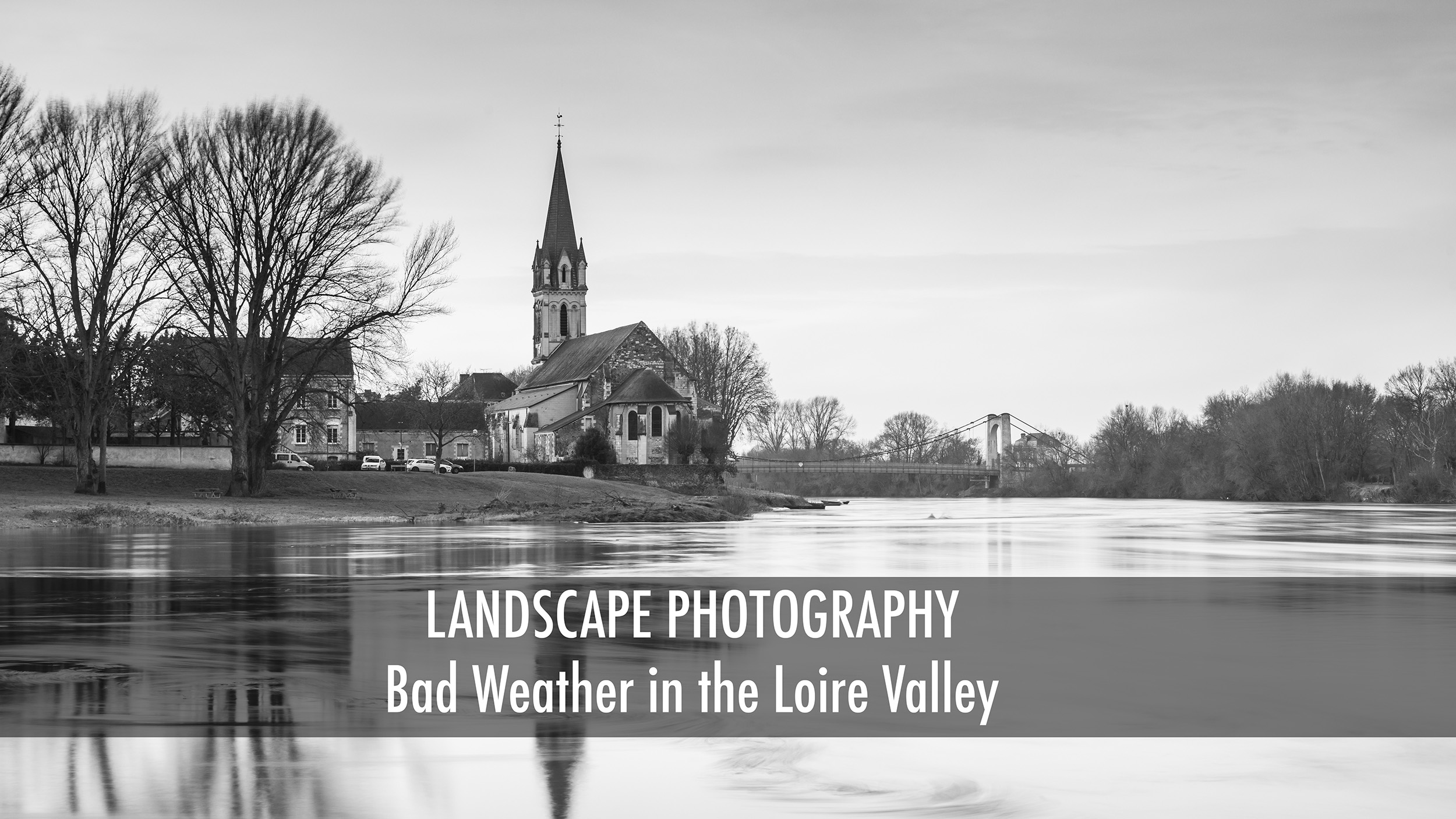

Bad weather in the Loire Valley is my latest YouTube vlog detailing some of my exploits as I travel to various parts of the world.
Bad weather can ruin a photography day, and I don’t agree with the idea that there is always good light to be found if you look hard enough. Sometimes the forecast is wrong, the sky turns flat and heavy, and all you can do is make the best of it.
My first vlog back in the Loire Valley of France was blighted by bad weather. The weather forecasters on various sites were showing broken clouds and sunny spells, but it was anything but what they predicted.
In this week’s vlog, I took just one image because that was all that was worth taking. Honestly, I would prefer to be showing you all the area in a far better light than there is here.
And if you’re interested in discovering the Loire Valley with a camera, then do check out my annual Loire Valley photo tour in May.
I had only recently got back to France from the United Kingdom, and the trip back itself was thankfully fairly straightforward. I had my PCR test sorted, so entry into France was easy enough on that front.
The part that was far less welcome was the paperwork. Because of Brexit residency rules, I had to apply for residency in France, and at that point, I still didn’t know how long it would take. I basically had 90 days to get it sorted. If it dragged on too long, I would have to leave the country, which was not a situation I wanted hanging over me.
At the same time, I needed to be honest with myself about work and YouTube. Over the previous year, YouTube had taken a bigger role simply because I was in France and not travelling the world in the way I usually would. That shift made sense at the time, but it also pushed other parts of my work to one side.
I’m a professional photographer first, and there are only so many hours in the week. So I decided to cut my schedule back to one vlog a week, with a video every Friday. I wanted to keep showing the work, the places, and the thought process behind it all, but I also needed room to do the parts of the job that people don’t always see.
That change set the tone for this outing. I headed off, hoping to make a useful vlog, scout a few locations, and perhaps come back with something promising for the work I was researching. Instead, it turned into what I felt was my worst vlog of 2021.
The frustrating part was that I hadn’t gone out blind. Every weather forecast I checked suggested sunshine and broken cloud. What I got was cold, grey, and at times wet. The further I drove from home, near Tours in the central Loire Valley, the worse it became.
I was out for two reasons. First, I wanted to get a vlog filmed. Second, I wanted to research places that might be useful for a book I was hoping to work on, although I was still waiting on the contract. That delay was irritating, but it also meant I could keep using the time to look hard at locations and decide what was worth keeping.
One of the first places I stopped at had some promise on paper. Looking out from higher ground, I could see a church or a similar building down below, and there was also a structure near me that looked a bit like an old mining tower. I couldn’t be sure what it was, but the setting made me pause. The east was off to one side, so I could imagine the scene working better at dawn, when the light might come in at the right angle and give the whole place a bit of shape.
That is often how these days go. I don’t always need a finished image. Sometimes I need to stand in a place, study the direction of light, look at what clutters the frame, and decide whether it deserves another visit.
When I’m assessing locations I might one day include in my Loire Valley photography tours, I have to be strict. A place can be interesting and still not be worth recommending to photographers.
There are days when the best result is finding out where not to return.
One of the positives from a bad weather day is that it forces clear decisions. If a location has strong bones, it usually still shows some promise in bad conditions. If it falls apart under a flat sky, that tells me something useful.
I found an old ruined castle that was pleasant enough to look at, but photographically it didn’t do much for me. There was no clear structure to the composition, no element to draw the eye, and no strong way to lead a viewer through the frame. As a ruin, it had some charm. As a photograph, it didn’t give me enough.
I also checked a viewpoint and another beautiful church. They were close to the Loire Valley, and that made them tempting to consider, but close is not the same as good. If I’m going to tell people to stop somewhere, unload gear, and spend time there, the place needs to offer more than curiosity. It needs to work.
The ruined castle was the clearest example of that. I could admire it, but I couldn’t build a photograph around it.
The other locations had similar issues. A scene might be attractive in person, yet still fail in the frame because there is no foreground, no line, or no sense of balance. That’s the difference between sightseeing and picture-making.
Still, the day was not wasted. I crossed off places that didn’t deserve more time, and I found a couple that might be far better under a different sky.
The best of the lot was a riverside scene with a church, or perhaps an old abbey, sitting beyond the water. I don’t think I was on the Loire itself at that exact point. It seemed to be a different river, although the bridge nearby is the point where the official UNESCO Val de Loire World Heritage Site begins, or ends, depending on which way you’re travelling.
That location had something. The building had presence, the river gave me reflections, and the direction of view suggested it could work at sunrise or sunset, depending on the time of year. Even so, the conditions were still poor. The sky was flat, the colour was weak, and some elements in the scene were not helping at all.
I also wished the boats that were absent had been there. They would have added a proper foreground anchor and given the composition a stronger base. Without them, the whole thing felt thinner than I wanted.
So I stopped thinking about making something grand. I put on my 24-70mm lens, added a graduated filter, and decided to work in black and white. This was not fine art landscape photography in the way I would choose to show the Loire Valley at its best. It was a practical response to poor conditions.
Sometimes that is all the day allows.
My first problem was the edge of the frame. If I moved too far one way, trees crept in from the side and cluttered the composition. So I positioned the camera carefully to keep them out.
I also didn’t want the horizon cutting the frame in half. A centred horizon can kill a picture quickly, especially in dull light. I lifted the framing slightly so the horizon sat higher, and I accepted that the steeple and its reflection would sit close to each other.
That didn’t bother me too much. In fact, I preferred having a little extra breathing room in the sky. There was another reason for that as well. From a practical point of view, the image also needed to work as the cover for the video, so leaving space on the right-hand side made sense.
I considered switching to my 100-400mm and going tighter, but that lost too much context. My eye liked the broader relationship between river, building, and sky. Cropping in harder made the subject feel isolated rather than grounded in place.
Once I had the frame, I started looking for anything in the scene that could give me a stronger line. Pieces of wood were floating on the river, and with a long enough exposure, they might create something graphic, perhaps a zigzag or an S-curve leading towards the church.
That changed the exercise completely. Instead of one static long exposure, I began watching the water and timing frames around whatever drifted through.
My first attempts were around 10 seconds. Then I shortened the exposure to six seconds when the light shifted, and later tried eight seconds as the sun threatened, very briefly, to break through in the south-west. I kept the camera at ISO 100 and f/11, which gave me a clean file and enough depth for the whole scene.
This is where experience comes in. On a bad weather day, I keep asking myself whether there is one more option in front of me. Can I gain a line? Can I lose a distraction? Can I afford another third of a stop? Can I recover the highlights later?
I was also watching the histogram the whole time. The image on the back of the camera is a JPEG preview, not the raw file, so there is often a little more room than it first appears. I thought I might be able to squeeze a touch more exposure out of the scene and pull it back later in Lightroom if needed.
Some frames worked better than others. One exposure gave me a useful line on the water. Another lost it entirely. A later one produced a softer S-curve that moved into the church quite nicely, although I could see a bit of overexposure creeping in, probably in the blue channel.
None of the results were exactly what I wanted, but one frame felt decent enough to keep. Given the weather, that was about as much as I could ask for.
In bad weather, small changes matter more. A drifting branch can do more for a frame than the sky.
By the end of the shoot, my mood was hardly upbeat. I wasn’t going to get the winter sunset I had hoped for, and I knew the day had not shown my work in the best light. There are days when you feel every bit of the gap between the photograph you wanted and the photograph you managed.
Still, the day had done some good. I had found new places. I had ruled out others. I had seen one scene that might be worth revisiting in better conditions, and that alone gives a recce day value.
There was also the wider reality of work sitting in the background. One reason I had to step back to one vlog a week was simple lack of time. Alongside photographing, editing, and planning, I was also dealing with a serious copyright infringement problem. I had around 20 to 30 people to take to court over unauthorised use of my photographs, and preparing one court summons could take three to four hours. New infringements were landing every few days.
That is the less glamorous side of being a working photographer. Protecting your rights takes time, energy, and persistence. It also means something has to give, and for me that meant a reduced YouTube schedule.
Bad weather in the Loire Valley can flatten a scene that would sing on another day. This outing proved that plainly, and I wasn’t shy about feeling disappointed by it.
Even so, the day still mattered. I came away with one usable image, a clearer sense of which locations deserved another visit, and a reminder that research is often as important as the final frame.
France does not stop being photogenic when the forecast fails. It simply asks for patience, honesty, and a willingness to walk away when the light isn’t there.