 Skip to content
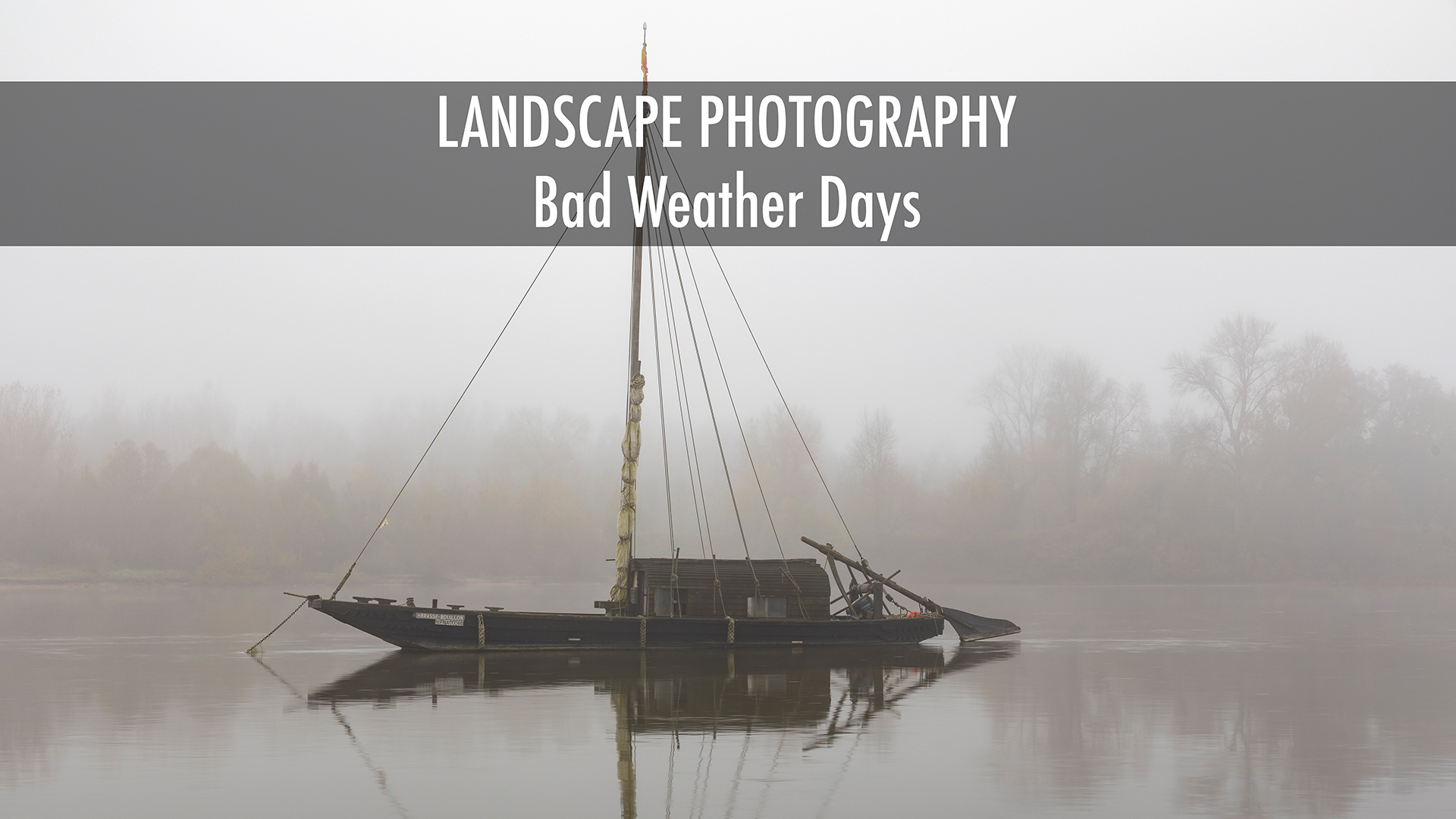

Landscape Photography and bad weather days. It happens to us all. You weather watch. You think all is going to be good, but Mother Nature decides otherwise.
This isn’t the greatest YouTube vlog I have ever done, but I filmed it, so I thought that I might as well just put it out there.
I intended this to be another video showing you all the Loire Valley, but the weather just did not play ball the entire day. What can you do? Not a lot! Hopefully, though, I can rectify that on the next one.
And if you’re interested in discovering the Loire Valley with a camera, then do check out my annual Loire Valley photo tour in May.
I began the day in the centre of Tours, where I had planned to continue photographing the Loire Valley from end to end. Straight away, though, the mist was thicker than I had hoped. Even in town, where I expected a bit more clarity, the air still had that flat, washed-out look that makes everything feel slightly muted.
I was standing near the Hotel de Ville, the town hall of Tours, and it is one of those buildings I never tire of seeing. It was designed by Victor Laloux, who also designed the railway station in Tours and the Musée d’Orsay in Paris. That alone gives it weight, but for me, there is something more personal about it. This is the place I first arrived when I came to live in the city 10 years ago, so every time I photograph it, there is a memory tied up in the frame.
The setting is strong for photography. A pedestrian walkway leads the eye towards the building, and on a clear morning, the lines work beautifully. The architecture has presence, and it feels grand without being cold. If you’re ever in the city, it is one of those spots that deserves a slow look rather than a quick glance.
I wanted to make the most of the foreground and the movement in front of the building, but the weather kept holding everything back. The structure was there, the composition was there, yet the atmosphere was not giving me enough. That is often the frustration on days like this. The scene is promising, but the light refuses to do its part.
For anyone interested in photographing this part of France in better conditions, I share more of the region through my Loire Valley photography tours.
The main reason I stayed by the town hall was the tram line. There is a stop close by, which means the trams slow down as they pass. That gave me a chance to use a long exposure and pull some movement into the scene.
I was working at around six seconds, which is enough to stretch the lights and give that smooth trail of motion without losing the shape of the setting. Because the tram was slowing for the stop, the light trail had a much cleaner look than it would have had if it had rushed through the frame at full speed.
My thinking was simple:
A bus appeared at one point, and I photographed that as well, because on mornings like this, you take the opportunities that come. Still, the image I really wanted was the tram moving back the other way, with the red taillights trailing across the frame.
On bad weather days, patience matters more than plans.
The trouble was the fog. It hung around for too long, and although the movement in the frame helped, the mist took away the crispness I wanted around the building itself. I could make a picture, but I could not make the picture I had in mind. There is a difference, and it matters.
After spending time in the city centre, I headed west of Tours. I kept checking the weather because I hoped the morning would open up once I left town. Instead, the fog stayed stubbornly in place.
I reached a spot on the Loire where I had photographed before. In better light, it is a lovely area, and even in mist, it can work. Still, I knew from the start that I was compromising. I was not looking at the river thinking, “This is perfect.” I was looking at it and thinking, “Can I make something from this?”
The main subject was a sunken boat in the river. There were others nearby, including a smaller one I had not seen before, but the strongest subject was the larger wreck that sat in the water with enough shape to carry a frame on its own. I chose to work at about 50mm and placed the boat slightly off the third. I did not centre it, and I did not place it exactly on the third either. That slight shift felt better.
I also chose not to include too much reflection. If I had opened the composition further and kept more water, the image would have carried too much negative space for my taste. By tightening in, I could hold the subject with a bit more intent.
Even then, the fog was thick. I knew I could add a touch of haze and contrast later in processing to give the frame some separation, but that only works if the bones of the photograph are sound. Post-processing can help a scene breathe. It cannot rescue weak conditions and weak composition at the same time.
One of the things I hoped to find that morning was woodland with enough openness for misty tree shots. On paper, that sounds easy. In practice, the woods around there are often too dense. They close in on you, and there is no room for shapes to breathe.
That matters more than many people think. Dense woodland can look wonderful in person, but if you cannot find a clearing or enough spacing between trunks, the frame collapses. A wide lens can flatten the scene and make everything pile on top of itself. Then the photograph loses order.
I have made images in foggy woods before, so it was not the mist that bothered me. The problem was the structure of the place. There was no clean arrangement of trees, no natural route for the eye, and no simple shape to hold the composition together.
That is why I decided to stop and head home for a while rather than keep grinding away at something that was not there. I would rather leave a location empty-handed than pretend it is working when it is not.
There was another layer to the day as well, because France was under lockdown at the time. I know that always raises questions when people see me out photographing, so it is worth saying plainly: I was out working.
I was on a book commission that would run over roughly 12 months, and I had a letter from the publisher to cover that work. In France, paperwork mattered a great deal during that period. If the police stopped you, you needed to show what you were doing and why you were out. I had nothing to hide, and I was not bending the rules.
The city itself felt odd because of that. Tours is never a noisy giant, but the emptiness was striking. In the centre, there were hardly any people around, and even when I went to a supermarket later to look for a cable for my computer, the place felt strangely hollow. It was also a bank holiday, which added to the quiet, but the lockdown atmosphere was still unmistakable.
That emptiness changed the mood of the photographs, too. Places that usually carry movement and life felt paused. Sometimes that can help a frame. On this day, it mainly added to the sense that nothing was quite clicking.
After going back home, I rested, dealt with a bit of business, had lunch, and then headed out again in the afternoon. I spent about two and a half hours driving and scouting, and for most of that time, I did not film anything because I simply did not find a scene worth sharing.
My main idea was to look for silver birches in woodland clearings. There are plenty of silver birches in the area, and with the right spacing, light, and atmosphere, they can be superb. But again, the woods were too dense. I drove roads I know well, turned into side tracks, looked at trails from both directions, and kept hoping for that one opening where the composition would reveal itself.
It never happened.
That can be hard to explain unless you’ve felt it yourself. You can be motivated enough to go out. You can have the time. You can know the area. Yet the spark that tells you to stop the car, get the camera out, and start walking is missing. Without that feeling, I tend not to force things, because the result is usually thin.
I have spoken before about planning photography trips, and the first thing behind any good outing is inspiration. If the place in front of me does not stir that response, I know I am unlikely to make work that satisfies me. So I kept moving.
At one point, I found a village with a church on top of a hill. From the road, it looked as though there should be a wonderful view across the valley towards it. I did find the angle, but it was on private property. That ruled it out, and there was no point wasting more time trying to solve something that was not open to me.
Even that was useful, though. Scouting matters. Learning where a view does and does not work saves time later.
On the way back towards the house, I stopped in the vineyards of Bourgueil. I do not come here all that often, but it made sense to pause and take stock before ending the day.
The sun was coming and going, and the cloud above had some shape, but not the kind of shape that excites me. It was not a sky that added drama or clarity. It was simply there. I could have lifted the camera, made a frame, and shown it as another location in the Loire Valley. But that would have missed the point.
I do not want to make photographs only to prove I was somewhere. I want the conditions, the subject, and the feeling of the place to come together. If they do not, then I would rather say so plainly. That is far more honest than pretending every outing turns into a keeper.
This matters when I show people around France, especially in a region as appealing as the Loire Valley. I want my photographs to give people a real sense of why they might want to visit and experience it for themselves. A half-hearted image taken under half-hearted conditions does not do that place any favours.
Although the day felt disappointing, it was not wasted. Some of the most useful photography days are the ones that refuse to hand over easy results.
A few things stayed with me:
There is also a bigger point. Weather watching helps, but it never guarantees anything. Fog can linger. Light can flatten. The sky can close down an otherwise good location. When that happens, I try to stay open to small chances, like the tram by the town hall or the wrecked boat on the Loire, whilst also knowing when to stop.
That balance is part of photography. Some days I make the photograph I hoped for. On other days I come home with better knowledge of the place, and that has value too.
The strongest lesson from this day is simple: bad weather days are part of the work, not a break from it. They test judgment more than technique.
I did not come away with the Loire Valley photographs I wanted, but I came away clearer about what I will and will not force. That honesty matters because the places I photograph deserve more than filler images.
Some days, the best result is not a finished frame. It is learning when to wait for better light, better structure, and a better reason to press the shutter.