 Skip to content
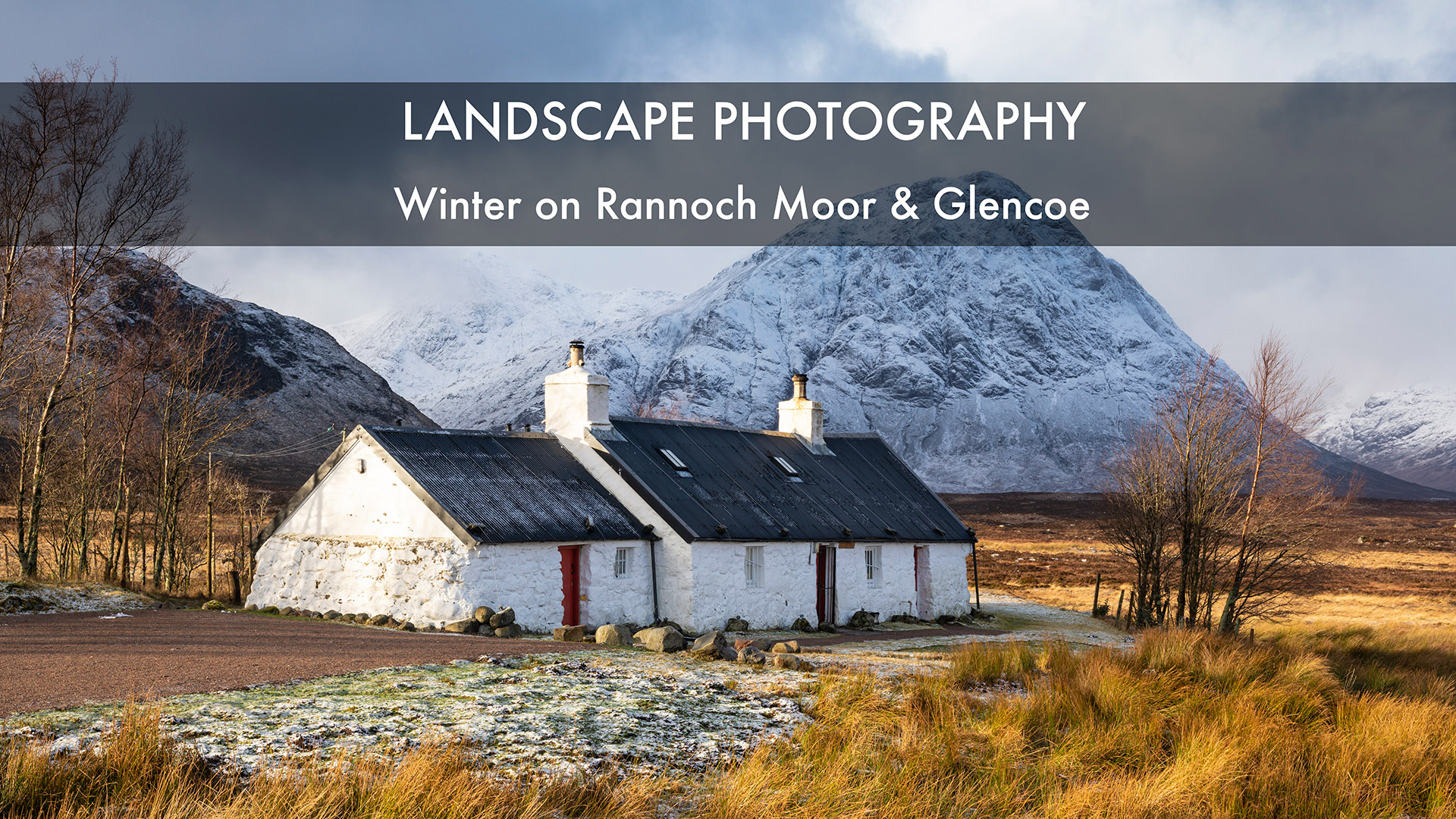

My latest YouTube vlog entitled Winter on Rannoch Moor & Glencoe shows some of what fellow vlogger Paul Thomson, Dick Coulthard and I did up in the Highlands of Scotland over the weekend of 11 and 12 January 2020.
It was a rough weekend with the usual fickle weather Glencoe can throw at you, and our first day was a near wash-out. Heavy rain descended upon us, and most of the day was spent in cafés wondering if we’d ever get a single photo.
But the Gods smiled upon us at the end of day 1, and some nice shots across Rannoch Moor to the famous Buachaille Etive Mor lifted our spirits.
Day 2 looked as if another rough ride was forthcoming, but thankfully, the sky opened up enough during the morning across Rannoch Moor that everyone came away with something they were pleased with.
And if you’re interested, I offer photography tours and workshops in a variety of destinations around the world. If you’re interested in learning more from me to help you get the best out of your photography, then get in touch.
The first afternoon gave us classic January weather in the Highlands. It was wet, windy and grey, with low cloud dragging across the hills and rain sweeping through in waves. Most people would look at that and write the day off. In truth, a lot of it was a write-off, and we spent more time waiting out the weather than shooting.
Still, one scene made perfect sense in those conditions, the isolated cottage in Glencoe. A place like that doesn’t need sunshine. It needs atmosphere. It needs cloud, a bit of gloom, and a sense that the weather has closed in around it.
Paul was in his van trying to work out a shot from behind us, and Dick stood nearby studying the scene. I said then what I still believe now: this sort of house works beautifully when the weather is rough. The bleakness becomes part of the photograph. You don’t have to force the image into black and white either. Colour works, black and white works, and both can carry the mood.
This type of shot is ideal in this condition.
What we needed was a short break in the rain. Nothing dramatic, only a few minutes without drops hitting the front element. We could see a slight gap in the cloud behind us, so we stayed put and waited. In Glencoe, that patience often matters more than moving on too quickly.
When the rain eased off, we got to work quickly. Dick had brought an umbrella, which turned out to be more useful than any bit of camera gear at that moment. While he shot, I helped keep the rain off his camera. Then he returned the favour. That is one of the best parts of photographing with other people. If the weather turns awkward, an extra pair of hands can save the shot.
I switched to my 24mm tilt-shift lens to open the frame up and give more space to the sky. The house sat low in the composition, roughly on the lower third, which gave the cloud room to do the heavy lifting. On a day like this, the sky was not the background. It was half the picture.
I also wanted the whole frame to feel spare and remote. The cottage needed to look small against the weather, not dominant within the frame. That balance mattered more than chasing a dramatic foreground.
A few choices helped here:
Meanwhile, Paul was full of coffee and charging about below us, doing what Paul does best, which added a bit of humour to a damp end to the day. In truth, that cottage was probably the only proper stop we managed on day one. Yet it felt like enough, because the conditions suited it so well.
We finished with the hope that the forecast snow might arrive overnight.
By Sunday morning, the scene had transformed. The rain from the day before had stripped away earlier snow, but fresh snowfall overnight had put winter back where it belonged. Rannoch Moor looked clean again, and the mountains had that crisp, bright dusting that makes the whole place feel sharper.
We stopped at the well-known waterfall with Buachaille Etive Mor behind it, one of those classic Highland scenes that draws photographers back again and again. The mountain looked superb with snow on its slopes, and the sky began to break in places after a fairly miserable start of sleet and low cloud.
Paul was off to one side, working on his composition. Dick was nearby, and at one point, I had to warn him that his tripod looked a bit too close to the edge for comfort. Waterfalls are great until the camera ends up in one.
That morning reminded me why I keep returning to this part of Scotland, both for my own photography and for the Glencoe landscape photography tours I run. When winter weather starts to shift, this area can go from flat to extraordinary in minutes.
Most people photograph that waterfall from the obvious spot, and for good reason. The standard view works. I wanted something a little different, so I scrambled down to a more awkward position and tried to get closer to the rocks. It was not an elegant route in, but it gave me a fresher angle on a scene I know well.
I framed vertically to give the waterfall more presence in the composition. At the same time, I kept enough of the mountain in view to anchor the frame. My exposure sat around f/16 at roughly 1/5 second, which gave the water some movement without turning it into a complete blur. I also bracketed the scene because the sky was starting to brighten, and I wanted to keep detail in the snow and cloud.
The improvement in the weather came in small stages. First, the sleet eased. Then the sky began to split. After that, the snow on the Buachaille started to catch a bit of light, and the whole scene lifted.
That is often how winter photography works in Scotland. You don’t get a clean switch from bad to good. You get brief openings, and you have to be ready when they appear.
From there, I turned to another subject nearby, a tree that can easily look wrong if you rush the composition. With a wide lens, it would have been easy to let the trunk lean or distort. I wanted the tree to stay upright and feel grounded, even if it was old and weathered.
That small choice made a big difference. A tilted trunk would have looked sloppy. Keeping it vertical gave the image a quiet strength and let the shape of the tree hold its own against the wider view behind it.
The distant landscape was looking better than I had seen it had for a couple of years. Snow covered the higher ground cleanly, and the breaks in the sky gave enough separation between land and cloud. I checked where Paul and Dick were before opening the composition too wide, because on a busy roadside stop, it is easy to include another tripod by accident.
Even in a classic location, a slight change in angle, weather, or timing can turn a familiar shot into something that still feels personal.
Later, higher up on Rannoch Moor, the cold became the main subject. The forecast suggested around minus 7°C with wind, and once that wind hit, it cut straight through everything. I had Paul on my left, my GoPro trying its best to survive, and a very expensive 50mm tilt-shift lens on the front of my camera, one that Canon had lent me. That combination focuses the mind when gusts start knocking tripods about.
I was trying to do three things at once: make pictures, film the day, and help Paul get his gear where he needed it. Compared with the first day, though, the sky had opened enough to give us a chance. We were already doing more than we had managed in the rain the day before.
Winter on Rannoch Moor does not forgive poor preparation. The cold drains you, and the wind can turn a stable setup into a problem in seconds. At one point, we came far too close to losing gear, which is the sort of warning you only need once.
If you come here in January, come prepared for the cold and keep a close eye on your tripod at all times.
The landscape was superb, but there is no point pretending the conditions were comfortable. They were not. That said, discomfort often sharpens concentration. When the weather demands your attention, you become much more careful about every choice.
No winter trip to Glencoe feels complete without at least one stop at Black Rock Cottage. It is iconic, and because it is iconic, you rarely have it to yourself. When we arrived, it looked exactly as you would expect, a line of tripods pointing at the house from every possible gap in the roadside.
Dick was on the left. I stood in the middle. Paul set up farther over to the right. The cottage looked brilliant in winter light, but the usual compositional problems were all there.
A viewer had commented on one of my earlier images that I had managed the scene without trees. I could only laugh, because when you stand there in person, the problems become obvious. Trees sit on both sides, a telegraph pole lurks behind the cottage, and another large boulder can be useful or annoying depending on where you stand.
I had to choose my position carefully to hide the pole behind the building. That was the main reason I stood where I did.
Three things shaped the composition here:
That is the reality of photographing famous locations. The subject may be fixed, but the work is in managing everything around it. I kept adjusting slightly, checked that Dick was not straying into my frame, and waited for the light to settle. Paul worked from lower down near a large boulder, which can make a strong foreground if it sits in the right place.
When the winter light came through, even briefly, the whole scene clicked. Snow, dark stone, pale walls and shifting cloud all came together. It looked every bit as good as I had hoped, but it still demanded patience and precision.
We ended the weekend at the famous viewpoint above Loch Tulla, hoping for one more spell of usable light. For a few minutes, it looked promising. We could watch the weather building in one direction, then, with typical Scottish timing, it rolled straight over us.
That window lasted about ten minutes. Then the sleet arrived, and the scene closed down again.
There is not much to do at that point except accept it. Chasing weather in Glencoe and across Rannoch Moor is part of the job. Some weekends, the breaks are generous. On others, they are mean and brief.
Even so, the humour stayed intact. Dick ended up holding the camera for me and getting thoroughly cold and wet in the process, so I told him I owed him a beer. By then, the GoPro was wet, our clothes were wet, and patience was wearing thin, but we could still laugh at it all. A bit of banter goes a long way when the weather starts pushing back.
That was the shape of the weekend: cold, wet, frustrating at times, but still rewarding. The Highlands rarely hand over photographs easily, and perhaps that is one reason they keep pulling me back.
Winter photography in Rannoch Moor and Glencoe is not about waiting for neat conditions. It is about recognising when rough weather suits the subject, and then being ready when the smallest break appears.
The isolated cottage needed gloom. The waterfall needed fresh snow and a split in the cloud. Black Rock Cottage needed careful positioning and patience with the light. Every stop asked for something different, but the same rule ran through all of them: stay flexible and keep working.
That is why I still love photographing this part of Scotland in January. The weather can be miserable, but when it turns in your favour, even for a few minutes, the images feel earned.
We noticed you're visiting from United Kingdom (UK). We've updated our prices to Pound sterling for your shopping convenience. Use Euro instead. Dismiss