 Skip to content
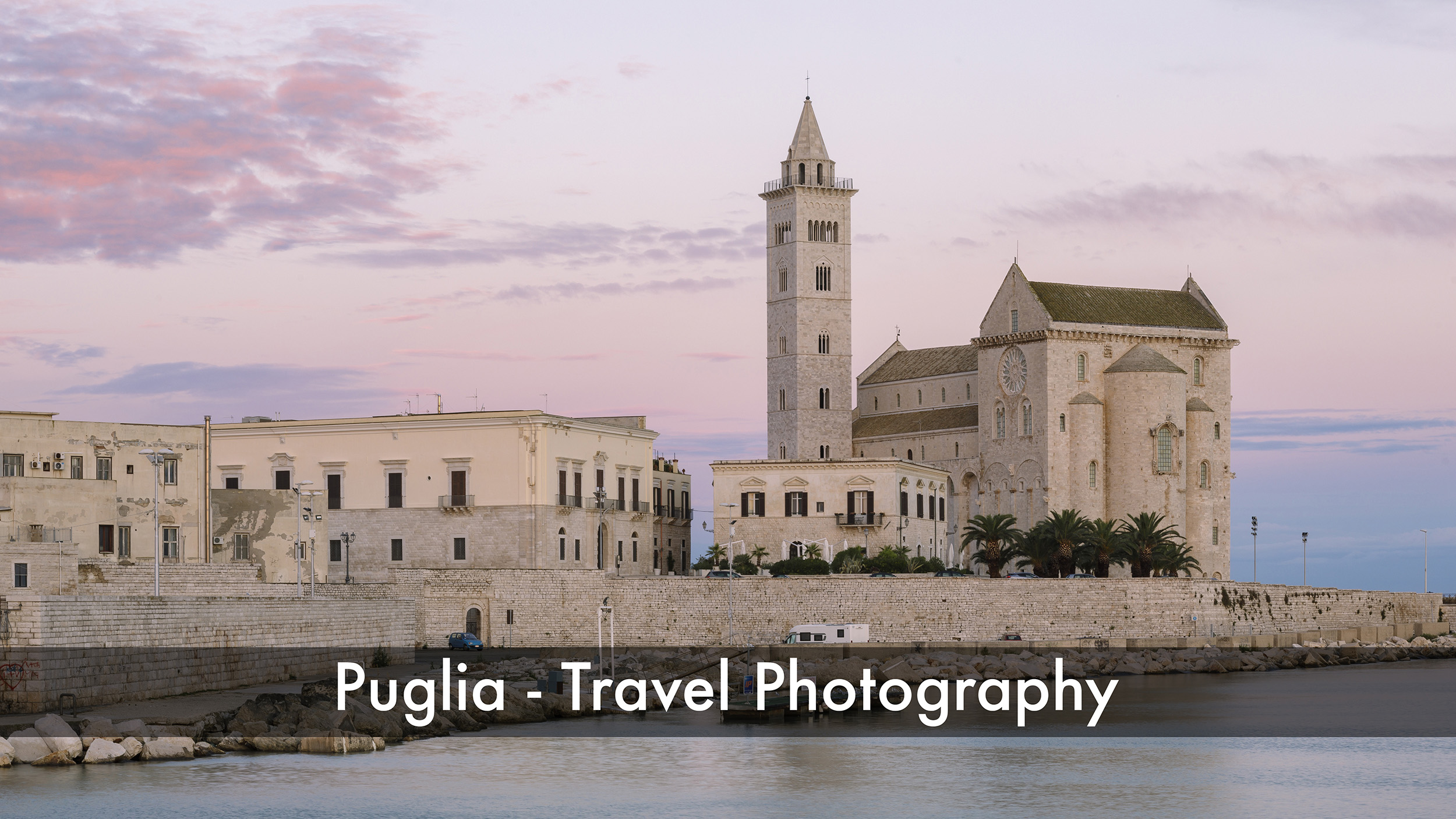

My latest YouTube vlog, Puglia Travel Photography, shows some of what I did in southern Italy in early October 2021.
Having never been south of Rome, it was a great introduction to the area as I was privileged to be given special access to several different including bell towers, rooftops and hotel terraces.
The work being carried out was for a commission, and the results of what I did should be published in a couple of months.
My channel is dedicated to all things landscape and travel photography, so if that’s your thing, then I’d love to have you come along for the ride.
And I run regular Italy photo tours, so if you’d like to learn in person with me, then please take a look at what I offer.
There was a lot to like about this trip to Puglia before I had even taken a frame. I was back in Italy, back on assignment, and back working the way I like to work, moving through cities with a camera and responding to whatever the light gives me. After everything that had happened over the previous 18 months, that felt good.
Puglia gave me a packed schedule. I was based in different towns across the region, including Taranto, Lecce, Foggia and Trani, with Bari also part of the wider route. Some of the access was special, which made a big difference. I spent time on hotel roofs, climbed bell towers and worked inside churches that I could not have photographed without permission.
The weather never settled into a neat pattern. One moment, there was colour in the clouds, then rain would sweep through, then the sky would open again. For photography, that is often far better than stable sunshine. A client might hope for endless blue, but a camera usually prefers cloud, depth and changing light.
Changeable weather often gives me stronger travel photographs, because the sky becomes part of the picture instead of an empty backdrop.
That became a running theme throughout my week in Puglia. Nearly every city asked for patience, and nearly every good frame came from waiting a little longer than planned.
Taranto was my first proper taste of southern Italy, and it made a strong first impression. I was staying in a hotel with a view across the city, and from the roof I could see how the place sat together, the old city, the island, the mainland beyond, and the spread of rooftops pulling the eye towards the water.
From that roof, I set up one of the images that defined the stop. I had a 50mm tilt-shift lens mounted, along with a rail, so I could build a stitched panorama with a cleaner rotation point. The setup was familiar: tripod locked down, camera levelled, then a slow sweep from one side of the city to the other.
From my position, I could see the old city stretching out below me. Off to one side was the mainland, and in the distance, there were high-rise buildings that gave the skyline a different rhythm. Somewhere within that view stood what I believed was the Duomo of Taranto. I did not know the city well at that stage, but that was part of the appeal. I was seeing it fresh.
The weather helped. There had been rain in the night, and the sky still had unsettled clouds moving through. Across the rooftops, that gave shape and tone to the scene. A clear sky would have made the picture flatter.
Later, down by the harbour, I found myself staying much longer than planned. I had been watching the light on the fort across the water and could see the cloud shifting in a way that might briefly light the subject properly. When that happens, walking away too early is often a mistake.
So I waited. That decision changed the rest of the day, because once I had the harbour light I wanted, I also went back to rework an image from the hotel roof. Earlier, I had taken a version that felt more atmospheric. Then I returned for a cleaner, more open frame, closer to the kind of postcard light people expect from a city view.
I had also thought about staying longer still and going up a bell tower to photograph back towards the city. In the end, time won. By lunchtime, I needed to leave for Lecce, which was about 90 minutes away. Still, Taranto had already done its job. It gave me a strong start, reminded me how much I had missed this kind of work, and showed me at once that Puglia had depth.
Lecce felt different from Taranto straight away. The architecture had a richer, more ornate character, and the city seemed to rise in layers of church facades, towers and warm-toned stone. Even in poor weather, it had presence.
The journey across Puglia from Taranto went smoothly enough, but when I arrived in Lecce, the rain set in. That limited what I could do for much of the day, so I had to wait for small openings rather than follow the plan I had in mind.
By dawn the next morning, I was up on the hotel roof looking east. There was not much to photograph in the direction of sunrise itself, but the roof gave me a useful position over the city. Below me sat the Roman amphitheatre. Behind me was the Duomo of Lecce, and around me were church domes, towers and rooftops stretching out through the centre.
Lecce is one of those cities where the skyline keeps offering small details. A bell tower here, a church facade there, then another cluster of rooftops catching the first light. On the back of the camera, I already had a few frames from that session, including a landscape composition made with a 24mm lens and a 1.4x extender.
I could also see a photograph I wanted but could not reach. One church facade would have looked superb from a slightly higher roof nearby, yet there was no access. A flat roof sat in the right place, but I could not get onto it. Even the hotel breakfast room was no help, because the window would not open. Travel photography is often like that. Some images happen because of access, while others remain out of reach by a few metres.
Although the rain disrupted most of my first day in Lecce, it did not wipe it out. Later on, I was invited into a church to photograph an interior light display, which gave me something very different from the rooftop work. After a grey day outside, being inside with controlled light and rich detail was a welcome change.
I also had an appointment at the cathedral. Part of what I was doing there was not something I could talk about in detail, and it was not something I was able to show fully either. That is often the reality with commissioned work. Sometimes I can share the atmosphere of the place and the process behind the pictures, but not every frame or every location detail.
Even with those limits, Lecce stayed with me. It is a city full of texture. Baroque architecture appears almost everywhere you look, and because the weather kept changing, the stonework never looked the same for long. One minute it sat under flat grey cloud, then a break in the sky would bring out shape and warmth in the buildings.
The roof session also reminded me how useful elevated viewpoints can be in old cities. From street level, Lecce is rich and close. From above, it becomes a pattern of towers, church roofs and hidden courtyards. That wider view gave me a better sense of the place, even on a morning when the light remained unsettled.
Foggia was the hardest stop of my trip in Puglia from a weather point of view. It rained heavily for the whole day, and there was no real chance of working outside in the way I had hoped. Sometimes there is no clever way around that. The rain simply wins.
Even so, the day was not wasted. I was able to photograph inside the cathedral, and that only happened because the father of the cathedral kindly gave me permission. He had seen an article about my work, and because of that, he opened the door for me.
That mattered a great deal. Outdoor work was off the table, so the interior became the day. Instead of chasing city views or waiting for breaks in the cloud, I concentrated on the details and atmosphere inside the building.
I owe a huge thank you to the father of the cathedral in Foggia for making that possible. On a day that could easily have produced nothing, his generosity gave me a photograph and a reason to remember the stop for the right reasons.
By the time I reached Trani, I was in one of the places that had drawn me to Puglia in the first place. Long before this commission, I had seen a photograph of the town and stored it away in my mind. I keep a mental bank of places that spark something in me, and Trani had been sitting there for a long time.
That first morning in Trani felt promising straight away. The sky behind me, where sunrise would happen, was starting to colour up, but my attention was fixed in the other direction. I was not there to photograph the sunrise itself. I was there for the waterfront, the harbour and the cathedral on the edge of the sea.
I kept catching myself calling it a church, but it is the cathedral, and it dominates the scene. Set against the coast, it has the kind of shape that works well even before the light arrives. Add low cloud and the first hint of colour in the sky, and the whole place begins to lift.
The conditions were exactly what I had hoped for. There were moody clouds overhead, enough space in the sky for colour, and a softness in the light that suited the stone. After several unsettled days elsewhere in Puglia, it felt as though the weather had finally lined up with the picture I had been carrying for years.
I began with a blue-hour image using the 50mm tilt-shift lens. It was a good starting point, but when I looked at the frame, I knew the cathedral sat a little too far back in the composition. The answer was simple. I needed to bring it closer.
So I switched approach and worked at roughly 70 to 75mm by adding the 1.4x extender. That tighter framing gave the cathedral more presence and made the image feel more direct. It is a small adjustment, yet it changed the balance of the picture.
I was also due to go up the bell tower later that morning, at about 10 o’clock, which opened up another set of possibilities. From there, I planned to work on a panorama over the harbour, using the height to show the relationship between the waterfront, the cathedral and the wider town.
Trani rewarded patience in the same way Taranto had, although in a different setting. I stood there watching the cloud colour develop and knew I was in the right place. Sometimes a photograph lives with you for years before you finally stand in front of it. When that happens, the challenge is not only technical. It is also about getting out of your own way and letting the place speak.
The end of this journey was not filmed in Puglia at all. It happened back near home in the Loire Valley, which was not the plan when the week began. On the final afternoon in Trani, I became unwell, and from that point, my health came first.
I still managed to finish what I had gone there to do, which mattered because the trip was commissioned work. However, once the job was done, I had no energy left for filming or wrapping things up neatly on location. Vlogging became secondary to feeling human again.
So the closing moments came later, with a Loire Valley castle behind me instead of the skyline of Puglia. It was not the ending I had imagined, but it was an honest one. Travel work rarely unfolds in a tidy line. You can plan the route, arrange the access and study the light, yet a trip still has the final say.
That uneven finish did not change what the week had given me. Puglia had been my first proper experience of southern Italy, and it had already left a mark.
What stays with me most from this trip is not one single photograph, but the mix of access, weather and persistence that ran through the whole week. Puglia gave me rooftops in Taranto, stone and rain in Lecce, a cathedral interior in Foggia and a long-held image finally realised in Trani.
For me, that is what travel photography is at its best. It is not about perfect conditions every day. It is about staying alert, working with what the place gives you, and recognising the moment when everything briefly comes together.