 Skip to content
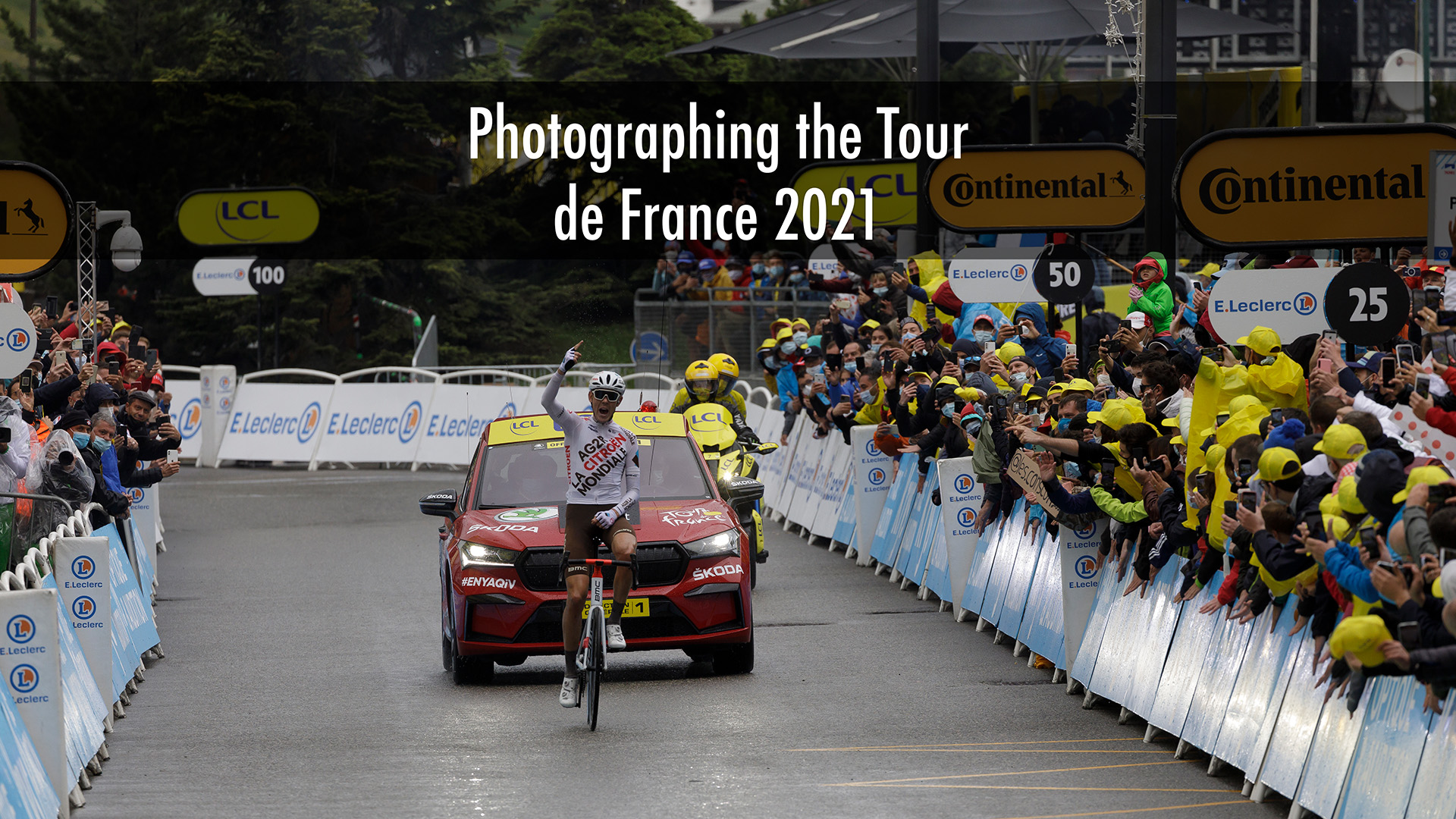

Back at the end of June and beginning of July, I was an accredited photographer for the Tour de France 2021. Originally, I was going to photograph just three days of it, but I decided to make it 5, which took me up into the mountains.
You won’t see any footage of the Tour itself, as contractually we are not allowed to film it, from what I remember. But I’ve added in some of what I did.
The regular content is a couple of weeks away, whilst I work through a backlog of work and vlogs.
My YouTube channel is dedicated to all things landscape and travel photography, so if that’s your thing, then I’d love to have you come along for the ride.
I live in central France, so stage 6 felt almost local by Tour de France standards. Even so, the rhythm of the race changes everything. Early starts, long drives, quick meals, upload deadlines, and the pressure of getting the shot all stack up fast.
I joined the Tour de France 2021 at stage 5 in Laval for the time trial, then stayed on through the next four stages. That meant moving from flatter country into the mountains, and from familiar roads into the harder, more tiring part of the job.
Stage 6 of the Tour de France was the gentlest start of the lot. Because the race began in Tours, I did not need the sort of brutal pre-dawn departure that usually comes with event work. That felt like a gift. I could get up without rushing, head over to the start, and ease into the day before the usual pressure returned.
By stage 7 of the Tour de France, that brief comfort had gone. The pattern of the Tour de France had taken over, and every day started to feel like its own small campaign.
People see the Tour de France race, the riders, the colour, the crowds. What they do not always see is the amount of driving it takes to cover a stage properly when you are working independently. I was not travelling with a big agency team or moving around on a motorbike. I was doing it myself, and that changed everything.
Stage 7 of the Tour de France 2021 was a good example. The race began in Vierzon and ended in Le Creusot. On paper, that looks simple enough. In practice, it meant an early start, a hot drive, a rushed lunch, then another push to get into place before the finish. I found time to eat, but only barely. I had about 20 minutes, then it was back in the car.
At the finish, the pressure changed shape. Access for photographers was limited, and position mattered more than anything. Because I was working as a freelancer and feeding images into various libraries, I was not getting the same front-row treatment as photographers from the largest agencies. That meant I was pushed back.
At the finish line, position was everything. If I did not get there early, the shot was already half gone.
That is where my long lens saved me. I had my Canon 100-400mm with a 1.4x extender, and it gave me enough reach to make something from a less-than-ideal place. Without it, I would have been beaten by distance before the riders even came into sight.
There was also a hard truth to working amongst other photographers. It could feel dog-eat-dog. If someone stepped into your line of sight at the wrong moment, there was no second chance. The riders flashed through in seconds. You got the frame, or you missed it.
By that point of the Tour de France, I was exhausted. I kept thinking about how hard the race must be for the cyclists, but I also knew that covering it from the roadside had its own draining rhythm.
Rather than drive all the way home from the Tour de France after stage 7, I stayed overnight in Autun, in Saone-et-Loire. That was a practical choice because I needed to be ready for stages 8 and 9 in the mountains. Still, it gave me something I had been wanting for days, a chance to point the camera at something other than a bike race.
Autun Cathedral became the subject. I arrived in the evening and used the last of the light to work out a few compositions. Then, the next morning, I went back out early.
One of the best things about a stop like this is that a little planning goes a long way. I had used Google Maps beforehand to look for elevated viewpoints, and it paid off. From above the town, I found two different ways to photograph the cathedral.
The first was a higher viewpoint looking down towards Autun. For that shot, I needed a lens longer than 300mm to make the cathedral sit properly in the frame. A polariser helped as well, because it cleaned up the greens in the surrounding hills and gave the whole scene a neater look.
The second viewpoint was closer to eye level, near a school. That gave me a more conventional composition, and I used the 100-400mm at around 150mm for that frame. It was less dramatic than the higher view, but it felt more grounded and direct.
What I liked most was how different the cathedral looked from each position. From above, it sat in the town like a marker. From the lower viewpoint, it held its own against the surrounding buildings and felt more part of daily life.
The following morning, I returned to the Croix de la Liberation, a viewpoint I had found years earlier. The sky to the north and north-east had colour in it, and the sidelight on the cathedral was superb. There was also a small band of mist on the horizon, which gave the scene a softer edge without hiding the detail.
I made a panorama at 135mm and spent a bit of time watching the light shift across the stone. It was one of those mornings that remind me why I still get up early, even when I am running on too little sleep and too much coffee.
A few local people I met also pointed me towards another nearby spot with a wide panoramic view over Autun. I went to have a look after shooting the cathedral, and although I did not stay long, it confirmed what I had already felt. This town rewards a bit of patience, especially if you have a long lens and a clear morning.
The voice recorder batteries had died the night before, which felt about right for the week I was having. Even so, that quiet hour with the cathedral cut through the noise of the job. The Tour de France will start again soon. For a short while, I had stone, light, mist, and silence.
Because I was accredited, I had one advantage that mattered a great deal. At the start of each stage of the Tour de France, I was able to get right up near the front of the peloton. Once I had spoken to security and confirmed access, I could work close to the riders before they rolled out.
That gave me some of my favourite moments from the whole assignment. In Tours, Mark Cavendish passed within about 20 metres of me. In Vierzon, I had similar access again. Being that close to world-class riders before the noise and speed of the stage fully kicked in was special. There is a different energy at the start line, tense but calm, with everyone still held together.
Mid-stage photography was more hit and miss, because it depended on access, road layout, and time. In Ecueille, I found a tight corner with a good sweep to it, and the crowd there helped me out by letting me kneel low beneath their line so I could frame the riders coming through. That was the kind of roadside moment I enjoy, a quick read of the place, a burst of colour and movement, then the race is gone.
On another day, I stopped at a midpoint that did not give me what I wanted. That happens. Roadside sport often comes down to quick judgment, and sometimes the road wins.
The finish of stage 8 at Le Grand-Bornand was different again. I skipped the midpoint and went straight from the start in Oyonnax to the finish because I knew how important position would be. This time, I got there early enough to claim a strong place on some steps, which gave me a clean view down the final section of the climb. I then waited for an hour in the rain.
That was a much better way to work the stage. Instead of chasing too much, I backed one position and gave myself a proper chance when the leaders arrived.
What struck me through all five stages of the Tour de France was how little time there is to correct a mistake. A rider leans into a corner, a sprint opens, the winner appears at the line, and it is gone. The whole job often comes down to milliseconds.
That pressure is part of the appeal, but it is also why planning matters so much. By stage 8 of the Tour de France, I had settled into a clearer routine:
It sounds simple when written down. On the road, in traffic, with deadlines hanging over the day, it did not feel simple at all.
By the time I reached the Alps, I was craving mountain air as much as mountain roads. I had wanted to see proper height and shape after days of flatter country, and the final two stages I covered finally gave me that.
The morning after stage 8, I made a stop at the Plateau des Glieres. I had not gone out at sunrise because I was too tired after the previous night’s upload problems and a frustrating arrival at the hotel. When I saw the sign whilst driving, I turned off to have a look.
The scene was good, though the light was flat. A stretch of road winding away through the mountains looked promising, and with better light, it could have made a strong image. I did not photograph it in the end, but I was glad I stopped. Even a short pause in that sort of country can reset your head after days of race logistics.
There was also a bite in the air. I was still in shorts when I got out of the car, which felt optimistic once I stepped into the mountain breeze. Later, I planned to change before heading to the finish, where I would be waiting high up again for the race to arrive.
That is another part of the Tour de France that people rarely see. You are always adjusting to weather, road delays, access, uploads, food, and fatigue. One day it is heat and dust. The next is rain on a climb or a cold stop in the hills before breakfast.
A few pieces of kit earned their place over and over again. The first was the 100-400mm, because it covered so much of what I needed, from distant finish-line work to compressing the view of Autun Cathedral. The 1.4x extender mattered too, especially when I got pushed further back than I wanted.
A polariser helped in Autun, where the greens in the hills and the cleaner contrast made a visible difference. Beyond that, the less glamorous tools were just as important. A working card workflow, enough batteries, and a clean upload system matter as much as glass when you are filing images every night.
One of my bigger frustrations came after shooting, not during it. I had trouble sending images to an agency using their uploader, and it chewed up time I needed for sleep. FTP gave me fewer problems, and after a day like that, reliability is worth more than convenience.
The same went for planning. Google Maps helped me find cathedral viewpoints. Arriving early improved my odds at finishes. Keeping the day simple often worked better than trying to do too much.
I also came away reminded that combining event work with travel or landscape photography is possible, but only in small windows. Those windows are precious. If I had driven straight home instead of stopping in Autun, I would have missed one of the best visual moments of the whole trip.
When I look back on those five stages of the Tour de France, the race itself is only part of the memory. I remember Mark Cavendish passing close at the start. I remember crowds pressing in at corners, rain at a mountain finish, and the constant pressure of getting to the next place in time.
But I also remember standing above Autun at dawn, watching the light slide across the cathedral whilst the rest of the day had not yet started. That was the balance of the week. The Tour de France 2021 gave me noise, speed, and stress. France itself gave me a quieter frame around it.
That mix is why the trip still sticks in my mind. I went for the race, yet some of the strongest images came from the gaps in between.