 Skip to content

The Châteaux of the Loire Valley are famous worldwide and rightly so. From old medieval fortresses such as those at Chinon to more stately castles dotted around the area, they make great subjects for both landscape and travel photography.
In this latest episode from my YouTube channel, more castles are the subject of my lens in the Indre-et-Loire department of France. I’ll show you three castles that probably haven’t been on your list of places to visit, but hopefully, you’ll change that with these beauties. This central area of France plays host to some 144 castles that are registered as historic monuments.
With this series, I aim to introduce some of the well-known as well as lesser-known castles that are here in central France. Do be aware, though, that not all of them are accessible to the public and remain behind high walls sealed off from public gaze. But those that are visible will be covered where I can.
And if you’re interested in discovering the Loire Valley with a camera, then do check out my annual Loire Valley photo tour in May.
I started my day photographing the Châteaux of the Loire in the small town of Beaumont, just outside what I believe is the UNESCO World Heritage area of the Loire Valley. There, set behind its gates, was Château de Beaumont, a beautiful old castle with a medieval feel and a facade that caught my eye at once.
I couldn’t find much information on it before arriving, so the building had to speak for itself. What stood out straight away was the mix of styles. Parts of it felt firmly medieval, while some of the windows looked distinctly Gothic. That blend gave the place a layered look, as though several centuries had left their mark on the same walls.
From the street, though, it was awkward. I was photographing from the pavement on the opposite side, and the angle wasn’t ideal. Looking through the gates got me nowhere, and even a 17mm tilt-shift wouldn’t have solved the problem from the entrance because the view was too restricted.
So I used my 24mm and worked with what I had. Even then, I couldn’t avoid the trees completely. I managed not to cut off the tree on the right, but the one on the left crept into the frame. That was one of those moments every photographer knows, where the subject is right there, but the composition refuses to behave.
A few details stood out from the road:
That last point turned out to be wrong, and I’m glad it did.
After my first attempt, I phoned the property. Nobody answered, but there were cars on the drive, so I went over and knocked. The owners were kind enough to let me in to photograph the exterior properly, and that changed the whole experience.
The sign I had misread wasn’t for a hotel at all. It was marking the château as a historic monument on private property. That made much more sense once I was closer to the building.
I always prefer to ask before stepping onto private land, even if the shot seems harmless from the outside. A chateau like this is still somebody’s home, and that matters.
If a better photograph depends on crossing onto private property, I ask first.
The lady I spoke to was generous with her time and told me the castle includes styles ranging from the 12th century up to the 18th or 19th century. That explains why the facade feels so rich and so mixed. It’s not a pure single-period building, and that is part of its charm.
Once I had permission, Château de Beaumont opened up properly. The front was elegant, the stonework had real presence, and the whole place felt like one of those hidden Loire Valley finds that almost nobody talks about. For me, it was one of the nicest surprises of the day.
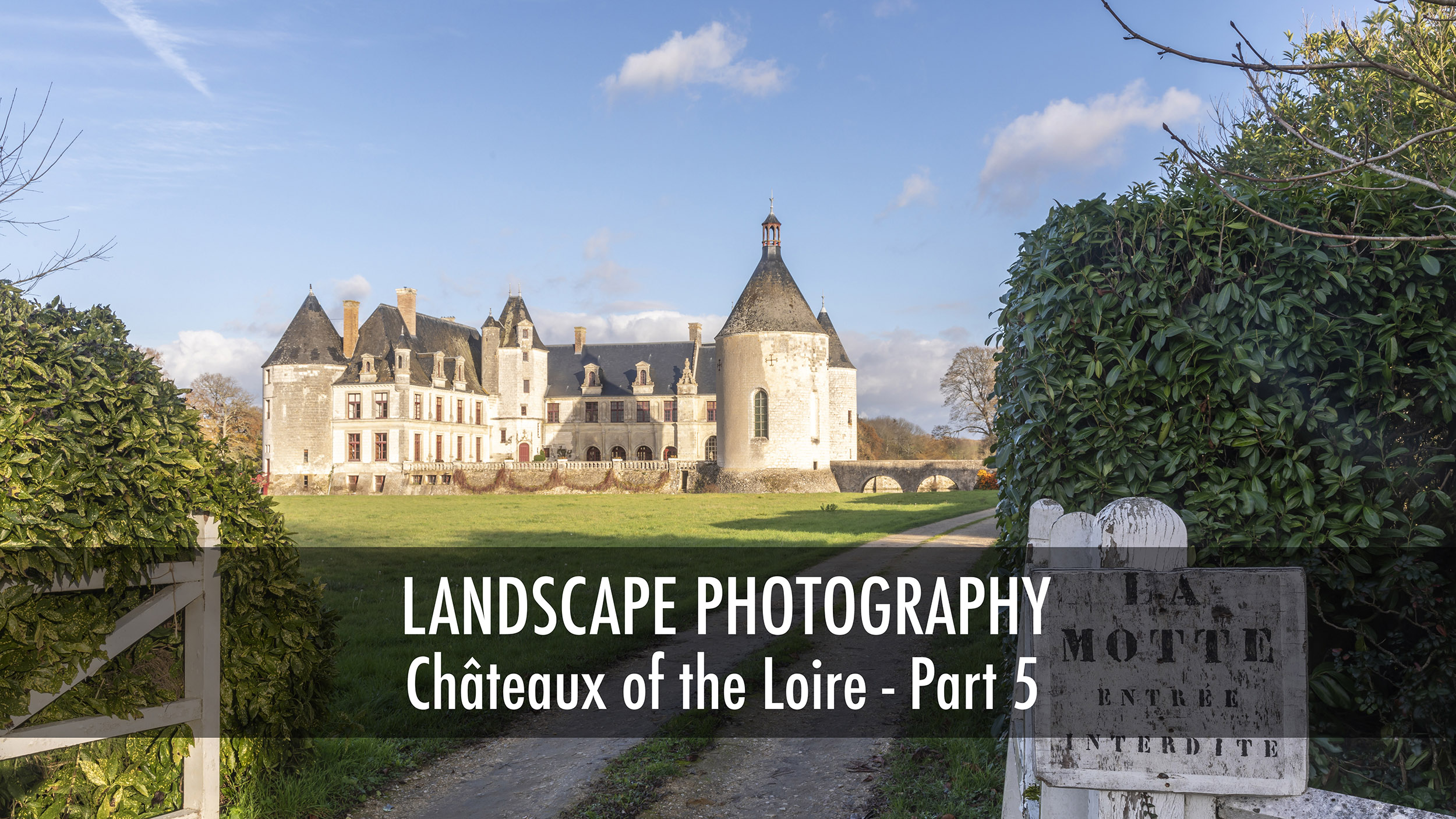
My second Châteaux of the Loire was Château de la Motte, a 16th-century castle in the north-western part of Indre-et-Loire. This was another beautiful subject, but the access was far more limited.
At the entrance, there was a clear sign saying no entry, so I stayed outside and photographed it from the side of the road. That might sound restrictive, but the good part was that I could pull off safely on a small country road opposite the chateau and work from there without standing in traffic or causing a problem.
The castle looked superb even from that public viewpoint. I could see the moat, and there was a red bridge in the corner of the scene that added a small jolt of colour against the stone and winter tones. I had seen photographs of the moat from a better position, and I would have loved to get over to that side. Still, private property is private property, and there was no point pushing it.
I had two obvious compositions in mind:
The wind didn’t help. Even if I’d reached that second spot, the water probably wouldn’t have given me much of a reflection that afternoon.
That left me with what I can only call a one-shot wonder. There wasn’t a huge range of angles available from public ground, but the single view I did have was still worth the stop.
Unlike the other châteaux of the Loire I photographed that day, Château de la Motte felt more tied to a certain time of day. The facade and the available angle made this more of an afternoon subject for me.
When a castle is easy to access from several sides, I can often make it work in changing light. Here, because I was limited to one public viewpoint, the light had to do more of the heavy lifting. The shape of the building, the moat, and that roadside perspective all suited softer afternoon light better than a flat midday look.
That said, there was nothing disappointing about the place itself. Quite the opposite. Château de la Motte had the kind of presence that makes me stop the car twice, first to look and then to check I haven’t missed a better angle.
I also suspect that people passing through must pull over to photograph it quite often. It’s too striking not to. Even with the restrictions, it is one of those castles that reward a short stop.
My final stop for my châteaux of the Loire vlog was Château de Vaujours, and this one already meant something to me because I’d photographed it earlier on a freezing, misty morning whilst following the trail of Honore de Balzac. On that first visit, the conditions were fantastic, but I hadn’t arranged access in advance.
This time, I phoned the owners first and asked if I could enter the car park area, which had been sectioned off before. They said yes, and I was grateful for that because it gave me the angle I had wanted from the start.
Château de Vaujours dates from the 12th to 15th century, and it carries a strong sense of age even in ruin. It also has a royal connection, as it was given to Louise de La Vallière, the mistress of Louis XIV. That detail adds another layer to a place that already feels rich in story.
I mentioned on the day that I had photographed another castle linked with Louise de La Vallière for contacts in Paris who were selling it. I left that thread there, though, because Vaujours was the subject in front of me, and it deserved the attention.
Only about a third of Château de Vaujours is still standing, but what remains is enough to suggest how substantial it once was. There is a large turret-like section, a stretch of defensive wall, and part of what seems to have been the central portion of the castle.
From where I stood, I could also see that more fragments continued beyond the edge of my frame. Even the broken pieces hinted at a much larger structure in its day.
That’s often what I like most about ruins. They make me work a little harder with the camera because the story isn’t handed over in one neat facade. I have to read the lines of the walls, the surviving corners, and the way the land still holds the shape of what used to be there.
With Vaujours, that sense of former scale came across clearly. It wasn’t hard to imagine a far larger castle occupying the site, and it wasn’t hard to see why I wanted a better angle than the straight-on roadside view.
Once I was inside the permitted area, the composition improved at once. Instead of facing the ruins head-on from the road, I could shoot across at an angle and bring depth into the frame. That mattered because Vaujours is a ruin, not a complete building. Angle gives it form.
The afternoon light helped as well. The sun was behind me and lit the stone cleanly, which brought out the shapes in the surviving walls. In winter, that soft, low sun often does more for old masonry than bright summer light ever can.
I was shooting with my Canon 5D Mark IV, and this was one of those scenes where I could see the image before I took it. The line of the remaining walls, the broken mass of the castle, and the open ground around it all worked together.
I stayed on in the hope that sunset might add a little extra, but cloud started to push over and block the sun. Sometimes that gamble pays off, and sometimes it doesn’t. Even without a dramatic ending, I left happy because I finally had the viewpoint I wanted.
Vaujours is also one of the easier castles to return to because it works in different conditions. I liked it in afternoon light, but I can already picture it on a frosty winter morning with low mist hanging around the ruins. That would suit the place perfectly.
One of the reasons I keep coming back to the quieter corners of the Loire is that they feel less staged. The famous sites are famous for good reason, but these smaller or less-visited châteaux of the Loire often ask more of me as a photographer. I have to think harder about access, light, and angle, and that process makes the final image more satisfying.
This part of central France has a huge number of historic monuments, and many of them remain private or partly hidden. That means I can’t assume entry, and I can’t assume the perfect view will be waiting for me. What I can do is stay patient, work from public ground when needed, and ask permission when the chance arises.
If these quieter châteaux of the Loire are the sort of places that pull you in as much as they do me, my Loire Valley photography tours are built around that same sense of place, light, and atmosphere.
A few patterns stood out across the three stops. First, phoning ahead helped at Beaumont and Vaujours. Second, respecting boundaries mattered at every location. Third, each chateau had its own best conditions, and there was no single formula for photographing them all.
That afternoon gave me three very different experiences, yet all three belonged to the same wider story of the châteaux of the Loire. Beaumont had elegance and surprise, La Motte had restraint and distance, and Vaujours had the pull of a ruin that still carries weight.
What stayed with me most was how much these places rewarded patience. A gate, a phone call, a roadside angle, or a patch of winter light can change the whole result.
I came away feeling what I often feel in this part of France, that the quieter châteaux of the Loire can stay in the mind longer than the obvious ones.
We noticed you're visiting from United Kingdom (UK). We've updated our prices to Pound sterling for your shopping convenience. Use Euro instead. Dismiss