 Skip to content
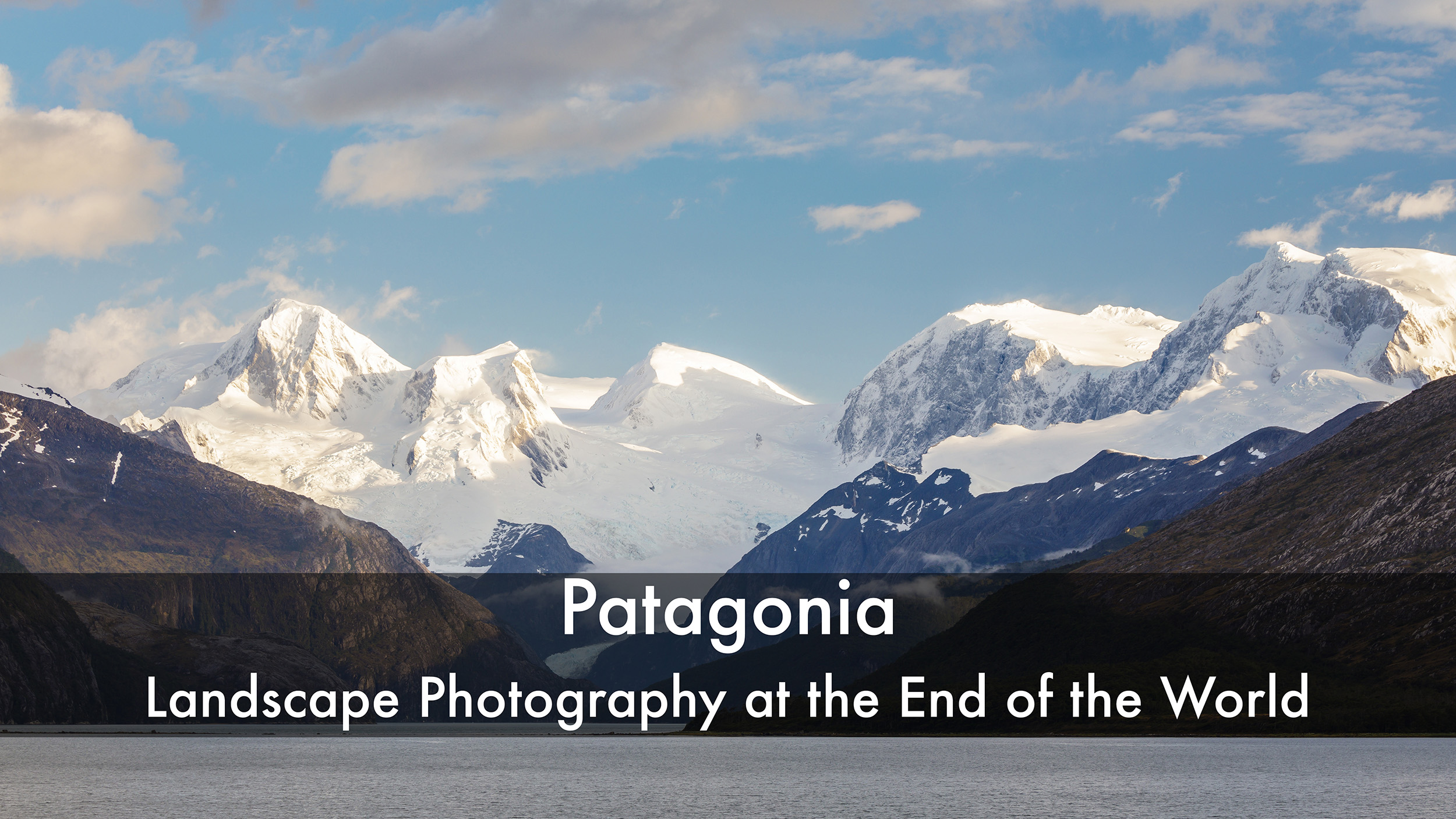

Welcome to my latest YouTube vlog entitled: Patagonia Landscape Photography at the end of the World. The video highlights the first part of an epic journey I took down to the fjords of Chile in South America.
On a commissioned trip for a cruise liner, I had the opportunity to see stunning mountain scenery, glaciers, and get up close to some of the wildlife that inhabits this part of the world.
To say the scenery was mind-blowing is an understatement. Even breathtaking seems not to do it justice. It was quite simply awe-inspiring down there, and it’s a journey that can only be described as epic.
So take a seat and have a look at the first part of this adventure.
Throughout the year, I offer photography tours and workshops in a variety of destinations around the world. If you’re interested in learning more from me to help you get the best out of your photography, then get in touch.
I began near Ushuaia, still close enough to civilisation to hear traffic in the background, but already surrounded by countryside that felt ancient. My guide and taxi driver, Daniel, pointed out the glacier above Laguna Esmeralda and told me that fewer people head there than to some of the more obvious spots. Even with the odd truck passing by, the place felt huge.
Every direction held something worth photographing. One way, there was the glacier. Turn slightly, and the mountains opened out. Turn again, and the whole scene widened into the sort of view that makes you stop talking. It was one of those places where a camera feels both essential and slightly inadequate.
I was able to put the drone up there, which gave me a better sense of the shape of the valley and the scale of the mountains. From above, the landscape felt even more remote. It was a perfect start, because it set the tone for the days ahead. Patagonia has that effect. It makes familiar ideas about scale feel too small.
What had brought me there was a commission for a cruise company. Over eight days, I had to photograph the ship and the journey as we travelled around Patagonia and through the Chilean fjords. That meant ship exteriors, interiors, excursions, weather, wildlife, and all the fleeting moments between them.
There is a romantic idea of this sort of work, and parts of it are exactly that. Yet commissioned photography also means being switched on all the time. When the light started to hit the mountains as we left Ushuaia, I wasn’t sitting back with everyone else. I was out on deck with the camera, trying to make the most of a brief patch of evening light from a moving boat.
People often assume a trip like this is one long scenic holiday with a camera in hand. Some moments feel like that. A lot of the time, though, I am working against movement, weather, schedule, and light all at once.
That first evening was a good example. Dinner was underway, but the mountains outside were catching the last light and changing by the minute. I grabbed the camera and went out because those few minutes matter. On land, you can settle yourself, wait, and refine. On a ship, the whole platform is moving, the angle shifts, and the light can be gone before you’ve even found the right spot on deck.
My 100-400mm lens made a big difference there. The image stabilisation helped me keep shooting in awkward conditions, especially when I wanted to isolate mountain detail from farther away. I wasn’t trying to produce one grand, heroic scene. I was trying to respond quickly and come back with a set of strong images from whatever the ship, the weather, and the light gave me.
That is one of the harder parts of photographing Patagonia from a cruise. The place is so good that you want more time at every turn. But the ship moves on, the schedule is fixed, and the work doesn’t stop because the view is beautiful.
Still, as we sailed out, it was impossible not to feel the force of the place. Some locations are attractive, some are dramatic, and some feel older than the language. This stretch of southern South America belonged in that last group.
On 1 February, we reached Cape Horn. The weather was grey, damp, and rough enough to remind everyone that this place has a reputation for a reason. I had been told that conditions there can change fast, and the week before, the waves had reached about six metres. Down there, that isn’t a detail. It shapes everything.
From a distance, the island looked oddly familiar to me. The geology and colour tones brought to mind north-west Scotland. In that rain and low cloud, it could almost have been a remote Atlantic headland back home, apart from the knowledge that Antarctica lay far to the south.
I was one of the first off the ship and onto the island, but even then, time was limited. That is another truth of places like Cape Horn. You don’t get to dictate terms. Weather, sea state, safety rules, and access windows decide how long you have and where you can go.
After climbing the steps, I reached the memorial. It is a powerful structure, and when you look closely, you can see the outline of an albatross. It honours the sailors who died rounding Cape Horn, when ships travelling between the west and east coasts of South America had little choice but to face this route.
Standing there, the history of the place came into focus. Cape Horn isn’t only dramatic scenery. It is also a site shaped by loss, weather, risk, and human stubbornness.
Because the island is a protected UNESCO biosphere, access is controlled. We weren’t free to roam wherever we pleased, and before boarding and leaving the zodiac, we had to disinfect our boots in a special solution to avoid bringing in contaminants. That made sense. A place this fragile needs care.
The conditions at Cape Horn also underlined something I see on many assignments. The public image can look glamorous, but the job often comes down to accepting what is possible, then working fast inside those limits.
I had only a short time ashore. Once back on the ship, lunch was brief because I still had interior photographs to make. That is how commissioned work often goes. A dramatic landing in harsh weather can be followed by photographing cabins and public spaces an hour later.
As we moved on from Cape Horn and into the fjords, the scenery shifted again. At one stop, which I understood to be around Wulaia, I stood above a wide sweep of water and mountains that demanded a panoramic frame. This was Patagonia on a grand scale, far from the places most people already know by name.
The climb to that viewpoint took us through sub-Antarctic forest, which I was told is effectively the last forest before Antarctica. That made immediate sense once I was in it. The trees were shaped by wind, the ground was damp and uneven, and the whole place felt close to the edge of where trees can survive.
I made photographs in the forest itself, not only at the viewpoint. The tangle of trunks, branches, moss, and wet ground had its own mood, and that contrast mattered. One moment I was looking across vast fjords; the next I was working in tight, enclosed woodland.
By 2 February, we were heading down the Beagle Channel. Once again, I found myself thinking of Scotland. Parts of it reminded me of Torridon. Another section brought Loch Leven and Glencoe to mind, with one mountain shape even making me think of the Pap of Glencoe.
That similarity didn’t make the place feel less special. If anything, it made it more interesting. Travel often works like that. You recognise forms and textures from somewhere else, but the wider setting gives them a new weight. Here, those mountain shapes sat within a channel at the far south of the Americas, under changeable weather and vast skies.
I wanted to fly the drone there as well, but restrictions meant that it wasn’t straightforward. In a place like this, you don’t always get every tool available to you. Sometimes you work with the camera in hand and accept that the conditions are part of the picture.
One of the toughest excursions took me into the rainforest with Miguel as our guide. He carried my GoPro for part of the route whilst we moved through a path that was barely visible in places. We ducked under branches, climbed over fallen trunks, and picked our way through difficult ground with wet footing.
I was carrying about 12 kg on my back, plus a tripod, so it was no gentle stroll. Still, that sort of terrain doesn’t bother me too much. What changed the day was the weather.
Before we reached the waterfall at the end of the route, the captain radioed down and told us to return to the ship at once. The conditions were turning, and that was the end of the attempt. We turned around immediately and headed back.
Safety is more important than a waterfall.
When we returned, the guides apologised because I hadn’t reached the final viewpoint. I meant it when I told them I didn’t care. In remote Patagonia, far from towns and hospitals, even a simple injury can become serious. No photograph is worth a broken arm or a broken leg when help is hours away.
That belief carries into my own photography workshops, too. If a decision comes down to safety or a picture, safety wins every time.
If the earlier fjords felt grand, Pia Glacier felt immense. As we arrived, there was a huge crack and bang as a large section of ice broke away. I didn’t catch that exact moment on film, but the sound alone told the story. When ice collapses from a glacier, you feel the power of it in your chest.
We had a good amount of time there, which was a gift. On many stops, the schedule is tight, but at Pia I could settle a little, sit near the water’s edge, and work more slowly. That changed the kind of photographs I made.
At first, I made the obvious wide views because the setting demanded them. Soon after, I put on the longer lens and began looking for smaller things, fractures in the ice, tones in the glacier face, dark lines, and abstract shapes that only appear when you stop trying to take in the whole scene at once. That kind of landscape photography matters to me as much as the broad vista. Patagonia gives you both, and both are worth your time.
There was also an interesting conversation around impact. I had wondered what effect a cruise ship has in such a place, but the guides explained that visits there are rare and that ours was the only cruise ship using that particular stop. I took that on board whilst also recognising that wild places always deserve caution and respect.
Condor Glacier brought another kind of challenge. We approached by Zodiac, which meant getting close without landing. That was more than enough. The scale of the glacier from the water was overwhelming, and every few moments, I found myself stopping to watch rather than photograph.
Ice was falling there, too, which made distance important. Glaciers can look still in photographs, but they are active, shifting masses. Even from what felt like a safe range, I could hear and see movement in the face of the ice.
Back on the boat, I had the camera mounted on a tripod. That might sound odd on a moving vessel, but the tripod still helped me level the frame and compose carefully. The key was shutter speed. With the wind manageable and the speed high enough, I could still make sharp images from the deck.
The weather changed fast that morning. At around 09:00, it was grey, rainy, and closed in. By 10:00, it had opened up completely. Again, it felt a lot like Scotland, where a bad hour tells you very little about the rest of the day. In Patagonia, that quick shift can transform a scene from flat to extraordinary in minutes.
Later, I stood before another glacier so large that names almost stopped mattering. I had been told the name shortly beforehand, but in the middle of trying to photograph it I lost it. What stayed with me was the shape and the scale.
From a few hundred metres away, the glacier still felt enormous. The face towered above the water, and the textures looked almost unreal, as if something had carved it rather than frozen and compressed it over time. Wide-angle photographs gave me the full setting, yet the details kept pulling me back. Blue seams, jagged breaks, smooth planes, and odd patterns in the ice all made strong frames on their own.
That was one of the lessons of the trip. In a place like Patagonia, the obvious photograph is only the start. The deeper work often begins when you stop chasing grandeur and begin looking for structure, pattern, and mood within it.
By the end of the first four days, I had already photographed Cape Horn, glacier after glacier, wild forest, and some of the finest fjord scenery I’ve seen anywhere. Then came another reminder that Patagonia keeps giving. We landed on an island surrounded by penguins and other wildlife, a fitting close to the first half of the voyage.
That combination of subject matter is what makes the region so hard to forget. You are never dealing with one thing only. It is not only mountains, not only weather, and not only wildlife. Everything overlaps. The ship rounds a bend and a glacier appears. A landing turns into a walk through a wind-bent forest. Grey light becomes clean sun within the hour.
For a photographer, that means constant adaptation. It also means constant reward, if you’re ready for both the work and the unpredictability.
If you’d like to follow more of my travels and photographs, you can also find me on Instagram and Facebook.
That first half of the journey confirmed something I had felt from the moment I arrived. Patagonia is one of those rare places where scale, weather, history, and raw beauty all hit at once.
What stayed with me most wasn’t one single photograph. It was the mix of pressure and privilege, working in difficult conditions, racing the light, accepting limits, and still finding moments that felt almost beyond belief. For landscape photography, few places ask more of me, and few places give more back.
We noticed you're visiting from United Kingdom (UK). We've updated our prices to Pound sterling for your shopping convenience. Use Euro instead. Dismiss