 Skip to content

My latest YouTube video sees me travel to the Italian Dolomites in South Tyrol from the 25th October to 2nd November 2017.
Designated a UNESCO World Heritage Site, the 18 peaks which go to make up the extraordinary landscape of the Dolomites are a must for any landscape photographer who loves mountain scenery.
The trip itself was split into two parts. This was done due to the huge area that the Italian Dolomites cover. I did wonder whether it should be split into three different parts, but came to the conclusion that the majority of the best bits can be seen as having two different bases.
The hire car started out having about 7500km on the clock, and by the time I had finished, it was just over 10000km, which gives you an idea of how much driving can be needed if you’re trying to cover it all in a short period of time.
For most of the time, the weather was mostly clear skies with some high cirrus clouds, but there were some beautiful dawn skies too early on when we were based in the Val di Funes.
The overall aim of the trip wasn’t just to capture the autumn colour but also to get a thorough understanding of the area, as I am planning a Dolomites photography workshop and tour for October/ November 2018.
When it comes to photo workshops, I want to ensure that participants get the best that they can from an area, as well as ensuring that we are in town to eat when the restaurants are open. I found that it wasn’t always easy finding somewhere to eat on a Sunday or when there is a bank holiday, such as the 1st November.
So enjoy this first part of two from the Italian Dolomites. And if you’re interested in joining me next year for a photography workshop, then get in touch!
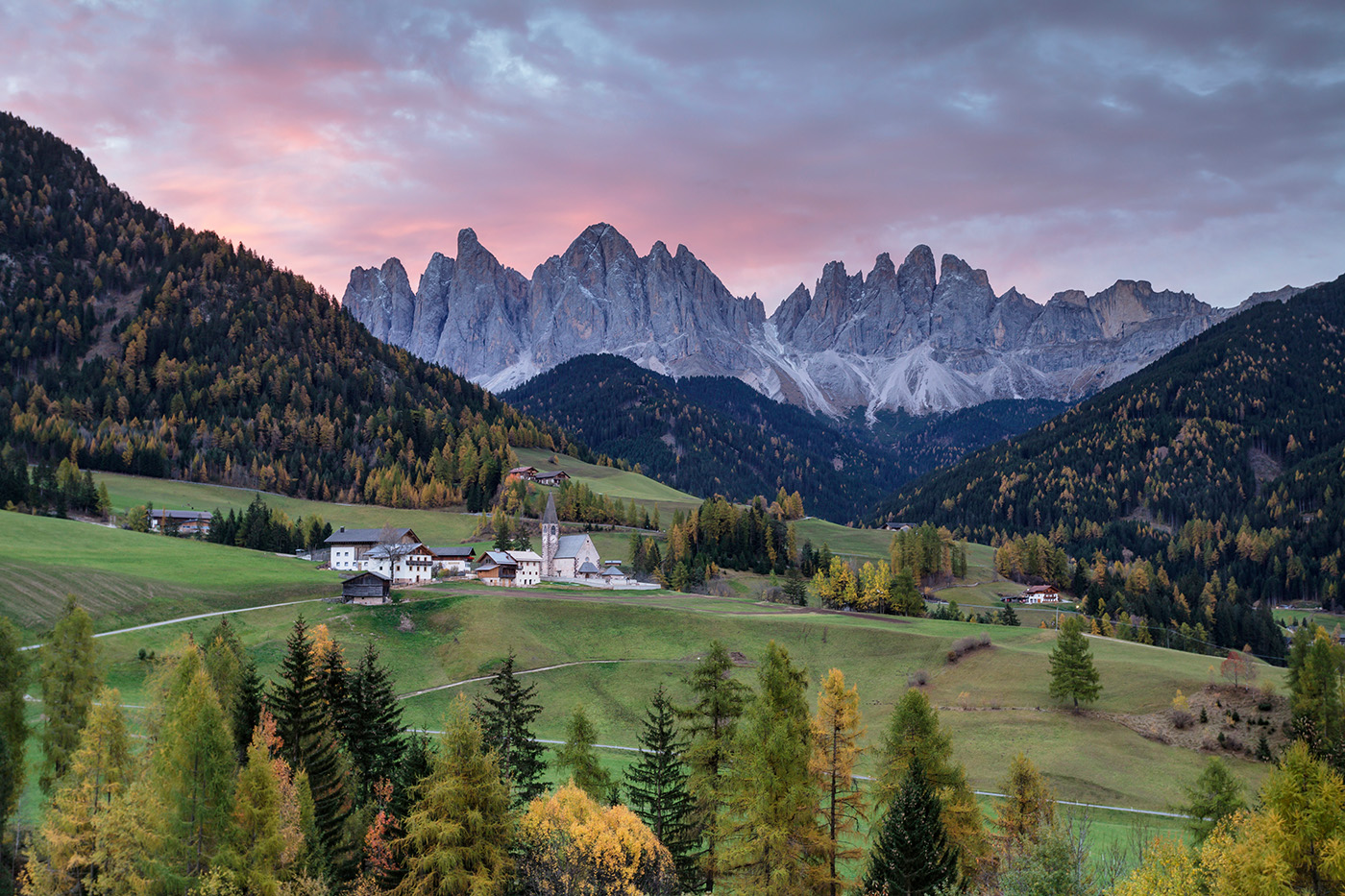
I began in Santa Maddalena, looking out towards one of the best-known scenes in the Dolomites. There are famous viewpoints for a reason, and this one earns its reputation. The church, the valley, the jagged peaks beyond, it all lines up in a way that feels almost too perfect.
That first morning was quiet and cold after a long drive the day before. My wife stayed back to rest, so I headed out alone and started working the scene as the light came up over the Dolomites. What pulled me back again the next morning was simple: the cloud had started to catch pink, red, and orange above the peaks, and the whole backdrop came alive.
I set up for stills and also ran a short time-lapse. I hadn’t made one for a while, but the sky had too much character to ignore. Moments like that are why I keep returning to the same place, even when I already know the composition. A mountain view such as this one in the Dolomites can be familiar one day and completely fresh the next.
The best-known view is not always the easiest one to improve, but the light can still turn it into something new.
Later on, we went back out together and looked for a variation on the usual roadside view. My wife helped with the camera work, and that gave me a bit more freedom to move around and see how the valley changed from one position to the next.
The obvious viewpoint had already given me what I needed earlier in the day, so I started searching for something with a little more character. Along the track, there was a wooden fence and a slightly shifted line into the valley, and that small change made the frame feel different enough to be worth shooting. The afternoon light had already swept across the valley a couple of hours earlier, so the challenge was no longer about drama. It was about variety.
That matters on a photography workshop. If I bring photographers to a place like the Dolomites, I don’t want everyone standing shoulder to shoulder making the same image. A recce is as much about alternatives as it is about the famous shot.
From there, my attention turned towards Val Gardena. Someone had already told me that the autumn colour over that side of the Dolomites was stronger than where I was standing, so it made sense to head there next.
That sort of local information can save a lot of time. It doesn’t replace seeing a place for myself, but it often points me in the right direction.
Around midday, I went up to Passo Gardena to see what the view might offer at dawn. Midday is rarely the best time to photograph a Dolomites mountain pass like that, but it’s a useful time to scout. I could see the shape of the land, how the road sits against the mountains, and where the first light might fall if I returned early.
I made a panorama, although the wind made it awkward. At that height, even a simple stitched frame becomes harder than it should be. The tripod shudders, the camera moves between exposures, and anything delicate becomes a test of patience.
Still, it looked promising. The view had depth, scale, and enough separation in the ridges to make dawn worth a try on another day.
We then pushed higher, up near Passo Sella, at about 3,000 metres. This was one of those places where the scale of the Dolomites is hard to explain without standing in it. Rock walls, towers, and broken ridgelines filled the horizon in every direction.
I had expected the wind to be worse there, especially after what it was doing lower down on the pass, but we found a more sheltered spot. A grassy rise behind us took some of the force out of it, and that made it far easier to assess the location properly.
What I needed to know was whether it would work as a photography workshop stop. Was there enough room? Was the access reasonable? Could people work safely and comfortably while still having strong compositions? At first glance, the answer felt positive. The setting had the sort of mountain drama that people travel a long way for.
Later, with the weather turning flatter, I changed tack and went to photograph a small waterfall near one of the villages. I had found it while researching the area online, and it made sense for a dull afternoon. Big mountain scenes can die under a blank sky. Water, forest, and rock often improve in the same conditions.
I worked the waterfall at about 1/8 second, much as I would with a seascape, fast enough to keep some shape in the flow, but slow enough to show movement. The water was strong, so the balance mattered. Too quick, and it looked harsh. Too slow, and the structure disappeared.
We had already seen snow earlier in the day up high, and the conditions on the exposed ground were cold and windy. Down here, though, there was shelter. That made the place far more useful than it might seem at first glance.
For a photography workshop, that was the key point. Not every day in the Dolomites will be golden side light and glowing peaks. I need wet-weather locations as well, and this waterfall had enough space and enough interest to make it a proper option.
The second day in the Dolomites began well and ended with one of those small failures that stay with me longer than they should. I spent the evening chasing a viewpoint with rolling layers of mountains and enough elevation to catch the sunset. The trouble was that the last part of the puzzle, the exact place I needed to stand, took too long to work out.
By the time I reached the spot, which was on a ski slope, the best light had already started to fade. The most painful part was that the drive up had shown me how good it was. The cloud had shape, the light had warmth, and the valley was turning exactly as I had hoped.
Sometimes a recce works because I get the shot. Sometimes it works because I learn what not to do. This was the second kind. I knew I needed to return the following evening, and I also knew I needed to allow more time.
The next morning, in the Dolomites started early again, this time below Latemar, at a lake I had hoped would give me a clean mountain reflection. The problem was the sky. It was too clear, and the scene never quite lifted. To make things worse, access to the water itself wasn’t allowed, so the compositions felt limited from the start.
That can happen with well-known locations. On the map, they look perfect. In the field, a fence, a path restriction, or a poor angle can take the edge off them fast.
A local I spoke to suggested another viewpoint up a nearby path. We followed that advice and found a better option above the original location.
The walk took about 20 minutes, with a short final climb over a steeper section. It wasn’t a difficult route, but it was enough for me to think carefully about whether it would suit a mixed workshop group.
The viewpoint itself was small, which matters. Space is part of the equation. Still, the view towards Latemar was strong, and by about half past nine the sun had cleared the ridge and started to light the autumn trees. That made a big difference. Gold leaves against a cold rock can carry a frame even when the sky is quiet.
So although the lake had disappointed me, the morning wasn’t lost. I came away with a better sense of what works there, and when.
Around the Lago di Carezza area, I found it harder than expected to locate viewpoints that felt different from the usual postcard scene. After a bit of digging and a useful stop at the tourist information office, we were pointed towards a path that climbed to a mountain plateau.
The walk took about half an hour and opened up into a much broader panorama. From there, the Rosengarten range sat beautifully across the scene. That range is famous for turning red at sunset, and even without the full show, the shape of it made the walk worthwhile.
For my planning of a Dolomites photo workshop, this was encouraging. The route was manageable, the reward at the top was clear, and the range gave enough width for people to interpret it in their own way.
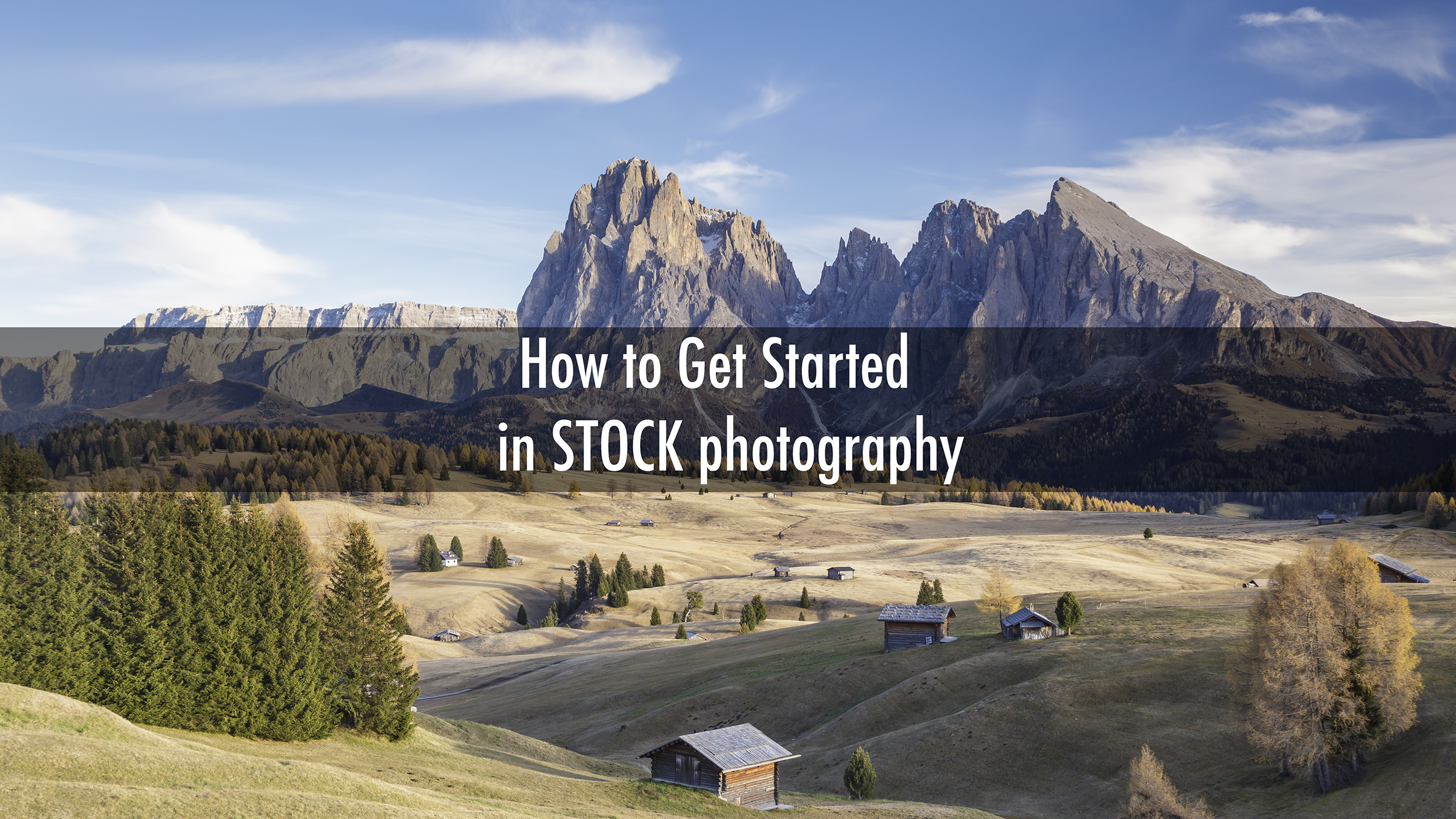
By early evening, we reached Alpe di Siusi, the highest mountain plateau in the Dolomites and Europe. This was one of the standout moments of the trip. Behind me, Sassolungo looked superb in the side light, and because we had arrived about an hour and a half before sunset, I finally had time to work the foreground properly.
That mattered more than the mountain itself. On earlier visits to the Dolomites, I had missed the best raking light on the huts and grass. This time, the low autumn sun stretched long shadows across the plateau, and those shadows gave the whole scene shape and rhythm.
The mountain huts became part of the composition rather than an afterthought. The foreground stopped being empty space and started carrying the frame. When the light is low in autumn, even a simple field can take on structure.
This quickly went onto the list of places I would want to return to with photographers when it came time to run a Dolomites photo tour. It offered strong compositions, enough space to move around, and a very good chance of beautiful evening light.
A few things made both of these spots stand out:
On my last morning of this part of the trip in the Dolomites, I went back up towards Passo Gardena and Passo Sella. I had hoped for better conditions, but the mountains in the distance were carrying too much cloud, and the light never quite reached where I needed it.
The wind was even more of a problem. It was hard to stand still, let alone work carefully. Exposure, framing, and timing all become slower when the cold gets into your hands, and the tripod keeps trembling.
I did manage a few frames of one of the jagged towers above the pass, where the sun caught the face of the rock while the top stayed dark and heavy under cloud. Even on a rough morning, the Dolomites can still offer something if I stay flexible.
That morning also marked the end of the first stage of the trip. From there, we were heading towards the Cortina area, where the terrain becomes even more rugged, and the passes twist and turn through some of the best mountain roads in the Dolomites.
By that point, I already had a clearer sense of the region. I knew which classic viewpoints still held up, which places needed better timing, which weather patterns helped, and where I could go when the conditions were less than ideal.
That is what I wanted from the recce. I wasn’t only chasing finished images. I was building a working map of the Dolomites in autumn, one that balanced iconic views with practical choices.
The strongest lesson from this trip was simple. The Dolomites reward persistence, but they also reward flexibility. A famous sunrise can work one day and fall flat the next, while a sheltered waterfall or a less obvious path can save the whole afternoon.
By the time I moved on towards Cortina, I had more than a folder of photographs. I had a much better feel for the rhythm of the place, the light, the access, the weather, and the kind of variety that makes a photography workshop in the Dolomites worth doing.
That is what stays with me most from this first section of the journey, not one single frame, but the sense that the mountains still had more to give.
We noticed you're visiting from United Kingdom (UK). We've updated our prices to Pound sterling for your shopping convenience. Use Euro instead. Dismiss