 Skip to content
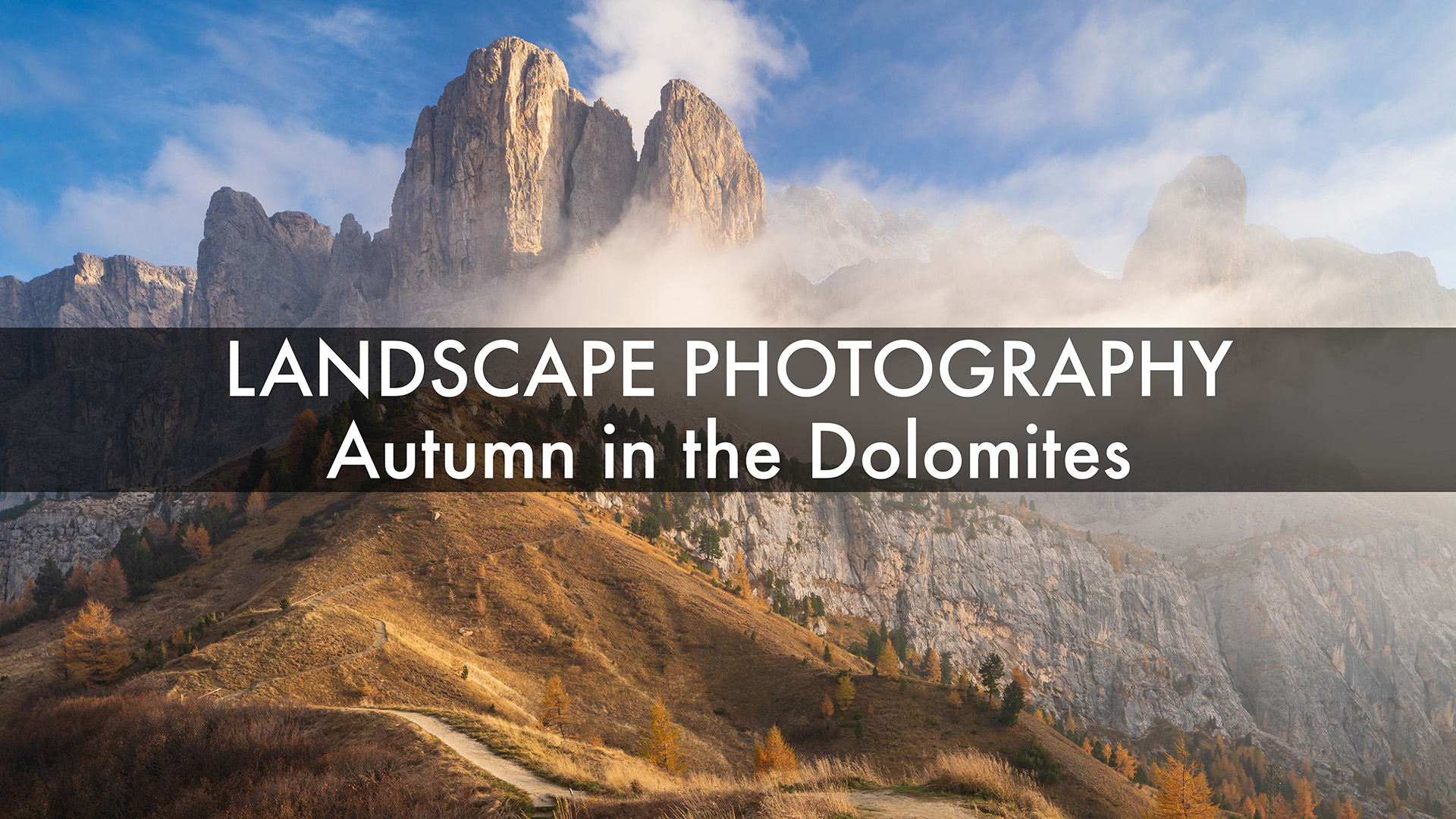

My latest YouTube vlog, Autumn in the Dolomites, shows a small snippet of what I did during my annual photography tour in the area.
As always, the Dolomites proved to be spectacular with some stunning locations, but I couldn’t film too much.
Even so, I hope you enjoy a small slice of what you can see if you come with me to Northern Italy.
My YouTube channel is dedicated to all things landscape and travel photography, so if that’s your thing, then I’d love to have you come along for the ride.
It had been a while since I last filmed a YouTube video, so coming back here felt all the better for it. For me, October means one thing: my yearly return to the Dolomites to run a photo workshop. That rhythm is now part of the year. Once autumn arrives, I know I will be back amongst these peaks again.
We had already started well the night before. Up on one of the mountain passes, the conditions gave us some lovely light, and the traffic on the road below added a bonus. Light trails curling down a pass can give a frame a bit of structure and movement, especially when the mountains around them are starting to catch the last glow of the day.
That first evening set the tone for the week. The weather was mostly kind, and although I could have done with a few more clouds now and then, I was not going to complain. In the Dolomites, even a clear evening can still give you something special if you are in the right place at the right moment.
What keeps bringing me back is not only the scenery, although that would be enough on its own. It is also the way the place changes with light, height, and season. A road pass at dusk feels completely different from a church view at first light or a high ridge when the sun slips behind the peaks. That variety is what makes an autumn workshop here so rewarding.
If you are curious about the trips I run, you can find all my photo tours here.
One of the first scenes I filmed on this trip looked down towards the famous San Giovanni church in Val di Funes. It is a much-photographed spot, but I was looking at it from a slightly different position than the one most people know. That change of angle made a difference. It gave the church more space in the valley and let the wider setting breathe.
It is not the easiest view to photograph well, because timing matters a lot. The light is not forgiving for long, and you need to be there when the balance between the valley and the peaks feels right. I am happy to let people work that part out for themselves when they visit, because half the pleasure of a place like this is learning how it behaves.
Even without much cloud, it was still beautiful. Of course, a bit more texture in the sky would have helped, especially for adding depth to the frame, but you take what you are given and make the most of it. That is part of photographing the mountains. You can prepare well, you can return to the same place many times, but the final say always belongs to the weather and the light.
I have been up there a number of times now, and the view still holds up. That says a lot. Some famous locations can feel overfamiliar after a while, yet this one still has a calm pull to it. The church sits quietly in the valley, the mountains rise behind it, and the whole place feels settled in a way that photographs often struggle to explain.
Some scenes stay popular because they are easy. Others stay popular because they are genuinely good. San Giovanni is one of the latter.
Later on, I was up at around 2,300 metres with the peaks spread all around me. That kind of height changes your sense of scale. You are no longer looking up at the mountains from the valley floor. You are in amongst them, with ridges and towers sitting at eye level, and the evening sun picking out the shapes.
I spent some time making a panorama of the view straight ahead, and I also took a few frames of Cinque Torri. When the light begins to skim across the rock at the end of the day, the Dolomites can look almost unreal. The stone catches warm colour, the shadows deepen, and everything becomes more defined for a few short minutes.
That is one of the reasons I love photographing up high in autumn. The light is lower, the air often feels cleaner, and the tones are richer. Even when the sky is not doing much, the mountains themselves can still carry the image.
Before heading back down, I made a quick stop because one foreground had lit up beautifully in the evening light. It was one of those moments where you know time is tight, but you also know the shot is there. So I had to stop, work fast, and then move on.
For that frame, I needed to blend exposures. I had a Kase Filters CPL on the front, and with the sun off to one side, the polarisation helped. Still, the main issue was not the sky. It was the contrast within the scene itself.
The foreground was glowing, but there was also a large dark area close by that could easily dominate the picture if I included too much of it. That is the sort of thing that can pull the eye away from the part of the frame that matters. In scenes like this, I try to stay disciplined with composition. A dramatic patch of darkness is only useful if it helps the picture. If it drags the whole frame down, it needs to go.
Graduated filters would not have been right there, because the shape of the mountains was too uneven. A hard or soft grad cutting across rock never looks good unless the horizon suits it. So blending exposures made more sense.
If you come to the Dolomites, I think one thing matters more than people sometimes admit. You need to get away from the well-worn paths now and then. Of course, I take people to some of the classic locations, because they are classic for a reason. Still, I always want to mix those places with quieter corners that feel less expected.
That matters even more now, because some spots have become social media landmarks. They are photographed from the same place, in the same way, over and over again. The scene is still beautiful, but the experience can feel a bit thin if you only chase the obvious view.
One place that came up on this trip was Cadini di Misurina. It is a striking mountain range and, for many photographers, a bit of an Instagram favourite. There is a narrow ridge where people head for that well-known shot, often with one person standing out on the point while another takes the picture from behind.
I could see people moving through the scene, including one person walking down in red, which gave a nice sense of scale. Even with a few people about, the setting was still superb. The jagged shapes of the range are hard to ignore, and when the light drops across them, they look sharp and sculpted.
For my own frame there, I worked at around 50mm and made two exposures because the brightness range was too wide for one clean file. Again, I left the graduated filters in the bag because they would have cut into the mountain tops. We had probably arrived a touch late as well, and the light was fading quickly, so it became a case of working with what remained rather than waiting for it to improve.
That is a common theme in the Dolomites. You do not always get the perfect moment. Sometimes you get a narrow window, a half-minute of colour, or a scene that is almost there but not quite. The point is to stay alert and make the best frame you can.
By the end of the trip, the photography workshop had finished, and I had a bit of time on my own. That shift in pace always feels strange after spending days guiding, shooting, driving, and moving between locations with a group. Then, suddenly, it goes quiet.
On that final day the weather had turned grey. Most of the week had given us clear skies, but this time there was not much sunlight on the mountains. My camera was clicking away on a time-lapse for Kase Filters, and I was standing in a beautiful Alpine setting that probably deserved better conditions than it got. Even the previous evening had not done much at that location, so we had taken what we could and moved on.
That said, I still enjoyed being there. I always do. The Dolomites are one of those places where a disappointing bit of light does not wipe out the value of the visit. You still learn the shape of the ground. You still notice how scenes might work in different conditions. You still come away with ideas for next time.
Every time I come back, I find something new. That is one of the best reasons to keep returning.
That happened again on this trip. I found new details, new viewpoints, and fresh reminders that some of the strongest reactions often come from places I do not talk about much. One day, I took people to a quieter location that I did not film, and their response said everything. They arrived, looked around, and simply said, “Wow”. Those are the moments I enjoy sharing most. Not because they are secret in any dramatic sense, but because they feel discovered rather than consumed.
Although the focus was the trip itself, there were a few bits of kit in the mix that shaped how I worked. The polariser helped on the brighter mountain scenes, especially where side light gave me something to work with. For the more contrast-heavy views, blending exposures was the better answer than forcing a filter into a shape that did not suit the skyline.
I was also filming parts of the trip, which is always a balancing act on photography workshops. There is never as much time as you think there will be. The priority has to stay with the photography and the people on the tour, so filming often becomes something I squeeze in between shots or during the quieter moments.
Even so, I enjoy recording these trips because they give a more honest sense of what the week feels like. Not every scene comes with dramatic weather. Not every location is empty. Not every sunset goes off. Yet the place still delivers, again and again.
I also met a few people in the Dolomites who recognised me from YouTube, which was a nice surprise. If you were one of them, thank you. It is always appreciated when someone takes the time to say hello.
Once the Dolomites trip wrapped up, my thoughts moved on to the next videos. One of them was going to be footage from Hanoi, more street material than a traditional talking video. After that, I had plans to spend three weeks in Vietnam, which meant plenty more to shoot before slowing down a bit and heading towards Christmas and time back in the UK.
That mix suits me well. A mountain workshop in northern Italy, street scenes in Hanoi, then more time in Vietnam. The subjects change, but the appeal is similar. I like being out with a camera, finding shape, rhythm, and light, whether that is on a ridge in the Dolomites or on a busy road in a city half a world away.
Autumn in the Dolomites keeps pulling me back because it offers more than famous viewpoints. Yes, the iconic locations are strong, and places like San Giovanni and Cinque Torri deserve their reputation. Still, the real joy is in the mix of big scenes, changing light, and those quieter spots that catch people off guard.
That is what stays with me after a trip like this. The Dolomites are not a place I feel I have finished with. Every return adds something, even on the flatter days when the weather does not quite play along.
For photographers who love mountains, colour, and the chase for good light, October here still feels hard to beat.
We noticed you're visiting from United Kingdom (UK). We've updated our prices to Pound sterling for your shopping convenience. Use Euro instead. Dismiss